
If a judge has made a ruling in your Texas family law case that feels profoundly wrong, you may feel your case was handled unfairly and that your fight is over. An unjust outcome in a divorce, custody dispute, or property division can be devastating, but it is critical to understand that it is not always the final word.
So, what is your first move? Before considering the court of appeals, your most immediate and important step is often filing a Motion for New Trial.

This motion is a formal request asking the same judge who made the decision to take a second look and correct a serious error. It is your opportunity to address the problem directly with the trial court before proceeding with the lengthy and complex process of an appeal.
More Than Just Paperwork—It's Your Strategic Foundation
Filing this motion is not just a procedural step; it is a vital strategic action. Its most important function is to preserve your right to appeal, ensuring any mistakes from the trial are officially part of the record. If you skip this step, you might forfeit your chance to argue that those errors ultimately led to an improper judgment.
In practice, the motion serves two key purposes:
- An Opportunity for a Quick Fix: It gives the trial judge a chance to correct their own mistake. Perhaps they misapplied the law or overlooked key evidence. A successful motion can reverse the unfair outcome right then and there, saving everyone the time, stress, and cost of an appeal.
- Locking In Your Arguments for Appeal: Even if the judge denies your motion, filing it is essential. It creates the official record of your legal complaints. This is what lawyers call "preserving error," and without it, the appellate court likely will not consider your arguments later.
A Motion for New Trial is the foundation of a strong appeal. It puts everyone on notice: you believe a fundamental error occurred, and you are formally taking the first step to make it right.
At The Law Office of Bryan Fagan, we view this motion as the cornerstone of any appellate strategy. It’s not about being aggressive; it’s about being methodical and strategic. This filing is your official statement that you are committed to securing a just result, whether that happens in the original courtroom or on appeal.
What Exactly Is a Motion for New Trial in Texas?
When a judge’s final decision is not in your favor, it is easy to feel like the case is over and the system has failed you. But in Texas family law, you have a powerful tool at your disposal: the Motion for New Trial. It is a formal, written request filed with the same judge who just ruled on your case, asking them to reconsider and set aside their judgment.
Think of it as an instant replay in a sports game. The official on the field made a call you believe was wrong. Instead of immediately escalating to the league office (the court of appeals), you are asking the official to review the play right then and there. This motion is your chance to have the mistake corrected at the source, without the time and expense of a full appeal.
The Two Critical Functions of This Motion
A Motion for New Trial is not just a simple request for a do-over; it is a strategic move with two distinct and vital purposes. Understanding both is essential to recognizing its power.
First, its purpose is to persuade. You are presenting a clear, legally sound argument to the trial judge, explaining precisely why their decision was flawed. This gives the court a structured opportunity to correct a significant error—whether in a complex child custody ruling or a high-stakes property division—and reach a fair outcome.
The second function is often the most critical: preservation of error. Realistically, most Motions for New Trial are denied. But even in denial, the motion serves an indispensable purpose. By filing it, you officially place your legal complaints on the record. For many types of errors, if you do not raise them in this motion, you forfeit your right to ever argue them before an appellate court.
Understanding the Court's Authority to Act
Once a judge signs a final judgment, their power to change it begins to expire. This window of authority is known as the court’s plenary power. A properly filed Motion for New Trial acts as a procedural tool, extending the court’s plenary power and giving the judge more time to consider your arguments and potentially reverse or modify their own ruling.
A Motion for New Trial is more than a request; it is a procedural tool that resets critical timelines and preserves your arguments for a higher court's review. It transforms a potential dead end into a pathway forward.
Filing the motion also fundamentally changes the appellate timeline. It pauses the finality of the judgment and extends your deadline to file a Notice of Appeal from 30 days to a more manageable 90 days. That additional time is invaluable. It gives your appellate team the runway they need to obtain the full trial record, meticulously review it for reversible errors, and craft a compelling argument for the higher court. This motion is a foundational piece of post-trial and appellate strategy, safeguarding your right to a fair outcome.
Navigating the Strict Filing Deadlines
When you receive a court ruling that feels unjust, time is not on your side. In Texas family law, the deadlines for filing a motion for new trial are rigid and unforgiving. If you miss a deadline, even by one day, you can lose your right to ask the judge for a second chance and effectively close the door on your opportunity to appeal. The legal system operates on a strict calendar, and understanding how it works is your first line of defense.
The clock starts ticking the moment the judge signs the final judgment or order in your case. That signature is the starting point for every post-trial deadline that follows.
The 30-Day Filing Window
You have a very short window to take action. Under the Texas Rules of Civil Procedure, a motion for new trial must be filed within 30 days of the date the judge signs the final judgment. This is a hard deadline. The date that matters is the date the judge signed the order, not when you received it or when the clerk entered it.
This 30-day period is when your legal team must analyze the judgment, identify the legal errors, and build a persuasive argument for a new trial. There is no room for delay.
The Court's Power to Act
Once you file your motion, another timer starts—this one for the trial court. The judge has what is called "plenary power," which is the legal term for their authority to change, correct, or vacate the original judgment. Filing a motion for new trial extends that power.
The court has a total of 75 days from the judgment signing date to rule on your motion. If the judge does not issue a written order granting or denying your motion within that 75-day period, it is automatically denied. This is called being "overruled by operation of law." On day 76, the court loses all power to change its original decision, and your only path forward is to the court of appeals.
This timeline illustrates the critical periods that control the court's authority over your case.
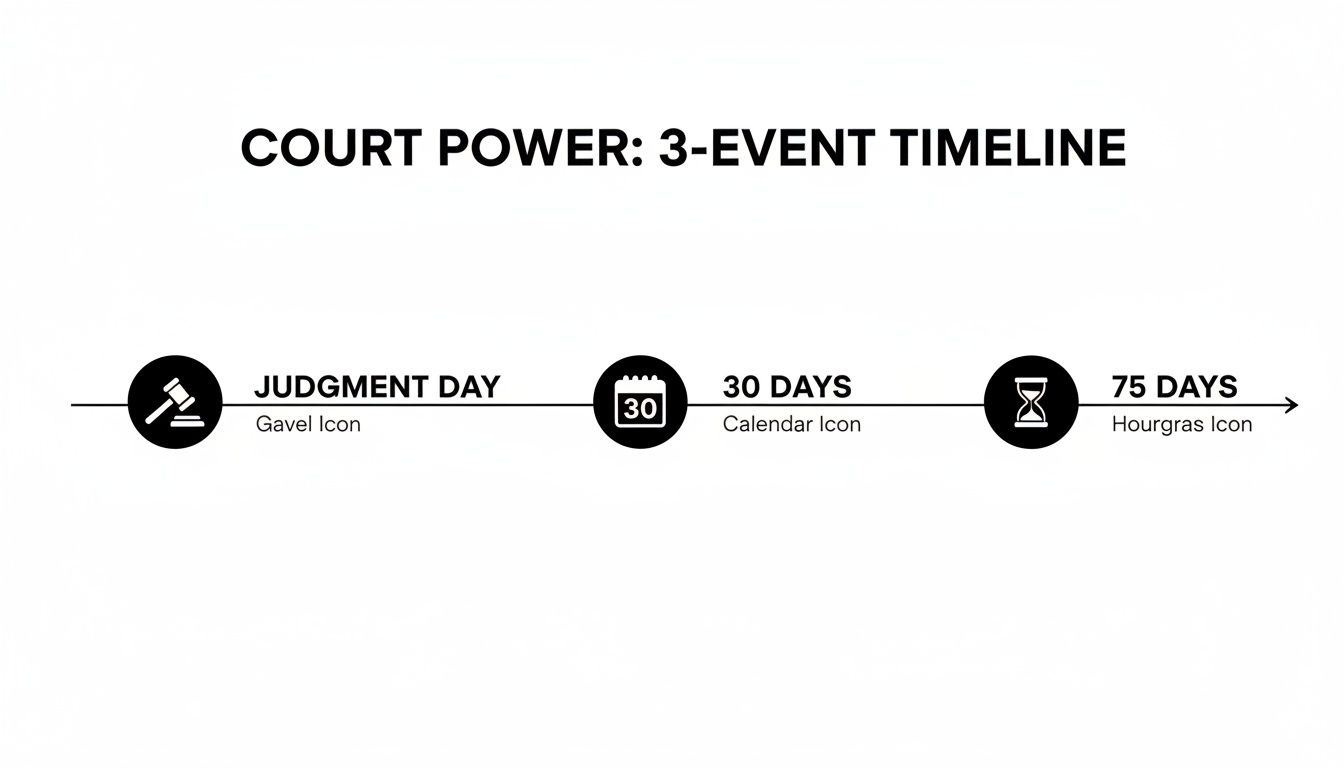
As you can see, your action within the first 30 days is what unlocks the court's extended 75-day window of authority.
To help you keep these critical dates straight, here is a quick reference table.
Critical Deadlines for a Motion for New Trial in Texas
This table outlines the key timelines you and your attorney must follow after a final judgment is signed in your family law case.
| Event | Deadline | Governing Rule | What Happens If You Miss It? |
|---|---|---|---|
| Filing the Motion | 30 days from the date the judgment is signed. | TRCP 329b(a) | You lose the right to ask for a new trial and may forfeit key issues for appeal. |
| Court Ruling on Motion | 75 days from the date the judgment is signed. | TRCP 329b(c) | The motion is automatically denied ("overruled by operation of law"). |
| Court Loses Power | The 76th day after the judgment is signed (if a motion was timely filed). | TRCP 329b(e) | The trial court can no longer change or set aside the judgment. The appeal process must begin. |
These are not suggestions—they are absolute cutoffs that dictate the course of your case.
The deadlines in the appellate process are absolute. They serve as the framework for the entire system, ensuring that cases move forward with finality and order. Your adherence to these dates is non-negotiable for a successful challenge.
Because these timelines are so unforgiving, managing your calendar is paramount. For attorneys handling multiple cases, some find that specialized AI legal assistant tools can help track these complex, overlapping deadlines to ensure nothing falls through the cracks. Ultimately, filing a timely motion for new trial in Texas is what keeps your case alive and protects your opportunity to seek a truly just outcome from a higher court.
Valid Grounds for a New Trial in Family Law
A court will not grant a new trial simply because you are unhappy with the outcome. To succeed with a motion for new trial in Texas, you must provide a legally sound reason—or "grounds"—proving that a fundamental error occurred and prevented a fair result. This is not a chance to re-argue your original case; it is an opportunity to highlight a serious flaw in the legal process itself.

Your appellate attorney must demonstrate that the mistake was not a minor, harmless slip-up. The error must be significant enough that it likely caused the court to make the wrong decision. Each of these grounds has a high standard of proof, demanding a meticulous argument built on evidence from the trial record.
Newly Discovered Evidence
Discovering a critical piece of evidence after the trial is over can be a powerful reason for a new trial. However, the standard for this is incredibly high.
To obtain a new trial based on newly discovered evidence, you must prove all of the following:
- The evidence came to light after the trial was completed.
- You could not have found it sooner despite exercising due diligence.
- The new evidence is material and not merely cumulative of other evidence.
- The new evidence is so critical it would likely produce a different result in a new trial.
A classic example in family law is discovering hidden financial accounts that a spouse failed to disclose during property division. If you can prove you made every reasonable effort to find those assets before the final decree was signed, you may have a compelling argument for a new trial.
Factual or Legal Insufficiency of the Evidence
Another common ground is arguing that the evidence presented in court was legally or factually too weak to support the judge's final decision. This is not about disagreeing with the judge's interpretation of the facts, but whether the evidence met the legal standard required by Texas law.
- Legal Insufficiency: This is a "no evidence" argument. You are contending that for a key element of the case, the other side presented zero credible proof.
- Factual Insufficiency: This is different. Here, you acknowledge there was some evidence, but you argue it was so weak—or the evidence you presented was so overwhelming—that the judge's finding is clearly wrong and unjust.
For example, if a judge severely restricts a parent’s access to their child based on an allegation of substance abuse, but the court record contains no drug tests, no expert testimony, or other credible proof, you could build a strong case for legal or factual insufficiency.
Significant Procedural Errors or Misconduct
The trial itself must be conducted fairly. If a major procedural mistake or misconduct by an attorney, party, or even the jury taints the process, it can be grounds for a new trial. These are not minor technicalities; the errors must be substantial enough that they likely influenced the final judgment.
An error that is "harmless" will not result in a new trial. To succeed, you must show the mistake was a "reversible error"—one that probably caused the rendition of an improper judgment or prevented you from properly presenting your case to the court of appeals.
Common examples of reversible error include:
- The judge wrongly excluded critical evidence or testimony essential to your case.
- The jury was given improper instructions that misstated the law.
- The opposing attorney engaged in misconduct, such as hiding evidence or making improper, inflammatory arguments.
Identifying these errors requires an expert-level understanding of the Texas Rules of Evidence and the Texas Rules of Civil Procedure. Successfully arguing them in a motion for new trial is often the first and most critical step in the appellate process. You can learn more by exploring common grounds for appeal in family court.
How This Motion Protects Your Right to Appeal
Filing a Motion for New Trial does far more than ask the trial judge to reconsider. It is a critical strategic move that lays the groundwork for a successful appeal. Its most important function is to protect your rights by preserving legal errors and, crucially, extending your appeal deadlines.
Think of it as officially flagging a problem for the trial judge before you take your complaint to a higher court. The rules of appellate procedure require you to first give the trial judge a fair chance to correct their own mistake. This motion is precisely how you do that, creating an official record of your legal objections.
Preserving Error for the Higher Court
The concept of preserving error is fundamental in appellate law. It means you must make your specific legal complaints known to the trial court at the right time and in the right way. For many of the strongest arguments you can make on appeal, a Motion for New Trial is the required tool for the job.
If you fail to file this motion, you could permanently lose the right to argue that certain mistakes occurred. For example, if you believe the evidence was legally insufficient to support the judge's final decision in your divorce or custody case, you are almost always required to raise that specific point in this motion. Skipping this step can be fatal to your appeal before it even begins.
A well-drafted Motion for New Trial acts as a roadmap for your appeal. It shows the appellate court exactly where the trial court went wrong and proves you gave the judge an opportunity to correct the course.
Extending Your Appellate Deadlines
Beyond preserving your legal arguments, the motion provides a priceless strategic advantage: more time. Under the Texas Rules of Appellate Procedure, you typically have just 30 days after a judgment is signed to file your Notice of Appeal. This is an incredibly tight window.
However, when you timely file a Motion for New Trial, that deadline automatically extends to 90 days from the date the judgment was signed. This 60-day extension is a strategic lifeline that gives your appellate attorney the time they need to:
- Order and Review the Record: Obtaining the official court reporter's transcript and the clerk's record can take weeks, and a thorough analysis cannot begin without them.
- Analyze for Reversible Error: An attorney must meticulously comb through hundreds, sometimes thousands, of pages of documents and testimony to identify the types of mistakes that can lead to a reversal.
- Craft a Compelling Argument: It takes time to build a persuasive legal strategy grounded in solid case law and statutes.
That extended deadline makes a thoughtful, well-reasoned appeal possible. You can learn more about the next steps in our guide explaining what a Notice of Appeal is. This extra time ensures your case receives the deep-dive analysis it deserves.
Why an Appellate Attorney's Insight Is Crucial
Preparing a powerful motion for new trial in Texas requires a different skillset than what is needed to win at trial. Your trial lawyer was an expert storyteller, weaving facts and testimony into a convincing narrative for the judge or jury. But after the judgment is signed, the focus shifts to the legal record, and that is where an appellate attorney’s specialized expertise becomes indispensable.
An appellate lawyer brings a fresh, objective perspective. Their entire role is to scrutinize the trial record—every transcript, exhibit, and ruling—to identify specific legal mistakes. They are not there to re-tell a story; they are there to find reversible error, which is a legal term for a mistake so significant that it likely led to an improper judgment.
A Different Skill Set for a Different Battle
The skills that make a trial lawyer effective in the courtroom are not always the same skills needed for the appellate process. Understanding this difference is key.
- Trial Attorneys Persuade with Narrative: They are masters of building a story, connecting with jurors, and presenting evidence to build a persuasive case.
- Appellate Attorneys Persuade with Legal Precision: Their craft is building an airtight, logical argument grounded in statutes, case law, and procedural rules. Their audience is a panel of judges focused exclusively on legal correctness.
Your Motion for New Trial is the critical bridge between these two worlds. It must be written persuasively enough for the trial judge to grant it, but also technically precise enough to preserve every potential issue for the appellate court.
Framing Arguments for a Future Audience
An experienced appellate attorney drafts a Motion for New Trial with the understanding that the ultimate audience is often the court of appeals. Every argument is carefully framed to meet the specific legal standards that will be used on appeal, such as demonstrating that the trial judge committed an "abuse of discretion." This plain-English term refers to a decision that is arbitrary, unreasonable, or made without reference to guiding legal principles.
This foresight is crucial. It ensures your best arguments are not just made, but are perfectly preserved so they have the greatest chance of success later on.
A Motion for New Trial is not just a request for a do-over; it's the architectural blueprint for your appeal. An appellate lawyer is the architect who ensures that foundation is strong, stable, and built to withstand judicial scrutiny.
This is a highly specialized field. Identifying appealable errors and framing them correctly is not something every lawyer can do effectively. By engaging a skilled Texas family law appeal attorney to handle your motion, you are making a strategic investment in your future and giving yourself the best opportunity for a just outcome.
Common Questions About Motions for New Trial
After a judge issues a final ruling in your family law case, you may feel that the fight is over. But what if you believe the court made a mistake? A motion for new trial in Texas is a critical tool, but it often raises many questions for clients. Here are some of the most common ones.
What Happens If the Judge Denies My Motion for New Trial?
First, do not be discouraged. A denial is the most common outcome and often an expected part of the appellate strategy. The primary purpose of the motion is often not to convince the trial judge to change their mind, but to formally "preserve" your arguments for the next stage: an appeal.
When the judge denies your motion, it finalizes their original decision. This denial is the procedural step that allows your appellate attorney to file a Notice of Appeal and take your case to a higher court, where a new panel of judges will review it for significant legal errors.
Can I Use New Evidence in a Motion for New Trial?
Yes, but it is very difficult. You cannot simply introduce evidence you forgot to present at the original trial. To obtain a new trial based on "newly discovered evidence," you must satisfy a strict, multi-part test.
You must prove the evidence was genuinely discovered after the trial ended and that you could not have found it earlier even with diligent effort. More importantly, the new evidence must be significant—not just cumulative of other evidence—and so compelling that it would probably lead to a different outcome. Meeting this high standard is challenging, which is why having an experienced attorney evaluate your potential new evidence is crucial.
The standard for introducing new evidence is set incredibly high to ensure the finality of court judgments. The legal system is designed for cases to conclude, so only truly powerful and previously undiscoverable information will justify reopening a case.
Does This Motion Stop the Judge's Orders From Taking Effect?
No, and this is a common point of confusion. Filing a motion for new trial does not automatically pause the judge's orders. The divorce decree remains active, meaning any property division, child support payments, or possession schedules are still legally enforceable while the motion is pending.
If you need to prevent the orders from being enforced, your lawyer must file a separate request to "supersede" or stay the judgment. This often requires posting a bond (a sum of money) with the court as a form of security. Deciding whether to pursue a stay is a separate strategic decision to make with your attorney, as it involves its own costs and legal hurdles.
If you believe the court made a mistake in your family law case, our appellate attorneys can help you seek a fair outcome. Contact The Law Office of Bryan Fagan today for a free consultation at https://familylawcourtappeals.com.