Receiving your Texas final decree of divorce is supposed to bring closure, but for many, it can feel like the beginning of a new injustice. This document is the court's final order, a legally binding rulebook that dictates your financial future and parental rights. You may feel your case was handled unfairly, that the judge misunderstood the evidence, or that the outcome is simply wrong.

When the Final Word Feels Unfair
Reading through the final decree can be a difficult experience. You might feel a sense of relief that the process is over, but that can quickly be replaced by a sinking feeling if the orders for property division or child custody don't align with the facts presented in court. If you believe a serious legal error was made, it's important to know that "final" does not always mean irreversible.
This document is more than just paper; it is a court order that will shape your life for years to come. In that way, it acts much like other binding personal family contracts by creating legal obligations. But the legal system isn't perfect, and judges can make mistakes. The Texas appeals process exists specifically to correct these errors and ensure that justice is served.
The Power of a Final Decree
It is critical to understand every provision in your decree, as this document governs the most important parts of your future:
- Financial Security: The division of your assets and debts will directly impact your financial stability.
- Parental Rights: The decree outlines your rights and responsibilities regarding custody, visitation, and child support.
- Future Obligations: It establishes legally enforceable duties, such as spousal or child support payments.
If you read the decree and feel the court missed key evidence, misinterpreted the law, or made a decision unsupported by the facts, you may have grounds for an appeal. This feeling of injustice is often the first sign that a reversible error—a mistake significant enough to have potentially changed the outcome—has occurred.
You must act quickly. Texas law provides a very short and strict deadline to challenge a flawed judgment. Recognizing that your decree may contain a legal error is the first step toward seeking a fair resolution. The appellate courts serve as a crucial check on the trial court's power, ensuring that decisions are grounded in the law and the evidence.
What You Can Appeal in a Texas Divorce Case
To challenge an unfair divorce judgment, you must first understand the specific orders within your Texas final decree of divorce. This document is a detailed roadmap for your post-divorce life, with separate sections governing your finances, property, and children. Identifying where a trial court may have made a legal error is the key to a successful appeal.

The financial stakes are high. A contested Texas divorce can be costly, and an unfair decree can lead to even more expensive legal battles for years. You can learn more about the costs of divorce in Texas to see why ensuring the decree is fair and accurate is so important.
Let's break down the essential provisions you'll find in nearly every decree. Each section addresses a different part of your life and is a potential area for legal error.
The table below outlines the core sections of a Final Decree and common issues that can lead to an appeal.
| Provision Area | What It Determines | Common Grounds for Appeal |
|---|---|---|
| Property & Debt Division | Who receives assets (house, retirement) and who is responsible for debts (mortgage, credit cards). | Mischaracterizing separate property as community property or using incorrect asset valuations. |
| Conservatorship | The rights and duties of each parent, including who makes major decisions about the child's life. | Granting one parent exclusive rights without sufficient evidence to justify removing them from the other parent. |
| Possession & Access | The detailed visitation schedule, covering weekdays, weekends, holidays, and summer breaks. | Imposing a schedule that is not in the child's best interest based on the evidence presented at trial. |
| Child & Medical Support | The amount of monthly child support, who provides health insurance, and how uninsured medical costs are divided. | Incorrectly calculating a parent's income or deviating from state guidelines without proper legal justification. |
| Spousal Maintenance | Whether one spouse must pay post-divorce financial support to the other, for how long, and in what amount. | Awarding alimony when the receiving spouse does not meet the strict legal requirements under the Texas Family Code. |
These provisions form the foundation of your post-divorce life. A legal error in any of them can have lasting financial and emotional consequences.
Property Division Orders
One of the most complex areas of a divorce is the division of property. Texas law requires a "just and right" division of the community estate. This section of your decree should contain a detailed list of every asset and debt, clearly assigning each one.
This is a common area for judicial mistakes. A reversible error—an error serious enough to be overturned on appeal—can occur if the court:
- Mischaracterizes property: The judge incorrectly treats your separate property (like an inheritance) as community property, making it subject to division.
- Fails to value assets correctly: The court uses an outdated or inaccurate appraisal for a business, home, or investment account, leading to an inequitable division.
- Overlooks hidden assets: The court fails to account for assets your ex-spouse concealed, resulting in an unfair split.
An unjust property division can permanently undermine your financial security. An appeal is designed to identify these errors and seek a truly "just and right" outcome based on the law.
Child Custody And Support Provisions
For parents, the sections dealing with children are the most critical. These provisions establish the rules for your co-parenting relationship for years to come.
- Conservatorship (Custody): This outlines who has the legal right to make major decisions about your children's education, medical care, and general welfare.
- Possession and Access (Visitation): This is the detailed schedule that specifies when each parent has the children, including weekends, holidays, and summer vacations.
- Child and Medical Support: This section sets the amount of monthly child support, determines who provides health insurance, and explains how out-of-pocket medical expenses will be divided.
An appeal may be necessary if the judge's orders are not supported by the evidence presented in court. The legal term for this is an “abuse of discretion,” which occurs when a court's ruling is so arbitrary or unreasonable that it defies logic and the law. For example, a judge might ignore credible evidence of a parent's instability or impose a visitation schedule that is clearly not in the child’s best interest.
Plain English Definition: Abuse of Discretion
This legal term means the trial judge made a decision without following established legal rules or principles. It’s not just a ruling you disagree with; it's a decision so unreasonable or unsupported by the facts that it is considered a legal error.
Spousal Maintenance and Other Orders
Finally, the decree addresses any spousal support and includes final injunctions that govern future contact and behavior. Spousal maintenance (often called alimony) is not guaranteed in Texas. It can only be awarded if a spouse meets strict eligibility requirements defined in the Texas Family Code.
A court commits a reversible error by ordering maintenance when it is not legally justified or by setting an incorrect amount or duration based on the evidence. Ambiguity or flawed language in any part of the decree can lead to years of conflict and expensive court battles. If you suspect your decree contains such errors, a thorough appellate review is essential.
Understanding the Standard of Review and Critical Deadlines
The word "final" in your Texas Final Decree of Divorce is a legal starting gun. It doesn't just mark the end of your trial; it triggers a strict, non-negotiable countdown for you to challenge an unfair result. The moment the judge signs that document, a critical clock starts ticking.
This timeline is a hard rule under the Texas Rules of Appellate Procedure. For most family law cases, you have only 30 days from the date the decree is signed to formally challenge it. If you miss this narrow window, the opportunity to appeal is almost always lost for good, regardless of how unjust the judge's decision may have been.
The 30-Day Rule Explained
This 30-day period is your one chance to preserve your right to seek justice in a higher court. Within this time, your appellate attorney must file a crucial document:
- A Motion for New Trial: This asks the same trial judge to reconsider the decision, pointing out specific errors and giving them an opportunity to correct the judgment without a full appeal.
- A Notice of Appeal: This is the formal declaration that you are escalating the case to the Court of Appeals for review.
Filing a Motion for New Trial in Texas can extend the deadline for filing your Notice of Appeal to 90 days from the judgment date. However, you should never assume this extension applies. The safest strategy is to treat the initial 30-day deadline as absolute.
The appellate timeline is one of the most unforgiving aspects of Texas law. There are very few exceptions for missing the deadline. This is why it is absolutely essential to contact an appellate attorney immediately after receiving a final decree that you believe is unjust.
Why Time Is Of The Essence
The urgency is not meant to cause panic, but to underscore a legal reality. Properly evaluating a case for appeal is complex and cannot be rushed. An appellate lawyer needs time to conduct a strategic analysis of the entire trial record.
This review involves:
- Analyzing the Final Decree: Scrutinizing every provision related to property, custody, and support.
- Examining the Trial Record: Reviewing court transcripts, evidence, and all filed documents to identify potential judicial errors.
- Identifying Grounds for Appeal: Determining if any mistakes rise to the level of an "abuse of discretion" or another type of reversible error that a higher court would be willing to correct.
This is meticulous work that requires time. Waiting until the last minute puts your entire future at risk. By acting quickly, you give your legal team the time needed to build a strong foundation for your appeal, beginning with a timely notice of appeal.
How an Appeal Can Correct an Unfair Divorce Decree
After the emotional strain of a divorce, discovering your final decree is unfair can be devastating. It is a common misconception that an appeal is a "do-over" where you can present new evidence. In reality, the process is very different.
Think of an appeal as a higher court reviewing the trial court's work for legal mistakes.
The appellate court’s job is to determine if the trial judge made a critical error in applying the law. They do not hear new testimony or consider new evidence. Instead, your appellate attorney carefully examines the official record—transcripts, exhibits, and motions—to find specific legal errors that led to an unjust result.
The Anatomy of a Texas Family Law Appeal
The appellate process is highly structured and governed by the Texas Rules of Appellate Procedure. It is a formal process that moves your case from the trial court to the Court of Appeals, where a panel of judges will review the legal reasoning behind your decree.
The path forward follows strict deadlines:
- File the Notice of Appeal: This is the first, non-negotiable step. You typically have only 30 days from the date the decree is signed to file this document, which officially notifies the court and your ex-spouse that you are challenging the judgment.
- Prepare the Official Record: Your attorney will work with the court reporter and clerk to assemble the complete record of everything that happened at trial, including transcripts and all filed documents.
- Draft and File the Brief: This is the core of the appeal. The brief is a detailed, persuasive legal argument written by your attorney. It connects the facts from the trial record to Texas law to demonstrate exactly where the trial court erred and why the decision should be corrected.
The timeline is strict from the very beginning, as this graphic illustrates.
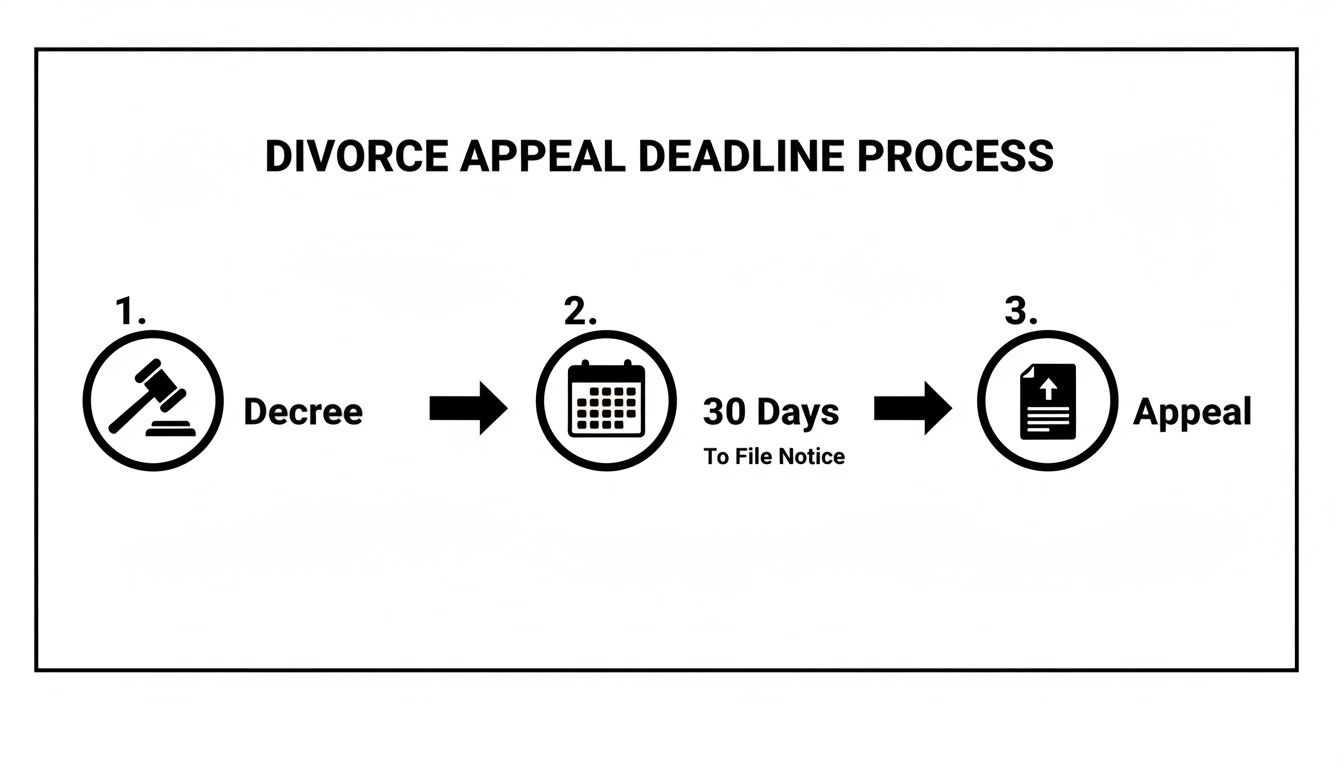
That 30-day window to file your notice of appeal is absolute, which is why acting quickly is so important.
Understanding the Standard for Overturning a Decree
You cannot win an appeal simply because you are unhappy with the result. Appellate courts give significant deference to trial judges' decisions. To succeed, you must prove the judge made a specific type of mistake known as a reversible error.
Plain English Definition: Reversible Error
A reversible error is not a minor technicality. It is a significant mistake in law or procedure that likely caused the court to issue an improper judgment. In other words, you must show that if the mistake had not been made, the outcome of your case would probably have been different.
In family law, the most common standard for a successful appeal is proving an abuse of discretion. This means the judge's decision was arbitrary, unreasonable, or made without regard for legal rules and principles. It is a high standard, but it is the key to correcting unfair property divisions and flawed custody orders. You can explore what grounds for appeal exist in Texas for a deeper understanding.
Unfair outcomes are more common than you might think. Discover more insights about Texas divorce statistics to see how many families are impacted by court orders each year, highlighting why the appeals process is such a vital safeguard for ensuring fairness.
How an Appeal Seeks a Fair Outcome
The purpose of an appeal is not to punish the trial judge but to correct a legal wrong and restore a fair outcome based on the law.
If your appeal is successful, the Court of Appeals has several options:
- Reverse and Render: The court can overturn the trial court's decision and issue a new, correct judgment.
- Reverse and Remand: More commonly, the court will reverse the incorrect part of the decree and send the case back (remand it) to the trial court with specific instructions on how to fix the error. This might require a new hearing on a single issue, like valuing a business or recalculating child support.
An appeal provides a strategic path to challenge a legally flawed divorce decree. It is your opportunity to have a higher court correct an injustice and ensure your future is built on a fair and lawful foundation.
If you believe the court made a mistake in your family law case, our appellate attorneys can help you seek a fair outcome. Contact The Law Office of Bryan Fagan today for a free consultation.
Common Reversible Errors in Texas Family Courts
When your Texas final decree of divorce feels profoundly wrong, it's natural to focus on the unfairness of it all. However, a successful appeal is built on identifying specific legal mistakes the trial court made. These are known as reversible errors—mistakes so significant they likely caused the judge to reach an incorrect conclusion.

Learning to recognize these common errors is the first step in turning a sense of injustice into a strong legal argument. This is how you shift from "this isn't fair" to "this is legally flawed and must be corrected."
Property Division Errors
Some of the most financially damaging errors occur during property division. Texas law requires a "just and right" division of community property, but judges can get the facts or the law wrong.
A common error is the mischaracterization of property. For example, if you inherited money and kept it in a separate account, it is your separate property. If the court mistakenly classifies it as community property and divides it, that is a clear legal error that can be challenged on appeal.
Other common property division errors include:
- Incorrect Valuation: The court relies on an outdated appraisal for a home or business, resulting in an inequitable division.
- Failure to Reimburse: The court overlooks a valid reimbursement claim, such as when you used separate funds to pay down community debt.
- Unequal Division Without Justification: The judge orders a disproportionate split (e.g., 70/30) without providing a sound legal reason supported by the evidence, such as fault in the breakup or a significant disparity in earning capacity.
Errors in Child Custody and Support Rulings
For parents, orders concerning children are paramount. These decisions must be guided by the "best interest of the child." When a judge's ruling seems disconnected from the evidence, it may be an abuse of discretion.
For instance, if you provided credible evidence of the other parent's substance abuse, but the judge ignored it and named that person the primary parent without any safeguards, that could be a clear abuse of discretion because the ruling is not supported by the facts.
Other potential errors involving children include:
- Improper Child Support Calculations: The court miscalculates a parent's net monthly income, leading to a child support amount that violates Texas Family Code guidelines.
- Geographic Restrictions Without Evidence: A judge imposes a restrictive geographic limitation on where you can live without any evidence showing it is in your child's best interest.
- Decisions Based on Bias: The ruling appears to be based on a judge’s personal bias rather than the facts and the law.
Procedural and Evidentiary Mistakes
Sometimes, the error lies not in the final decision but in the flawed process used to reach it. The rules of evidence and procedure are designed to ensure a fair trial. When these rules are broken, it can prevent a judge from hearing crucial information.
For example, if the judge improperly refused to admit critical financial records you tried to introduce as evidence, you may have been prevented from fully making your case. If this procedural error harmed the outcome, it could be grounds for an appeal.
If any of these scenarios sound familiar, you may have a valid reason to seek justice at the appellate level. The only way to know for sure is to have an experienced appellate attorney conduct a thorough review of your trial record.
Your Next Steps After Getting The Final Decree
Receiving your Final Decree of Divorce can be overwhelming, especially if the judge's orders feel unjust. This is not the end of the road; it is a critical moment that requires clear, strategic action.
The most important thing to understand is that you are on a strict clock. Texas law provides an unforgiving 30-day deadline from the day the judge signs the decree to challenge the outcome. If you miss that window, your right to appeal is likely lost forever.
Your immediate priority should be to have an experienced appellate attorney review the decree and the entire case record. This expert analysis can determine if a reversible error occurred—a significant legal mistake by the trial court that could justify an appeal. Waiting to take this step can put your rights in jeopardy.
Take Strategic Action Now
The first legal step is to file a document that officially preserves your right to challenge the decision. This is typically a Motion for New Trial in Texas or a formal Notice of Appeal, depending on the specifics of your case. Filing this motion can be a vital first step, as it signals your intent to fight the decision and can extend other important deadlines.
Do not be intimidated by the word "final" in Final Decree of Divorce. An appeal is not about re-litigating your entire divorce. It is a focused, methodical process aimed at correcting legal errors to achieve a just and fair result.
While you consider your legal options, there are also practical matters to address. You should begin updating estate planning documents, such as your will, and take control of your divided assets. If you plan to travel or live internationally, you may need to have your decree recognized in other countries; you can find helpful tips for translating legal documents for this purpose.
If you believe the court made a mistake in your family law case, our appellate attorneys can help you seek a fair outcome. Contact The Law Office of Bryan Fagan today for a free consultation.
Frequently Asked Questions
After receiving a Texas Final Decree of Divorce, it is normal to have many questions, especially if the outcome feels unfair. Here are answers to some of the most common questions we hear from clients in your position.
Can I Appeal My Divorce Decree Just Because I'm Unhappy With It?
No, simply being unhappy with the judge’s decision is not sufficient grounds for an appeal. You must have a solid legal reason, known as a "reversible error."
This means you must prove that the trial court made a significant legal mistake that affected the final outcome. An appellate attorney's role is to meticulously review your case record to find these errors.
Examples include:
- The court incorrectly classified your separate property (like an inheritance) as community property and divided it.
- The judge ignored or excluded critical evidence related to your child's best interest.
- Child support was calculated using incorrect income figures, violating Texas guidelines.
These are the types of concrete legal errors that can form the basis of a successful appeal.
What's The Difference Between Modifying And Appealing My Decree?
This is a critical distinction. Appealing and modifying are two different legal processes for two different situations.
An appeal looks backward. It challenges the original decree, arguing that the judge made a legal error based on the evidence presented at the time of the trial. You are on a very strict deadline for an appeal, typically just 30 days from when the decree was signed.
A modification, on the other hand, looks forward. It is used to change parts of the decree later because of a "material and substantial change" in circumstances. For example, a significant job loss might warrant a modification of child support, or a parent may need to relocate for work.
In short: appeals correct past legal mistakes, while modifications adapt to new life circumstances.
How Long Does A Family Law Appeal Take In Texas?
Appeals are a marathon, not a sprint. While every case is unique, you can generally expect the process to take anywhere from nine months to over a year from the day the Notice of Appeal is filed until a final decision is issued.
The process is thorough and involves multiple steps:
- Gathering the Record: We collect every document, exhibit, and transcript from the original trial.
- Briefing: This is the core of the appeal. Your attorney conducts extensive legal research and writes a detailed, persuasive argument (the brief) for the appellate judges.
- Oral Argument: In some cases, the court may request that the attorneys argue the case in person to answer the judges' questions.
- The Decision: The Court of Appeals will issue its formal written opinion, which is the final decision on the appeal.