You may feel your case was handled unfairly after enduring the stress of a family law trial. When a judge issues a custody order that ignores the facts, misapplies the law, or simply feels unjust, it can be devastating. You placed your trust in the court to protect your child’s best interests, and now you are left with a possession schedule that harms your family.
You are not powerless, and an unfair ruling is not necessarily the final word. The Texas legal system provides a specific path for correcting judicial mistakes: the appellate process. If you believe the trial court made a serious error in denying you an Expanded Standard Possession Order, an appeal can be your path to restoring a fair and balanced outcome for your child.
When Your Texas Custody Ruling Feels Wrong
If you are facing a possession order and are convinced the judge made a significant mistake, it is easy to feel lost. The emotional weight of an unjust custody outcome is heavy, affecting everything from your daily routine to your fundamental role as a parent.
Many people assume a judge's decision is permanent. However, the Texas legal system has a crucial safeguard for these situations: the appellate process. An appeal is not a second trial or an opportunity to present new evidence. Instead, an appellate court reviews the official record from your trial to determine if the judge made a critical legal error that led to an improper outcome. It is a vital check on judicial power designed to ensure fairness and due process.
Why an Unfair Outcome Isn't the Final Word
The purpose of an appeal is to identify a reversible error—a mistake so significant that it likely caused the court to issue the wrong decision. When it comes to the Expanded Standard Possession Order (ESPO), these errors can manifest in several ways:
- The judge may have disregarded key evidence demonstrating that the expanded schedule was in your child’s best interest.
- The court could have misinterpreted the Texas Family Code, which establishes the ESPO as the presumed schedule for parents living 50 miles or less apart.
- A ruling might have been based on legally improper factors, which appellate lawyers refer to as an “abuse of discretion.”
If you feel the system failed your family, this guide will explain what the Expanded Standard Possession Order is, why a judge might deny it in error, and how the appellate process offers a strategic path to seek justice. Understanding your options is the first step toward achieving a fair result for you and your child.
What Is the Texas Expanded Standard Possession Order?
Before you can determine if a judge made a legal error in your custody case, you must understand the starting point for every Texas family court: the Expanded Standard Possession Order, or ESPO.
The ESPO is the Texas Legislature’s default parenting plan. It is the standard schedule for parents who live 50 miles or less from each other, designed on the principle that children benefit most from having regular, substantial time with both parents.
Crucially, the law presumes the ESPO is in a child’s best interest. This means a judge must begin with the ESPO as the default and can only deviate from it if one parent provides clear evidence that this schedule would be detrimental or unworkable for the child. Understanding the ESPO is the first step in identifying whether a judge’s ruling was a fair decision or a legal error that can be challenged on appeal.
Core Components of the ESPO
The ESPO is designed to create a predictable and consistent schedule that children can depend on. It covers the regular school year, holidays, and summer vacation with the goal of fostering a strong, ongoing relationship between the child and both parents.
Here is a breakdown of its key components:
- Weekend Possession: The non-primary parent has the child on the first, third, and fifth weekends of a month.
- Expanded Weekend Time: This is the most significant change from the previous standard order. The weekend begins when school is dismissed on Thursday and ends when school resumes on Monday morning.
- Holiday Schedules: Major holidays like Thanksgiving and Christmas are divided between the parents, typically alternating each year.
- Summer Vacation: The non-primary parent generally receives a 30-day extended period with the child, which can be exercised in one block or split into two visits.
This chart illustrates how an appeal is not simply about dissatisfaction with a result; it is a specific legal journey focused on identifying clear legal errors made by the trial court.
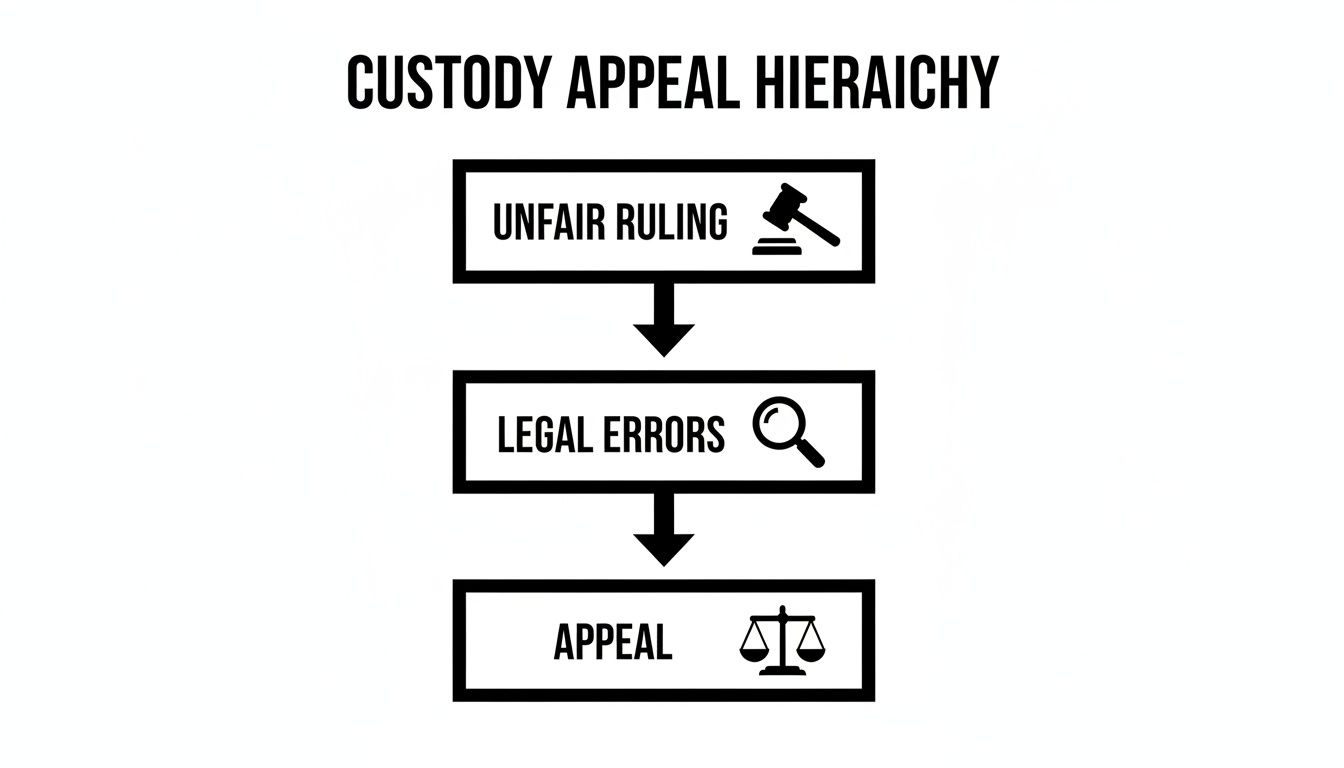
As you can see, an appeal is a technical process centered on pinpointing exactly where the judge erred according to the law, not just re-arguing the facts of your case.
The ESPO as the Legal Presumption
Making the ESPO the default schedule was an intentional policy decision by the Texas Legislature. As of September 1, 2021, it became the presumed custody arrangement for parents living within 50 miles of each other, significantly reshaping the dynamics for many families.
The shift from the old Standard Possession Order to the Expanded version increased a non-primary parent's possession time by approximately 33%. Those Thursday-to-Monday weekends make a substantial difference in fostering deeper parent-child bonds. While this schedule is the standard, it is important to remember it is a presumption—it can be challenged and overcome with sufficient evidence. You can read more about this shift toward equal parenting time defaults in Texas.
To see how much has changed, here is a quick comparison:
Standard Possession vs Expanded Standard Possession Order
| Possession Element | Standard Possession Order (Pre-ESPO) | Expanded Standard Possession Order |
|---|---|---|
| Weekend Start | Friday, typically at 6:00 PM | Thursday, when school is dismissed |
| Weekend End | Sunday at 6:00 PM | Monday, when school resumes |
| Total Weekend Time | Approximately 48 hours | Approximately 84-90 hours |
| Mid-Week Possession | Often required an overnight visit | Not explicitly included (covered by expanded weekend) |
The table makes it clear: the ESPO provides significantly more continuous time, moving the non-primary parent away from a "visitor" role toward a more integrated parenting schedule.
What This Means for Your Appeal: When a court orders a schedule that provides less time than the ESPO, it has a legal duty to explain why. The judge must state specific, evidence-based reasons on the record justifying why restricting possession is in the child's best interest. If they failed to do this, it could be a major legal error known as an abuse of discretion—exactly the kind of mistake that can be corrected on appeal.
Ultimately, understanding the details of the Expanded Standard Possession Order is your foundation. It is the rulebook the court is supposed to follow. An experienced appellate attorney can dissect your trial record to see if the judge deviated from that rulebook without a legally sound reason, which could open the door to having the ruling corrected.
Understanding Reversible Errors in a Custody Appeal

It is understandable to leave a courtroom feeling that the judge’s decision was fundamentally wrong. However, in appellate law, a feeling of unfairness is not enough to win. An appeal is not a second chance to tell your story or re-litigate your case.
Instead, it is a highly specific legal challenge that focuses on procedural and legal mistakes the trial court made. To succeed, you must prove the judge committed a reversible error—a legal mistake so significant that it almost certainly led to an improper outcome. Without identifying such an error, the appellate court will not disturb the original possession order.
What is “Abuse of Discretion” in Plain English?
In Texas family law appeals, the most common argument for reversing a custody order is abuse of discretion. This legal term does not mean the judge was rude, malicious, or acting in bad faith.
It is a legal standard meaning the judge's decision was legally flawed. An abuse of discretion occurs when a trial court’s ruling is:
- Arbitrary or Unreasonable: The decision appears to have no logical connection to the facts or evidence presented in court.
- Without Reference to Guiding Legal Principles: The judge ignored or misinterpreted the rules established in the Texas Family Code or other controlling laws.
In simple terms, the judge operated outside the legal boundaries they are required to follow. Your appellate attorney's job is to meticulously review the entire trial record—every transcript, exhibit, and court filing—to pinpoint exactly where and how the judge crossed that line.
Common Reversible Errors in Custody Cases
While every case is unique, certain judicial mistakes appear frequently in custody appeals. These errors can provide the solid legal foundation needed to challenge a flawed possession order. For a broader overview, our guide on the general grounds for appeal in civil cases offers additional context.
Here are a few examples of what a reversible error might look like in a case involving an Expanded Standard Possession Order:
- Ignoring Key Evidence: The court heard credible testimony from a child psychologist strongly recommending an expanded schedule for the child's well-being, but the judge completely disregarded that expert opinion in the final order without providing a valid reason.
- Misapplying the Law: A judge denies the Expanded Standard Possession Order based on a personal preference for older, more restrictive schedules, completely ignoring the legal presumption that an ESPO is in the child's best interest when parents live within 50 miles of each other.
- Improperly Excluding Testimony: Your attorney attempted to call a crucial witness, such as a teacher or therapist who knows your child well, but the judge refused to allow them to testify without a valid legal basis.
- Failing to Make Required Findings: If a judge deviates from the standard possession order, they are generally required to explain why on the record, detailing how the change is in the child's best interest. A judge who fails to do so leaves their decision legally unsupported and vulnerable to reversal on appeal.
The Appellate Perspective: An appellate court does not reweigh evidence or decide which parent is more credible. It acts as a referee reviewing the trial. It asks, "Based on the law and the evidence presented, was the trial judge’s decision a reasonable one?" If the answer is no, you may have a reversible error.
Proving an Error Harmed Your Case
Identifying a mistake is only the first step. You must also demonstrate that the error was harmful—meaning it probably caused the judge to make the wrong decision. A minor procedural error that had no real impact on the final outcome will not be enough to win an appeal.
For example, if a judge incorrectly disallowed a minor piece of evidence that was cumulative of other testimony, it is an error, but likely not a harmful one. However, if the judge refused to consider the only evidence you had proving your stable housing and fitness as a parent, that is a mistake directly linked to an unjust outcome.
This is where the skill of an experienced appellate attorney is critical. They know how to connect the trial judge's error to the unfavorable result, building the powerful legal argument needed to have an improper decision reversed.
How an Appeal Differs From Your Original Trial
After a difficult custody battle, it is natural to think, "If only I could explain my side to a different judge, they would understand." This feeling is completely valid. However, it is essential to understand that an appeal is not a repeat of your trial.
An appeal is fundamentally different from the trial you experienced. During your trial, you presented evidence, witnesses testified, and your attorney made arguments directly to the judge. An appeal involves none of that. There is no new evidence, no witnesses, and no jury. The appellate court acts like a panel of referees reviewing the official record to see if the original judge made a critical error in applying the rules of the game.
Step-by-Step Insights: From Trial Record to Appellate Brief
The entire appeal is based on the "record" from the trial court. This is the official compilation of everything that happened in your case, which includes two main parts:
- The Reporter’s Record: This is the word-for-word transcript of everything said during your hearing—every question, every witness answer, and every ruling the judge made.
- The Clerk’s Record: This is a collection of all documents filed in your case, including petitions, motions, and every exhibit admitted as evidence.
Your appellate attorney's primary role is to scrutinize this record for a reversible error. It is critical to remember that arguments on appeal can only be based on what is already in the record. Nothing new can be introduced.
Another major difference is how arguments are presented. In an appeal, your case is argued in a highly technical legal document called an appellate brief. This is not simply a letter explaining your position; it is a structured legal argument that identifies the trial judge's errors and explains, using statutes and case law, why those errors require the decision to be overturned. The process of preparing and filing this document is known as briefing.
The success of your appeal often depends on the "standard of review," which is the level of deference the appellate court gives to the trial judge's decisions. For custody orders, that standard is typically "abuse of discretion."
This means it is not enough for the appellate court to simply disagree with the trial judge's decision. To win, your brief has to prove that the judge's ruling was unreasonable, arbitrary, or made without any reference to guiding legal principles. It is a high but achievable standard.
After briefing is complete, the appellate court may hold a short oral argument, where attorneys answer questions from a panel of justices. The court then issues its decision. Grasping these fundamental differences is the first step toward building a realistic and effective appellate strategy.
Challenging Deviations From the Standard Order
The Expanded Standard Possession Order (ESPO) is the default in Texas—the law presumes it is what's best for children when parents live nearby. However, a judge can order a different schedule, but they cannot do so arbitrarily. Any deviation must be supported by clear evidence showing why a custom schedule is in the child's best interest.
When a judge issues an order that provides less time than the ESPO, it can feel punitive. Sometimes, there are legally sound reasons for it. The critical question for a potential appeal is whether the judge's decision was a carefully considered adjustment or a legal mistake.
When Deviations Are Legally Justified
A judge can and should tailor a possession schedule to fit a family's unique circumstances. The goal is to create an order that serves the child’s best interest, not to rigidly apply a template.
Here are a few common scenarios where a judge might rightfully modify the schedule:
- A Parent's Work Schedule: The standard Thursday-to-Monday weekend is unworkable for a parent with a non-traditional job, such as a firefighter on a 24-hour shift rotation or a nurse working overnight. A judge can create a custom schedule that ensures that parent has meaningful time, even if it does not resemble the ESPO.
- A Child's Special Needs: If a child has complex medical needs or severe anxiety, frequent transitions can be harmful. In such cases, a court might reasonably limit exchanges to protect the child’s well-being.
- The Child's Age: The standard order is designed for children aged three and older. For infants and toddlers, it is common for judges to implement "step-up" plans that gradually increase possession time as the child matures.
When Deviations Become Reversible Errors
A judge's modification crosses the line from a reasonable adjustment to a reversible error when the decision is not supported by evidence or is based on improper reasoning. This is where an appeal can provide a remedy.
Legally, this type of error is called an abuse of discretion. It occurs when a judge makes a decision that is arbitrary, unreasonable, or contrary to guiding legal principles. You can learn more about the abuse of discretion standard in our in-depth guide.
For an appeal, the crucial question is: Did the judge clearly explain why deviating from the Expanded Standard Possession Order was in the child's best interest, and is that explanation supported by evidence in the trial record?
If the record does not provide a sufficient answer, you may have strong grounds for an appeal. For example, a judge cannot limit your time simply because they disapprove of your new spouse unless there is evidence that person poses a danger to your child. A decision based on personal bias rather than facts is a classic abuse of discretion.
Similarly, if the court reduces your possession time but fails to state on the record why it is making that change, the order is legally vulnerable. Every decision that restricts a parent's rights must be built on a foundation of evidence. A ruling that lacks this foundation is more than just unfair—it is a potential legal error that an appellate court has the power to correct.
Navigating the Appellate Process Step by Step

The idea of another legal proceeding after a draining trial can be daunting. However, an appeal is not a repeat of the trial you just experienced. It is a structured, methodical review of what already happened, governed by the Texas Rules of Appellate Procedure. Understanding the steps can reduce anxiety and empower you to seek a fair outcome.
The process begins with a detailed case evaluation. We will analyze your case to determine if a legitimate, reversible error provides a strong basis for an appeal. This initial assessment is crucial for gauging the likelihood of success before you commit to the process.
Ordering and Scrutinizing the Trial Record
If we identify a viable path forward, the next step is to obtain the complete trial court record. This includes the reporter's record (the word-for-word transcript of court proceedings) and the clerk's record (all documents filed in your case).
Once the record is prepared, our appellate team begins its detailed analysis. We meticulously review every page for legal mistakes made by the trial judge that may have unfairly impacted the ruling on your Expanded Standard Possession Order in Texas. We search for specific instances where the judge may have misapplied the Texas Family Code, ignored critical evidence, or made a decision constituting an "abuse of discretion."
Drafting the Appellate Brief
After identifying potential errors, we construct your legal argument in the appellate brief. This document is the cornerstone of your appeal. It is a persuasive legal argument written to convince the higher court to reverse the trial court's decision. The brief presents the facts, identifies the judge's specific mistakes, and uses statutes and prior court decisions (case law) to explain why the original order was legally incorrect.
At this stage, the parties are:
- The Appellant: You—the party challenging the trial court’s decision.
- The Appellee: The other party, who will argue to uphold the original ruling.
After both sides file their briefs, the court may schedule an oral argument. This is a formal hearing where we present your case directly to a panel of appellate justices and answer their questions. Finally, the justices deliberate and issue a written opinion that decides the appeal. To understand the very first required step, you can learn more about filing a Notice of Appeal on our blog.
The appellate process requires patience, precision, and strategic legal thinking. Each step is designed to ensure that the law was applied correctly and that justice is served.
Frequently Asked Questions About Texas Custody Appeals
When a judge’s ruling on custody goes against you, it is natural to feel overwhelmed and uncertain about your next steps. The decisions regarding your child and your parental rights are life-altering, and getting clear answers is essential. Here are some of the most common questions we hear from parents considering an appeal.
What’s the Deadline to Appeal a Custody Order in Texas?
The timeline for appealing a court order under the Texas Rules of Appellate Procedure is strict and unforgiving. For most family law cases, you have only 30 days from the date the judge signs the final order to file a Notice of Appeal.
While certain post-trial motions can extend this deadline to 90 days, you cannot rely on this extension. Missing the initial 30-day deadline is almost always fatal to your case—you permanently lose your right to challenge the ruling. It is therefore critical to consult an appellate attorney as soon as you receive an unfavorable result.
Can I Present New Evidence During My Appeal?
No. An appeal is not a second trial; it is a review of what has already occurred. This is a crucial distinction between trials and appeals.
The appellate court's function is to identify legal errors the trial judge made based on the evidence and arguments presented at that time. They will not hear from new witnesses or review new documents. Their entire decision is based on the official "record on appeal," which consists of the trial transcripts and admitted exhibits.
Key Takeaway: An appeal is not a second trial. It is a meticulous review of the trial court record to determine if a legal mistake—a reversible error—was made that led to an unjust outcome.
Beyond understanding the appeals process, individuals often have common questions about Texas custody issues. For legal practices in the region, effective Texas law firm SEO is crucial for reaching clients seeking assistance with these specific matters.
What Does "Abuse of Discretion" Mean in a Custody Case?
In family law appeals, "abuse of discretion" is the primary standard of review. The term does not imply that the judge was malicious or corrupt.
In legal terms, it means the judge’s decision was either:
- Arbitrary or unreasonable, meaning it lacked a rational basis in the evidence presented.
- Made without following guiding legal rules, such as ignoring the Texas Family Code's presumption in favor of the Expanded Standard Possession Order.
If a judge makes a ruling based on personal opinion instead of facts, or disregards clear evidence about what is best for a child, that may constitute an abuse of discretion and form the basis for a successful appeal.
What Happens if I Win My Possession Order Appeal?
Winning an appeal does not typically result in the higher court issuing a new custody schedule. Instead, the most common outcome is that the appellate court will "reverse and remand" the case.
"Reverse" means the appellate court invalidates the trial judge’s incorrect decision. "Remand" means it sends the case back down to the same trial court for a new hearing or trial. This gives you another opportunity to present your case, but this time, the trial judge must follow the specific legal instructions from the higher court. It is a chance to secure a just outcome based on a proper application of the law.
If you believe the court made a mistake in your family law case, our appellate attorneys can help you seek a fair outcome. Contact The Law Office of Bryan Fagan today for a free consultation.