You may feel your case was handled unfairly. A judge may have limited your time with your child, divided property in a way that makes no sense to you, or signed an order that seems disconnected from what happened in court.
That feeling matters. But in Texas family court, an appeal doesn't move forward because the result feels wrong. It moves forward when the record shows a legal mistake, a procedural mistake, or a ruling that falls outside the trial court's discretion. That's the difference between frustration and a viable appellate issue.
If you're asking what are valid grounds for appeal in texas family court, the short answer is this: you need more than disappointment. You need an error the appellate court can review, an order that is appealable, and a record that preserves the complaint.
When a Texas Court Ruling Feels Unjust
A parent leaves a custody hearing stunned. The judge issues orders that change possession, school access, or decision-making rights. The parent believes key testimony was ignored and harmful evidence came in without proper foundation. Another spouse reads a divorce decree and sees property treated as community property that they believe was separate from the start.
Those reactions are common. Family court decisions affect children, homes, income, and daily life. When the ruling cuts against what you expected, it can feel personal in a way few other court decisions do.
What an appeal is really for
An appeal is a structured request for review by a higher court. It is not a chance to tell the story again from scratch. It is a process for asking whether the trial court followed Texas law, applied the right rules, and acted within the limits of its discretion.
That distinction matters because many people seek appellate help at the exact moment they are most focused on fairness in a broad sense. Appellate courts look at fairness through a legal lens. They ask whether a judge made a reversible error, not whether the result feels harsh.
Practical rule: The question is rarely “Was the outcome painful?” The question is “What did the judge do wrong under the law, and where does the record show it?”
What usually works and what usually doesn't
Some complaints are worth close review. Others usually are not.
A stronger starting point often looks like this:
- Wrong legal standard: The court applied the wrong rule in a conservatorship, support, or property issue.
- Important procedure was ignored: A party was denied notice, denied a meaningful chance to be heard, or blocked from presenting admissible evidence.
- The ruling has no proper support in the record: The result may reflect an abuse of discretion or an evidentiary problem tied to the existing record.
A weaker starting point often sounds like this:
- “The judge believed the other side.”
- “I explained everything, but it still went against me.”
- “The order is unfair.”
Those statements may reflect a real problem. But by themselves, they do not identify an appellate issue. Appellate courts don't re-weigh credibility the way trial courts do.
The first shift in mindset
The most productive first step is to stop asking whether the order feels wrong and start asking better questions:
| Question to ask | Why it matters |
|---|---|
| Was there a final order? | Many family rulings cannot be appealed immediately. |
| What exact ruling was wrong? | Appeals focus on specific legal complaints. |
| Was there an objection, request, or motion in the trial court? | Many issues are lost if they were not preserved. |
| Does the transcript support the complaint? | Appellate courts rely on the record, not memory. |
That shift doesn't minimize what happened to you. It gives you a path forward.
An Appeal Is Not a Retrial Understanding the Difference
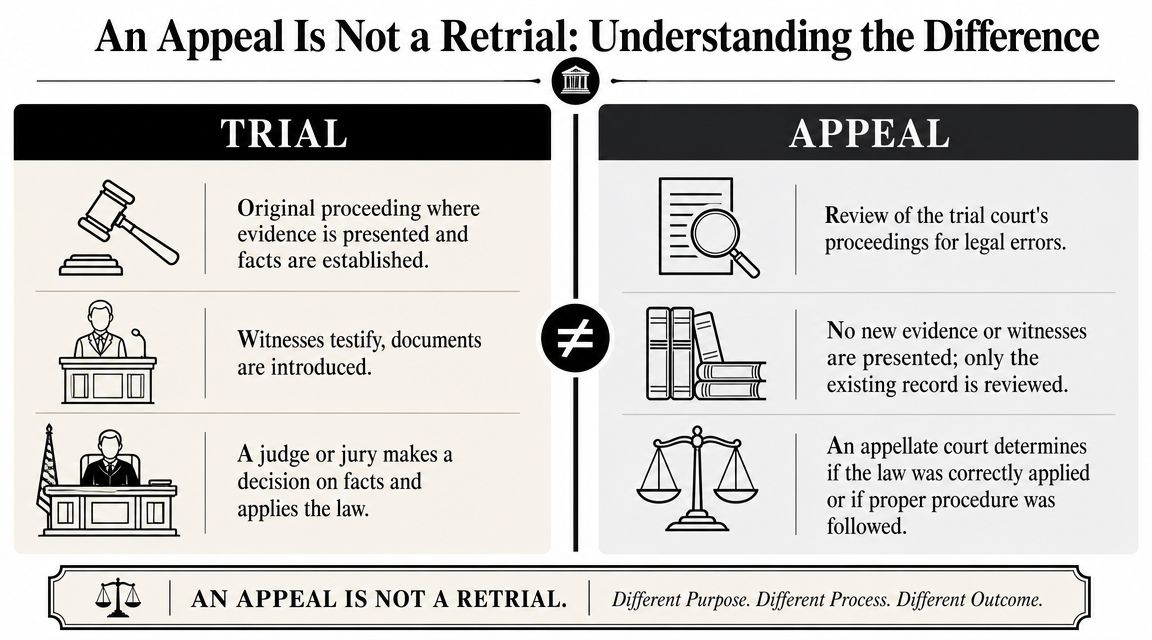
The cleanest way to understand an appeal is to compare it to a referee reviewing game tape. The referee does not replay the whole game. The referee checks whether a specific call was legally wrong based on what is already on the record.
That is how Texas family appeals work. The appeal usually comes from a final judgment that resolves all claims and parties, and the appellate court reviews for legal error rather than retrying facts. Historical Texas appellate data also shows that reversal happens, but it is limited. In the 2018 to 2019 Texas court year, reversal rates were 27% for jury verdicts and 25% for summary judgments in the Texas Courts of Appeals, which underscores that relief depends on identifiable legal or evidentiary error, not simple disagreement with the result, as discussed in this Texas appellate jurisdiction analysis in family law cases.
What the appellate court actually reviews
The appellate court reviews the record. That usually includes the clerk's record and the reporter's record. In plain English, that means the filed papers, exhibits that became part of the case, and the transcript of what was said in court.
The appellate court does not hear fresh testimony from your witnesses. It does not consider new documents that were never admitted. It does not let a party fix a weak trial presentation by adding stronger evidence later.
If you've heard the term de novo review in Texas appeals, it helps to know that the phrase refers to a standard of review for certain legal questions. It does not mean your family law appeal becomes a whole new trial.
Trial vs appeal at a glance
| Aspect | Trial Court | Appellate Court |
|---|---|---|
| Main job | Decide facts and apply law | Review alleged legal error |
| Evidence | Witnesses and exhibits are presented | No new evidence is presented |
| Credibility | Judge or jury evaluates witnesses | Appellate court defers to the record |
| Outcome focus | What happened and what order should be entered | Whether the trial court made a reversible mistake |
A strong appeal often begins with a hard sentence: “Even if everything feels wrong, the appellate court can only fix what the record shows.”
That's why appellate strategy starts with the transcript and the orders, not with a retelling of events from memory.
The Standards of Review What an Appellate Court Looks For
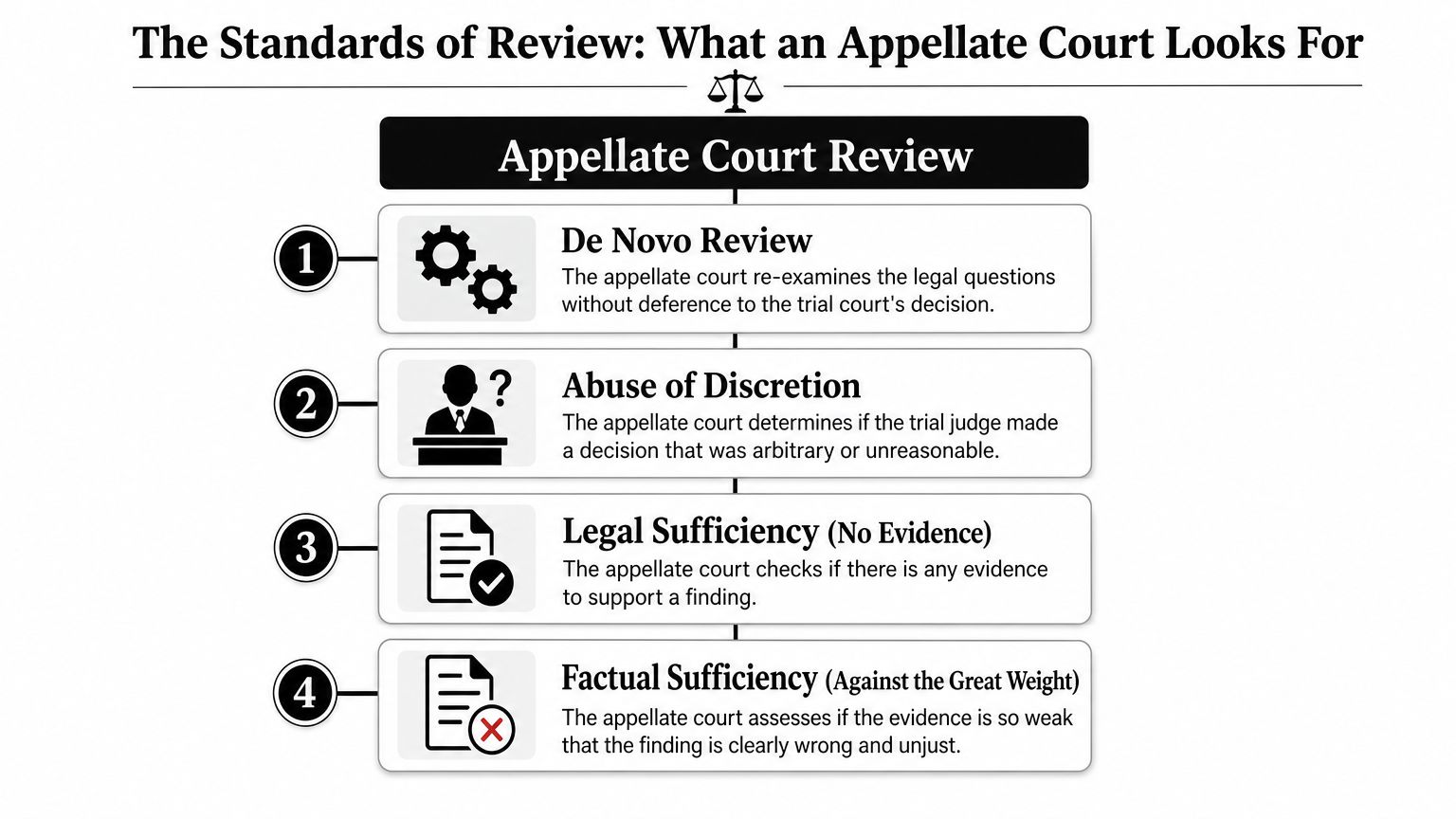
A valid appellate issue still has to pass through another filter. The appellate court asks not only whether there was an error, but also how that error should be reviewed. That is the standard of review.
In family law, this part changes everything. A complaint may sound compelling to a client and still face a steep uphill fight because the standard gives the trial judge substantial room to decide the issue.
Abuse of discretion
This is the standard family law clients run into most often. Abuse of discretion means the appellate court is asking whether the trial judge made a decision that was arbitrary, unreasonable, or made without reference to guiding legal rules.
A useful comparison is an umpire's strike zone. Some calls are close. People can disagree. But the call still falls within the zone. An abuse of discretion argument says the judge's ruling was outside the zone.
This is why many appeals fail even when the losing party has understandable complaints. If the ruling falls within a range of acceptable decisions, the appellate court may affirm it.
De novo review
De novo review applies to certain legal questions. In plain English, the appellate court gives no deference on that legal issue and decides it fresh.
If the trial court used the wrong legal standard or misread a statute, that may place the issue closer to de novo review. These arguments can be powerful because they focus on whether the law itself was applied correctly.
Legal and factual sufficiency
These standards concern whether the evidence can support a finding.
- Legal sufficiency asks whether there is evidence that supports the finding.
- Factual sufficiency asks whether the evidence is so weak, or so outweighed by contrary evidence, that the finding cannot stand.
In family cases, sufficiency complaints often matter because they can connect directly to abuse of discretion review. But they must be framed carefully. The appellate court is not deciding which witness it personally believes.
Why this matters in real cases
The same complaint can look very different depending on the standard:
| Complaint | Better framing | Likely problem if framed poorly |
|---|---|---|
| “The custody result was unfair” | The court applied the wrong legal standard or made a ruling unsupported by the record | Sounds like disagreement only |
| “The judge got the law wrong” | Identify the statute, rule, or controlling principle misapplied | Too vague without a specific ruling |
| “The evidence wasn't enough” | Tie the lack of evidence to a key finding in the order | Becomes an invitation to reweigh testimony |
The strongest appeals don't just point to an error. They match the issue to the correct standard of review and explain why the ruling fails under that standard.
Common Grounds for Appeal in Texas Family Law
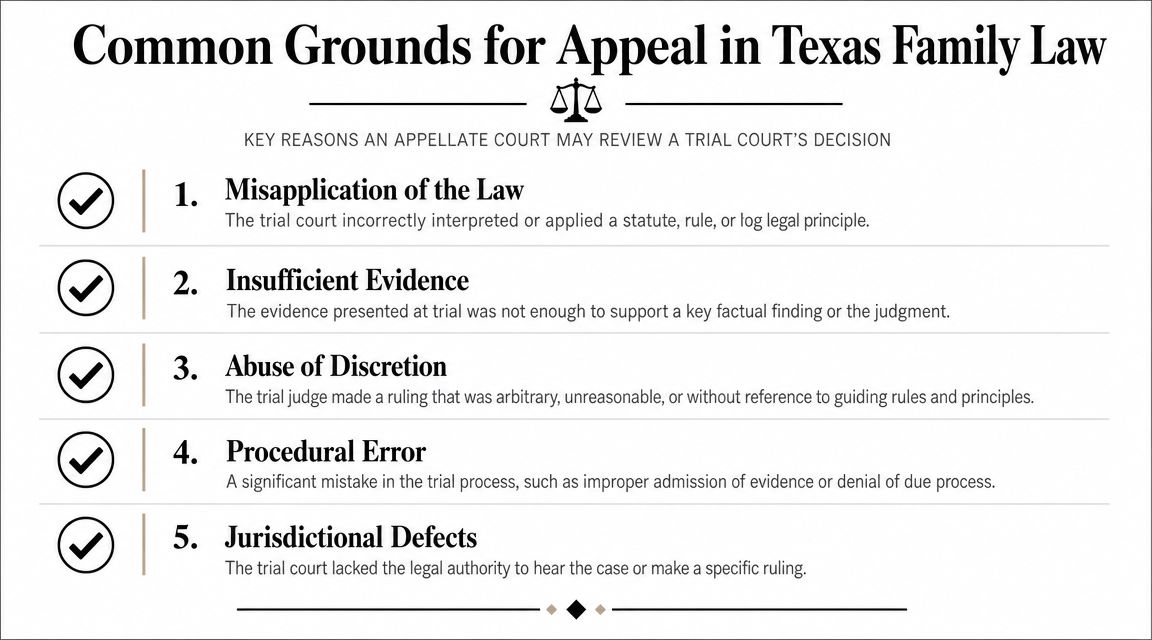
Texas family appeals are strongest when they fit recognized categories of legal error. The most defensible grounds are error of law, abuse of discretion, procedural error, and in some cases evidentiary insufficiency or constitutional error. Appellate courts review the trial record and do not take new evidence, so a viable appeal usually depends on showing that the judge misapplied the Texas Family Code or procedural rules, as outlined in this discussion of legal error in family court appeals.
Misapplication of the law
This is one of the clearest appellate grounds. In a divorce case, a judge may classify property under the wrong legal framework. In a support dispute, the court may apply the wrong rule to income or support obligations. In a custody case, the order may rely on a legal premise that does not fit the governing statutes or rules.
That kind of issue matters because appellate courts can correct legal mistakes without retrying witness credibility.
Procedural error
Some rulings are vulnerable because the process itself broke down.
Examples include:
- Improper admission or exclusion of evidence
- Lack of proper notice
- Denial of a meaningful opportunity to present a claim or defense
- Failure to follow required procedures in a hearing
A procedural mistake is not automatically reversible. The argument must show that the error mattered.
Abuse of discretion in family rulings
Family judges have broad discretion in many areas, including parenting schedules, property division, and related issues. But broad is not unlimited.
A ruling may be challenged if it falls outside the range of reasonable decisions or if it rests on a mistaken legal foundation. For a closer look at how appellate courts analyze these issues, see this explanation of reversible error in Texas family court.
Key point: “The judge had discretion” does not end the discussion. The real question is whether the judge exercised that discretion within the law and on a record that supports the ruling.
Examples by case type
| Case type | Possible appellate issue |
|---|---|
| Child custody | Court used the wrong legal standard or made a ruling unsupported by the record |
| Child support | Court applied the wrong rule or entered findings the evidence does not support |
| Property division | Court mischaracterized separate and community property or used the wrong legal framework |
| Protective order | Due process problems, procedural defects, or rulings not supported by the record |
| Enforcement or contempt-related matters | Jurisdictional or procedural defects tied to the specific order entered |
The most common mistake clients make is assuming every bad result creates a good appeal. It doesn't. The best appeals identify a specific ruling, a specific legal problem, and a record that proves both.
Preserving Your Right to Appeal The Critical Step You Cannot Miss
A strong appellate issue can disappear if no one preserved it in the trial court. As a result, many otherwise promising cases become difficult.
Under Tex. R. App. P. 33.1(a)(1), a party generally must make a timely request, objection, or motion in the trial court, and the grounds must be stated with enough specificity for the complaint to be preserved. If that does not happen, the appellate court may treat the issue as waived, as explained in this Texas presentation on preserving your record for appeal.
What preservation means in plain English
Preservation is the rule that says you usually must complain at the right time, in the right way, before you can complain on appeal.
If improper evidence comes in and no one objects, that issue may be gone. If the court makes a ruling and counsel never raises the specific legal complaint, that issue may be gone too. Some complaints also require post-trial action, depending on the issue and the posture of the case.
A common waiver problem
A parent may later say, “The judge should never have considered that document.” But if the document was offered, admitted, and met with no timely objection, the appellate court often won't reach the complaint.
That does not mean the document was proper. It means the issue may no longer be reviewable.
For a fuller explanation of how these rules affect family cases, this guide on preserving error for appeal in Texas family court is a useful starting point.
What to look for in the record
When evaluating preservation, appellate counsel usually checks for several things:
- A timely objection or request: Was the complaint raised when the problem happened?
- Specific grounds: Did counsel explain why the ruling was wrong?
- A ruling or refusal to rule: Does the record show what the trial court did?
- Any required post-trial motion: Was an additional step needed to preserve the issue?
If the record doesn't show the complaint, the appellate court usually won't act on it.
This is one reason appellate review often begins with a careful transcript analysis rather than broad conclusions about unfairness. Preservation can turn a serious trial problem into a nonstarter on appeal.
The Texas Family Law Appellate Process Step by Step
The appellate process becomes more manageable when you break it into stages. The path is structured, and each stage serves a specific purpose.
One early point causes a great deal of confusion. In Texas family law, appeals usually must wait for a final order that resolves all issues. Temporary custody orders are generally not appealable, and only narrow interlocutory exceptions permit review before final judgment, as explained in this overview of challenging a final divorce or custody order.
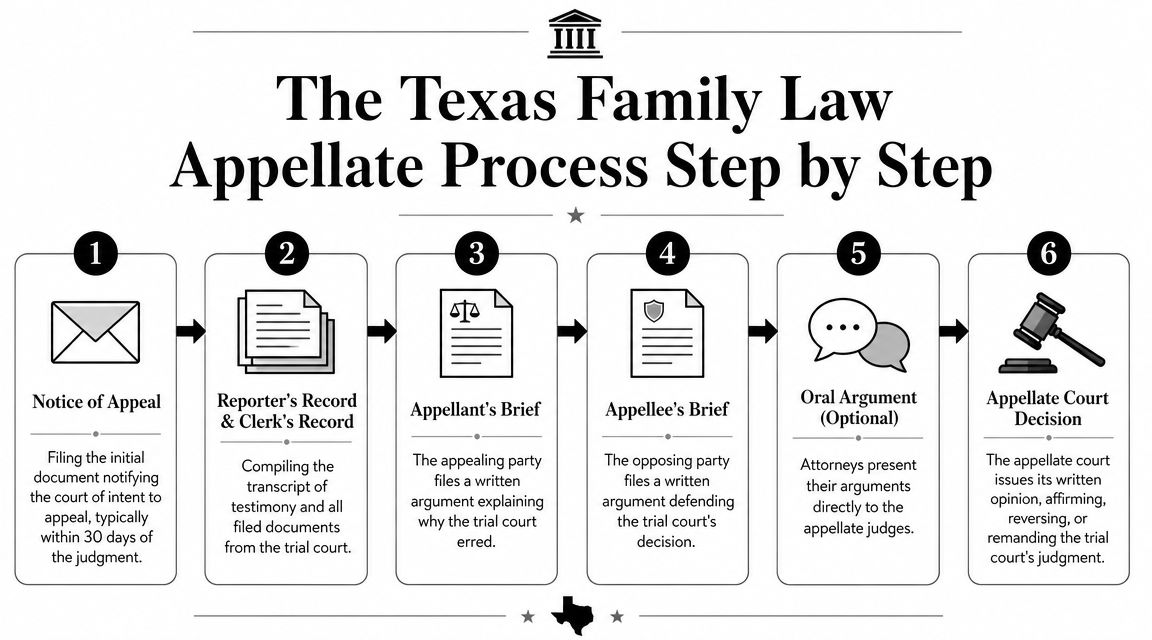
Step one through step three
The opening stages focus on getting the appeal started and building the materials the appellate court will review.
Notice of appeal
This is the filing that tells the court and the other side that you are appealing.Clerk's record and reporter's record
These assemble the papers, exhibits, and transcripts from the trial court.Appellant's brief
This is the written argument explaining what the trial court did wrong, why the issue was preserved, what standard of review applies, and why the error requires relief.
If you want a visual overview of the process, this short video helps orient clients to the appellate timeline and structure.
Step four through step six
The middle and later stages turn the case into a written legal dispute between the parties.
| Stage | What happens |
|---|---|
| Appellee's brief | The opposing party answers the arguments and defends the judgment |
| Reply brief | The appellant may answer points raised in response |
| Oral argument | Sometimes granted, sometimes not. Lawyers answer judges' questions directly |
| Decision | The appellate court may affirm, reverse, or remand for further proceedings |
A practical difference from some lower-court appeals
Texas appellate materials draw an important distinction between family-law appeals and trial de novo appeals from courts that are not of record. The Texas Judiciary's FY23 statistical report confirms that trial de novo is the model for appeals from justice courts, while family-law appeals from district courts are record-based reviews, not new trials, as reflected in the Texas Judiciary FY23 appellate and revised caseload statistics report.
That's why the process feels paper-heavy. Appellate courts are deciding legal issues from an existing record, not hearing the case all over again.
How Our Appellate Attorneys Evaluate Your Case for Appeal
The hardest part of appellate practice is not naming possible grounds. It is deciding whether those grounds have a realistic path to relief.
Texas family appeals often rise or fall on a narrow set of questions. Was the order appealable. Was the issue preserved. What standard of review applies. Did the error probably matter enough to justify reversal. A technical issue may exist on paper and still be too weak to carry an appeal.
What a real case review looks like
A serious appeal evaluation usually starts with the core documents:
- The final order or judgment
- Relevant pleadings and motions
- The reporter's record
- Admitted exhibits
- Any findings of fact and conclusions of law, if applicable
Counsel then isolates specific complaints. General unfairness is not enough. The task is to identify preserved, judge-focused issues supported by the written record.
Clients often benefit from outside review. A trial lawyer may know the story of the case better than anyone. An appellate lawyer looks at the transcript differently. The focus is narrower and more strategic.
The gap between a possible issue and a strong appeal
One of the central realities in this area is the gap between having a technical issue and having a meaningful chance of reversal. Texas family appeals face a deferential abuse-of-discretion framework in many settings, so case evaluation must consider not just whether an error occurred, but whether an appellate court is likely to treat that error as significant enough to overturn the ruling, as discussed in this analysis of appeals in divorce and family cases.
That is why some appeals should be filed quickly and pursued aggressively, while others should be approached with caution. Honest advice matters here.
A firm such as The Law Office of Bryan Fagan, PLLC can review the trial record, assess finality and preservation, and determine whether the issues are likely to support an appeal under the applicable standards of review.
The best appellate consultation doesn't promise a second chance at trial. It tells you whether the law gives you a real chance at correction.
If you believe the court made a mistake in your family law case, the next move is not to relive the hearing. It is to have the order, transcript, and procedural history reviewed with precision.
If you believe the court made a mistake in your family law case, our appellate attorneys can help you seek a fair outcome. Contact The Law Office of Bryan Fagan, PLLC today for a free consultation.