Skip to content
A judge signs the final order in your divorce or custody case, and your first reaction is simple. This wasn't fair.
Maybe the court cut off testimony you believed mattered. Maybe the other side got a hearing you barely had time to prepare for. Maybe the judge relied on something that should never have come into evidence. In that moment, one might ask the same question: can procedural mistakes win an appeal in Texas family law?
Yes, they can. But not every frustrating mistake is a reversible procedural error.
The significance of that distinction is often underestimated. Texas appeals are based on the existing record, not new testimony, and the reviewing court focuses on whether the trial court made a legal or procedural mistake that was properly preserved and that affected the outcome. If the record doesn't show a timely objection, a clear ruling, and harm tied to the judgment, even a real mistake may not lead to relief. That narrow, record-driven framework is why appeals in family cases require a different kind of strategy than trial work, as noted in this Texas family appeals overview.
Feeling Your Family Court Ruling Was Unfair
Family cases don't feel abstract when you're living through one. A custody ruling changes where your child sleeps. A property division order reshapes your finances. A support decision can affect your monthly stability for years.
Clients often come in with a clear sense that something went wrong, but they don't yet know whether the law sees it the same way. That's where appellate analysis begins. The question isn't just whether the judge made a mistake. The question is whether the record shows an error the court of appeals can correct.
When unfair and appealable are not the same
A parent may say, “The judge didn't listen to me.” A spouse may say, “The hearing moved too fast.” Those reactions may be completely understandable. But appellate courts don't reverse judgments merely because the process felt unsatisfying.
They look for something more concrete:
- A rule was broken during the case
- The complaint was preserved in the trial court record
- The mistake mattered to the final judgment
Practical rule: The court of appeals won't retry your family case. It reviews the written record to decide whether a legal or procedural error justifies relief.
That is why some appeals succeed on procedure and others do not. A missed notice requirement, a wrongly excluded document, or a refusal to allow a party to present an issue can matter. A general sense that the judge was unfair usually won't be enough by itself.
Why clients often miss the real issue
Many people assume an appeal means a new chance to tell their story better. It doesn't. The appellate court reviews transcripts, filings, admitted exhibits, rulings, and briefs. It asks whether the trial court followed the law and the required process.
That can feel cold when you've lived through a painful case. But it also means the system has a path for correcting rulings that were reached through legal error.
If you're asking whether procedural mistakes can win an appeal in Texas family law, the answer starts here: yes, when the mistake became a reversible error in the record.
Procedural vs Substantive Errors What Can Be Appealed
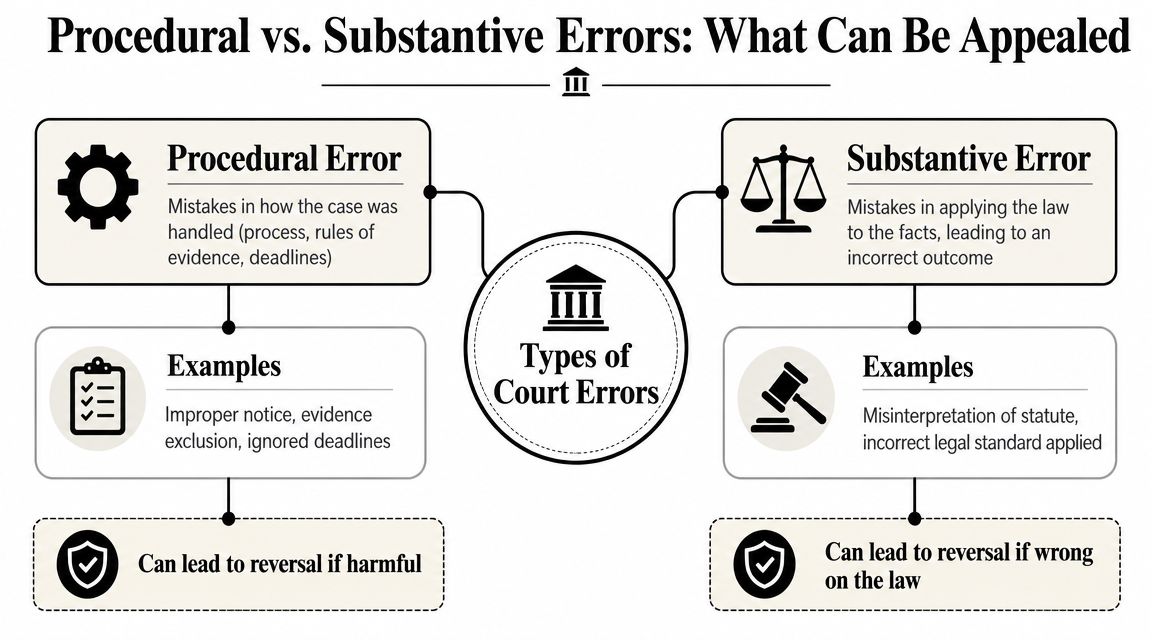
Some mistakes affect how the case was handled. Others affect what decision the court reached under the law. Both can matter on appeal, but they are not the same.
Procedural errors involve the rules of the game
A procedural error is a mistake in the process. Imagine a referee ignoring the rules during play. The final score may look official, but the path to that score may have been flawed.
In family court, procedural problems often involve notice, evidence, deadlines, or the right to be heard.
Examples include:
- Improper notice of a hearing that affects custody, support, or property issues
- Wrongful exclusion of evidence that a party had a right to present
- Failure to follow required procedure under the Texas Rules of Appellate Procedure, court rules, or family-law statutes
- Refusal to rule on an issue after a proper request was made on the record
A procedural mistake becomes important on appeal when it affected the fairness of the proceeding or kept the court from deciding the case on a proper legal basis.
Substantive errors involve the legal result
A substantive error is a mistake in applying the law to the facts. Using the same sports analogy, this is closer to declaring the wrong team the winner after the game is over.
Examples include:
- Applying the wrong legal standard in a conservatorship dispute
- Misinterpreting a statute governing property division or support
- Classifying property incorrectly under Texas law
- Entering relief the law doesn't support based on the findings made
Substantive mistakes often focus on whether the court got the law wrong. Procedural mistakes focus on whether the case was handled in a way the law allows.
Why the distinction matters
Not every bad outcome comes from a legal error. Sometimes a court hears conflicting evidence and makes a decision one side hates, but the judge still followed the law and procedure. That is much harder to overturn.
A strong appeal usually identifies the type of error with precision. Was the complaint about process, legal reasoning, or both? That framing shapes the argument, the standard of review, and the likelihood of relief.
A good appellate issue is specific. “The ruling was wrong” is weak. “The court excluded admissible evidence after a timely offer and that exclusion affected the judgment” is the kind of issue appellate judges can analyze.
For families considering an appeal, this distinction helps sort emotion from legal strategy. You don't need to ignore your sense that the result was unjust. But you do need to translate that feeling into an issue the appellate court can review.
The Rules for Winning a Texas Family Law Appeal
A trial error doesn't become an appellate issue automatically. Texas appellate courts apply gatekeeping rules, and they apply them strictly.
The two that matter most are preservation of error and the standard of review.
Preservation comes first
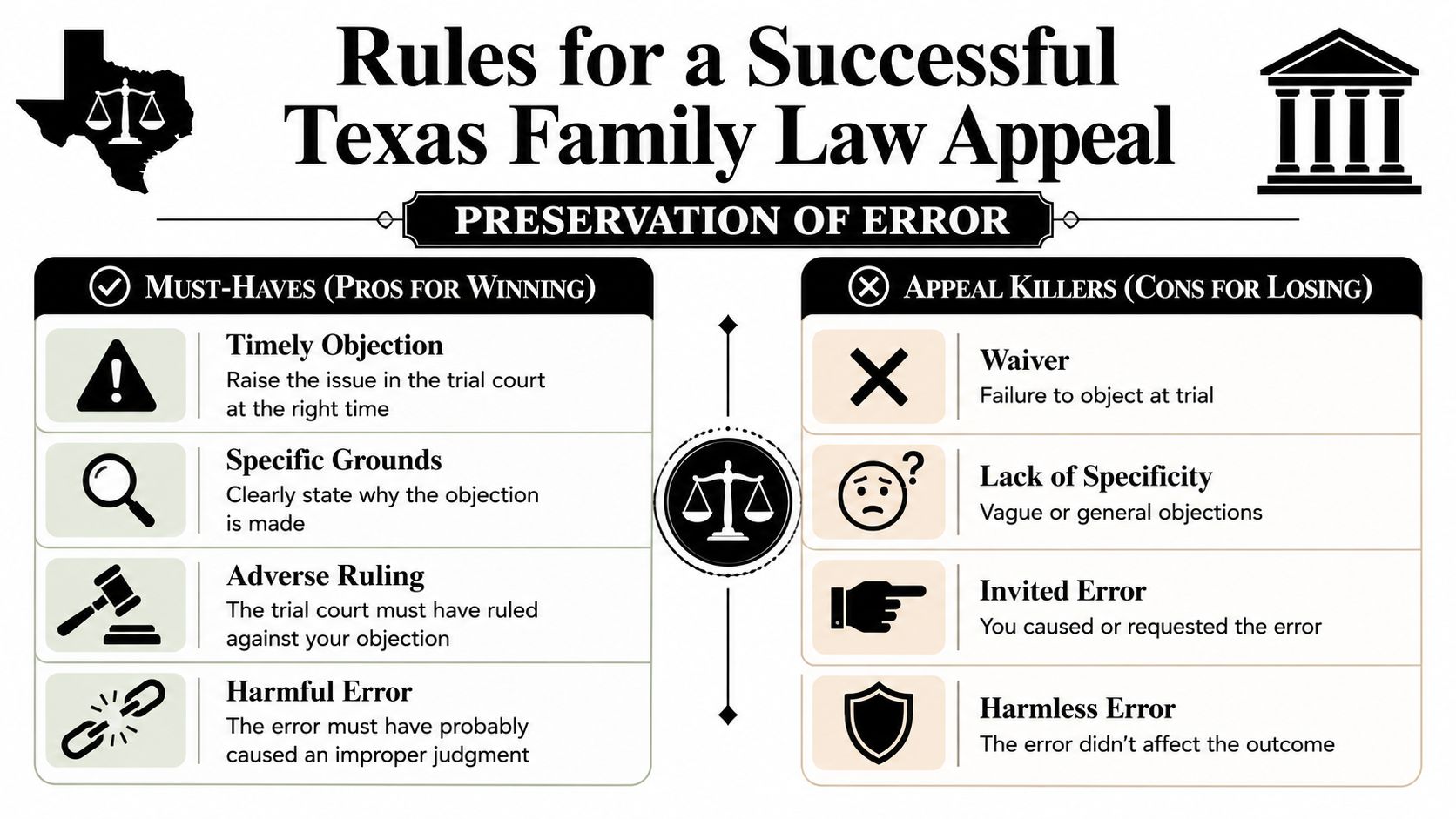
In plain English, preservation of error means your lawyer had to raise the problem the right way in the trial court before the appellate court will usually consider it.
In Texas family-law appeals, a procedural mistake can only win relief if it was preserved. The objection must be timely, specific, and overruled, or the judge must refuse to rule after a proper request, because appellate courts review the written record and generally won't consider issues raised for the first time after trial, as explained in this discussion of preserving objections for a Texas appeal and in this preservation of error guidance.
That rule sounds technical because it is technical. It can also be outcome-determinative.
What preserved usually looks like
A preserved issue often includes these features:
- Timely objection. Counsel objected when the problem occurred, not long after the fact.
- Specific grounds. The objection said what rule or right was being violated.
- Ruling by the court. The judge denied the objection, sustained the other side's objection, or refused to rule despite a proper request.
- Record support. The transcript or filings show what happened clearly enough for appellate judges to review it.
If one of those pieces is missing, waiver becomes a serious risk.
Standards of review decide how the court looks at the issue
Appellate judges don't review every issue the same way. They use standards of review, which are legal tests that define how much deference the trial court receives.
Here are the terms clients most often need translated into plain English:
| Term | Plain-English meaning |
|---|---|
| Abuse of discretion | The trial judge had some room to decide, but made a ruling outside the range a reasonable judge could make under the law and record. |
| Reversible error | A legal or procedural mistake that justifies appellate relief because it affected the judgment or prevented proper presentation of the case. |
| Briefing | The written argument filed in the appellate court explaining the facts, legal errors, preservation, and requested relief. |
| Harmful error | Error that probably caused an improper judgment or kept a party from properly presenting the issue on appeal. |
Harm is where many appeals rise or fall
Even when error is preserved, the appellate court still asks a practical question. Did the mistake matter enough to justify changing the result?
That's the idea behind harmful error. Texas family appeals are not retrials. The record must show that the complained-of error probably caused an improper judgment or prevented the party from properly presenting the issue. Harmless errors and ordinary factual disagreements usually won't support reversal, as discussed in this overview of legal error in family court appeals.
A successful appeal usually proves two things at once. The trial court was wrong, and the wrong mattered.
That's why appellate work is so record-focused. Lawyers aren't trying to recreate the trial. They are tracing the exact point where a preserved procedural failure affected the judgment.
Common Reversible Procedural Mistakes in Family Law Cases
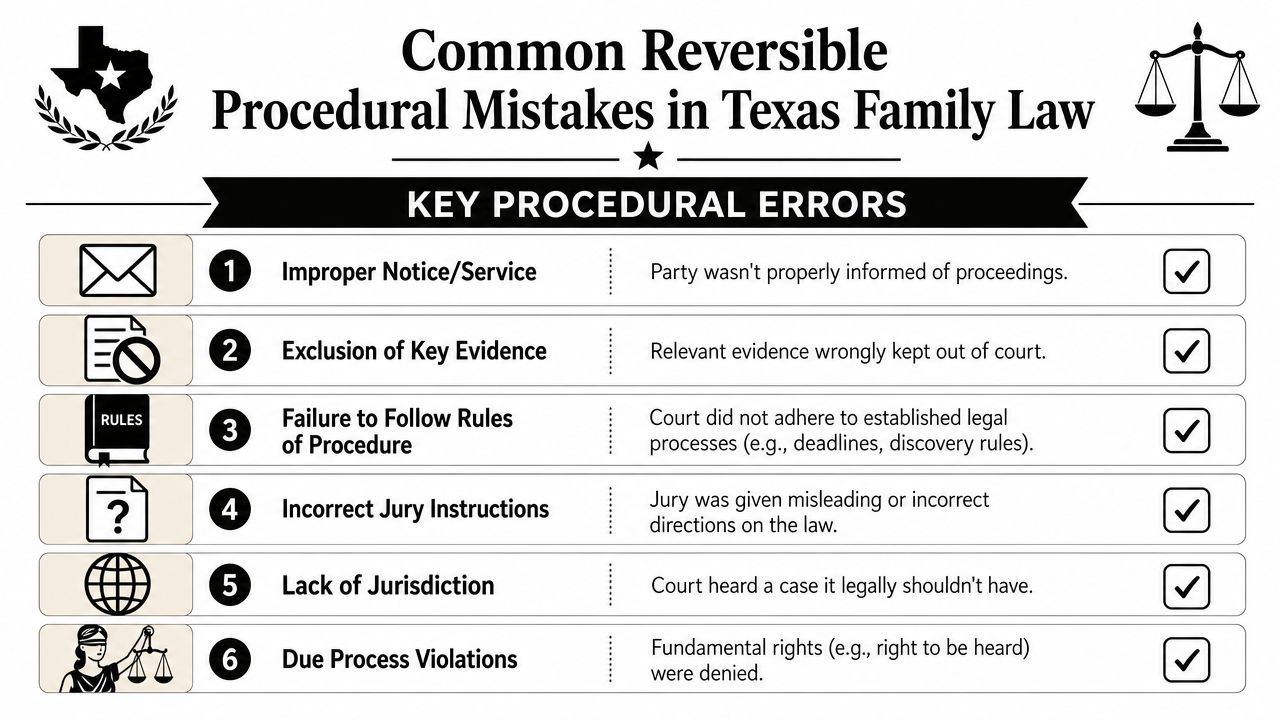
Some procedural errors show up repeatedly in Texas family appeals. Not because courts always get these issues wrong, but because family cases move fast, emotions run high, and trial records can become messy.
Texas appellate data show that procedure matters. In a study of Texas Courts of Appeals reversal reasons, 18% of reversals in the 2010 to 2011 court year were attributed to procedural errors, and the overall reversal rate in family cases was 21%, according to the Houston Law Review study on reversal reasons in Texas appeals. That doesn't mean every procedural complaint wins. It does show that procedure can be a real path to relief.
Lack of proper notice
A hearing changes visitation, imposes support obligations, or affects possession rights, but one party didn't receive proper legal notice.
That kind of problem cuts to due process, which is the right to notice and a meaningful opportunity to be heard. If a parent wasn't properly informed about a hearing where critical rights were decided, the appellate court may view the resulting order very differently than a routine scheduling dispute.
Excluding important evidence
A spouse tries to admit a financial document tied to property division. A parent tries to offer school records or testimony relevant to a child-related issue. The court excludes the evidence, and the excluded material could have changed the legal analysis.
Not every evidentiary ruling is reversible. But exclusion can become serious when the evidence was admissible, the issue was preserved, and the ruling likely affected the result.
For a fuller discussion of what courts look for, this explanation of reversible error in Texas family court is a useful starting point.
A short video can also help clarify how appellate review works in practice.
Denying a meaningful opportunity to present your case
This issue appears in several forms:
- Cutting off testimony before a party can address a central issue
- Refusing an offer of proof after excluding evidence
- Moving forward too quickly on a contested matter without allowing fair presentation
- Blocking a party from developing the record on a key dispute
These cases are often fact-sensitive. The problem is not merely that the hearing was short or frustrating. The problem is that the procedure used kept the party from presenting an issue the law entitled the court to hear.
Sometimes the strongest appellate issue isn't what the judge believed. It's what the judge refused to let the record show.
Failing to follow mandatory procedure
Some family-law rulings require the court to follow particular steps. If the trial court skips a required procedure, that can support appeal when the omission affects the judgment.
This category can include problems involving:
- Statutory procedures in cases involving children
- Required findings or rulings
- Jurisdictional defects
- Improper handling of discovery or hearing procedure
Invited or harmless error usually won't help
Clients are often surprised by what does not make a strong procedural appeal.
If your own side requested the complained-of ruling, agreed to the procedure, failed to object, or cannot show the mistake mattered, the issue weakens quickly. That is why appellate review begins with transcripts and clerk's records, not intuition.
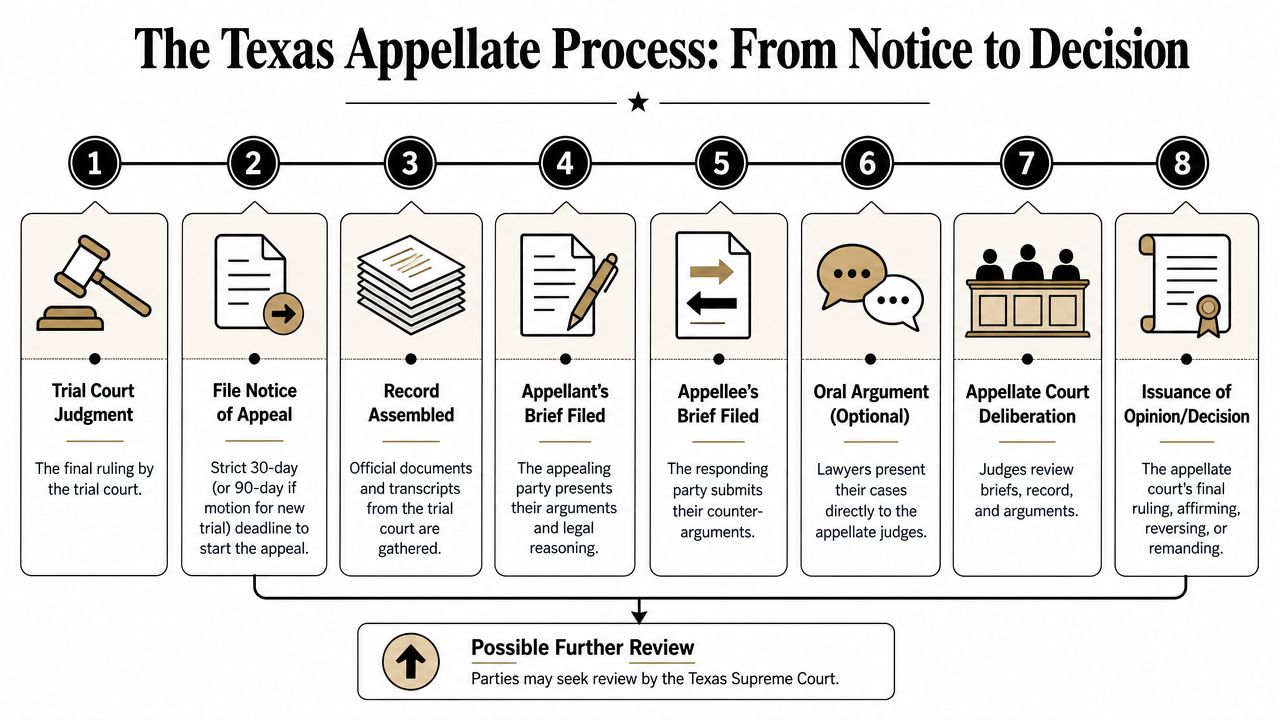
The Texas Appellate Process From Notice to Decision
An appeal has its own structure, deadlines, and vocabulary. It does not replay the trial. It reviews the trial court's work through the written record.
Texas family-law appeals are record-based reviews of legal or procedural error, and the notice of appeal usually must be filed within 30 days after the final judgment is signed. If a timely motion for new trial, motion to modify, motion to reinstate, or request for findings of fact and conclusions of law is filed, the deadline can extend to 90 days under Texas appellate rules, as described in this guide to Texas family-law appeal deadlines.
Step one starts with the final judgment
Most family appeals begin after a final judgment is signed. That matters because Texas appeals are generally limited to final, appealable orders.
The first practical question is deadline control. If the notice of appeal is late, the case may be over before the appellate court ever reaches the merits. This review of deadlines that can destroy a Texas family-law appeal explains why immediate calendar review matters so much.
The record becomes the entire battlefield
After the notice is filed, the appeal is built from the appellate record. That usually includes:
- The clerk's record, which contains pleadings, motions, orders, and filed exhibits
- The reporter's record, which contains transcripts of hearings and trial testimony
No new evidence comes in. No witness takes the stand again. If something important never made it into the record, that absence can define the appeal.
Briefing is where the legal argument is made
The appealing party files an opening brief. The responding party answers. Sometimes a reply brief follows.
This written advocacy does most of the work in an appeal. A brief should identify the issue, cite the record, explain preservation, apply the correct standard of review, and show why the error warrants reversal, remand, or another form of relief.
The strongest appellate briefs don't argue that the case felt unfair. They show, page by page, where the record proves unfairness under Texas law.
Oral argument and decision
Some cases are decided on the briefs alone. Others are set for oral argument, where lawyers answer questions from a panel of appellate judges.
The court then issues a written opinion. It may:
- Affirm the judgment
- Reverse the judgment
- Vacate part of the order
- Remand the case for further proceedings in the trial court
Trial vs appeal at a glance
| Aspect | Trial Court | Appellate Court |
|---|---|---|
| Primary role | Decides facts and enters judgment | Reviews for legal or procedural error |
| Evidence | Witnesses testify and exhibits are introduced | No new evidence |
| Focus | What happened and what order should issue | Whether the trial court followed the law and proper procedure |
| Advocacy style | Live testimony, objections, factual development | Record analysis, written briefs, legal argument |
| Outcome | Final order or judgment | Affirm, reverse, vacate, or remand |
For clients, this shift can be hard to absorb. At trial, the courtroom feels personal. On appeal, precision matters more than emotion.
How to Evaluate Your Case for an Appeal
If you believe the ruling in your family case was wrong, that instinct matters. But the next step is not filing first and sorting it out later. The next step is a disciplined review of the record.
A real appeal evaluation asks practical questions:
The questions that usually matter most
- Is there a final, appealable order?
- Was the notice deadline preserved?
- What exact ruling is being challenged?
- Was the complaint preserved in the record?
- Can the error be framed under the right standard of review?
- Did the mistake probably affect the judgment?
Those questions often produce hard answers. Some cases involve obvious unfairness but weak preservation. Others involve a technical ruling that looks minor until the record shows it likely changed everything.
What a serious record review should include
A proper appellate screening usually means reviewing:
- The final order and any post-judgment filings
- Reporter's records from key hearings and trial
- Clerk's record, including motions, objections, and exhibits
- Any requests for findings, rulings, or related filings
- The likely remedy if the appeal succeeds
This is where appellate counsel adds value. The work is less about broad outrage and more about issue selection, preservation, harm, and remedy. The Law Office of Bryan Fagan, PLLC is one Texas family-law appellate practice that reviews trial records to identify legal or procedural error and evaluate whether an appeal is viable.
A fair answer is better than false hope
Not every painful ruling is reversible. But some are, and procedure is often where that path appears.
If you're still asking whether procedural mistakes can win an appeal in Texas family law, the honest answer is this: yes, when the mistake was preserved, harmful, and shown clearly in the record. That isn't a loophole. It is part of how appellate courts protect fairness, due process, and the integrity of family-law judgments.
If you believe the court made a mistake in your family law case, our appellate attorneys can help you seek a fair outcome. Contact The Law Office of Bryan Fagan, PLLC today for a free consultation.