You may feel like the judge missed what mattered most in your custody case. Maybe key records were kept out. Maybe the other side was allowed to say things that should never have come in. Maybe the final order doesn't reflect what you believe the evidence demonstrated about your child's best interests.
An appeal can be a path toward fairness, but it's a very specific kind of review. It isn't a chance to start over. It's a chance to ask a higher court to examine whether the trial court made a legal mistake that affected the outcome.
That distinction matters when parents ask how evidentiary errors impact Texas custody appeals. The short answer is this: some evidence mistakes matter a great deal, but many don't lead to reversal unless the record shows the problem clearly and the mistake likely changed the result. That's where strategy becomes more important than outrage.
Your Search for a Fair Outcome After an Unjust Ruling
When a custody order feels wrong, most parents focus on what the judge got wrong factually. That reaction is understandable. You lived the case. You heard the testimony. You know which documents mattered and which statements were misleading.
But an appellate court looks at the case differently. It asks whether the trial court made a legal error within the rules that govern trials, evidence, and appellate review. In family cases, that usually means looking closely at the record, the objections, the rulings, and whether the alleged mistake was material.
What an appeal can and can't do
An appeal can address problems such as:
- Wrongly admitted evidence: Testimony or exhibits that should have been excluded under the rules of evidence.
- Wrongly excluded evidence: School, medical, counseling, or other records that the judge should have considered.
- Procedural unfairness: Situations where a ruling prevented one side from fairly presenting the case.
- Legal missteps in the best-interest analysis: Errors that distorted how the court evaluated the child's needs.
An appeal can't fix every bad feeling from trial. It doesn't give you a second hearing just because the result was disappointing. It doesn't let you bring in new witnesses to improve a weak presentation after the fact. It asks a narrower question. Did the court make a reversible legal mistake?
Practical rule: The strongest custody appeals usually connect a specific ruling to a specific part of the final judgment.
That's why an appeal based on evidentiary error has to be built carefully. The issue isn't merely whether something unfair happened. The issue is whether the unfairness appears in the trial record in a way the appellate court can act on.
Understanding the Difference Between a Trial and an Appeal
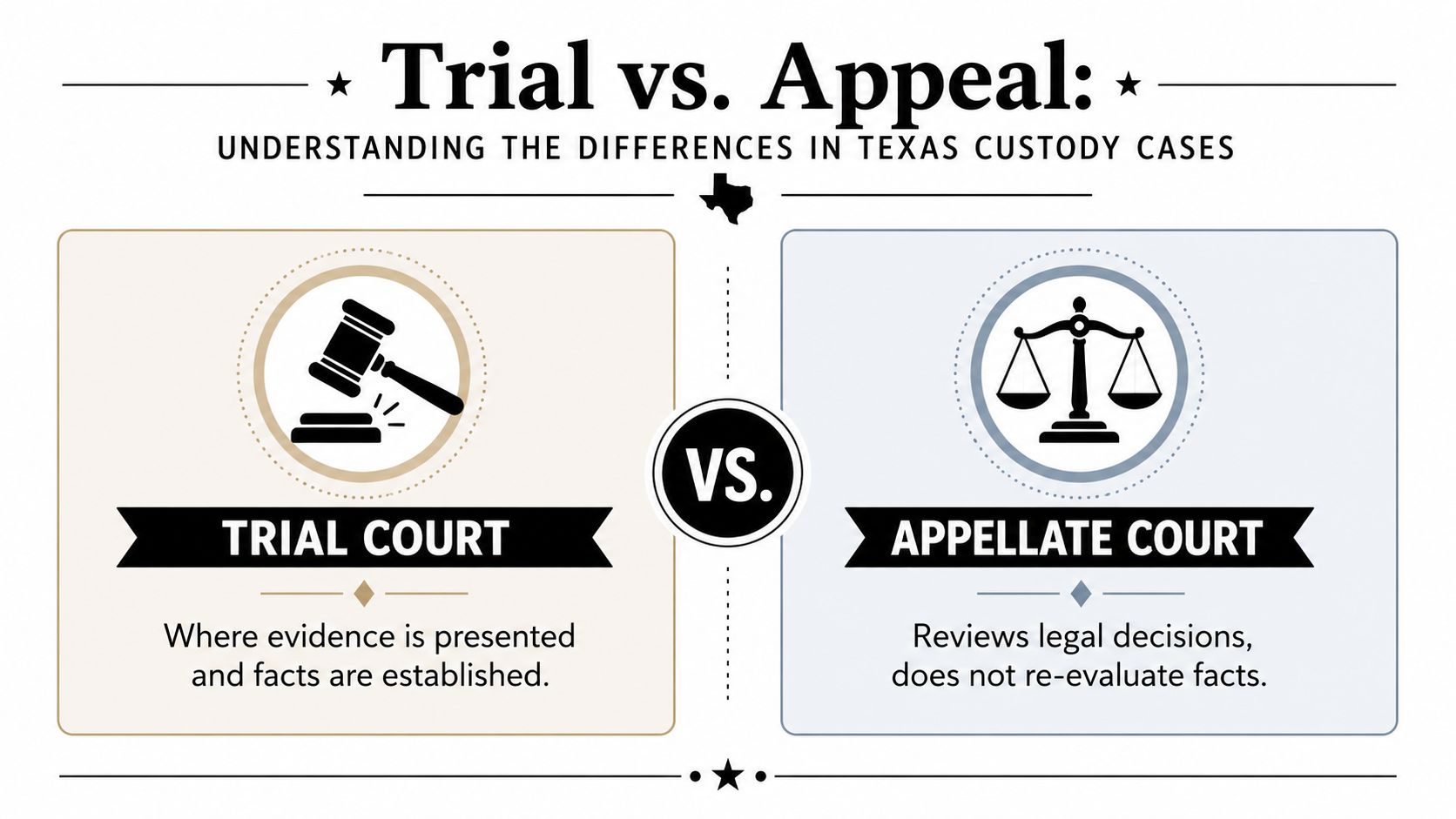
A trial court decides facts. It hears testimony, receives exhibits, and weighs credibility. In a custody case, that often means the judge is sorting through competing stories about parenting, communication, stability, safety, and the child's daily life.
An appellate court does something else. It reviews the trial court's legal decisions. It does not re-try the case, and it generally does not consider new evidence. As explained in this discussion of how appellate courts review family law cases in Texas, the appeal turns on the record that already exists.
What the appellate record includes
The appellate record usually includes the clerk's record and the reporter's record. In plain English, that means the filed papers, written orders, admitted exhibits, and the transcript of what was said in court.
That limitation is why evidence issues become so important on appeal. The higher court can only evaluate what made it into the record and what objections were made at the time.
According to this Texas appeals overview, the practical effect is that evidentiary errors often change custody outcomes indirectly by limiting what the appellate court can rely on, because appeals are not retrials and new evidence is generally excluded. That same discussion notes that only final orders are generally appealable and that Texas family cases generally have a 30-day notice deadline.
Trial versus appeal in plain English
| Process | Trial court | Appellate court |
|---|---|---|
| Main job | Decides facts and enters orders | Reviews legal rulings |
| Evidence | Witnesses testify and exhibits are offered | No new evidence is generally added |
| Focus | What happened and what order serves the child's best interest | Whether legal error appears in the existing record |
| Outcome | Final custody ruling | Affirm, reverse, or send the case back |
Appeals are built from transcripts, exhibits, objections, and rulings. They aren't built from what you wish had been said after the hearing ended.
If you're trying to understand how evidentiary errors impact Texas custody appeals, this is the first practical takeaway. The appellate court can't rescue evidence that was never properly introduced, and it won't hear new proof to fill the gaps.
What Counts as an Evidentiary Error in a Custody Case
An evidentiary error happens when the court admits evidence it should have excluded, excludes evidence it should have admitted, or handles proof in a way that breaks the rules and affects the fairness of the hearing. In custody cases, these mistakes matter because the judge is making decisions about conservatorship, possession, and the child's best interests based on the evidence in front of the court.

Common examples parents recognize
Some of the most common complaints in custody appeals involve issues like these:
- Hearsay getting through: One parent testifies about what a neighbor, teacher, or relative supposedly said, and the statement is offered for its truth without fitting a proper exception.
- Important records being kept out: Medical files, school records, counseling notes, or communication records are excluded even though they may bear directly on parenting concerns.
- Improper character evidence: A party tries to win by painting the other parent as a bad person in general, rather than offering evidence tied to parenting ability or the child's welfare.
- Expert testimony being mishandled: A counselor, evaluator, or psychologist is cut off, limited improperly, or allowed to offer opinions without a sound foundation.
Not every bad ruling is a winning appeal point
Many parents often become frustrated. A ruling can feel plainly wrong and still not justify reversal. As discussed in this explanation of improper admission of evidence on appeal in Texas, the crucial question isn't only whether the judge made a mistake. It's whether the mistake was important enough, preserved correctly, and connected to the final judgment.
This discussion of Texas custody appeals points out a common gap in public explanations. Many articles say error must be shown, but they don't explain the difference between a harmless evidence mistake and a reversible one, or how the abuse-of-discretion standard makes reversal difficult even when evidence was arguably mishandled.
That's why lawyers preparing an appeal often spend significant time with transcripts, exhibits, and hearing notes. A clean transcript is a critical legal tool for legal teams because it helps pinpoint the exact objection, the judge's exact ruling, and the exact testimony that may have influenced the custody decision.
Why this matters: In an appeal, vague memories don't carry the argument. The transcript does.
The Three Hurdles for Reversing a Custody Order
Parents often assume that proving the judge made a mistake should be enough. In appellate practice, it usually isn't. A custody appeal based on an evidence issue has to clear three separate hurdles.
The easiest way to think about it is as a three-gate system. If the case fails at any one gate, the appeal usually fails on that issue.
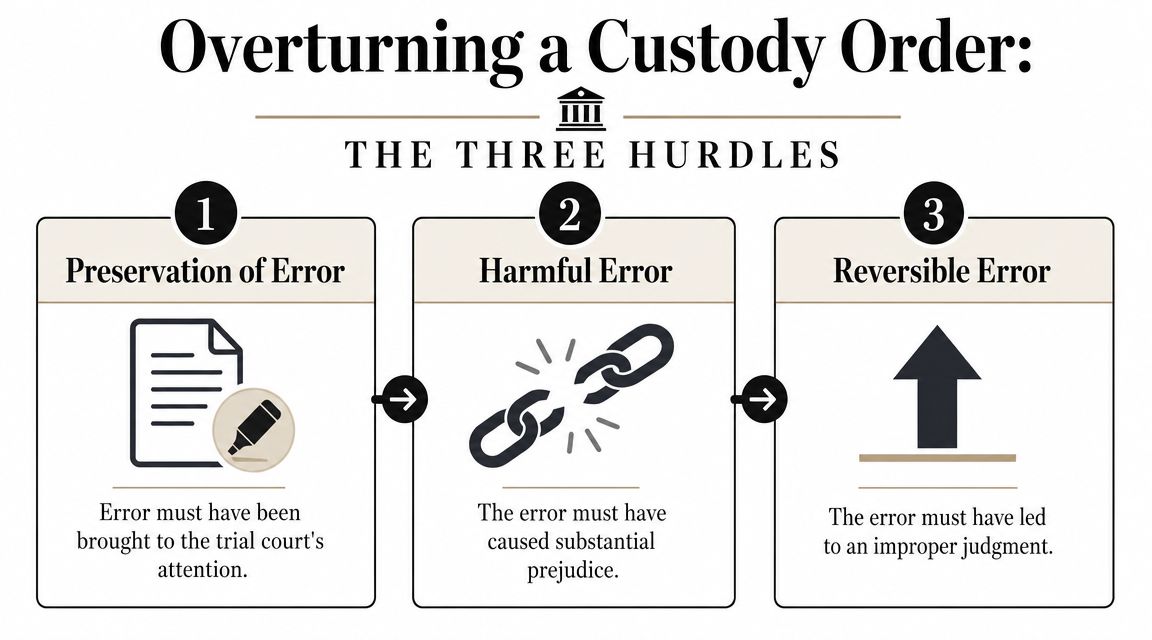
First hurdle is preservation
Preservation of error means the complaint had to be raised in the trial court at the right time and in the right way. In practical terms, that usually means a timely, specific objection, plus a ruling from the judge.
If evidence was admitted and no one objected, the complaint may be waived. If evidence was excluded and no one made a proper offer showing what the evidence would have been, the appellate court may have no way to evaluate whether the exclusion mattered.
According to this Texas custody appeal discussion, Texas custody appeals are typically won or lost on preservation and harm, not on a full rehearing of the case. That same source explains that Texas appellate procedure requires a party to make a timely, specific objection in the trial court and obtain a ruling, and that appeals from final custody orders generally must be filed within 30 days of the order.
Second hurdle is abuse of discretion
Abuse of discretion is the standard of review that often governs family law rulings. In plain English, it asks whether the trial judge acted outside the range of reasonable choices allowed by law.
That doesn't mean the appellate court asks whether it would have ruled differently. It asks whether the ruling was legally unreasonable given the record and the rules. This is one reason custody appeals are hard. Trial judges have broad room to make judgment calls, especially on close factual issues.
A parent may say, “The judge should have believed my witness.” That usually won't carry an appeal. A stronger argument is, “The judge admitted testimony that should not have been considered under the rules, and then relied on it in deciding conservatorship.”
Here's a short overview that helps illustrate the point:
| Term | Plain-English meaning | Why it matters |
|---|---|---|
| Abuse of discretion | The judge made a ruling outside the bounds of reasonable legal judgment | Limits when an appellate court will interfere |
| Reversible error | A legal mistake serious enough to justify changing the result | Not every wrong ruling qualifies |
| Briefing | The written argument filed in the appellate court | This is where the legal case is made |
A video explanation can also help if you're trying to understand the appellate mindset:
Third hurdle is harm
Even if the issue was preserved and the ruling was wrong, the appellant must usually show harm. That means showing the error probably caused the rendition of an improper judgment or prevented proper appellate review.
This is the hurdle that surprises many parents. Courts don't reverse just to correct technical mistakes. They reverse when the mistake likely mattered in a meaningful way.
A successful appeal usually tells a complete story. The objection was made. The ruling was wrong. The error shaped the judgment.
That's the practical answer to how evidentiary errors impact Texas custody appeals. They matter when they changed the field on which the custody decision was made.
Examples of Potentially Reversible Errors
The best way to understand these rules is to see how they work in situations that come up in real custody litigation. These examples are illustrative, but they track the kind of reasoning appellate courts use.
Excluding the only neutral mental health evidence
A court-appointed mental health professional evaluates the child and the parents. The evaluator's testimony addresses the child's adjustment, concerns about conflict exposure, and recommendations about parenting time. At trial, the judge excludes the testimony after an objection that doesn't fit the actual basis for exclusion.
Trial counsel responds correctly. Counsel explains why the testimony is admissible and makes a clear record of what the evaluator would say. The judge still excludes it.
That issue may have appellate force because the excluded testimony goes to the child's best interests, the complaint was preserved, and the missing evidence may have left the court with a one-sided record.
Admitting hearsay that becomes the center of the ruling
A parent testifies that a third party said the child was afraid to visit the other parent. The opposing side objects that the statement is hearsay. The objection is overruled. Later, the final ruling tracks that accusation in a way that suggests the judge relied on it heavily.
That kind of issue can be stronger on appeal than many parents realize. The problem isn't just that the statement got in. The problem is that the objection was made, the ruling was preserved, and the evidence may have influenced a central finding.
This discussion of appealable errors captures the point well. In Texas custody appeals, evidentiary mistakes matter only if they are both preserved and prejudicial. A complaint is typically waived unless trial counsel timely objected when the evidence was offered, and relief depends on showing the error likely affected the judgment rather than proving the ruling was wrong in isolation.
Blocking an offer of proof after evidence is excluded
A parent tries to introduce school records showing attendance issues and repeated disciplinary changes during the other parent's periods of possession. The judge excludes the records. Counsel then asks to make an offer of proof so the appellate record shows what the excluded material contained. If the court refuses to allow a proper record to be made, that can create a serious appellate problem.
Disciplined case review matters. Lawyers and clients who are summarizing legal cases for appeal often focus on the final order, but the turning points are usually buried in the transcript. The appellate issue may sit inside a few pages where evidence was offered, challenged, and ruled on.
Strong appeal points usually arise from moments that look small during trial but become decisive when the record is reviewed line by line.
How to Protect Your Right to Appeal During a Trial
The foundation for a good appeal is laid in the trial court. That's true even if no one knows yet whether an appeal will be necessary. In custody litigation, trial counsel should be thinking not only about persuading the judge today, but also about protecting the record in case the ruling has to be reviewed later.
What making a record really means
Making a record means creating a clear transcript and exhibit trail that shows what happened, what was objected to, why it was objectionable, and how the court ruled. Without that, appellate arguments often collapse before they start.
Some of the most important steps are simple, but they have to be done precisely:
- Object on time: If objectionable evidence comes in without a timely objection, the issue may be lost.
- State the specific ground: A vague objection may not preserve the actual complaint for appeal.
- Get a ruling: If the judge never clearly rules, the record may be incomplete.
- Make an offer of proof: If evidence is excluded, the appellate court needs to know what the evidence would have shown.
A detailed explanation of objections required to preserve appeal in Texas is useful for parents and trial lawyers alike because preservation problems often start with small moments that don't seem important until after the order is signed.
What usually doesn't work
Some approaches almost never help on appeal:
- General complaints of unfairness: Appellate judges need a legal issue tied to the record.
- New arguments after trial: A party usually can't raise a brand-new evidence objection for the first time on appeal.
- Focusing only on the final order: The error often happened earlier, when evidence came in or stayed out.
A common gap in public explanations of custody appeals is preservation of evidentiary error. Many articles mention evidence mistakes but don't explain that Texas appellants usually can't raise new objections on appeal unless the objection was made and ruled on in the trial court.
For families and referring trial counsel, one practical option is a focused appellate record review by a firm that handles family appeals, such as The Law Office of Bryan Fagan, PLLC. That kind of review typically looks at transcripts, exhibits, objections, and the final order to identify whether a custody appeal is legally viable.
If you believe the court made a mistake in your family law case, our appellate attorneys can help you seek a fair outcome. Contact The Law Office of Bryan Fagan, PLLC today for a free consultation.