Skip to content
Yes, you can sometimes appeal a custody decision after agreeing to terms in Texas, but the path is narrow and the chances of success are limited. In most situations, an agreed custody order can only be challenged when there is a serious legal problem, such as fraud, lack of valid consent, duress, or a fundamental legal error in how the order was entered.
Many parents call after the paperwork is signed and the circumstances start to settle in. The schedule may look very different in daily life than it did in mediation, or the final order may not seem to reflect what they thought they accepted. Some felt rushed. Others were exhausted, pressured, or trying to end conflict for their children.
That regret is real. But Texas appellate courts don't treat regret the same way they treat legal error. If you are asking can you appeal a custody decision after agreeing to terms in Texas, the answer depends less on whether the result feels unfair and more on whether the record shows a valid appellate issue.
Your Custody Agreement Is Signed Now What
The hardest moment often comes after the hearing, not during it. You leave court, read the order again, and start seeing problems you either missed or hoped you could manage. For many parents, that second look leads to the same question. Did I just give up my right to fight this?

Why signing changes the legal landscape
When a custody case ends with a contested trial, the appellate focus is usually on what the judge did with disputed facts, objections, evidence, and legal rulings. When the case ends with an agreement, the appellate court starts from a different place. It asks whether the order was properly entered and whether the consent behind it was valid.
That difference matters because Texas law places real weight on finality. Courts want signed orders to mean something. If parties could routinely undo agreements because they later regretted them, settlement would become unstable and custody litigation would become even more uncertain for families and children.
What clients often hope will work, and what usually doesn't
Parents often want to argue one of these points:
- The deal feels one-sided: That feeling matters personally, but standing alone it usually isn't an appellate issue.
- I wish I had negotiated harder: Appeals don't exist to redo settlement strategy.
- The other side got the better bargain: An uneven result is not automatically a legal defect.
- I have new facts now: A direct appeal usually isn't the vehicle for fresh evidence.
Practical rule: If your complaint is "I shouldn't have agreed," that usually isn't enough. If your complaint is "the order was entered through a legal defect," that may deserve immediate review.
The real first question
The first question isn't whether the order feels unfair. It is whether there is a specific legal basis to challenge it. In agreed-order cases, that often means looking closely at how the agreement was reached, whether the written order matches the actual consent given, and whether anything happened in court that created a preserved legal issue.
That is why these cases require a careful, early review, not assumptions.
Agreed Orders vs Trial Judgments Why It Matters for an Appeal
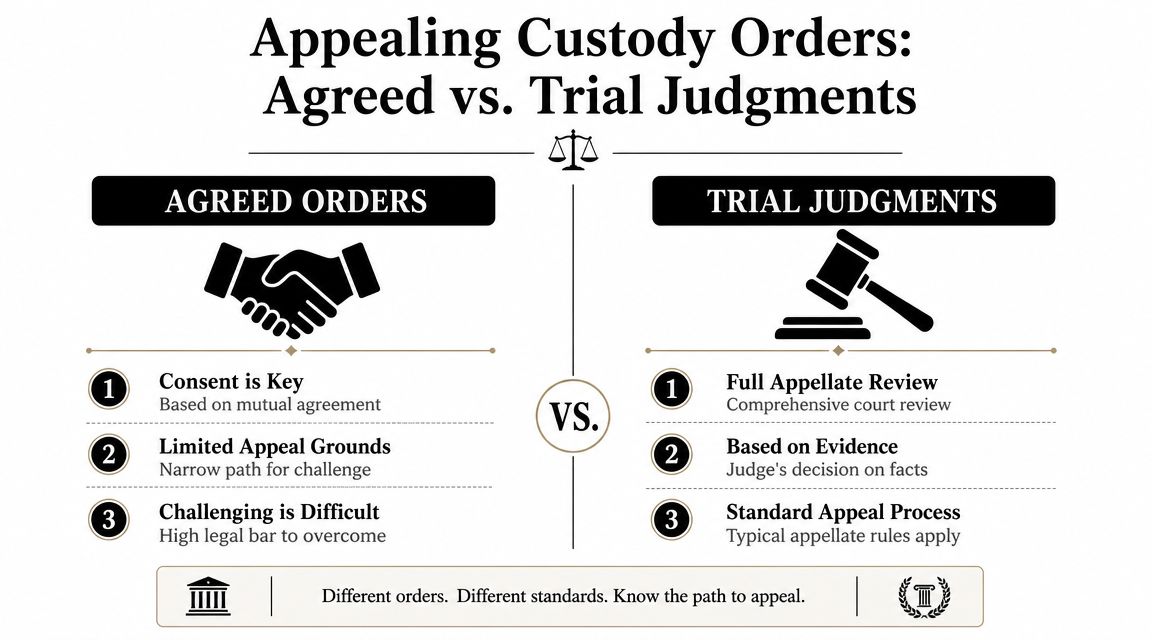
An agreed custody order and a trial judgment may look similar on paper. Both are signed by the court. Both are enforceable. Both can shape a child's daily life for years. But on appeal, they are not treated the same way.
A side by side comparison
| Situation | What usually drives the appeal | Why it is difficult |
|---|---|---|
| Judgment after trial | The appellant argues the judge made a legal or procedural mistake while deciding disputed issues | The appellate court still gives the trial court deference |
| Agreed custody order | The appellant usually must attack the validity of the consent, the way the order was entered, or another legal defect in the record | The court is reluctant to undo an order the parties themselves accepted |
A simple way to think about it is this. Appealing a trial judgment is often like saying the referee made a bad call during the game. Challenging an agreed order is more like saying the game should not count because your agreement to end it was not legally valid in the first place.
The standard of review is already demanding
Texas custody appeals use the abuse of discretion standard. That means the appellate court asks whether the trial court acted arbitrarily, unreasonably, or without reference to guiding legal principles. It does not reverse just because it would have decided the case differently. The court must identify an actual legal or procedural error in the record, and in agreed-order situations the focus often shifts to whether the agreement and resulting order were properly entered, whether consent was valid, and whether the law was misapplied, as explained in this discussion of Texas child custody appeals and abuse of discretion.
That standard is hard enough after a full trial. It is even harder after consent.
Why agreed orders get extra resistance on appeal
An agreed order is often built on settlement principles. In practical terms, the court sees that both sides chose resolution instead of asking the judge to decide every disputed issue. If you're dealing with a mediated or negotiated settlement, it also helps to understand how a Rule 11 agreement in Texas family law can affect what was agreed to and how that agreement may later be enforced.
Courts are much more open to correcting a judge's mistake than rescuing a party from a deal the party voluntarily made.
That doesn't mean an agreed order is untouchable. It means the argument must be narrower, cleaner, and anchored to the record.
The Narrow Legal Grounds for Appealing an Agreed Order
If there is a path forward, it usually runs through a small group of legal theories. These are not broad fairness arguments. They are targeted challenges to the validity of the agreement or the legality of the resulting order.
Fraud
Fraud means someone induced the agreement through deception. In plain English, that usually means a parent agreed because the other side hid something important or made a false representation that materially affected the deal.
A custody example might involve false information that was used to secure consent to a possession arrangement or a restriction that the agreeing parent would not have accepted if the truth had been known. The key issue is not disappointment. The key issue is whether deception corrupted the agreement itself.
Fraud-based challenges are fact-sensitive. They also require proof, not suspicion.
Duress or coercion
Duress is pressure so serious that it overcomes meaningful consent. Family cases can be emotionally intense, but not all pressure is legal duress. Hard bargaining, stress, and fear of litigation costs usually do not qualify by themselves.
A stronger concern may exist if a parent was threatened in a way that destroyed the ability to make a voluntary decision, or if the circumstances around the signing call real consent into question. These cases depend heavily on what can actually be shown from the record and surrounding evidence.
Lack of consent
Some agreed-order disputes are really consent disputes. A parent may say, "I agreed to one thing, but the signed order says something else," or "I never consented to those final written terms."
This issue can arise when the language in the order goes beyond what the parties accepted, or when the final paperwork does not accurately reflect the agreement announced in court or reduced to writing. In that setting, the legal problem is not that the bargain became inconvenient. The problem is that there may never have been valid consent to the order as entered.
Important distinction: A bad deal is not the same as no deal. Appellate courts care about that difference.
Fundamental legal error
Some defects go beyond the parties' negotiations. If the court lacked authority to enter the order, or entered an order in a way that violated controlling law, the issue may be larger than consent alone.
These arguments are narrow and technical. They often turn on jurisdiction, procedure, or whether the trial court entered something the law did not permit. They are not common, but when they exist, they matter.
Misapplication of law in entering the agreed order
Even in a consent setting, a judge still has to follow the law. If the trial court misapplied a controlling legal principle when approving or entering the order, that may support appellate review. This is one reason agreed-order appeals require close reading of the clerk's file, hearing transcripts, and the exact wording of the final order.
What usually fails
The following complaints usually don't support a direct appeal by themselves:
- I changed my mind later: Regret is understandable, but it usually isn't reversible error.
- The schedule became harder than expected: That may support a future modification analysis, not an appeal.
- I think the judge should have pushed harder for a different result: That often misses the central problem in agreed-order cases.
- I want to present new evidence now: Appeals are generally based on the existing record, not fresh testimony.
A useful mindset is this. Ask whether the issue attacks the legality of the order or only the wisdom of the agreement. Appeals address the first category much more often than the second.
Texas Appellate Procedure The Clock Is Ticking
Even a strong legal issue can be lost if you move too slowly. Timing is one of the most unforgiving parts of Texas appellate practice.
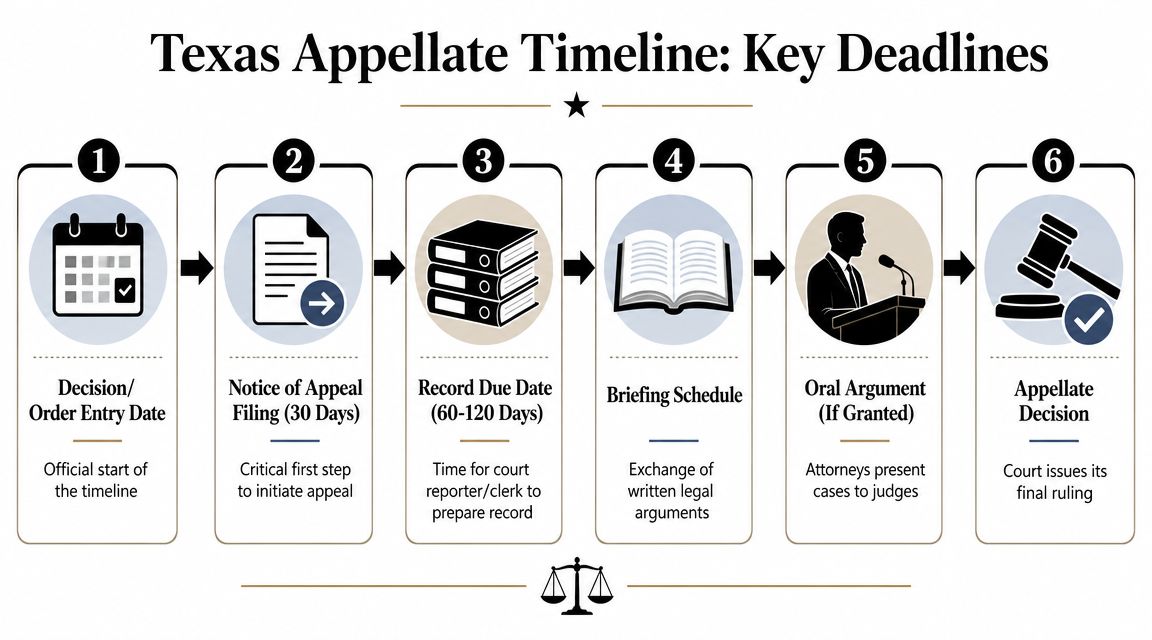
Texas custody appeals are usually limited to a final order, not a temporary one, and the deadline to challenge that final judgment is typically 30 days from the date the order is signed, as outlined in this overview of Texas child custody appeal deadlines and final orders. That same discussion also explains an important point many parents miss. An appeal is not a new trial. The appellate court reviews the existing record for legal error, using the pleadings, transcripts, and preserved evidence already in the case.
The first deadline that matters most
That 30-day window is where many potential appeals live or die. If you think the order was entered through fraud, coercion, lack of consent, or another legal defect, waiting to "see how things go" is risky. Once the appellate deadline passes, your options narrow.
If you need a focused explanation of the filing window, this article on the deadline for filing a notice of appeal in Texas is a good place to start.
What the early appellate process usually looks like
The sequence often includes:
- Review the signed final order immediately: Confirm what was signed, not what you expected to be signed.
- Identify the possible appellate issue: The issue must be legal, procedural, or tied to consent.
- Protect the deadline: A notice of appeal or other post-judgment step may be necessary very quickly.
- Secure the record: That includes the clerk's papers and any reporter's record from hearings that matter.
- Evaluate the correct strategy: Sometimes the best path is appeal. Sometimes it is not.
Why record preparation matters so much
An appellate court cannot fix a problem it cannot see in the record. If the hearing where consent was discussed was not transcribed, or if the critical objection never made it into the court file, proving the issue becomes harder.
That is one reason agreed-order appeals can be so difficult. The legal theory may sound compelling in conversation, but appellate courts decide cases from a fixed record, not from later explanations.
Move as if every day counts, because in appellate practice it often does.
Texas Rules of Appellate Procedure and the Family Code
Clients often hear these terms and assume there must be a broad fairness review somewhere in the process. There usually isn't. The Texas Rules of Appellate Procedure govern how and when you invoke the court's review, assemble the record, and present written argument. The Texas Family Code shapes the substantive family-law framework behind the order. Both matter. Neither gives a party a free second chance because settlement now looks like a mistake.
That is why procedural discipline matters as much as the legal theory.
Understanding Key Appellate Terms in Plain English
Legal terms can make an already stressful situation harder to process. A few definitions can make the path clearer.
Abuse of discretion
What it is: The main standard appellate courts use in Texas custody cases.
Why it matters: The question is not whether the appellate judges would have made a different parenting decision. The question is whether the trial court acted outside the legal rules that guide its discretion. That makes appeal a narrow review, not a fresh weighing of who is more persuasive.
Reversible error
What it is: A legal mistake serious enough to justify appellate relief.
Why it matters: Not every mistake changes the outcome of a case. To matter on appeal, the error must be one the appellate court can recognize from the record and one that warrants a remedy such as reversal, modification, or remand.
The record
What it is: The file the appellate court reviews. It usually includes pleadings, filed documents, exhibits that became part of the case, and hearing or trial transcripts if they were properly taken and requested.
Why it matters: The appellate court decides the case from that record, not from new testimony or later explanations. In agreed-order disputes, the record is often where the fight is won or lost.
Preservation of error
What it is: The rule that a party usually must raise an objection or legal complaint in the trial court before asking an appellate court to review it.
Why it matters: In Texas custody appeals after a settlement-style agreement, preservation of error is a major issue. An appellant typically must have objected to the disputed ruling or legal issue in the trial court, and appellate courts often refuse to consider issues that were not preserved. That makes appeals from agreed custody terms especially hard when the complaint is only that the agreement was unfavorable rather than legally defective. The strongest theories are usually legal or procedural errors shown in the existing record, as discussed in this explanation of preservation of error in Texas custody appeals.
Briefing
What it is: Written legal argument filed in the appellate court.
Why it matters: Briefing is where the case is really presented. A strong brief does more than complain about unfairness. It identifies the issue, ties it to the record, applies the law, and asks for a specific remedy.
A brief is not a letter to the court. It is a structured legal argument built from the record.
Are There Practical Alternatives to an Appeal
Sometimes the smartest strategy is not a direct appeal. That is especially true when life changed, the schedule no longer works, or the order became unmanageable after entry.
Modification may fit better than appeal
A motion to modify is often the more realistic tool when the complaint is forward-looking rather than backward-looking. In plain terms, modification asks the court to change the order because circumstances have changed since it was signed.
That is very different from an appeal. An appeal asks whether the trial court committed legal error when entering the order. A modification asks whether the current order should be changed based on what has happened since then.
A bill of review is different from both
A bill of review is a separate, more specialized proceeding used in limited situations to attack a judgment after ordinary deadlines have passed. It is not a substitute for a missed appeal in every case, and it has its own demanding rules.
If you are weighing that path, this guide on a bill of review versus appeal in Texas helps clarify the difference.
A practical comparison
| Option | Best for | Main limitation |
|---|---|---|
| Direct appeal | Legal or procedural error in the signed final order | Strict deadlines and record-based review |
| Modification | Circumstances that changed after the order | It doesn't fix past legal error |
| Bill of review | Rare situations where a judgment may be attacked after deadlines expire | Narrow remedy with technical requirements |
How to choose the right path
Start with the source of the problem:
- If the order was entered through a legal defect: An appeal may be worth immediate review.
- If your life, your child's needs, or the other parent's conduct changed later: Modification may be the better fit.
- If deadlines have passed and there is a serious judgment-level problem: A bill of review may need to be evaluated.
For some families, a targeted legal consult is enough to sort this out. Some lawyers handle both trial-level family matters and appeals. Others focus only on appellate work. Firms such as The Law Office of Bryan Fagan, PLLC evaluate Texas family-law appeals and related post-judgment options, which can help when you need to decide whether to pursue appeal, modification, or another remedy.
How an Appellate Attorney Can Help You Seek a Fair Outcome
A careful case review can save you from chasing the wrong remedy. In agreed custody cases, that matters a lot because the wrong move can waste both time and money while deadlines continue to run.

What a real appellate review should examine
An appellate attorney should look at the signed order, the timeline, the consent process, the hearing record, and any filings that may show a preserved issue. The goal is not to tell you what you want to hear. The goal is to identify whether a legally viable path exists.
That review often answers practical questions quickly:
- Is this a final order that can be appealed
- Was there a valid appellate issue preserved in the trial court
- Does the written order match the actual agreement
- Would a modification or another post-judgment remedy make more sense
This video gives more context on how appellate review works in family law matters.
An honest assessment is often the most valuable service at this stage. Some cases do justify immediate appellate action. Others are better approached through modification, enforcement, or a different post-judgment strategy.
If you believe the court made a mistake in your family law case, our appellate attorneys can help you seek a fair outcome. Contact The Law Office of Bryan Fagan, PLLC today for a free consultation.