Adultery is not a crime in Texas. A spouse can't be jailed, fined, or given a criminal record for adultery under Texas law, but the issue can still carry serious consequences in a divorce case.
That difference is where many unfair rulings begin. A trial judge may treat adultery as highly relevant in property division, may hear weak or disputed evidence about an affair, or may let the accusation spill into custody arguments that should be judged by a different legal standard. If that happened in your case, the answer to “is adultery a crime in Texas” is only the starting point. The harder question is whether the court used adultery the right way under Texas family law and appellate procedure.
If you just left court with a result that feels one-sided, you're not alone. Many people assume that once a judge signs a final order, the damage is done. In appellate practice, that isn't always true. A final order can be reviewed for legal error, and family-law appeals often turn on whether the trial court followed the proper rules, applied the correct legal standard, and based its ruling on the record rather than emotion or assumption.
An Unfair Ruling Is Not the Final Word
A divorce case involving adultery often feels personal long before it becomes legal. By the time the judge rules, one spouse may believe the court punished them for moral blame rather than applying Texas law carefully. The other spouse may believe the court ignored strong evidence and let obvious misconduct slide. Both situations can raise appellate concerns.
What matters after judgment is precision. Appeals don't ask whether the trial judge was sympathetic, stern, or persuasive in the courtroom. They ask whether the court made a reversible error, meaning a mistake that likely affected the outcome and justifies appellate relief.
What an appeal actually reviews
An appeal isn't a second trial. The appellate court reviews what already happened in the trial court. That includes the clerk's record, the reporter's record if testimony was transcribed, admitted exhibits, and the written orders.
In plain English, the appellate judges don't hear fresh witnesses or new accusations. They review the existing record to decide whether the trial court followed the law.
Practical rule: If adultery played a major role in your final order, the question on appeal isn't whether the appellate court believes your spouse cheated. The question is whether the trial court used the law and the evidence correctly.
Why adultery cases create appellate issues
Adultery allegations tend to produce the same recurring problems:
- Weak proof treated as fact: A judge may rely on suspicion, rumors, or conduct that doesn't meet Texas's legal definition.
- Property rulings that go too far: A court may grant a sharply uneven division without tying that result to the evidence in the record.
- Custody reasoning that misses the applicable standard: A judge may focus on adult misconduct without showing how it affected the child.
These issues don't automatically win an appeal. But they are the kinds of problems appellate lawyers look for when reviewing a final decree.
Criminal Penalties vs Civil Consequences of Adultery
Texas draws a clean line between crime and family law. Texas doesn't classify adultery as a criminal offense, and older criminal-era treatment moved even further into history when the Legislature repealed former Article 1220 in 1973 through Senate Bill 34, as discussed in this Texas adultery law overview.

That historical shift matters. It shows that Texas no longer treats adultery as conduct that triggers criminal punishment. It treats adultery as a civil issue that may matter in a divorce case.
A resource such as Texas Family Law Appeals Lawyer involves appellate representation challenging final family law orders for legal error. That is the framework that fits adultery disputes in modern Texas practice.
The practical difference
People often ask the wrong question first. They ask whether a cheating spouse can be arrested. The primary legal question is usually whether the conduct can affect the divorce judgment.
Here is the cleanest way to separate those issues:
| Aspect | Criminal Law Consequence | Family Law Civil Consequence |
|---|---|---|
| Arrest | None for adultery itself in Texas | None |
| Jail time | None for adultery itself in Texas | None |
| Fine | None for adultery itself in Texas | None |
| Criminal record | None for adultery itself in Texas | None |
| Divorce grounds | Not applicable | Adultery can be raised as a fault ground in divorce |
| Property division | Not applicable | A court may consider adultery when dividing marital property |
| Spousal maintenance arguments | Not applicable | Adultery may matter in some maintenance disputes |
Why this distinction matters on appeal
This distinction becomes critical when a trial court blurs moral blame and legal consequence. A judge can consider adultery in the civil ways Texas law allows. A judge can't treat it like a criminal offense in disguise.
The farther a ruling moves from the statutory purpose of adultery as a divorce issue, the stronger the appellate question becomes.
That doesn't mean every harsh result is reversible. Trial judges have discretion. But discretion still has limits, and appellate courts exist to police those limits.
How Adultery Influences Property Division in a Texas Divorce
In Texas, adultery matters most in the financial part of the case. Texas is a no-fault divorce state, but it also permits fault-based divorce, and Texas Family Code Section 6.003 expressly lists adultery as a ground for divorce in favor of the innocent spouse.
That matters because property division in Texas isn't a mechanical split. The trial court must divide the marital estate in a manner the law considers just and right. When adultery is proven, the court may weigh fault when deciding how to divide that estate.
What those terms mean in plain English
Community estate means the property and debts the spouses acquired during the marriage that are subject to division in the divorce.
A disproportionate division means one spouse receives more than the other. It is not automatic. It must be supported by the facts and fit within the court's lawful discretion.
If you want a broader explanation of how fault and no-fault theories interact, this discussion of whether Texas is a no-fault divorce state helps frame the issue.
Where appellate problems often appear
In trial court, adultery arguments about property usually fall into two categories:
Fault in the breakup of the marriage
One spouse argues the affair itself supports a larger share of the estate.Spending tied to the affair
One spouse argues community money was spent on the non-spouse. That may include gifts, travel, lodging, transfers, or other expenditures reflected in the record.
The first category is more subjective. The second usually gives the court a firmer evidentiary basis. On appeal, that difference matters.
A trial court usually has broad room to make a just-and-right division. But broad room isn't unlimited room. If the decree gives one spouse a markedly better outcome because of adultery, the record should show why. Appellate counsel will look for whether the evidence actually supports the unequal division and whether the judge applied the law instead of reacting to the accusation.
What works and what doesn't
What tends to work in trial court is focused proof tied to money. Bank statements, card charges, transfers, and testimony that connects those expenses to the affair create a cleaner record.
What often doesn't work is relying on outrage alone. Courts still need evidence and legal reasoning. A spouse may have behaved badly, but an appellate court reviews legal sufficiency and discretion, not moral theater.
When a property ruling rests on adultery, the record should connect the conduct to a lawful property analysis. If that link is missing, the decree may be vulnerable on appeal.
Proving Adultery in Court Evidence and Legal Standards
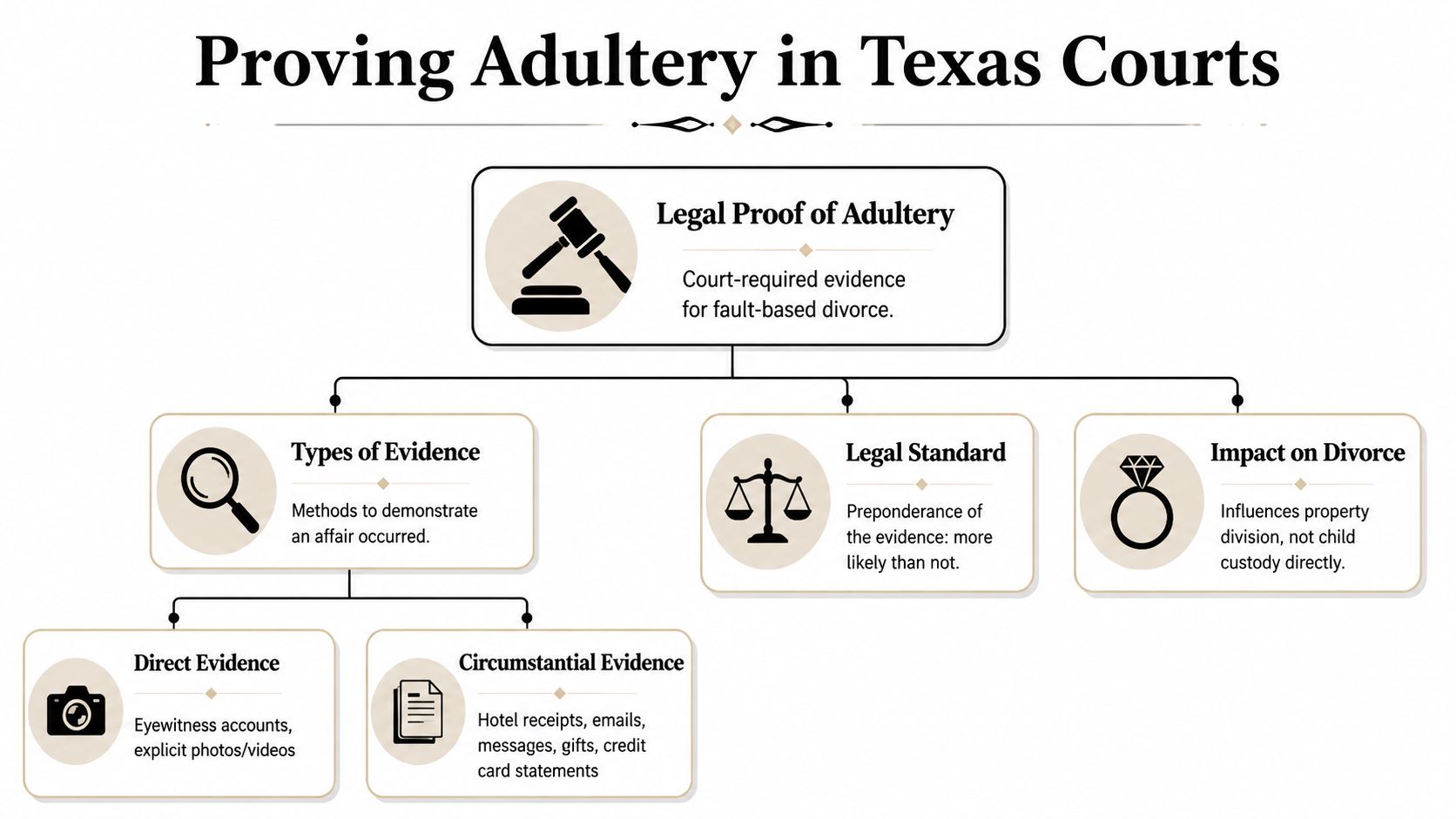
Texas uses a narrow legal definition of adultery in divorce litigation. For these cases, adultery means voluntary sexual intercourse by a married person with someone who is not the spouse, and proof is generally established by a preponderance of the evidence, as explained in this Texas adultery evidence discussion.
That definition is narrower than everyday use of the word “cheating.” Hurtful conduct may be real and still fail to prove legal adultery. Flirtation, kissing, suggestive messages, or explicit online communications may matter in the emotional story of the marriage, but they don't automatically satisfy the legal definition used for a fault finding.
What preponderance of the evidence means
Preponderance of the evidence means the court believes something is more likely true than not true. It is a civil standard. It is not the criminal standard of proof.
In adultery cases, courts may rely on direct or circumstantial evidence. Direct evidence might include an admission or eyewitness testimony. Circumstantial evidence might include messages, photos, financial records, or other documents that point to the affair.
For parties dealing with document requests, phone records, account statements, and contested disclosures, this overview of discovery for divorce is often relevant to how the proof gets built before trial.
Here is where parties often make strategic mistakes:
- Overstating weak evidence: Suspicious texts may suggest intimacy but still fall short of proving adultery.
- Ignoring the record: Strong evidence that never gets admitted can't help on appeal.
- Blurring separate issues: A spouse may prove dishonesty without proving legal adultery.
A short visual explanation can help if you're sorting through what kind of proof matters.
Why evidence errors matter in appellate practice
Appellate review often turns on rulings about evidence. Did the trial court exclude relevant exhibits? Did it admit unreliable proof over objection? Did counsel preserve the complaint for review?
Briefing is the written argument filed in the appellate court. Good briefing does more than say the judge got it wrong. It identifies the exact ruling, cites the record, states the correct legal standard, and explains why the error likely affected the judgment.
If adultery drove the result, the appeal usually rises or falls on record quality. A weak record limits strong arguments. A clear record gives the appellate court a legal path to act.
Can Adultery Affect Child Custody and Visitation Orders
For parents, this is often the most stressful part of the case. Many people fear that an affair will automatically cost them custody. Texas law doesn't work that way.
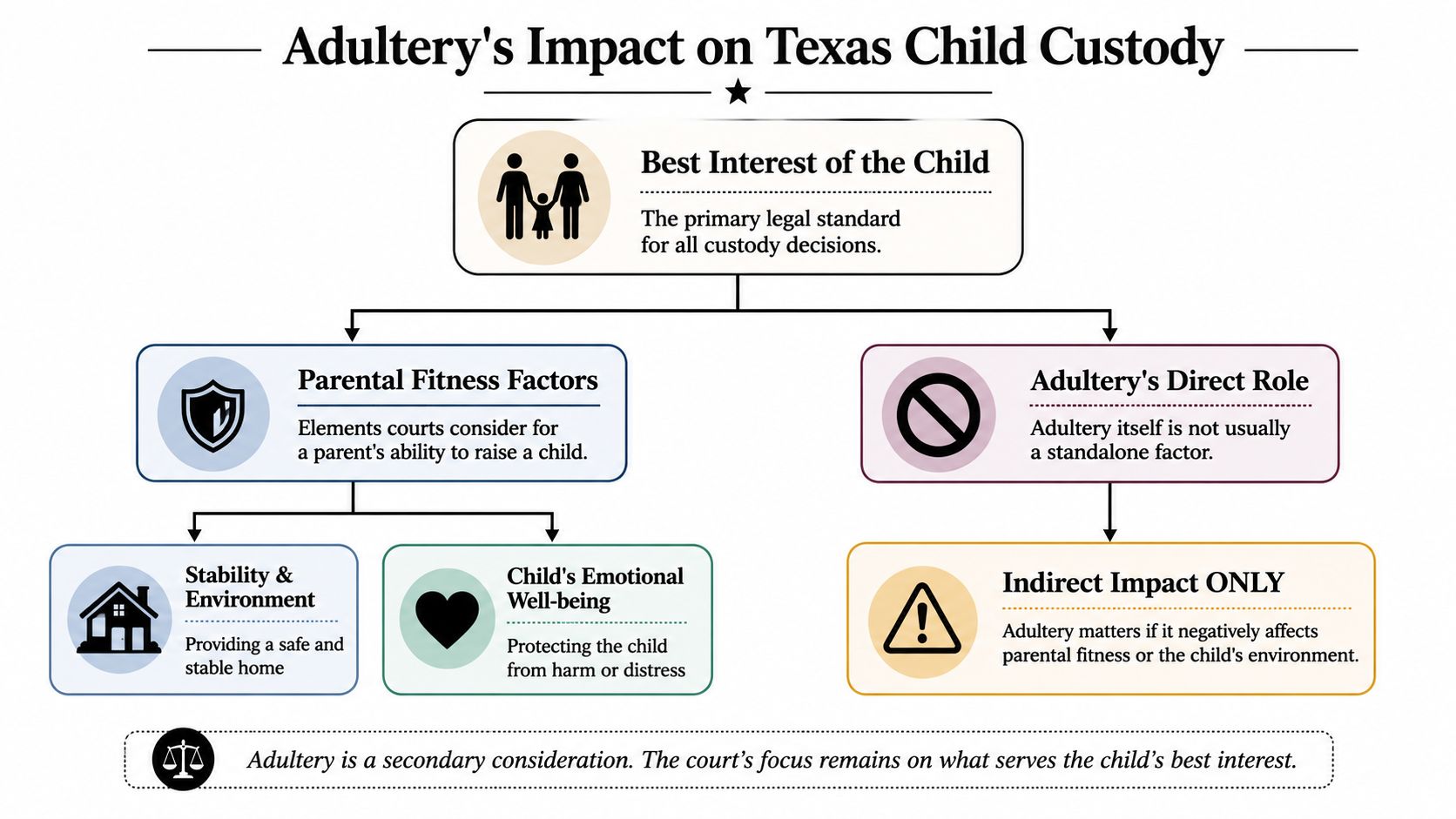
Adultery alone does not automatically determine custody or conservatorship in Texas. Courts focus on the child's safety, stability, and well-being under the best interest of the child standard, as summarized in this Texas child custody discussion involving adultery.
What courts actually examine
A judge isn't supposed to decide custody by asking which parent behaved more morally in the marriage. The judge is supposed to ask whether the parent's conduct affected the child.
That can make adultery relevant in some cases. It may matter if the affair exposed the child to unsafe people, unstable living conditions, neglect, conflict, or emotional harm. Without that link, adultery alone is usually a weak custody argument.
Where trial courts can go wrong
Custody appeals often arise when the written or oral ruling suggests the court used adultery as a shortcut. That can happen when:
- The court punishes adult conduct: The judge appears to penalize a parent for infidelity rather than evaluate parenting and child welfare.
- The evidence doesn't connect to harm: The record shows an affair allegation but no proof that the child was endangered or destabilized.
- The findings are too thin: The order changes conservatorship or possession without a clear best-interest foundation.
A custody ruling should rise or fall on the child's best interests, not on whether the judge disapproved of the marriage conduct.
That distinction matters not just at trial, but on appeal. Appellate courts review whether the trial court used the correct legal framework. If it didn't, the ruling may not stand.
Appealing a Judgment Involving Adultery
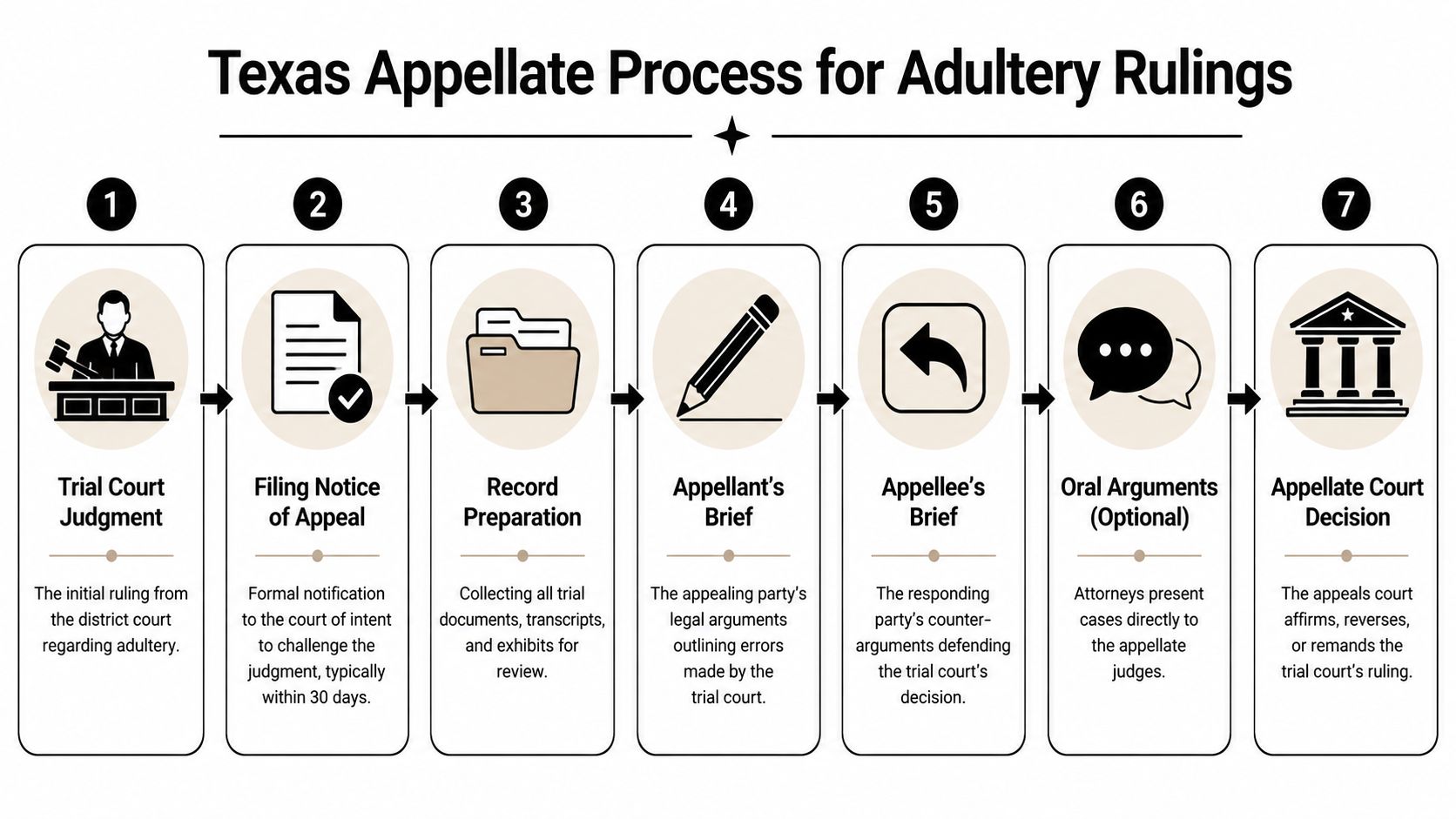
When adultery shaped the outcome of your divorce, the appeal starts with a disciplined review of the record. Appeals don't retry the marriage. They review the judgment for legal error under the Texas Rules of Appellate Procedure and the governing parts of the Texas Family Code.
The timeline and the record
In many Texas civil appeals, the notice of appeal is due within 30 days after the judgment is signed, though post-judgment filings can affect deadlines in some cases. That deadline issue is one of the first things appellate counsel checks.
After the notice is filed, the appellate record must be prepared. That usually includes:
- Clerk's record: Pleadings, orders, filed motions, and admitted paper exhibits.
- Reporter's record: Testimony, objections, bench rulings, and oral statements made on the record.
- Exhibits: Financial documents, communications, photos, and other admitted evidence tied to the adultery allegations.
If you are evaluating whether a fault-based ruling can be challenged, this resource on divorce by adultery provides useful context for the underlying issue that often drives the appeal.
Key appellate terms in plain English
Abuse of discretion means the trial court acted outside the zone of reasonable decision-making allowed by law. Family courts have discretion, but they can't make rulings that ignore controlling standards or lack record support.
Reversible error means a mistake that probably caused an improper judgment or probably prevented a party from properly presenting the case on appeal.
Briefing is the written submission that tells the appellate court what the trial court did, why it was legally wrong, where that error appears in the record, and what relief should follow.
Common adultery-related errors that may support appeal
A bad result isn't enough by itself. The issue is legal error. In adultery cases, common examples include:
Using the wrong custody standard
A judge may overstate the impact of adultery on conservatorship even though custody must turn on the child's best interests. That concern is reflected in this discussion of adultery and custody appeals.Relying on proof that doesn't fit the legal definition
The court may treat suspicious conduct as enough, even though the evidence doesn't support the required finding.Excluding important financial evidence
If the court keeps out records showing spending tied to the affair, that may skew the property division.Awarding a disproportionate division without adequate support
Discretion must still be tied to evidence and lawful reasoning.
Appeals differ from trials in ways that matter
Trial lawyers build facts. Appellate lawyers build legal arguments from a fixed record. That difference is why strong trial instincts don't always translate into strong appellate strategy.
A careful appellate review asks narrow questions. Was error preserved? What standard of review applies? Does the record support harm? Can the appellate court render judgment, or is remand more likely?
Those questions are often what decide whether an unfair adultery-based ruling can be corrected.
Your Next Steps Toward a Fair Outcome
If your case turned on adultery, don't assume the signed decree ends the analysis. The right next step is to separate anger from legal issues and evaluate the record with discipline. That means identifying what the judge decided, what evidence supported that ruling, what objections were preserved, and what deadlines now control your options.
A practical review usually starts with a few documents: the final order, any findings of fact and conclusions of law, the notice-related deadlines, key exhibits, and the hearing or trial transcript if one exists. From there, appellate counsel can assess whether the court likely made a legal mistake or whether the complaint is really about a result that was harsh but still within the court's discretion.
You don't need to know the answer on your own. You do need to act quickly and strategically. Appellate timelines move fast, and a missed deadline can close the door even when the trial court made a serious mistake.
If you believe the court made a mistake in your family law case, our appellate attorneys can help you seek a fair outcome. Contact The Law Office of Bryan Fagan today for a free consultation to evaluate your case.
If you believe the court made a mistake in your family law case, The Law Office of Bryan Fagan, PLLC can evaluate whether an appeal is viable, review the trial court record for reversible error, and explain the next procedural steps under Texas appellate rules.