You may feel like the court heard your case but missed the truth. In family law, that can mean a custody order that doesn't reflect your child's needs, a property division that doesn't match what was proven, or a support ruling that leaves you carrying the burden of a decision that feels wrong.
That feeling matters. But an appeal in Texas isn't about asking a new judge for sympathy or a second chance to tell your story. It's about asking a higher court to review whether the trial court made a legal mistake that changed the outcome. For families seeking an Appellate Attorney Texas can trust in a hard moment, the first step is understanding what the appellate process can do.
Texas has one of the largest and most complex state appellate court systems in the country, with 14 intermediate Courts of Appeals, plus the Texas Supreme Court for civil matters and the Texas Court of Criminal Appeals for criminal matters, according to Brownstone Law's overview of Texas appellate courts. In family law cases, that structure creates a demanding system with strict procedural rules and a real opportunity to correct legal error when the record supports it.
Your Family Law Case Was Decided Unfairly What Now
A common call comes in after a final order is signed. A parent has just left court with a custody ruling that doesn't line up with what happened in the courtroom. Or a spouse reads the divorce decree and sees property labeled in a way that seems plainly wrong. They aren't asking for revenge. They want to know whether anyone can still fix it.
That question deserves a direct answer. Sometimes yes. Sometimes no.
An appeal is the lawful process for asking a higher court to review the trial court's ruling for significant error. In family law, that often means reviewing whether the judge misapplied the Texas Family Code, ignored a controlling legal rule, admitted or excluded evidence in a way that affected the result, or used discretion in a way the law doesn't permit.
A bad result and an appealable result are not always the same thing.
That distinction can feel frustrating at first, especially when you're living with the consequences of the order every day. But it also gives you a practical path. Instead of reliving every painful fact, the work becomes focused: identify the legal issue, confirm it was preserved, build the record, and present a clear argument for relief.
What clients need to know early
- You may have a short window: Deadlines start running when the judgment is signed.
- Your trial record matters: The appellate court reviews what was filed, admitted, and said in the original case.
- Clarity helps more than outrage: Strong appeals are built on legal error, not just understandable frustration.
If the ruling in your divorce, custody, support, or protective order case feels utterly unfair, that doesn't automatically mean you're out of options. It means you need a disciplined review of what happened and whether the law provides a way to challenge it.
What a Texas Family Law Appeal Really Is and Is Not
You leave the courthouse with orders that will shape where your child sleeps, how often you see them, or whether you can carry a support obligation that already feels impossible. By the time you get home, the question changes from "How did this happen?" to "Can anyone fix it?"
A Texas family law appeal answers a narrower question than many clients expect. The appellate court reviews whether the trial judge made a legal error based on the record already created. It does not reopen the case so each side can start over with better witnesses, stronger exhibits, or facts that never made it into evidence.
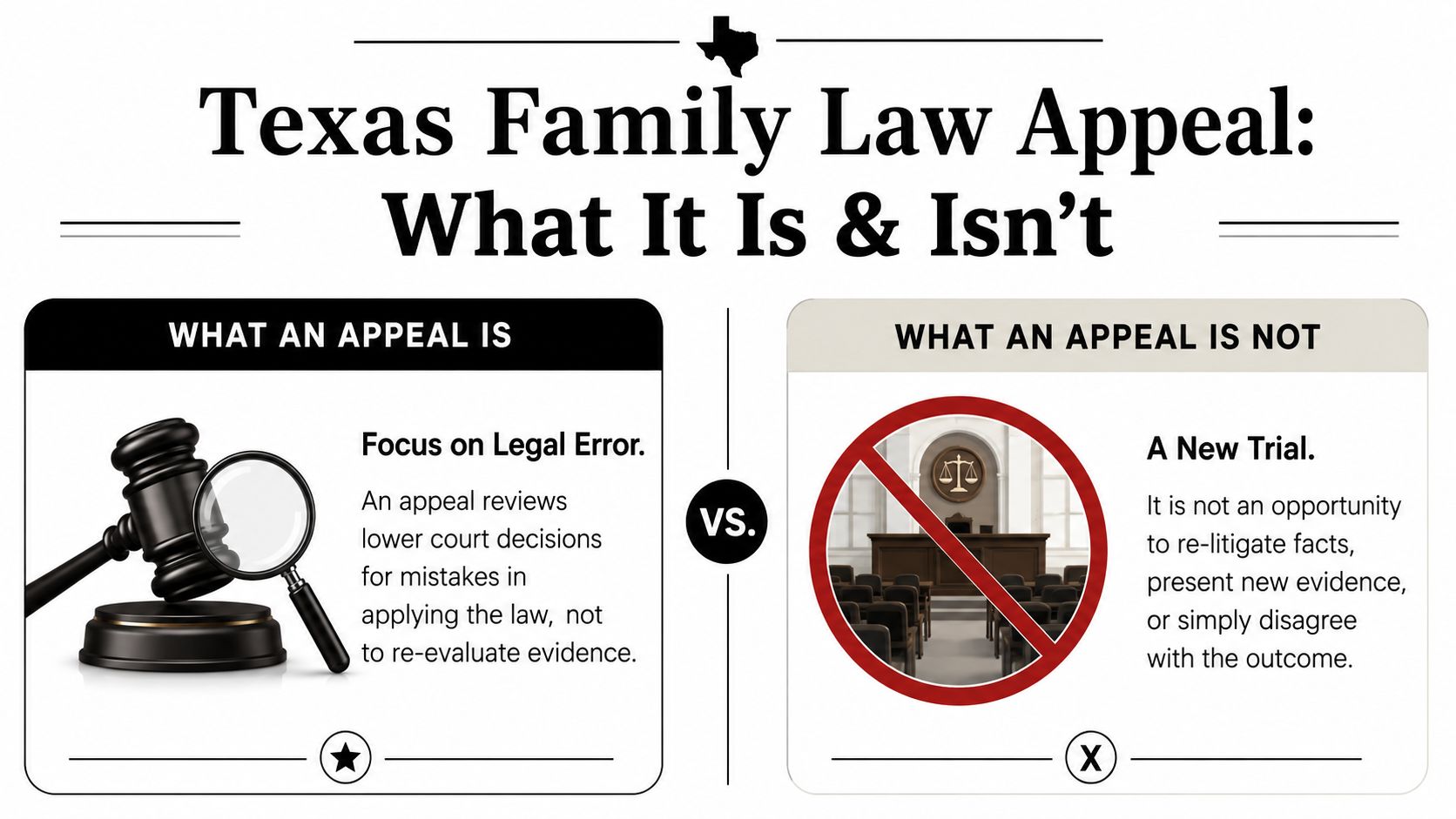
That difference matters more in family law than in many other civil cases. Family court orders often rest on broad judicial discretion, urgent hearings, credibility calls, and messy records built under pressure. Clients usually come to an appeal carrying both legal concerns and personal damage. A good appellate review has to respect both realities. It must separate what feels unfair from what an appellate court can correct.
What the court reviews
The appellate court works from the record, meaning the official account of what happened in the trial court. That usually includes the pleadings, motions, admitted exhibits, signed orders, and the reporter's record from hearings or trial.
If a witness was never called, the court of appeals will not hear from that person. If a document was not admitted, the court usually will not consider it. If an objection was never made, that can limit what may be raised later.
This is one of the hardest parts for clients to hear. Appeals are disciplined. They depend on what was preserved, what was filed, and what the judge ruled on. Appellate lawyers use a different skill set than trial lawyers because the job is not to recreate the story. The job is to identify the legal point that gives the appellate court a reason to act. Best Lawyers' discussion of Texas appellate practice explains that written briefing and issue selection sit at the center of that work.
Family law appeals also differ from a typical contract or business appeal in one practical way. The order often continues to affect parenting, possession, support, or safety while the appeal is pending. That makes strategy more personal and more time-sensitive. Clients are not just disputing money on a spreadsheet. They are living under the order every day.
For clients who want a practical sense of how the case moves after the notice is filed, this step by step Texas family law appeal process timeline helps frame what happens and when.
What a reversible error means
A reversible error is a mistake the appellate court considers serious enough to justify relief. In plain terms, the issue is not whether the result felt wrong. The issue is whether the trial court made a legal or procedural mistake that probably affected the outcome.
In family law cases, that can mean the judge applied the wrong legal standard, interpreted the Family Code incorrectly, excluded evidence that should have been admitted, relied on evidence that should have been excluded, or entered an order the pleadings and proof would not support. Sometimes the problem is obvious in the written order. Sometimes it is buried in a hearing transcript that has to be read closely.
| Aspect | Trial Court | Appellate Court |
|---|---|---|
| Primary focus | Facts, testimony, exhibits | Legal error in the existing record |
| Decision-maker | Usually one judge | A panel of appellate judges |
| Evidence | Witnesses and documents are presented | No new evidence |
| Strategy | Build the factual case | Isolate and argue preserved legal issues |
| Main written work | Motions, pleadings, trial filings | Appellate briefs |
| Outcome options | Final order or judgment | Affirm, reverse, modify, or remand |
Some clients need to hear one practical truth early. A painful result is not enough by itself. A strong appeal connects that result to a specific legal error the record can prove.
Practical rule: If your plan is to tell the appellate court what really happened, stop and reconsider. The better question is which ruling, objection, exclusion, finding, or legal standard in the record gives the court a lawful basis to intervene.
The Texas Appellate Process and Critical Timelines
You leave the courthouse with an order that will affect your children, your finances, or both. By the time the shock starts to wear off, the appellate clock may already be running. In Texas family law cases, that timing problem is often the first real obstacle, and it catches many people before they have even decided whether an appeal makes sense.
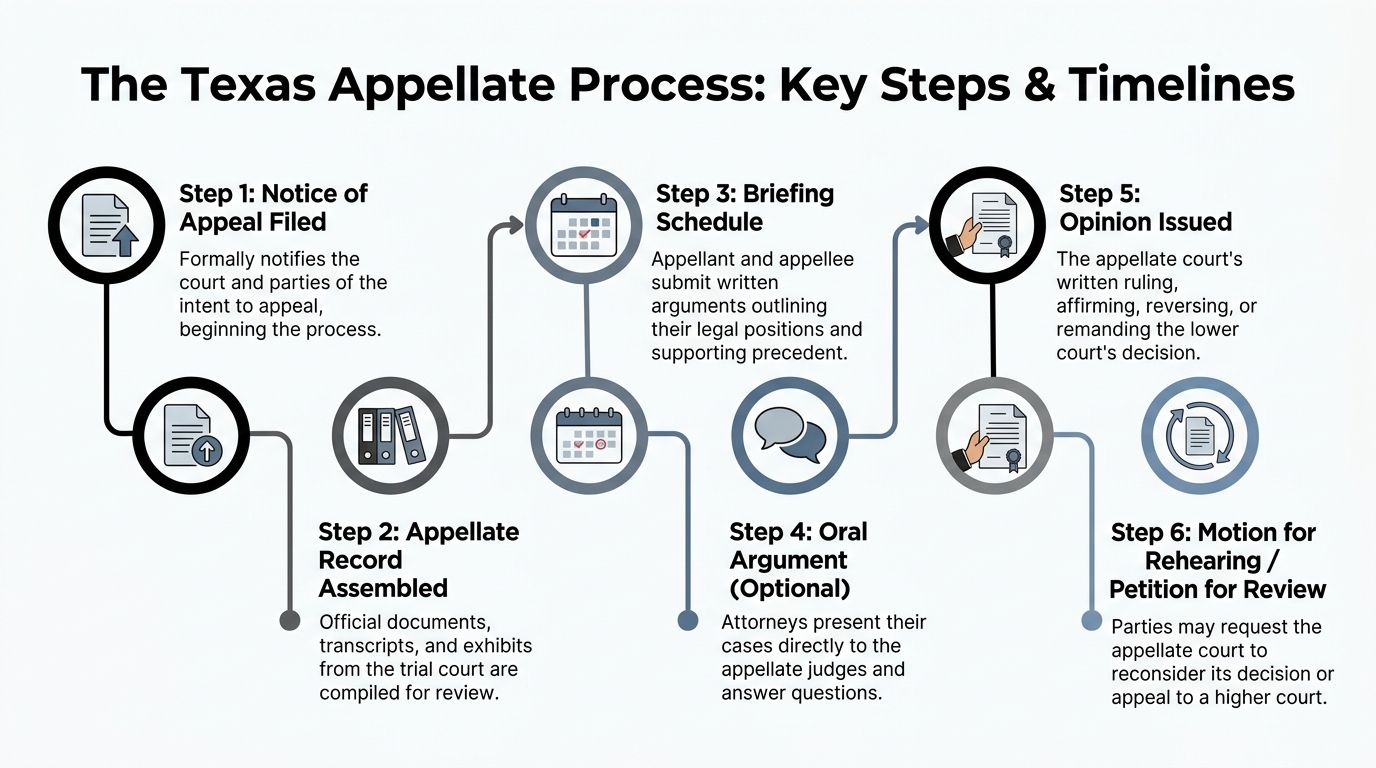
Appeals do not move with the constant hearings, calls, and filings of trial court practice. They move in stages. There is an early burst of deadline-driven work, then quieter periods while the clerk's record, reporter's record, and briefs make their way through the system. Family law clients often find that pattern unsettling because the case feels urgent, but the appellate court works from a written record and a structured schedule.
Under Texas appellate rules, the notice of appeal is generally due within 30 days after the judgment is signed. A timely motion for new trial can extend that deadline to 90 days, as reflected in the Texas Rules of Appellate Procedure material published by TDCAA. That extension can matter in any civil case, but in family law it often matters more because post-judgment filings can affect both preservation and trial-court cleanup on issues involving conservatorship, possession, support, or property division.
The basic sequence
Clients who want a fuller overview can review this step by step Texas family law appeal process timeline.
Notice of appeal
This filing starts the appellate process. If it is late, the court of appeals may never reach the merits.Record preparation
The appellate court reviews the clerk's record and, when needed, the reporter's record. In family law appeals, missing transcripts from temporary-orders hearings, final trials, or key evidentiary hearings can shape what arguments are realistically available.Briefing
The written briefs usually decide the case's direction, tying the legal error to the record, the preservation rules, and the standard the appellate court must apply.Oral argument
Some cases are set for argument. Many are decided on the briefs. When argument is granted, the judges usually focus on narrow legal questions and weak points in each side's position.Opinion
The court issues a written decision. It may affirm, reverse, modify, or remand for further proceedings.Further review
A motion for rehearing or a petition for review may be available, depending on the result and the issues involved.
Deadlines that shape strategy
Two early deadlines often shape the rest of the case.
- Motion for new trial: generally due within 30 days after the trial court signs the judgment.
- Notice of appeal: generally due within 30 days, unless a timely post-judgment motion extends the deadline.
Those dates are not just calendar entries. They affect choices. In a family law case, counsel may need to decide quickly whether to ask the trial court to correct a problem, clarify a ruling, or create a cleaner record for appeal. Some issues are preserved at trial and fully ready for briefing. Others may benefit from immediate post-judgment action. Delay can close off both.
This is one reason family law appeals differ from many business or contract appeals. The legal rules may be similar, but the practical pressure is different. Parents are often dealing with exchange schedules, school decisions, support obligations, or enforcement risk while the appeal is being evaluated. Good appellate strategy accounts for both the record and the reality that life under the order continues unless a court changes it.
Record and briefing details
The record matters more than clients expect. An appellate court cannot consider new documents, new witnesses, or facts that were never made part of the trial court record. If a hearing was important, the transcript usually is too. If an exhibit mattered, it needs to be in the record in usable form.
Texas briefing rules are also strict. In civil appeals, the appellant's brief and any reply brief are subject to page limits and formatting requirements, as discussed in the Texas Bar Journal's discussion of appellate brief length. Good appellate writing is not about saying everything. It is about choosing the issues that give the court a lawful reason to act and presenting them with precision.
Some civil appeals also involve procedural options concerning the appellate record, including use of an appendix in limited circumstances, as explained in this discussion of Rule 34.5a by Haley Olson. Whether that applies in a given family law appeal depends on the posture of the case and the record that will be needed.
The costliest appellate mistake is often simple. A deadline passes, and a potentially valid complaint never gets reviewed.
Understanding the Standard of Review in Family Law
The standard of review is the lens the appellate court uses when reviewing a family law order. Many clients assume the appellate judges will decide only whether they agree with the trial judge. They won't. The law tells them how much deference they must give to the ruling below.
That matters because family law appeals often turn less on the emotional force of the case and more on whether the issue fits a standard that allows relief.

A fuller discussion appears in this article on the standard of review in appellate briefs.
Abuse of discretion
In family law, the phrase clients hear most often is abuse of discretion. That does not mean the judge was cruel, biased, or personally abusive. It means the ruling fell outside the range of reasonable judicial decisions under the law and the evidence.
The key question is often whether no reasonable judge could have reached the same outcome. Recent Texas Supreme Court rulings discussed by Justia's Texas appeals resource are described as showing 72% of reversed custody orders were due to abuse of discretion findings.
Other common review standards
Different issues trigger different standards.
- De novo applies to legal questions. The appellate court reviews the issue fresh, without deference to the trial court's legal conclusion.
- Legal sufficiency asks whether there is enough evidence, viewed under the governing standard, to support a finding.
- Factual sufficiency involves a more limited review of whether the evidence supporting the finding is too weak or outweighed in a way the law recognizes.
Why this changes your strategy
A strong appeal doesn't just argue that the result was unfair. It matches each issue to the right standard of review and writes toward what that standard requires.
For example, if the complaint is that the judge interpreted a statute incorrectly, the briefing may focus on text and legal authorities. If the complaint is a custody ruling, the task is often narrower and harder. You must show why the ruling wasn't merely debatable, but legally unreasonable under the record that exists.
Many family law clients lose confidence when they hear "high deference." The better way to read it is this. Your argument has to be precise. Precision is what gives an appeal power.
Common Reversible Errors in Texas Family Court
You walk out of family court feeling like the judge missed the point. That feeling alone is not enough for an appeal. What matters is whether the court made a legal mistake that likely changed the result or made meaningful review impossible.
Under Texas Rule of Appellate Procedure 44.1(a), an error warrants reversal if it probably caused an improper judgment or prevented the appellant from properly presenting the case to the court of appeals. The rule appears in the Texas Rules of Appellate Procedure.
Family law appeals have a different texture from many business or contract appeals. The record often carries urgency, strained testimony, temporary orders, and broad trial-court discretion. That makes issue selection harder. It also makes precision more important.
Property and financial errors
Property mistakes can be reversible when the trial court mischaracterizes assets, divides the marital estate on an unsupported legal basis, or enters support orders using the wrong measure of income or the wrong statutory method.
Those errors are common in cases involving closely held businesses, reimbursements, retirement accounts, tracing claims, and uneven disclosure. On paper, the decree may look tidy. In the record, the ruling may rest on a legal shortcut, missing evidence, or findings that do not support the final numbers.
The practical question is simple. Did the court make a legal or evidentiary mistake that affected the division or support obligation? In family cases, a bad valuation date, an unsupported reimbursement award, or a decree that awards property the court had no basis to classify a certain way can have long-term consequences.
Custody and conservatorship errors
Parents usually describe the problem in human terms first. The judge ignored the history. The court credited the wrong witness. The order does not protect the child. Those concerns matter, but an appeal has to translate them into identifiable legal error.
Issues that can support reversal include:
- Using the wrong legal standard: The court applies a rule that does not fit the posture of the case or the governing Family Code provision.
- Missing required findings or analysis: The order skips a step the law required before the court could restrict rights, modify conservatorship, or set possession a certain way.
- Rulings on evidence that likely affected the outcome: The court excluded important testimony or admitted material that should not have shaped the decision.
- Order terms that exceed the court's oral ruling or the issues tried: The written order imposes limits or grants relief that were not properly decided.
This is one reason Texas family law appeals differ from many other civil appeals. In a contract case, the dispute may center on one clause or one legal interpretation. In a custody case, the legal issue is often buried inside a long hearing, credibility disputes, emergency allegations, and a final order drafted in broad language. Finding the reversible point requires discipline.
Procedural mistakes that change outcomes
Some of the strongest appellate issues are procedural because procedure leaves a clearer trail in the record.
Examples include:
- A proper objection was made and wrongly overruled: The complaint was preserved, and the court proceeded under the wrong rule.
- The record was handled in a way that blocked fair review: A party was prevented from making an offer of proof, creating a record, or presenting the issue clearly for appeal.
- The signed order does not match what happened in court: The final document adds restrictions, duties, or property terms that were not pronounced or tried.
- Required notice or hearing rights were denied: In some family cases, compressed timelines and emergency settings create due-process problems that matter on appeal.
These errors are rarely dramatic in the moment. They become important later because appellate courts decide cases from the record, not from memory, frustration, or a sense that the hearing felt unfair.
Not every mistake will justify reversal. The issue has to be real, preserved, and important enough to have affected the judgment. That is the hard part, especially in family law, where the order may contain several problems but only one or two are strong enough to carry an appeal.
How Our Attorneys Evaluate and Build Your Appeal
Appellate work starts with restraint. Before anyone promises a result, the file has to be read closely and the record has to be tested for real issues. That means looking at what was argued, what was admitted, what objections were made, what the court said, and what the final order does.

What the evaluation focuses on
A serious appellate review usually asks four questions.
- Was there legal error: The ruling must involve more than disagreement with the outcome.
- Was the issue preserved: Many arguments are lost because no proper objection, motion, or request was made in the trial court.
- Does the record support the point: If the transcript or exhibits don't show the problem clearly, the argument gets weaker.
- Did the error matter: Harmless mistakes usually won't justify reversal.
Texas also imposes ethical limits on what counsel should pursue. The Texas Standards for Appellate Conduct require a good-faith basis for the appeal and prohibit using an appeal mainly for delay or harassment, as discussed in the Arizona Journal of Appellate Practice article addressing those standards.
What effective briefing looks like
Good appellate briefing isn't a transcript summary. It isn't trial-court anger reformatted into numbered paragraphs. It is selective, disciplined writing aimed at judges who are reviewing law, standards, and the record.
That usually means:
- Framing a small number of strong issues instead of a long list of weak ones.
- Tying each argument to the exact place in the record where the problem appears.
- Explaining the remedy sought with precision.
A family law appeal may involve custody, property division, support, protective orders, or enforcement. One factual option in this area is The Law Office of Bryan Fagan, PLLC, a Texas family law appellate practice that handles appeals involving those subjects and evaluates whether a final order presents a viable legal challenge.
The strongest appellate briefs usually remove clutter. Judges don't need every grievance. They need the few issues that can actually move the case.
Choosing Your Lawyer and Taking the Next Step
Not every trial lawyer handles appeals, and not every unfavorable result can be appealed. Those are two hard truths that can save you time, money, and more disappointment.
An appellate case is narrower than a trial case, but it is also more technical. The lawyer has to read a cold record carefully, identify preserved legal points, understand the standard of review, and write for a panel of judges who are focused on law rather than live testimony. If you're comparing counsel, this guide on how to choose the best appellate attorney in Texas is a useful starting point.
What to look for
- Appellate focus: Ask whether the lawyer regularly handles appeals, not just trial work.
- Realistic case assessment: You want candor about weaknesses, not broad promises.
- Command of deadlines and record issues: In appeals, timing and preservation often decide whether a case can even be heard.
- Family law context: A divorce appeal and a business dispute appeal are both civil matters, but family law brings different statutes, remedies, and practical consequences.
Texas maintains a large appellate system, and family law cases move through it under strict procedural rules. Some appeals succeed by showing the trial court ignored critical evidence or failed to apply the Texas Family Code correctly, while the overall success rate for federal criminal appeals is about nine percent, illustrating how high the bar can be in appellate courts, according to Federal Lawyer's discussion of federal appeals and appellate strategy.
If your judgment was just signed, don't wait to "see what happens." The deadlines are already running. A prompt review can tell you whether you have a real appellate issue, what relief may be available, and what steps need to happen now to protect your rights.
If you believe the court made a mistake in your family law case, our appellate attorneys can help you seek a fair outcome. Contact The Law Office of Bryan Fagan, PLLC today for a free consultation.