You may feel that the judge got it wrong. In a Texas family law case, that can leave you carrying the weight of a custody order, property division, support ruling, or enforcement judgment that doesn't feel fair.
An appeal can be the right next step, but only if you approach it with the right lawyer and the right expectations. Choosing appellate counsel is different from hiring trial counsel. The question isn't who sounded strongest in the courtroom. It's who can identify legal error, work inside the Texas Rules of Appellate Procedure, and present a clear, disciplined argument from the existing record.
That's the practical starting point for understanding how to choose the best appellate attorney in Texas. In family law appeals, what works is specialization, careful record analysis, and honest case evaluation. What doesn't work is hiring a lawyer based only on personality, advertising, or trial volume.
Why a Texas Appeal Is Not a Second Trial
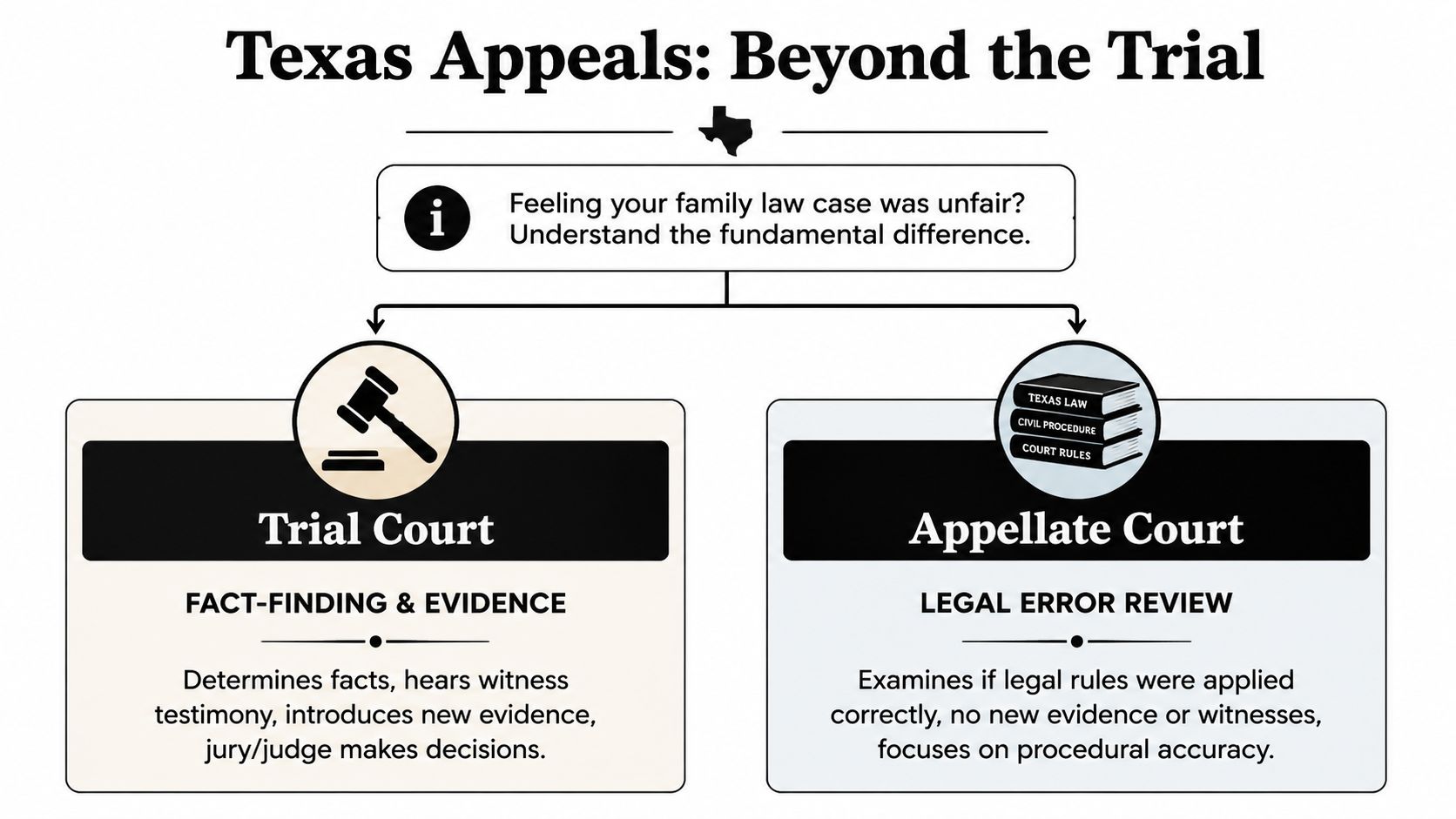
If you believe your case was handled unfairly, the first thing to know is this. An appeal is not a do-over. The appellate court doesn't hear new witnesses, accept new exhibits, or re-try the facts because one side is unhappy with the result.
Instead, the appellate court reviews the trial court's work for legal error. In Texas family cases, that usually means asking whether the judge applied the law correctly, followed proper procedure, and made rulings supported by the record already created in the trial court.
What the appellate court actually reviews
Three plain-English concepts matter early.
- The record means the papers, exhibits, orders, and hearing transcripts from the trial court.
- Reversible error means a legal mistake serious enough to justify appellate relief.
- Standard of review means the lens the appellate court uses when examining the trial judge's ruling.
One common standard in family law is abuse of discretion. In simple terms, that asks whether the trial court acted outside the range of reasonable legal choices. It does not mean the appellate judges would have ruled differently on the same facts. It means the ruling may have crossed a legal line.
Practical rule: A good appellate lawyer starts with the record, not with outrage. If the error isn't preserved in the record, the appeal becomes much harder.
Common errors in Texas family law appeals
In family law, appeals often focus on issues such as:
- Custody and possession rulings: Whether the court applied the correct legal standard under the Texas Family Code.
- Property division: Whether the court mischaracterized property, divided the estate on a legally flawed basis, or entered findings unsupported by the record.
- Child support and maintenance: Whether the court used the wrong legal framework or failed to follow required procedures.
- Protective orders and enforcement judgments: Whether the court denied due process, admitted or excluded evidence improperly, or entered relief beyond what the law allows.
Texas appellate practice is also shaped by the court system itself. Texas has 14 Courts of Appeals, plus the Supreme Court of Texas for civil and juvenile cases and the Texas Court of Criminal Appeals for criminal cases, as explained in this overview of Texas appeals. For a family law appeal, your case usually goes first to an intermediate court of appeals, which is one reason local court familiarity can matter.
If you want a clearer picture of how appellate judges approach family cases, this discussion of how appellate judges make decisions in Texas family law cases is a helpful companion.
Why specialization matters here
Trial lawyers and appellate lawyers solve different problems. A trial lawyer develops evidence and persuades a fact-finder. An appellate lawyer identifies preserved error, frames issues carefully, and writes for judges who are reviewing a paper record.
That distinction matters under both the Texas Rules of Appellate Procedure and the Texas Family Code. Missed deadlines, incomplete records, or poorly framed issues can damage even a case that feels profoundly unfair.
The Hallmarks of a True Appellate Specialist
Not every good trial lawyer is a good appellate lawyer. Some are. Many aren't. The skills overlap, but they aren't the same.
A true appellate specialist usually shows it in the way they talk about your case. They focus on preservation, standards of review, the clerk's record, the reporter's record, and briefing strategy. They don't start by promising a dramatic turnaround.
Objective markers that help narrow the field
External recognition isn't everything, but it can be useful. Best Lawyers, Super Lawyers, and Chambers & Partners are commonly used screening tools in appellate hiring because they reflect peer and market review rather than self-description, as noted in Best Lawyers' Texas appellate practice directory.
Those recognitions don't tell you whether a lawyer is right for your custody appeal or property division dispute. They do help you separate established appellate practitioners from lawyers who occasionally take an appeal because a former trial client asks them to.
Another useful credential in Texas is Board Certification in Appellate Law. While no credential replaces judgment and fit, specialization matters because appellate work depends heavily on legal writing, issue selection, and command of procedure.
Trial skill and appellate skill are not the same
Here is the clearest comparison.
| Area of Focus | Trial Lawyer's Role | Appellate Lawyer's Role |
|---|---|---|
| Facts | Develops testimony and evidence | Works only from the existing record |
| Persuasion | Speaks to judge or jury in live proceedings | Writes to appellate judges through briefs |
| Objections | Preserves error during hearings and trial | Evaluates whether error was preserved |
| Strategy | Decides how to present evidence and witnesses | Decides which legal issues are strongest on review |
| Rules | Applies trial procedure and evidence rules | Applies appellate deadlines, briefing rules, and standards of review |
| Outcome focus | Seeks a favorable ruling at trial | Seeks affirmance, reversal, remand, or modification on legal grounds |
The lawyer who was excellent with witnesses may not be the lawyer who can write the strongest appellate brief.
Signs you're talking to the right kind of lawyer
A real appellate specialist should be able to discuss your case in ways like these:
- They identify the likely appellate path: They know which court of appeals will hear the case and why that matters.
- They talk about preservation early: They want to know what objections were made, what was excluded, and what the order says.
- They ask for records before giving confidence: They don't pretend to know the answer from a short summary alone.
- They explain timing immediately: In appeals, delay can close doors.
That's why When to Call an Appellate Attorney in Texas matters as a practical point of reference. The right time to involve appellate counsel is right after judgment, when deadlines, post-judgment options, and record issues still need close attention.
Key Questions to Ask a Potential Appellate Attorney
The consultation shouldn't feel like a sales pitch. It should feel like a focused legal evaluation.
The best way to test appellate skill is to ask questions that force the lawyer to discuss process, not just confidence. In Texas family law appeals, a strong vetting method has three layers: confirm real appellate specialization, verify that the lawyer's experience matches your case type and jurisdiction, and ask for concrete examples of prior briefing strategy, as described in Brownstone Law's guide to choosing an appeal lawyer.

Questions that reveal real appellate judgment
Ask direct questions like these.
What is the likely standard of review in my case?
A strong lawyer should explain whether the issue is likely reviewed for abuse of discretion, legal error, or another standard, and why that affects strategy.What do you need to see in the record before you can evaluate the appeal?
Good answers mention the clerk's record, reporter's record, trial objections, findings, and final orders.What issue or issues would you examine first?
You're listening for prioritization. Appeals are usually strongest when counsel identifies a few serious, preserved issues instead of attacking every ruling made by the trial judge.How do you analyze a family law record for reversible error?
In a divorce appeal, that may involve the decree, inventory disputes, valuation rulings, tracing evidence, or characterization findings. In a custody appeal, it may involve conservatorship standards, evidentiary rulings, or due process concerns.
What a strong answer sounds like
A qualified appellate lawyer should be able to explain what must have been preserved in the trial record before discussing odds of success. That's one of the clearest signs that the lawyer understands how Texas appeals really work.
Look for answers that sound measured:
- They explain the issue.
- They tie it to the record.
- They describe the standard of review.
- They avoid certainty before seeing the materials.
Be cautious if the lawyer jumps straight to “you'll win” or “that judge was wrong” without asking for documents.
Client-side test: If the lawyer can't explain briefing, record preparation, and preservation in plain English, that's a warning sign.
Questions about communication and case handling
Substance matters, but process matters too. Appeals often involve stretches of quiet work while records are prepared and briefs are drafted. Ask:
Who will draft the brief?
You want to know whether the lawyer you meet will write the argument or hand it off entirely.How often will I receive updates?
A realistic communication plan is better than vague promises of constant contact.Will you handle oral argument if the court sets it?
Not every appeal gets oral argument, but you should know who will appear if it does.How do you coordinate with trial counsel, if needed?
In some appeals, that coordination is important for understanding what happened in hearings and why certain objections were or were not made.
A useful overview appears below if you'd like a short visual explanation before a consultation.
Family law questions worth asking specifically
Family appeals are not generic civil appeals. Ask whether the lawyer has handled appeals involving matters like:
- Child custody and visitation
- Divorce decrees
- Property division
- Child support
- Protective orders
- Contempt or enforcement judgments
If you're comparing firms, you can also ask whether they handle Texas family law appeals as a dedicated practice area, rather than only as occasional overflow from trial work.
How to Evaluate Their Writing and Argument Skills
Appellate law is a writing profession first. Oral argument matters, but the brief usually carries most of the weight.
That's why reputation alone isn't enough. Peer-review markers like Best Lawyers or Super Lawyers can help you identify candidates, but the better question is whether the lawyer can show a documented record of handling similar appeals and produce writing that is clear, disciplined, and persuasive. As Super Lawyers explains in describing its selection process, peer recognition is part of the picture. The actual work product is what earns and sustains that reputation.
What to look for in a sample brief
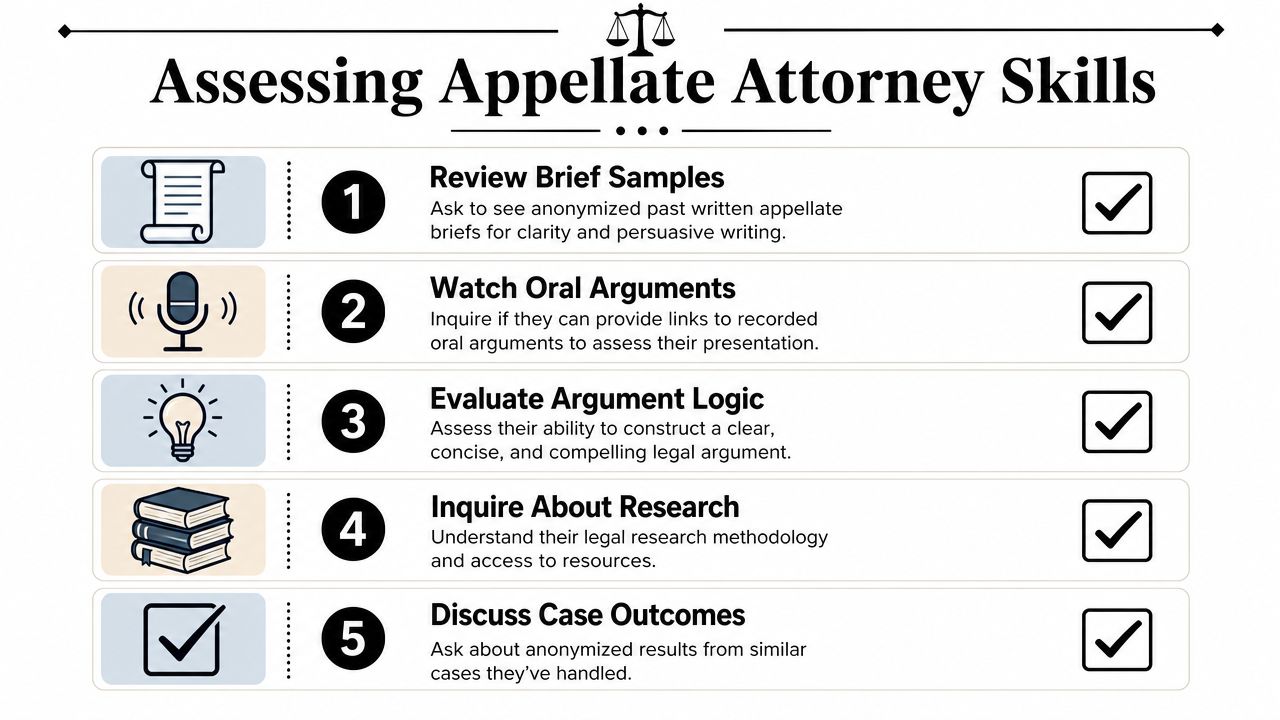
Ask whether the lawyer can provide a redacted or anonymized appellate brief. Many can share a sanitized sample.
When you read it, look for these traits:
- Clear issue statements: You should understand the legal question without decoding dense jargon.
- Strong structure: The argument should build logically from facts, to law, to why relief is warranted.
- Careful use of the record: The brief should rely on what was preserved below.
- Professional tone: Strong briefs are firm, not theatrical.
A weak brief often sounds angry, repetitive, or overloaded with every possible complaint. A strong one makes choices.
How to assess oral argument
If the attorney has argued appeals before Texas courts, ask whether recordings or public examples are available. When you watch, pay attention to how the lawyer handles questions from the bench.
Use a simple checklist:
| What to watch | Why it matters |
|---|---|
| Direct answers | Judges want responses, not speeches |
| Record command | Appeals turn on details already in the file |
| Calm under pressure | Hard questions are normal |
| Legal precision | Small wording choices can matter |
| Respectful tone | Credibility matters in appellate court |
Good appellate advocates don't avoid difficult questions. They answer them, narrow them, and return to the strongest issue.
Briefing is where many appeals are won or lost
In family law appeals, briefing means the written document filed with the appellate court that explains the legal errors, cites the record, and asks for specific relief. It is not a letter. It is the core argument of the case.
If you want to understand the formal side of that process, this guide to appellate brief requirements in Texas family law gives a useful overview.
The practical point is simple. If a lawyer can't show disciplined writing, careful organization, and a command of the record, don't expect those qualities to appear later under deadline pressure.
Understanding Appellate Timelines and Fee Structures
Appeals move by rules and deadlines. If you're interviewing counsel, one of the fastest ways to judge competence is to ask how they explain timing.
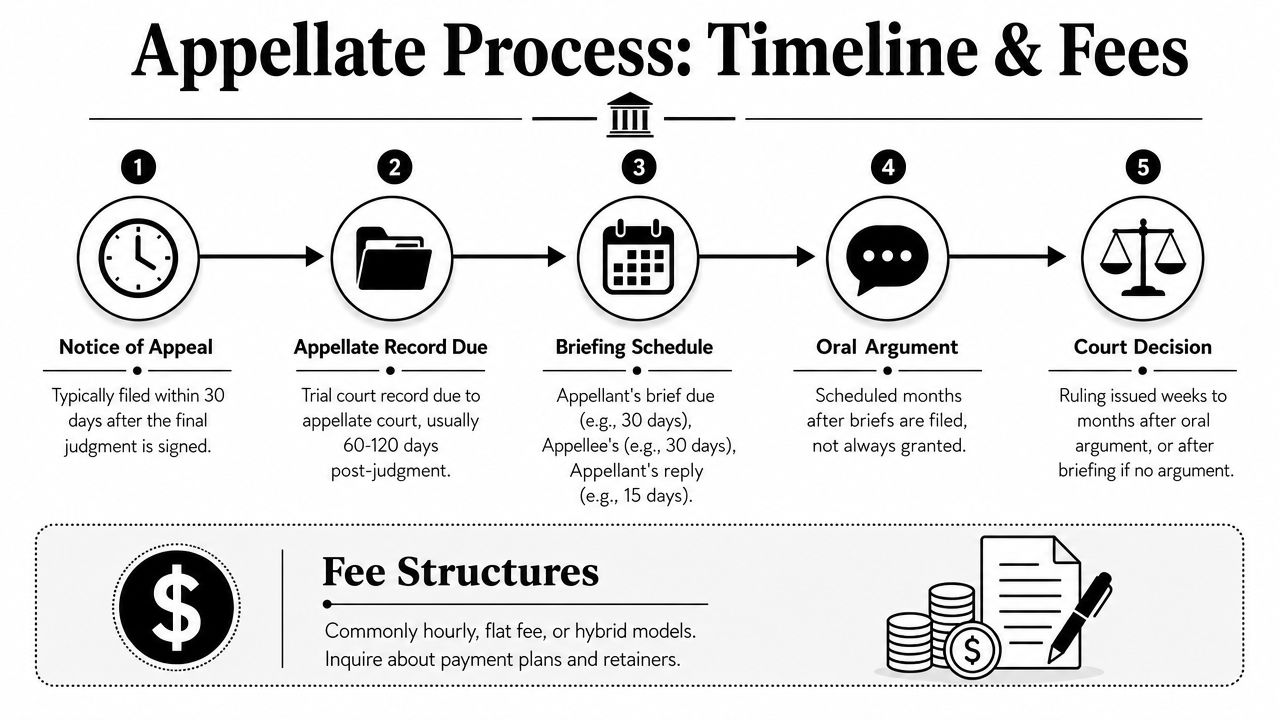
In a Texas family law case, the first deadline people usually focus on is the deadline to file the notice of appeal. That deadline can be short, which is one reason prompt legal advice matters after a final judgment or appealable order.
The usual stages of a Texas family law appeal
Most appeals involve these steps:
Notice of appeal
This starts the appellate process under the Texas Rules of Appellate Procedure.Record preparation
The appellate court receives the clerk's record and reporter's record from the trial court.Briefing
The appellant files an opening brief. The other side responds. A reply may follow.Oral argument
Some cases are set for argument. Some are decided on the briefs.Opinion and judgment
The appellate court affirms, reverses, modifies, remands, or otherwise resolves the appeal.
Family law clients often assume appeals move quickly once filed. They usually don't. The record must be prepared correctly, the briefing must be thorough, and the court controls its own decision schedule.
What to ask about fees
Appellate fee structures often differ from trial fee agreements. Common approaches include:
- Hourly billing: Work is billed as time is spent.
- Flat fee for a defined stage: For example, a fee for the appeal through briefing.
- Hybrid structure: A mix of flat-fee and hourly work.
Ask the attorney to explain exactly what the fee covers. Does it include record review, notice of appeal work, post-judgment motions, briefing, oral argument, motions for rehearing, or a petition to a higher court? A clear engagement letter matters.
If you're trying to understand how retainers are discussed in practice, this article on the average retainer fee for a lawyer can help frame the conversation. The useful habit is to ask for scope, not just price.
What works and what doesn't
What works is transparency. A careful appellate lawyer explains the timeline, the likely phases of work, and what could change the budget.
What doesn't work is hiring someone who treats the appeal like a vague extension of the trial. Appellate representation is document-heavy, deadline-sensitive, and narrower in purpose. The right lawyer should make that clear from the start.
Red Flags to Avoid and Your Next Steps
By the time you've had a few consultations, the wrong fit usually becomes visible. It shows up in how the lawyer talks about your case.
The biggest red flags are not always rudeness or inexperience. Often they are overconfidence, vagueness, or a failure to respect how technical appeals can be.
Warning signs that should make you pause
Watch for these problems:
- Guaranteed outcomes: No ethical appellate lawyer should promise reversal.
- No discussion of the record: If the lawyer doesn't ask for orders, transcripts, or objections, that's a serious concern.
- Confusion about deadlines: Appeals are unforgiving about timing.
- Trial-only thinking: If the strategy sounds like “we'll tell the court what really happened,” that misses the point of appellate review.
- Pressure to hire immediately without analysis: Urgency about deadlines is valid. Pressure without substance is not.
The right appellate lawyer should lower confusion, not increase it.
A practical next-step checklist
Before you choose counsel, make sure you can answer these questions:
- Do they focus on appellate work, not just litigation generally?
- Do they understand Texas family law issues, not just civil appeals in the abstract?
- Can they explain standards of review in plain English?
- Did they talk about preservation and the record before outcomes?
- Did they explain the process under the Texas Rules of Appellate Procedure clearly?
- Were they candid about strengths, weaknesses, timing, and fees?
A family law appeal is about fairness, due process, and legal accuracy. If the trial court made a serious mistake, the appellate system exists to review that mistake carefully. The right attorney won't inflame the situation. They'll bring order to it.
If you believe the court misapplied the Texas Family Code, ignored preserved objections, entered an unsupported order, or denied you a fair process, don't wait to get your case evaluated. Time matters. So does choosing counsel who can translate frustration into a focused appellate strategy.
If you believe the court made a mistake in your family law case, our appellate attorneys can help you seek a fair outcome. Contact The Law Office of Bryan Fagan, PLLC today for a free consultation.