You may feel your case was handled unfairly. A judge signed orders that affect your children, your home, your finances, or your future, and now you're trying to decide whether anything can still be done.
An appeal may be the next step, but only if you approach it with precision. In Texas family law, appeals are technical, deadline-driven, and built on the trial court record. They aren't a second trial. They are a focused review of whether the court made a legal mistake that materially affected the outcome.
Your Path to Justice After an Unfair Ruling
A lot of people start in the same place. They know the result feels wrong, but they aren't yet sure whether the law gives them a path to challenge it.
That first question is simpler than it sounds. Are you trying to appeal a final order, or are you reacting to a temporary ruling? In Texas, that difference controls whether the appellate court can hear your case at all.
Start with the type of order
A final order usually ends the trial court phase of the dispute. In family law, that may be a final divorce decree, a final custody order, a final child support ruling, or a final enforcement judgment.
A temporary order is different. It is meant to govern the case while the underlying dispute is still pending.
Practical rule: If the order is temporary, an appeal usually isn't the right vehicle.
Under Texas law, temporary custody orders are generally not appealable, which means many parents must wait for a final order before seeking appellate review. That distinction matters because 70% of pro se appeal dismissals in Texas family courts stem from appeals of non-final interlocutory orders, according to McClure Law Group's discussion of child custody appeals.
What an appeal actually does
If you're trying to learn how to file an appeal in Texas family court, the most important mindset shift is this. The appellate court won't hear new witnesses, accept new documents, or let you redo the trial.
Instead, appellate judges review what already happened in the trial court. They examine the written record, the transcript, the rulings, and the objections made along the way. The question is whether the judge misapplied the law, used the wrong legal standard, or handled the proceedings in a way that created reversible error.
That means fairness on appeal comes from procedure, preservation, and careful legal analysis. It doesn't come from retelling the story in a more emotional way.
Cases that often raise appeal questions
Texas appellate courts can review many kinds of family law decisions if there was legal error, including:
- Child custody and conservatorship
- Possession and access orders
- Child support rulings
- Property division in divorce
- Spousal maintenance
- Protective orders
- Enforcement and contempt-related rulings in appropriate circumstances
That broad scope is useful, but the path still begins with one discipline: identify the right order, the right issue, and the right deadline.
Understanding Grounds for Appeal and Reversible Error
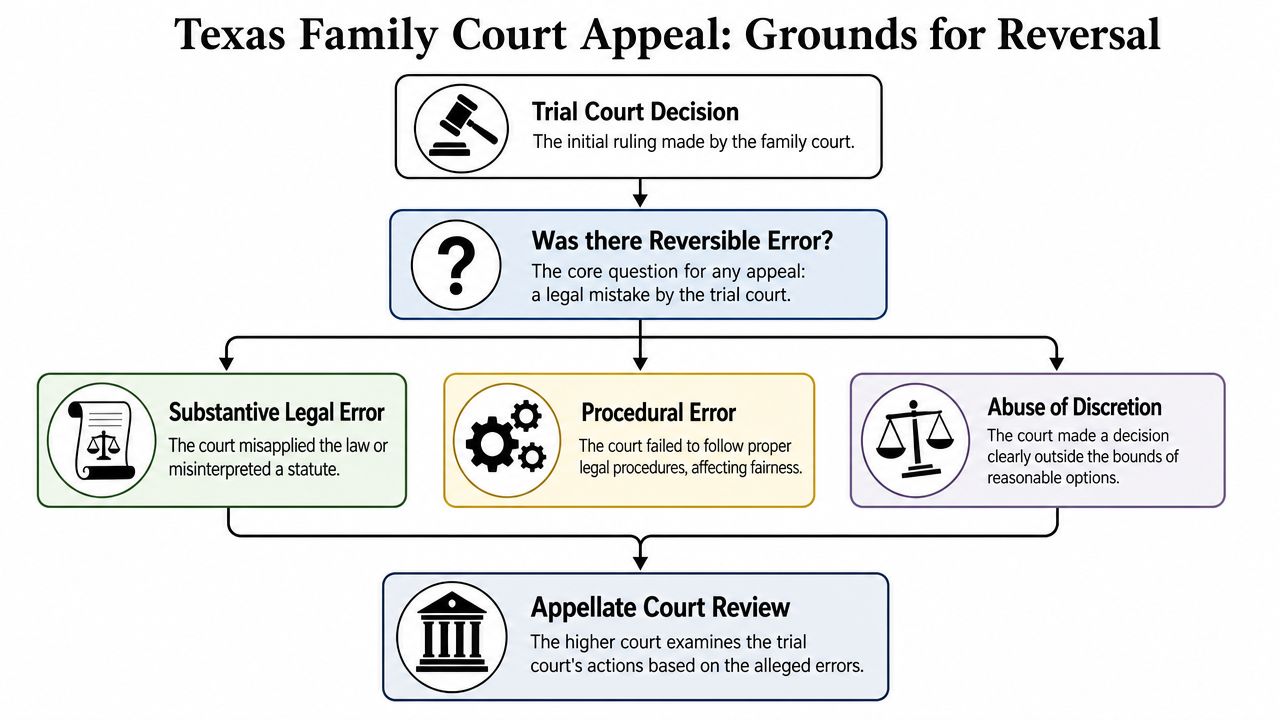
Being unhappy with the outcome isn't enough. A Texas family law appeal needs a legal basis. The core concept is reversible error, which means the trial court made a mistake serious enough that the result should be corrected.
What reversible error means in plain English
A reversible error is not just any mistake. It is an error that affected the outcome in a meaningful way. If a judge made a minor misstep that didn't change the result, the appellate court may leave the judgment in place.
Three categories come up again and again in family appeals:
- Abuse of discretion
- Legal error
- Procedural error
Understanding abuse of discretion
In Texas family cases, appellate courts often review rulings for abuse of discretion. In plain English, that means asking whether the judge acted arbitrarily, unreasonably, or without following the proper legal rules and principles. Courts generally find abuse of discretion only when there was no evidence on which reasonable and fair-minded people could have reached the same result, as explained in McClure Law Group's overview of appeals.
That standard is important because it explains why many appeals fail. The test isn't whether another judge might have ruled differently. The test is whether the ruling fell outside the range of reasonable judicial decisions.
What legal and procedural errors look like
Some errors are easier to identify because they involve a rule, statute, or process the court was required to follow.
Examples include:
- Property division mistakes: A court treats separate property as community property in a divorce.
- Custody mistakes: A court applies the wrong legal framework when deciding conservatorship or possession.
- Evidence problems: The court admits or excludes evidence in a way that affects a party's ability to present the case fairly.
- Procedure failures: The court doesn't follow required process under the Texas Family Code or Texas procedural rules.
If you want a more detailed look at what qualifies as reversible error in Texas family court, focus on whether the ruling reflects a legal mistake, not just a harsh result. The same question appears in Grounds for Appealing a Texas Family Law Ruling, which discusses the kinds of error that can support an appeal.
Preserving error at trial
Many valid frustrations can result in weak appeals. The appellate court usually reviews errors that were preserved in the trial court.
Preservation means the issue was properly raised through an objection, motion, offer of proof, or other step that placed the problem in the record. If the record doesn't show that the issue was presented and ruled on, the appellate court may refuse to consider it.
If your lawyer objected clearly and the court overruled that objection, that may become the foundation of an appeal. If nobody preserved the issue, the appellate court may never reach the merits.
A strong appeal often begins long before the notice is filed. It begins in the courtroom, where the record is made.
Filing the Notice of Appeal and Preparing the Record
Once you've confirmed that the order is final and you've identified a real appellate issue, the next phase is mechanical. It is also unforgiving.
The first filing is the Notice of Appeal. Miss that deadline, and the appellate court can lose jurisdiction before your legal arguments are ever heard.
The deadline that controls everything
In Texas, the deadline to file a Notice of Appeal is 30 days from the date the final order is signed. If certain timely post-trial motions are filed, that deadline extends to 90 days, as explained in this discussion of Texas family law appeals. That same source notes that the full appeal process typically takes 12 to 24 months.

The practical lesson is simple. Don't wait until you're emotionally ready. Start calculating the deadline as soon as the judge signs the final order.
For a closer look at how to file a notice of appeal, the core concern is timing and accuracy. The same timing issue is addressed in The Notice of Appeal Deadline in Texas Family Cases, which explains why you generally have only 30 days to start a family law appeal.
What it takes to perfect the appeal
To perfect an appeal in Texas, the appellant must file specific documents with the trial court clerk. Those include:
- Notice of Appeal with the case name, case number, date of judgment, and a statement that the party wants to appeal.
- Designation of items for the Clerk's Record
- Request for the Reporter's Record, meaning the transcripts
The appellant must also send a copy of the Notice of Appeal to the Court of Appeals and serve the opposing party. Those filing requirements are described in the Texas appellate pamphlet from TEX-APP.
The record is the whole case on appeal
The appellate court reviews the Clerk's Record and the Reporter's Record. Together, those materials form the universe of the appeal.
The Clerk's Record typically contains pleadings, motions, orders, exhibits admitted through the clerk, and other filed documents. The Reporter's Record contains the hearing and trial transcripts.
Below is a useful overview of the process.
Watch for this problem: parties sometimes know they want to appeal, but they fail to request the right records. That can cripple otherwise strong issues because the appellate court can review only what is in the record.
If testimony matters, the transcript matters. If an exhibit matters, it must be properly included. Appeals aren't won by broad claims that the judge was unfair. They're built document by document.
Building Your Case Through Persuasive Briefing
Once the record arrives, the center of gravity shifts. The appeal now lives or dies through the written brief.
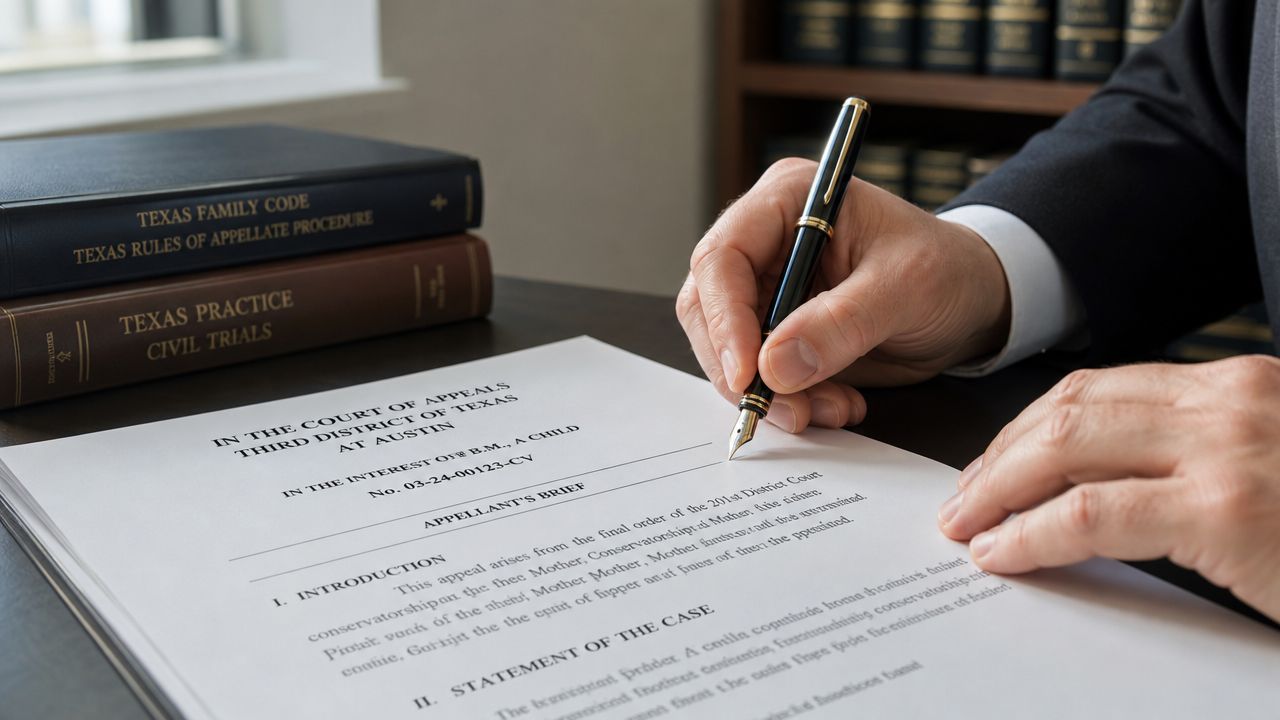
An appellate brief is a formal legal document, but its fundamental purpose is straightforward. It tells the court what went wrong, where it happened in the record, what law governs the issue, and why the error requires correction.
What briefing means in plain English
Briefing is the written argument phase of the appeal. The appellant files the opening brief. The other side answers. In some cases, the appellant files a reply.
Texas appellate courts don't retry cases or hear new evidence. They review whether legal errors affected the outcome, which is why judge-focused briefs and careful record analysis matter so much, as discussed in Matt Horak's overview of family law appeals.
The parts of a strong appellate brief
A persuasive brief usually includes several core parts, each with a different function:
| Part of the brief | What it does |
|---|---|
| Issues Presented | Frames the legal questions the court must answer |
| Statement of Facts | Tells the story through record citations, not emotion |
| Standard of Review | Explains how the appellate court evaluates the ruling |
| Argument | Applies law to facts and shows why the error requires reversal |
| Prayer | States what relief the appellant wants |
The Issues Presented matter more than many clients realize. If the issue is framed too broadly, it becomes vague. If it is framed too narrowly, it may miss the actual legal problem.
The Statement of Facts also works differently on appeal than at trial. At trial, lawyers persuade witnesses, judges, and sometimes juries through live testimony. On appeal, facts must be anchored to the actual record. If a statement isn't supported by the transcript or clerk's record, it doesn't belong in the brief.
Harm matters as much as error
A brief must usually do two things at once. First, it must show the trial court made a mistake. Second, it must show the mistake mattered.
A weak appeal says, "The judge got it wrong." A strong appeal says, "The judge applied the wrong rule, the record shows the effect of that error, and the result can't stand under the governing standard of review."
That is why appellate writing is a specialty. It is concise, record-based, and directed to judges who are reading for legal precision. If you're comparing resources, appellate brief requirements in Texas family law can help you understand what the court expects on the page.
From Oral Argument to the Final Decision
After briefing closes, many clients expect a courtroom showdown. Sometimes that happens. Often, it doesn't.
Oral argument is scheduled only in some cases. When it is granted, lawyers appear before a panel of appellate judges and answer focused questions about the record, the law, and the requested relief.
What oral argument is really for
Oral argument is not a chance to repeat the brief from memory. It is an opportunity to address the judges' concerns directly.
The judges may ask about preservation, the standard of review, the effect of an evidentiary ruling, or the exact remedy being sought. Good appellate counsel answers directly, concedes weak side points when necessary, and returns the court to the controlling legal issue.
For related guidance on appeals involving family law outcomes, readers often review matters connected to child custody appeals and related family court decisions.
Possible outcomes of the appeal
Texas appellate courts may:
- Affirm the judgment, which means the trial court's ruling stays in place
- Reverse the judgment, which means the appellate court determines the trial court committed reversible error
- Remand the case, which means it goes back to the trial court for further proceedings consistent with the appellate opinion
Those possibilities, along with the point that oral argument happens only in some cases and that the appellant bears the burden of showing the error materially affected the outcome, are discussed in Ramos Law Group's overview of family law appeals.
What winning may actually look like
Clients sometimes assume a successful appeal means the appellate court replaces the trial judge and enters a full new result. Sometimes relief is that direct, but often it isn't.
A successful appeal may instead produce:
- A corrected legal ruling on a specific issue
- A remand for a new hearing on a limited question
- A requirement that the trial court apply the proper legal standard
- A narrowed issue on return to the trial court
That matters for expectations. Appellate work is about restoring lawful process and fair application of the rules. In many family cases, that is exactly what changes the practical outcome.
An Appellate Strategy Checklist and When to Hire Counsel
Individuals looking for information on how to file an appeal in Texas family court usually want two things. They want a roadmap, and they want to know whether this is something they can realistically handle on their own.
The roadmap is manageable. The risk lies in the details.
A practical checklist before you move forward
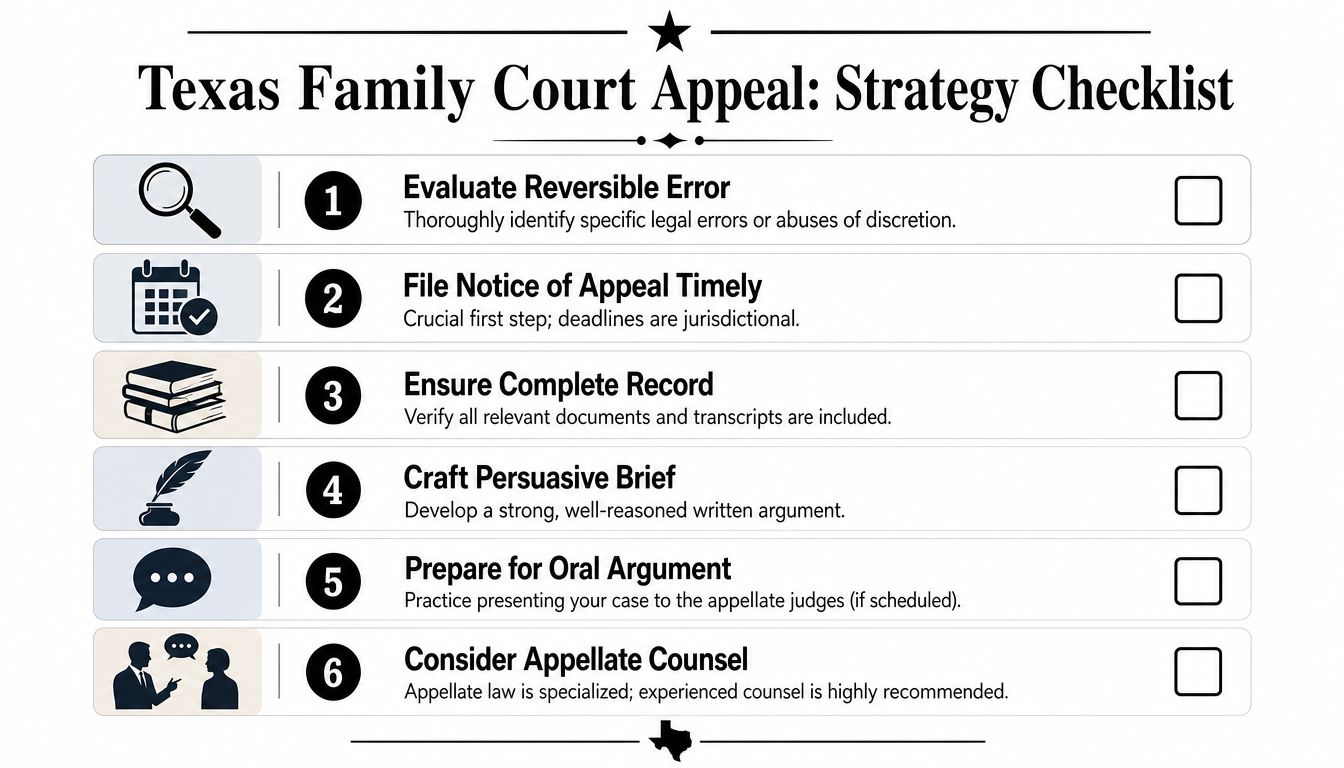
Use this short checklist to assess your position:
- Confirm the order is final: If you're looking at a temporary order, the appellate path may not be available yet.
- Calculate the filing deadline: The notice deadline controls the entire case.
- List possible legal errors: Focus on abuse of discretion, legal error, or procedural error.
- Check preservation: Ask whether the issue appears clearly in the trial record.
- Identify the necessary record: Decide what transcripts, filings, and exhibits the court must have.
- Decide whether a standard appeal is the right vehicle: In some cases, another appellate mechanism may fit better.
Some family law appeals are lost before briefing begins. The problem isn't always the legal issue. It's often the wrong procedure, the wrong deadline, or the wrong record.
Why appellate counsel matters
Trial skill and appellate skill overlap, but they are not the same craft. Trial lawyers build evidence, question witnesses, and respond in real time. Appellate lawyers work from a fixed record, identify reviewable issues, and write for judges who are looking for precision.
That difference becomes even more important when the ordinary appeal deadline has passed. A restricted appeal allows up to six months to file and is designed for cases involving errors apparent from the record. According to Smith Family Law Firm's discussion of appeal strategy, 40% of successful family law appeals in Texas in 2025 were filed under the restricted appeal provision.
That doesn't make restricted appeal available in every case. It does show why strategic analysis matters. The obvious path isn't always the best one.
Choosing the right kind of help
If you are evaluating representation, look for counsel who can do four things well:
- Read the record critically
- Spot preserved and reviewable error
- Write a disciplined appellate brief
- Choose the right appellate vehicle, including when a restricted appeal may apply
One option is The Law Office of Bryan Fagan, PLLC, a Texas family law appellate practice that handles appeals involving custody, divorce decrees, property division, support, protective orders, and enforcement issues.
For broader guidance on evaluating appellate strategy in family court matters, many clients also look for help with Texas divorce appeals and family law appellate options.
If you believe the court made a mistake in your family law case, our appellate attorneys can help you seek a fair outcome. Contact The Law Office of Bryan Fagan, PLLC today for a free consultation.