You may feel like the system moved too fast, listened too little, and left you with an order or finding that doesn't reflect what really happened in your family. That reaction is common after a CPS case. Parents often leave court or open a CPS decision letter with the same question: what can I do now?
An appeal may be the next step, but it helps to define that word carefully. An appeal is not a new trial. You don't usually get to bring in fresh witnesses or start over. An appeal asks a higher decision-maker to review whether CPS or the trial court made a legal mistake that affected the outcome.
That distinction matters in every family case, including disputes involving child custody appeals, divorce appeals, property division appeals, and protective order appeals. In CPS matters, the stakes are especially high because your relationship with your child, your record, and your future rights may all be on the line.
The good news is that Texas law does provide paths to challenge unfair decisions. The hard part is that CPS cases can involve two very different appeal tracks. One is administrative. The other is judicial. Knowing which one applies to your situation is the first step in protecting your rights.
Feeling Your CPS Case Was Unfairly Decided
Regarding a CPS case appeal in Texas, you are likely in one of two situations. CPS may have made an investigative finding against you, or a judge may have signed an order in a CPS lawsuit that affected custody, conservatorship, possession, or parental rights.
Those are not the same problem, and they don't use the same process.
What an appeal really is
An appeal is a focused review for legal error. The reviewing body looks at what happened earlier and asks whether the correct rules were followed, whether the evidence in the official record supports the ruling, and whether the decision-maker stayed within the limits of the law.
A lot of parents understandably hope an appeal means someone will finally hear the whole story from the beginning. That's usually not how it works. Appeals are built from the existing record, the written filings, the transcript, and the legal arguments made from that material.
A strong appeal doesn't simply say the result felt unfair. It shows where the process or ruling went legally wrong.
Why this process can still help
That may sound narrow, but it's also why appeals matter. Trial courts and agencies have to follow the Texas Rules of Appellate Procedure, the Texas Family Code, and basic due process. If they don't, a higher authority can step in.
Common issues in family cases include rulings based on the wrong legal standard, exclusion of important evidence, failure to follow required procedures, or an order that goes beyond what the law allows. Those same concerns can appear in CPS cases, whether the dispute started with an investigation or in district court.
When parents act quickly and strategically, an appeal can preserve rights that would otherwise be lost. The key is choosing the correct lane and moving within the deadlines that apply to that lane.
What You Can Appeal After a CPS Decision
A parent may leave court thinking, "I need to appeal CPS," while another parent is holding a CPS investigation letter and using the same words. Those are not the same case, and they do not follow the same rules.
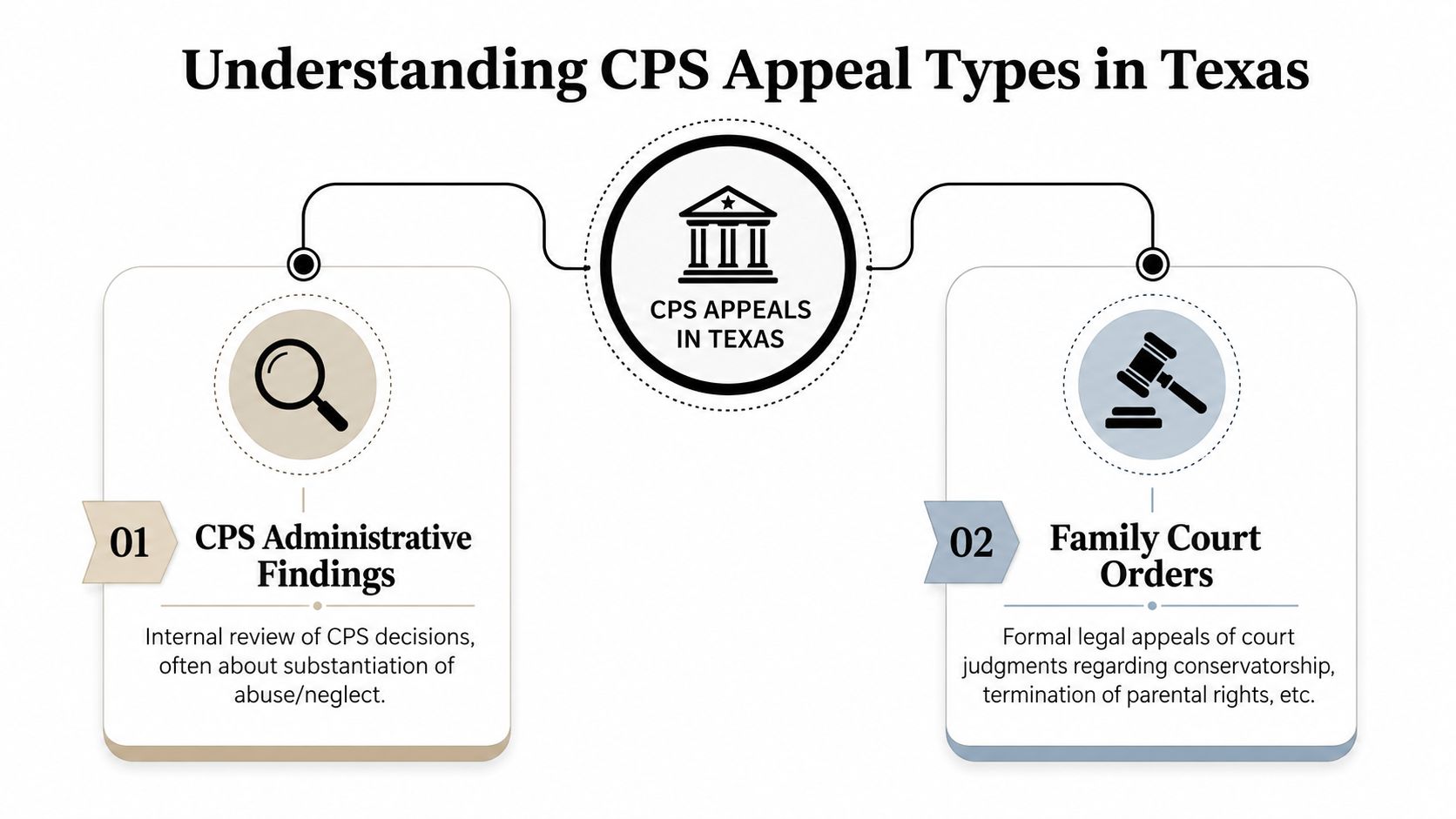
That distinction matters early. If you choose the wrong lane, you can lose time in the right one.
The administrative path
Some appeals start with an investigative finding, not a courtroom order. A parent may receive a final CPS letter stating that abuse or neglect was "reason to believe" and want to challenge that finding before it remains in the agency record.
Under Texas Family Code section 261.309 as summarized in this practical guide, the parent must submit a written request for administrative review to the Office of Appeals within 30 days of receiving the final investigation letter. The request should identify the decision being challenged and explain why the finding is disputed. If the agency keeps the original finding after that review, the parent may then request a hearing before an Administrative Law Judge, and that step has its own 30-day deadline under the same guide.
This process is about the investigation. It does not overturn a district court judgment, but it can affect whether the CPS finding stays in DFPS records and how that finding follows the family later.
The OCA step after ARIF
Many parents stop after the Administrative Review of Investigation Findings, or ARIF, because the denial reads final. In some cases, it is not.
As explained in this discussion of CPS administrative appeals after ARIF, families often overlook the Office of Consumer Affairs review. The DFPS Office of Consumer Affairs Handbook states that a written request for OCA review must be filed within 45 calendar days after notice of the ARIF decision. The request must include identifying information such as the requester's name, phone number, mailing address, and case details. The handbook also lists submission options including fax, email, and mail to the DFPS Office of Consumer Affairs in Austin. If OCA agrees with ARIF, the director issues a written final disposition. If OCA and the Investigations assistant commissioner disagree, DFPS general counsel acts as the commissioner's designee and issues the final agency decision.
That extra review step is easy to miss, especially when a family is also dealing with court hearings, placement issues, or service plans.
Critical difference: An agency appeal challenges a CPS finding. A court appeal challenges a judge's signed order. A parent can have one, the other, or both.
The court appeal path
If a judge signed a final order in a CPS lawsuit, the appeal goes through the Texas appellate courts. That can include final orders involving conservatorship, possession, or termination of parental rights in Texas.
Court appeals focus on whether the trial court made a reversible legal error based on the existing record. The question is not whether the appellate judges would have handled the facts differently. The question is whether the law was applied correctly, the required procedures were followed, and the evidence in the record legally supports the ruling.
One issue often shapes the entire court appeal. The standard of review determines how much deference the appellate court gives the trial judge on each issue. Standards of Review in Texas Family Appeals helps explain why some arguments are much stronger than others, even when a parent feels the result was plainly wrong.
A quick comparison
| Issue | Administrative appeal | Court appeal |
|---|---|---|
| Who made the decision | CPS or DFPS | Trial judge |
| What you're challenging | Investigative finding | Final court order |
| Where review happens | Internal agency process, then ALJ in some cases | Court of Appeals |
| Main focus | Whether CPS should keep the finding | Whether the court made reversible legal error |
If you are not sure which process applies, start with the document in your hand. A final investigation letter usually points to the agency review process. A signed court order points to an appellate court. In some cases, preserving your rights means handling both at once, carefully and on separate timelines.
Navigating Accelerated Appeal Deadlines in Texas
Deadlines in CPS appeals are short. In court-based CPS cases, they're shorter than many parents expect.
Why CPS court appeals move faster
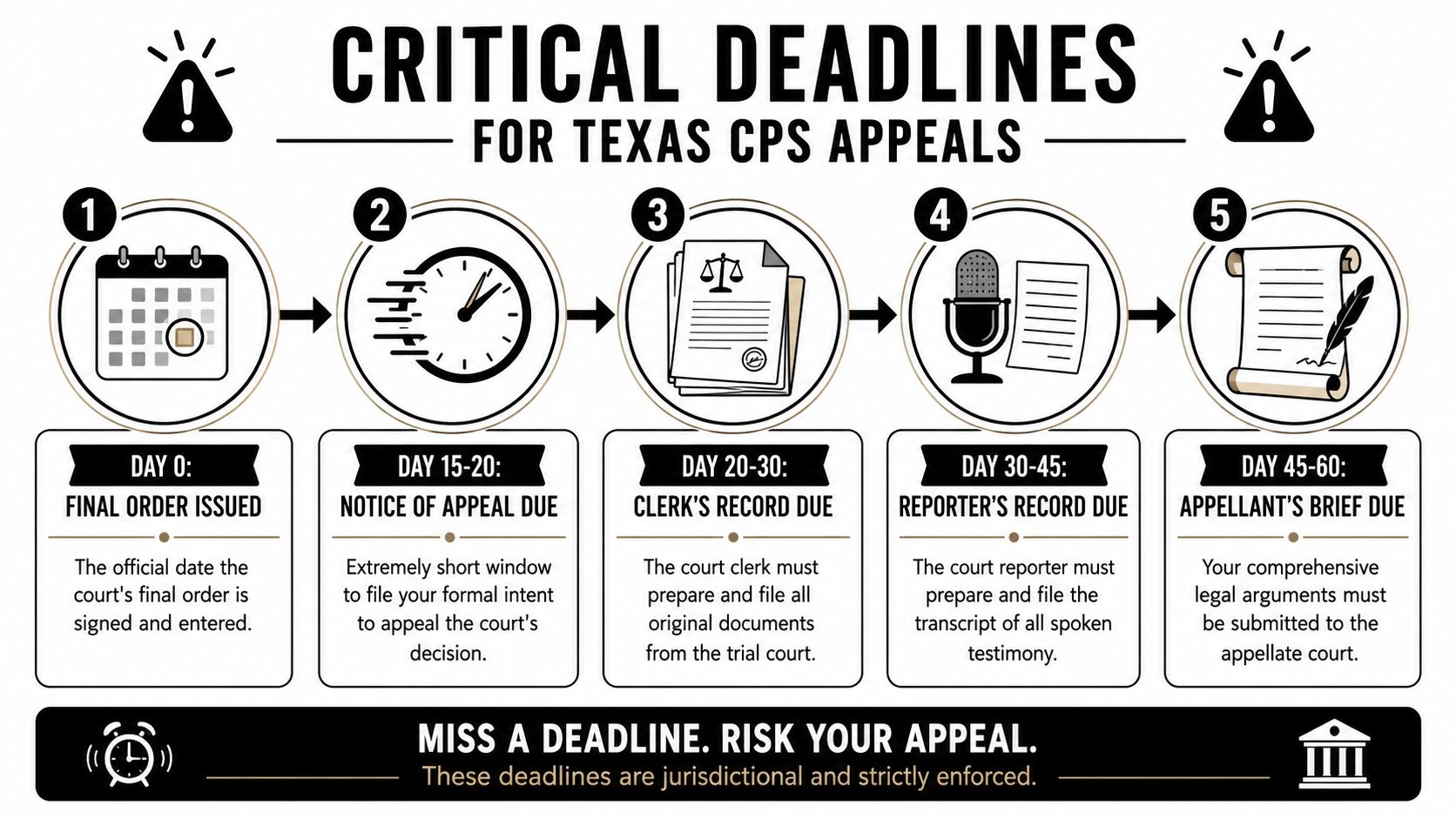
Texas treats child protection and parental termination appeals as accelerated appeals. According to the Texas Courts guidance on appeals in parental termination and child protection cases, the notice of appeal must be filed within 20 days after the judgment or order is signed. The appellate record must then be filed within 10 days after the notice of appeal is filed. The appellant's brief is due within 20 days after the clerk's and reporter's records are filed, and the appellee's brief follows 20 days later. The process aims for final disposition within 180 days of the notice of appeal.
That same guidance also makes another point parents often don't hear soon enough. Post-judgment motions don't extend the notice-of-appeal deadline in these accelerated child protection cases.
A practical timeline
For many parents, the timeline feels like this:
- Order signed: the clock starts immediately.
- Notice of appeal: must be filed quickly in the trial court.
- Record preparation: clerk's record and reporter's record have to be assembled fast.
- Briefing: written legal argument follows soon after the record is filed.
This is why waiting to "see what happens" is risky in a CPS appeal.
The calendar can defeat a valid appeal before the court ever reaches the merits.
How this differs from other family appeals
Not every family appeal uses the same timetable. In standard Texas family law cases, a notice of appeal must generally be filed within 30 days from the date the final judgment is signed, and some post-trial motions can extend that to 90 days, according to this overview of Texas family law appeal deadlines.
CPS court cases are different. If you're dealing with a child protection or termination order, the accelerated rules usually control. For a closer look at that filing step, see the deadline for filing a notice of appeal in Texas.
What works and what doesn't
What works is immediate file review, fast transcript requests, and a clear decision about whether a real appellate issue exists.
What doesn't work is assuming the ordinary family-law timeline applies, relying on informal advice from non-lawyers, or waiting for a post-trial motion to buy extra time in a case that the rules classify as accelerated.
Building the Foundation for Your Appeal
An appeal is only as strong as the error you can identify and the record you can prove it from.

What reversible error means
A reversible error is a mistake serious enough that the appellate court can change the result. Not every bad ruling qualifies. Trial judges make many discretionary calls, and appellate courts don't reverse merely because they might have decided things differently.
One of the most common theories in a Texas family appeal is abuse of discretion. As summarized by Scroggins Law Group's discussion of appeals in divorce and family cases, that means the judge acted arbitrarily, unreasonably, or failed to follow procedural rules or substantive law, producing an unjust ruling.
In plain English, abuse of discretion means the judge had a range of lawful choices but stepped outside that range.
Common appellate issues in CPS-related family cases
A few examples help:
- Procedural rulings that prevented a fair hearing. If the court cut off evidence it should have allowed, refused a required procedure, or acted without following governing rules, that may create an appellate issue.
- Orders unsupported by the law applied to the record. A ruling can be vulnerable if the court used the wrong legal standard or entered relief that the law doesn't support.
- Preserved objections that show the trial court was alerted to the problem. Appeals often depend on whether counsel objected, requested a ruling, or otherwise made the issue part of the record.
Preserving error matters
Many parents are surprised to learn that appellate courts generally review what was properly raised below. That idea is called preservation of error.
If no one objected when the mistake happened, the appellate court may treat the issue as waived. There are exceptions in some situations, but as a practical matter, the best appeals usually begin with a trial record that clearly shows what went wrong and when the court had the chance to correct it.
Practice point: Trial advocacy and appellate advocacy are connected. A clean objection and a clear ruling at trial often become the backbone of the appeal.
What the appellate record includes
The appellate record is the universe the appellate court sees. It usually includes two parts:
| Part of the record | What it contains | Why it matters |
|---|---|---|
| Clerk's record | pleadings, orders, motions, exhibits filed with the clerk | shows what was filed and what the court signed |
| Reporter's record | transcripts of testimony and hearings | shows what witnesses said, what objections were made, and how the judge ruled |
Parents sometimes want to attach new papers or explain facts that never made it into the case below. That's understandable, but appellate courts usually can't decide the appeal based on new material outside the record.
Briefing in plain English
Briefing is the written argument submitted to the appellate court. Good briefing doesn't retell the case emotionally. It identifies the issue, points to the exact place in the record where the issue appears, explains the governing law, and shows why the error affected the judgment.
That written work is where many appeals are won or lost.
From Filing the Notice to Arguing Your Case
A parent may feel some relief after the notice of appeal is filed, as if the case is finally in front of a higher court. In practice, that filing is only the start. From that point on, CPS appeals turn on deadlines, record accuracy, and disciplined written advocacy.

The notice of appeal
The notice of appeal starts the court appeal, and it must be filed in the trial court. That sounds simple, but small filing errors can create real delay in an already accelerated case.
Parents should also understand the bigger picture here. The court appeal is only one track. Some families are also dealing with an administrative challenge tied to CPS findings, including an OCA or ARIF process. Those are separate proceedings with different deadlines, different decision-makers, and a different record. Treating them as if they are interchangeable can cost you rights in both places.
What happens after filing
Once the notice is on file, the work becomes technical very quickly. The clerk's record and reporter's record have to be complete. Briefing deadlines start to matter. If anything is missing, counsel may need to act fast to correct it before the court reviews an incomplete picture of what happened.
At this stage, strong appellate work is usually selective. A parent may have ten complaints about how the case was handled. The better appeal often focuses on the two or three issues that are preserved, supported by the record, and likely to matter under the standard of review.
A practical review usually includes:
- confirming the appeal is tied to the correct signed order
- checking that all relevant hearings, exhibits, and testimony are included in the record
- identifying preserved error instead of arguing every unfair moment in the case
- tracking each appellate deadline closely
- deciding early whether related emergency action may be needed, such as a request discussed in this guide to emergency mandamus relief in Texas custody cases
That last point matters more than many parents realize. A standard appeal asks the appellate court to review the final result. It does not automatically stop ongoing harm while the appeal is pending.
The appellate brief
The appellate brief is where the case is usually won or lost. Judges read briefs to understand exactly what the trial court did, where the error appears in the record, what rule applies, and why the mistake affected the outcome.
Good briefing is focused. It does not retell the entire family history. It does not rely on facts outside the record. It shows the court, with precision, why relief is legally justified.
That is one reason trial and appellate work are different disciplines. Trial counsel builds facts in real time. Appellate counsel works from a fixed record and has to make careful choices about what arguments are worth the court's attention.
Here's a short overview that helps illustrate what appellate advocacy looks like in practice:
Oral argument and final decision
Some CPS appeals are decided on the briefs alone. In others, the court sets oral argument and gives lawyers a short window to answer questions from the panel. The judges usually focus on the weak points, the preservation problem, or the part of the record that cuts against your position.
Parents often ask whether oral argument is their chance to tell the court what was left out. Usually, it is not. The appellate court reviews the record already made. New evidence generally belongs in a different procedural vehicle, not in the appeal itself.
One practical option for families and trial lawyers who need focused appellate help is The Law Office of Bryan Fagan, PLLC, a Texas family law appellate practice that reviews records, identifies potential reversible error, and prepares appellate briefing in family and CPS-related matters.
Emergency Relief and Managing Appeal Outcomes
Parents in CPS cases often need to know what can happen while the appeal is pending, not just at the end.
Relief before the final opinion
In some cases, a party may seek emergency relief from the appellate court, such as a stay of the order being challenged. Whether that relief is available depends on the posture of the case and the order involved, but the main strategic point is this: if immediate harm may occur before the appeal is decided, waiting passively may not protect your position.
Another tool in limited situations is a writ of mandamus. A mandamus request asks an appellate court to correct a clear abuse of discretion when ordinary appellate relief isn't adequate. If you're dealing with urgent custody-related action during or around a CPS matter, this discussion of emergency mandamus in Texas custody cases gives useful context.
What a win can look like
Texas law gives these cases priority. Texas Family Code Chapter 109 provides that appeals involving termination of the parent-child relationship receive precedence over other civil cases. That faster review matters because family stability and due process can't wait indefinitely.
Still, an appeal can end in several ways:
- Affirmed: the appellate court leaves the trial court's ruling in place.
- Reversed: the appellate court overturns the ruling.
- Reversed and remanded: the appellate court sends the case back for further proceedings under the correct legal standards.
Not every successful appeal ends the case. Sometimes success means getting a new, fairer process.
Why You Need an Appellate Attorney for a CPS Appeal
A parent may leave the final hearing convinced the result was wrong, then learn the next fight is no longer about retelling the whole story. It is about the record, the deadlines, the legal errors, and in some cases a second track outside the courtroom if the case also involves a CPS finding being challenged through the agency's administrative process. That shift is where many appeals are won or lost.
An appellate attorney handles a different job than a trial lawyer. Trial counsel builds facts and presents evidence. Appellate counsel studies what was admitted, what objections were made, what rulings can be reviewed, and how to frame those points in a way an appellate court can act on. In CPS matters, that work often has to happen fast, with no room to miss a deadline and no chance to add facts that never made it into the record.
That matters for another reason. Texas parents may be dealing with two different review systems at once. One is the court appeal from a trial court order, such as a termination or conservatorship ruling. The other may be an administrative challenge to a CPS finding through the agency review process. Those are separate paths with different rules, different records, and different deadlines. A lawyer who understands both can help protect your position in each forum instead of treating them as if they were the same case.
Parents often ask whether they can do this themselves because they know the facts better than anyone else. They usually do. The problem is that appeals are decided less by who can explain the facts most forcefully and more by whether the right complaint was preserved, whether the record supports it, and whether the law gives the appellate court a way to correct it.
Good appellate counsel also gives honest advice about trade-offs. Some issues feel important but have little chance on appeal. Others look minor in the moment but may offer the strongest basis for reversal. A careful lawyer helps you choose where to spend time, money, and urgency.
If you believe a Texas CPS decision was handled unfairly, get legal advice quickly. The Law Office of Bryan Fagan, PLLC can review the order, the record, and any related administrative findings, then help you decide the strongest next step.