You may feel your case was handled unfairly. The judge may have ruled against the evidence you presented, applied the wrong legal standard, or signed an order that changes your finances, parenting time, or rights in ways that don't feel just.
That reaction matters, but the next step can't be driven by frustration alone. In Texas family law, one of the first strategic tools after an adverse ruling is a motion for new trial. Used correctly, it can preserve issues, give the trial court a chance to correct a mistake, and protect your path into the appellate process.
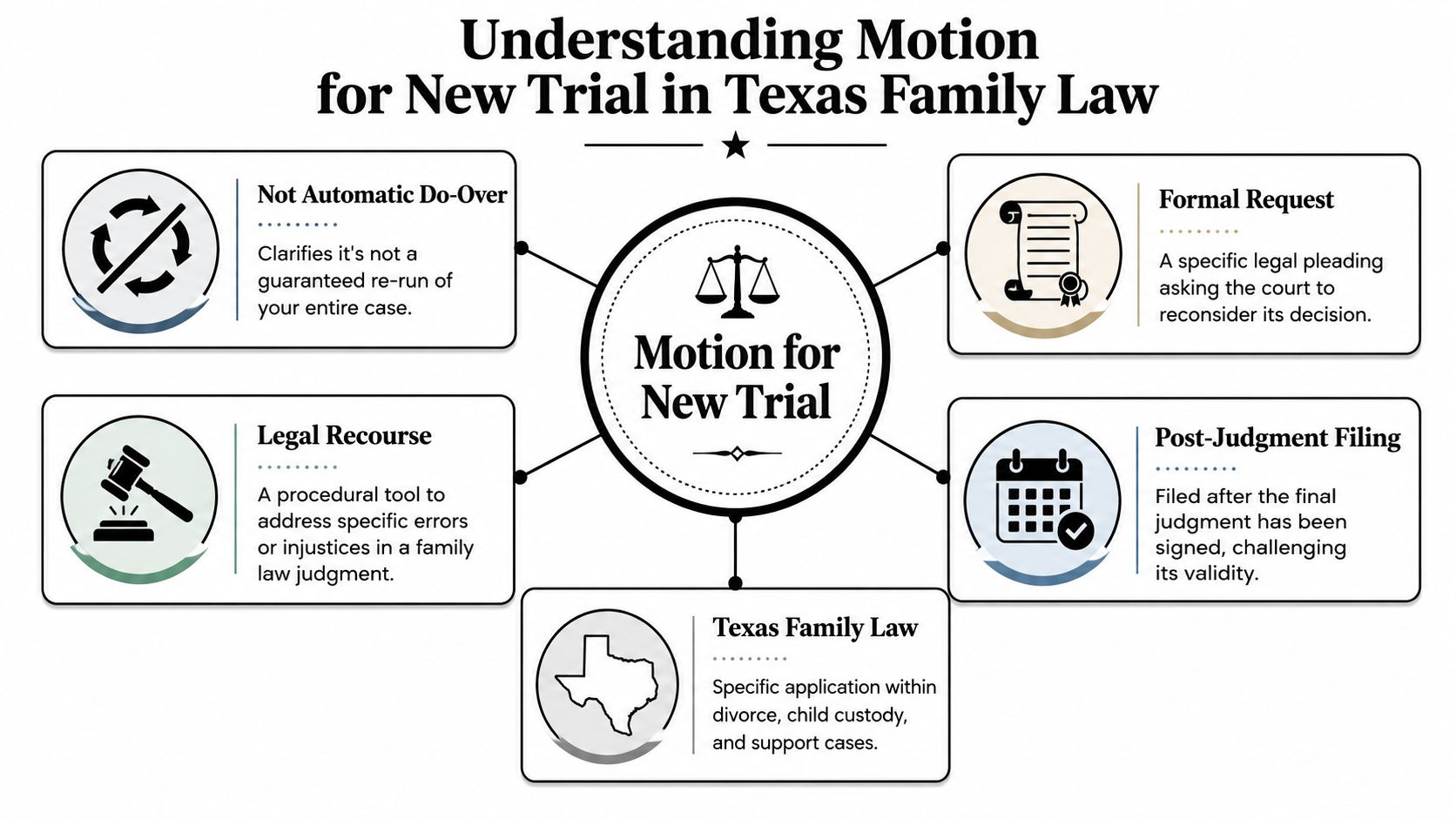
A lot of people misunderstand what this motion does. It isn't a guaranteed second trial. It's a formal post-judgment request that asks the same court to revisit a signed ruling for recognized legal reasons. In many cases, the primary value is procedural and strategic. It helps you act quickly, preserve options, and avoid losing rights by waiting too long.
Your Case Was Decided Unfairly Now What
The judge signs the final order on a Friday afternoon. By Monday, the practical question is no longer whether the result feels wrong. The question is what can still be done, and how fast.
In Texas family cases, the period right after judgment is often where rights are protected or lost. A parent who believes the court ignored key testimony, a spouse facing an uneven property division, or a party dealing with a flawed protective order ruling all face the same problem. The court has acted, the deadlines have started, and waiting to "see what happens" can close off options.
The first job is to separate frustration from strategy. Some complaints belong in the trial court first. Some belong in an appeal. Some require both. If you are sorting out that choice, it helps to understand the difference between an appeal and a motion for new trial in Texas family law, because they serve different purposes and run on different timelines.
The first strategic move after judgment
A motion for new trial is often the first procedural step worth examining after an unfair result. It asks the same trial judge to revisit the judgment for recognized legal reasons. In practice, its value is often less about getting a full second trial and more about preserving complaints, developing the record when appropriate, and extending key appellate deadlines if it is filed on time.
That distinction matters. Clients often hear "new trial" and assume the case will be tried again. Texas procedure does not work that way. A motion for new trial is a tool. Sometimes it leads to meaningful relief in the trial court. Sometimes its primary benefit is that it keeps the path to appellate review open while counsel evaluates the record and frames the issues correctly.
Practical rule: Once a final order is signed, identify the signing date, secure the signed judgment, and evaluate deadlines before doing anything else.
What an unfair result means in legal terms
An unfair outcome does not become reversible error just because the consequences are serious. In appellate practice, the focus is narrower. The question is whether the court made a legal mistake, abused its discretion, excluded or relied on evidence improperly, or reached a result the record cannot support.
That is why the early post-judgment period has to be handled carefully. The motion for new trial can be the first and best chance to present the problem in legal terms instead of emotional ones. If that step is missed, a party may still want relief, but with fewer options and less time to get there.
What Is a Motion for New Trial and Why It Is Crucial
A motion for new trial is a written request asking the trial judge to set aside the judgment and grant a new trial. In plain English, you're telling the same court, “Something legally important went wrong, and this judgment should not stand as entered.”
It helps to think of it as a final chance to ask the trial court to correct its own work before the case shifts into full appellate posture. That does not mean the judge must grant it. It means the law gives you a structured way to raise certain complaints and ask for relief.
What the motion does and what it does not do
Many people hear “new trial” and assume it means the court will start over. That's the wrong expectation. A motion for new trial is a procedural request, not a promise of a do-over on the merits.
A stronger way to view it is this:
| Function | What it means in practice |
|---|---|
| Correction tool | It asks the trial court to revisit a judgment based on specific legal grounds |
| Preservation tool | It can help preserve certain issues that may matter later on appeal |
| Timing tool | It can change the appeal timetable when filed on time |
One of the most important strategic effects is timing. A timely filed motion extends the appellate timetable from 30 days to 90 days for filing a notice of appeal, providing critical strategic breathing room for appellate preparation, as explained in this discussion of Texas new trial timing and appellate deadlines.
That breathing room matters. Appellate work takes record review, issue selection, transcript analysis, and careful briefing. If you need a practical overview of that deadline effect, Post-Trial Motions Before a Texas Appeal discusses how a motion for new trial can extend the appeal deadline.
Plenary power and why lawyers care about it
You may hear lawyers talk about the court's plenary power. That term means the trial court's authority to change, correct, or set aside its judgment for a limited period after signing it. A timely motion for new trial can keep that authority in play longer.
That's one reason this filing often sits at the center of early appellate strategy. It isn't only about persuading the trial judge. It's also about protecting the procedural runway your appellate team may need.
For a side-by-side explanation of the difference between these two paths, see appeal versus motion for new trial in Texas family law.
The Strict 30-Day Deadline You Cannot Miss
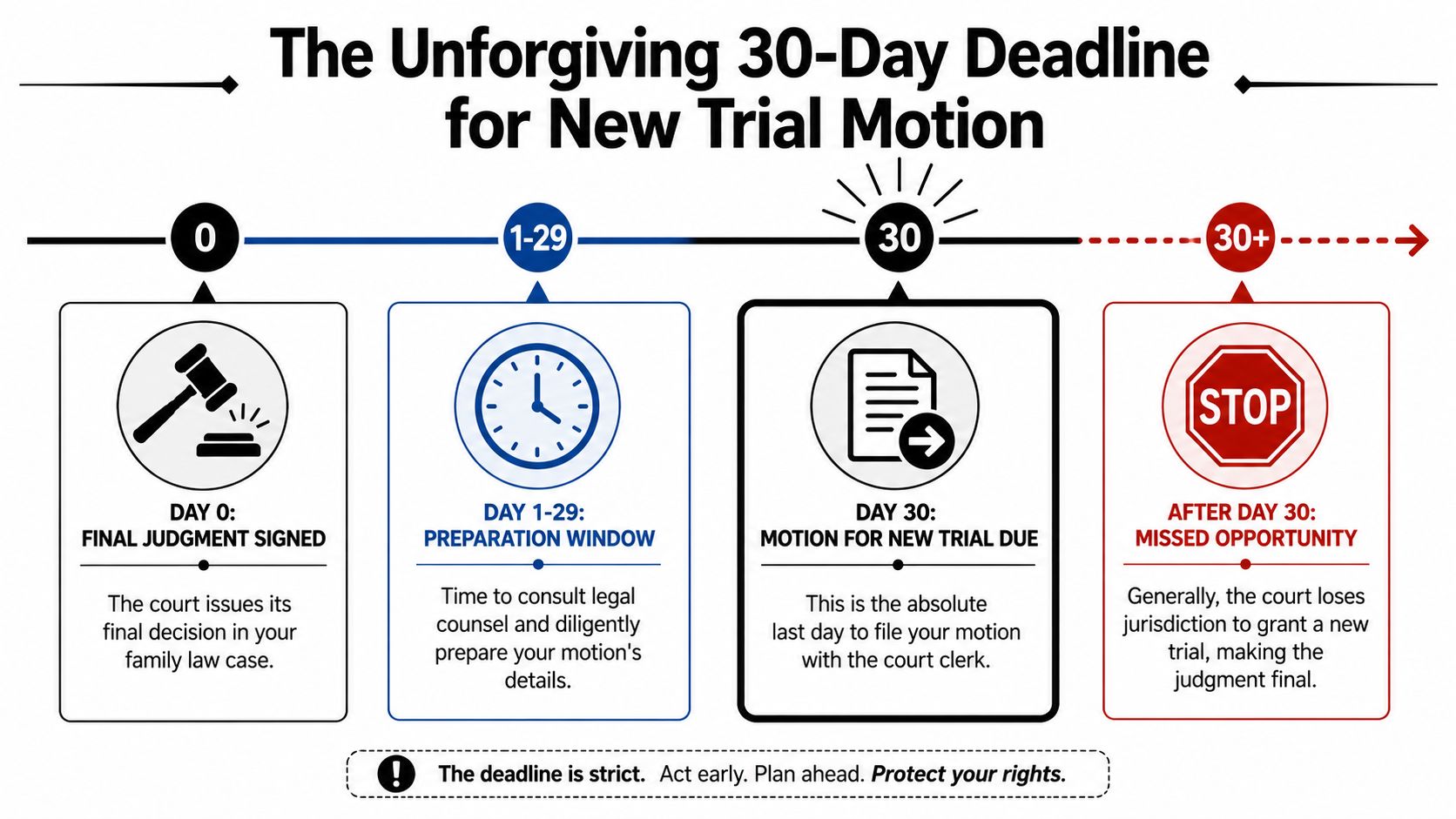
The most important deadline in this process is simple and unforgiving. In Texas family law, a Motion for New Trial must be filed within exactly 30 days after the judgment or order complained of is signed by the court, and this deadline is strictly non-extendable under Texas Rule of Civil Procedure 329b(a), as summarized in this explanation of a motion for a new trial in Texas.
That count starts from the date the judge signs the written judgment. It does not start when the judge announces a ruling in court. It does not start when someone mails the order. It does not start when you first read it.
A missed deadline here can change the entire case.
Why this deadline is harsher than many people expect
Family law clients often assume courts will forgive a short delay if there was confusion, late paperwork, or bad advice. That assumption causes real damage. Post-judgment deadlines are procedural rules, not suggestions.
The practical lesson is straightforward:
- Confirm the signing date: Get the signed judgment or order and identify the exact date the judge signed it.
- Count from that date: Don't use the hearing date, mailing date, or docket entry date.
- Treat the deadline as fixed: Build your drafting, evidence gathering, and filing plan backward from day 30.
Missing the filing window can waive the chance to seek this specific trial-court relief and can narrow what your lawyer can do next.
The day 75 rule
There is a second date that matters after filing. If the trial court does not sign an order granting or denying the motion by the 75th day after the judgment was signed, the motion is automatically overruled by operation of law. The court does not have to hold a hearing for that to happen.
If the judge hasn't ruled by day 75, the law treats the motion as denied.
That automatic denial matters because it preserves the case's movement toward appeal. If you're also trying to understand the next appellate deadline, this guide on the deadline for filing a notice of appeal in Texas is a useful companion.
A short video explanation can also help if you're sorting through the timing after judgment.
Valid Grounds for Requesting a New Trial
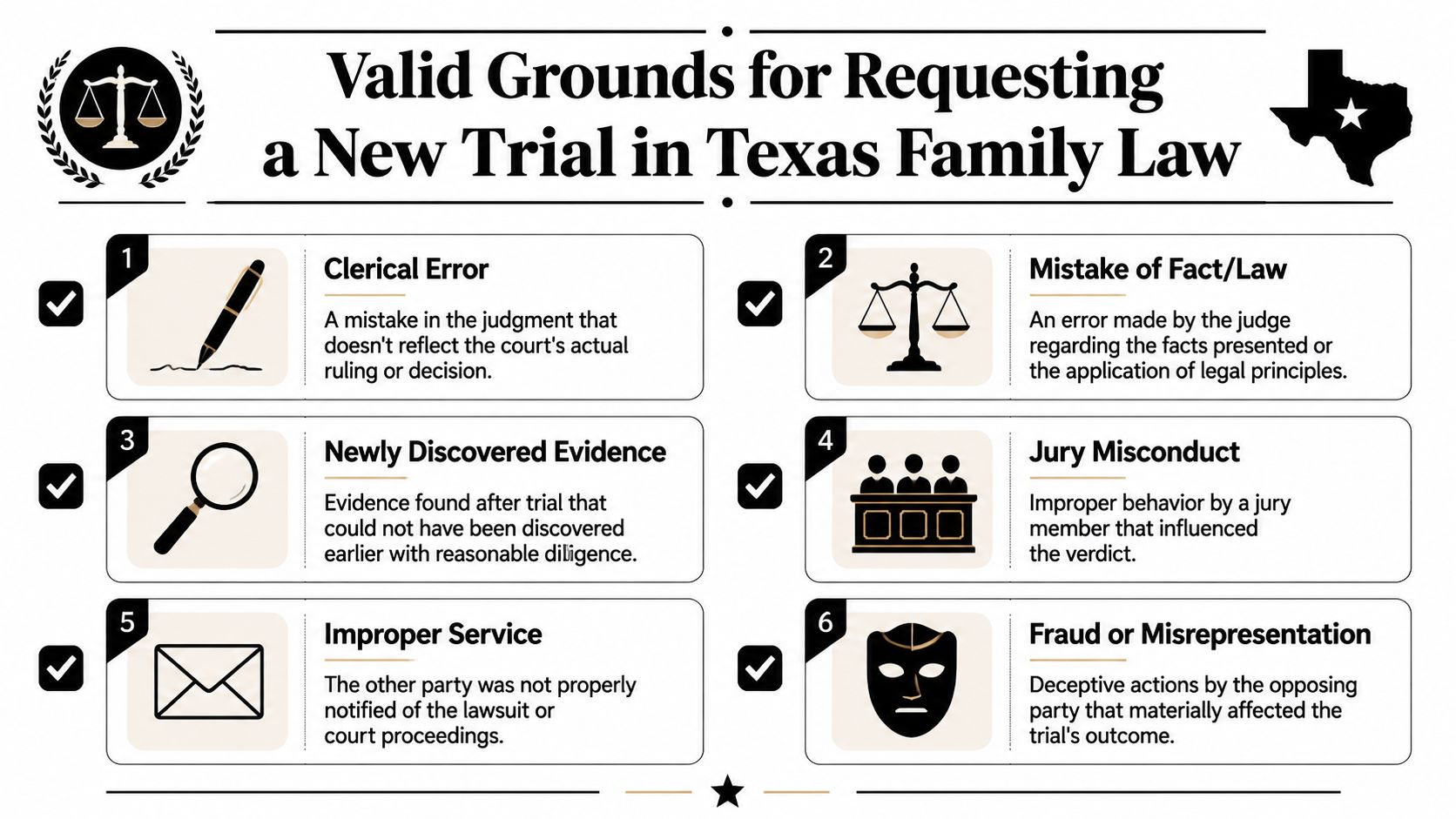
You leave a custody or divorce trial feeling sure the result was unfair. That reaction matters, but it is not enough by itself. A motion for new trial has to identify a recognized legal basis for relief, and in many cases its value is procedural as much as substantive. It can preserve complaints for appeal, develop facts that are not already in the record, and extend certain appellate deadlines. It does not guarantee that the judge will set the case for a complete do-over.
The court is looking for an error that likely affected the outcome, or for a complaint that Texas procedure requires you to raise in a motion for new trial.
Legal error and procedural unfairness
One common ground is reversible error. In family court, that may mean the judge applied the wrong legal standard, admitted or excluded evidence in a way that probably affected the result, or signed relief the law does not permit on the facts presented.
Examples include:
- Property division errors: The court classified or divided property under the wrong legal framework.
- Conservatorship or possession errors: The ruling relied on an incorrect standard instead of the governing best-interest analysis.
- Procedural unfairness: A party did not receive proper notice, was denied a meaningful chance to present evidence, or was prevented from responding to a key issue.
Preservation matters here. Some complaints are lost if trial counsel did not object, request a ruling, or make the record correctly at the time of trial. If you need to assess that issue, review these Texas objection rules for preserving appeal issues.
Newly discovered evidence and complaints that must be raised post-judgment
Some grounds depend on facts outside the existing record. Newly discovered evidence is the example clients ask about most often, but it is also one of the most misunderstood. The evidence usually must be material, likely to change the result, and something you could not have obtained earlier with reasonable diligence. A motion for new trial is often the vehicle for putting that material before the court through affidavits or other proof.
Texas procedure also requires certain complaints to be raised in a motion for new trial if they are going to be presented on appeal. Under the Texas Rules of Appellate Procedure, a motion for new trial serves as a prerequisite to presenting specific points of error on appeal only when a party needs to adduce facts not already in the record, such as newly discovered evidence affecting the case outcome, factual sufficiency complaints regarding jury findings, or incurable jury argument claims, as stated in the Texas Rules of Appellate Procedure.
That rule has real strategic consequences. In practice, I often tell clients that the motion is sometimes less about convincing the trial judge to reverse course and more about protecting what can still be argued later.
For a fuller discussion of what courts may treat as a legitimate basis to challenge a ruling, see our guide on Grounds for Appealing a Texas Family Law Ruling.
Plain-English definitions that matter
| Term | Plain-English meaning |
|---|---|
| Abuse of discretion | A ruling that falls outside the range of reasonable decisions or ignores controlling legal principles |
| Reversible error | A mistake serious enough that it likely affected the judgment |
| Briefing | The written appellate argument explaining why the ruling should be affirmed or reversed |
In Texas family law, abuse of discretion comes up often because many rulings receive deferential review on appeal. That is why the distinction matters. A motion for new trial is a procedural tool with specific legal uses. It is not a second chance merely because the result feels wrong.
Drafting and Filing Your Motion Correctly
A strong motion for new trial is specific, supported, and filed in the correct court on time. A weak motion reads like a complaint letter. A useful motion reads like a legal document that tells the judge exactly what went wrong, why it matters, and what relief is requested.
In practice, drafting is where many otherwise valid complaints get lost. The problem usually isn't passion. It's lack of precision.
What the motion should include
The basic structure usually includes these parts:
- Identify the judgment clearly: State the exact order or final judgment being challenged and the date it was signed.
- List the grounds with precision: Don't write that the ruling was unfair. State the legal or procedural error that supports relief.
- Connect facts to law: Explain how the error affected the outcome.
- Attach support when needed: If the motion depends on facts outside the existing record, include affidavits, exhibits, or other supporting materials.
- State the requested relief: Ask the court to grant a new trial, modify the judgment, or provide other appropriate relief under the circumstances.
Filing and service are not afterthoughts
The motion must be filed with the original trial court. It also has to be served on the opposing party or opposing counsel. Those are procedural acts with legal consequences, not clerical details to clean up later.
A practical workflow often looks like this:
- Review the signed judgment and hearing record.
- Identify whether the issue is legal error, newly discovered evidence, a preservation problem, or a procedural defect.
- Gather the support needed for any fact-dependent ground.
- Draft the motion with enough specificity to put the court and opposing party on notice.
- File and serve it before the deadline expires.
A motion that says too little can be almost as damaging as a motion filed too late.
Keep the 75-day limit in view
Timing doesn't stop once the motion is filed. If the trial court fails to sign an order granting or denying the motion by the 75th day after the judgment was signed, the motion is automatically overruled by operation of law at that time, which preserves the right to appeal, as explained in this overview of deadlines in a Texas appeal.
That means counsel has to track two things at once. First, the motion itself must be prepared and filed correctly. Second, the case must be positioned for appeal if the trial court does not grant relief.
Preservation also matters throughout the case, not only after judgment. If you're trying to evaluate whether issues were properly raised in the trial court, this article on objections required to preserve appeal in Texas helps explain that layer of strategy.
Common Mistakes to Avoid and When to Hire an Attorney
The call usually comes after the same kind of hearing. A parent leaves court convinced the result was unfair, waits a few weeks to regroup, then starts searching for a way to get the judge to hear the case again. By then, the actual problem may no longer be the ruling itself. It may be a missed deadline or a poorly framed post-judgment motion that did little to protect an appeal.
A motion for new trial often gets misunderstood. In practice, it is usually less about getting a full second trial and more about preserving complaints, asking the trial court to correct a specific error, and extending appellate deadlines when used properly. That difference matters because many avoidable mistakes happen when parties treat the motion like a guaranteed do-over.
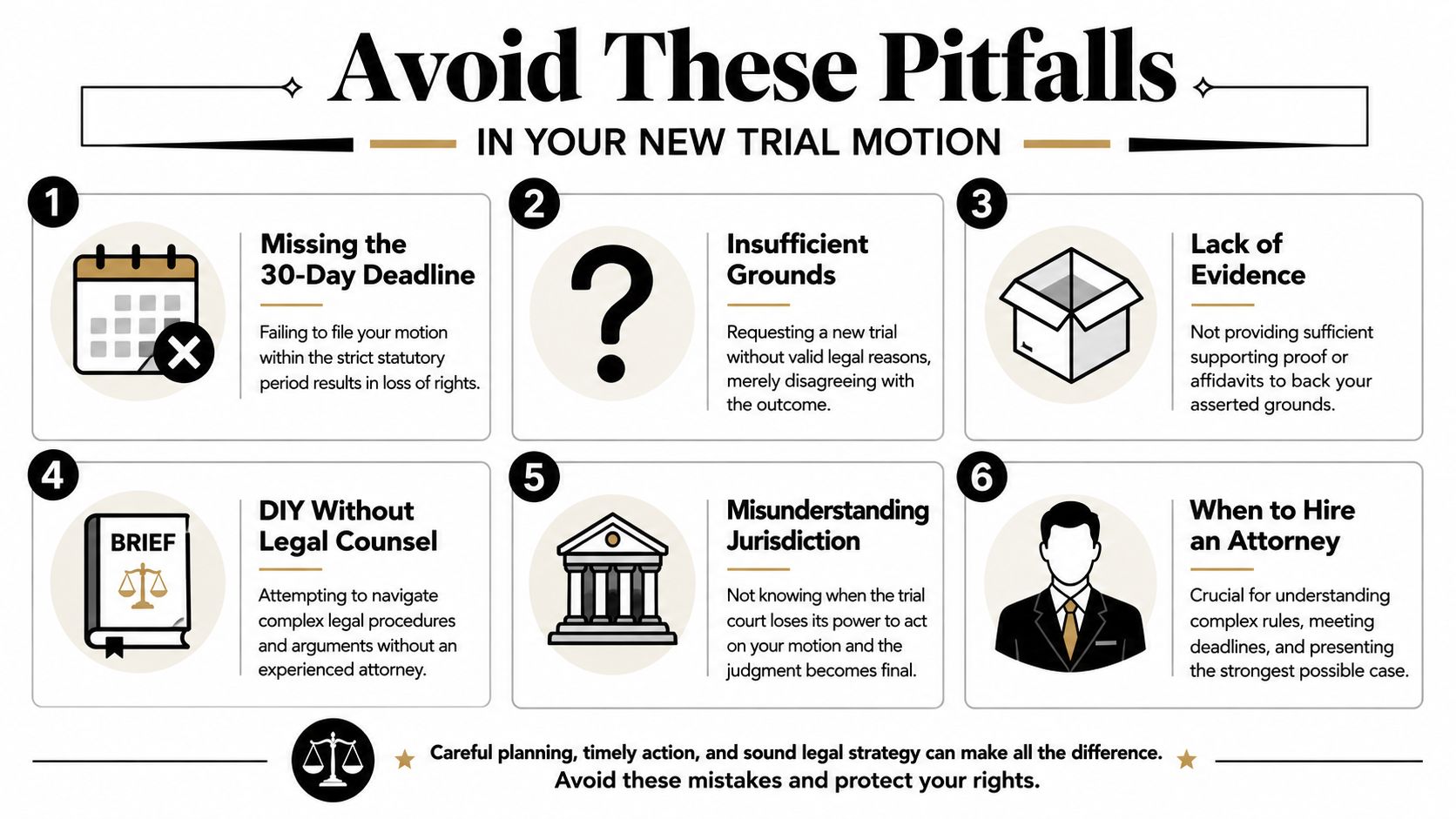
Mistakes that often damage otherwise viable cases
Some errors are simple but costly.
- Counting from the wrong date: The clock usually runs from the date the judge signs the judgment, not the hearing date and not the date a party receives notice.
- Using general frustration instead of legal grounds: A motion has to identify a recognizable error. Statements like “the judge did not listen” rarely preserve anything useful by themselves.
- Claiming evidence is new when it could have been found earlier: If the evidence was available with reasonable diligence before trial, the court is unlikely to treat it as newly discovered.
- Filing a thin motion just to beat the deadline: A placeholder filing may extend deadlines, but it can still fail to preserve the points that matter if it does not state them with enough clarity.
- Assuming trial counsel and appellate counsel approach the case the same way: Trial strategy focuses on witnesses, exhibits, and persuasion in the courtroom. Post-judgment strategy focuses on preservation, standards of review, and whether the record supports reversible error.
The last point is where many family-law litigants get into trouble. A client may feel strongly that the result was wrong. An appellate lawyer asks a narrower set of questions. What ruling is being challenged? Was the complaint preserved? Is there a reporter's record? Does the alleged error have a reasonable chance of changing the outcome under the standard of review?
Those questions can be uncomfortable, but they save time and money.
When hiring an attorney makes sense
Some motions are straightforward. Many are not. If the case involves child custody, a large property division, enforcement findings, credibility disputes, excluded evidence, or possible judicial error, experienced appellate review is usually worth getting quickly.
That is especially true when the record is messy or the legal theory is still unclear. Waiting until day 28 or 29 to ask for help limits the options. Counsel needs time to review the judgment, identify preserved issues, decide whether affidavits or exhibits are needed, and draft a motion that serves a real purpose instead of an empty filing on the docket.
In many family law appeals, the reviewing court applies the abuse-of-discretion standard. That is a deferential standard. The question is often not whether the appellate court would have ruled differently, but whether the trial court acted without a reasonable basis under the law. That framework is explained in this discussion of Texas appeals and standards of review.
One available option for that kind of review is The Law Office of Bryan Fagan, PLLC, a Texas family law appellate practice that handles appeals involving custody, divorce decrees, property division, support, protective orders, and enforcement-related judgments.
Take the Right Step to Protect Your Rights
You read the signed order, know the result was wrong, and assume the next step is asking for a new trial. In Texas family law, that instinct can help or hurt you depending on timing and purpose.
A motion for new trial is often the first procedural step after an unfair outcome because it can preserve complaints, extend appellate deadlines, and give the trial court a chance to correct a specific error. What it does not do is promise a fresh trial or erase the original judgment. Clients are often surprised by that distinction, and it matters.
The deadline matters even more. If there is any serious question about the ruling, treat the first 30 days after the judgment as a decision window, not a waiting period. Delay limits options fast.
The right next step is a prompt, focused review of the judgment, the record, and the deadlines that now control the case. That review should answer practical questions: whether a motion for new trial serves a real appellate purpose, whether another post-judgment filing makes more sense, and whether the issues are strong enough to justify the cost of further litigation.
The Law Office of Bryan Fagan, PLLC handles Texas family law appeals involving custody, divorce decrees, property division, support, protective orders, and enforcement-related judgments. If you are weighing a motion for new trial or an appeal after a family court ruling, a timely consultation can help you decide how to protect your parental and financial rights before the deadline closes.