Skip to content
You may feel your case was handled unfairly after investing so much time, emotion, and money into the adoption process, only to have a court deny your petition. A judge's decision is not always the final word. The Texas legal system provides a pathway to seek justice when you believe a serious legal mistake was made. This is the appellate process, and it is designed to ensure the law was applied correctly and fairly in your case.
Understanding your rights and the steps involved in an appeal is the first step toward correcting an unjust outcome. Unlike a trial, an appeal is not a second chance to present new evidence. Instead, it is a focused review of the trial court record to determine if a "reversible error"—a mistake significant enough to have changed the outcome—occurred.
Understanding Your Texas Adoption Financial Journey
Embarking on the adoption process is an incredibly exciting time, but the financial aspect can feel daunting. You might be coming from other family law experiences, feeling like things were handled unfairly, and now you just want clarity as you look to grow your family.
The truth is, there's no single price tag for adoption in Texas. It's a spectrum. The biggest factor influencing your total expenses will be the specific route you take. In the same way the cost of divorce in Texas fluctuates based on its complexity, so does adoption. Your journey will almost certainly fall into one of three main categories, each with its own financial landscape.
To give you a clearer picture, let's break down what you can generally expect from each path.
Adoption Cost in Texas at a Glance
This table offers a quick summary of the typical costs and primary expenses associated with the three main adoption pathways in Texas. It's a great starting point for understanding where your budget might fit.
| Adoption Type | Typical Cost Range | Primary Expenses |
|---|---|---|
| Private Agency Adoption | $25,000 – $50,000+ | Agency fees, birth mother support, legal services, home study, advertising. |
| Independent/Attorney Adoption | $15,000 – $40,000 | Attorney fees, birth mother support, court costs, home study. |
| Foster Care Adoption | $0 – $2,500 | Minimal out-of-pocket costs; most fees are reimbursed or covered by the state. |
As you can see, the differences are significant. Choosing a path isn't just about the cost, but also about the level of support and services you receive along the way.
The Three Main Adoption Pathways
Here's a closer look at what those numbers in the table actually mean.
-
Private Agency Adoption: This is typically the most expensive option, but it's also the most comprehensive. Agencies handle everything from matching you with a birth mother to providing counseling and coordinating all the legal details. You're paying for a full-service experience, with costs often ranging from $25,000 to over $50,000.
-
Independent Attorney Adoption: With this approach, you work directly with an adoption attorney to find a birth mother and complete the legal process. It can be less expensive than a full-service agency because you're not paying for the same level of wrap-around services, but the costs are still significant.
-
Foster Care Adoption: This is by far the most affordable way to adopt. The state's primary goal is finding loving, permanent homes for children in its care, so Texas covers most of the major costs, like the home study and legal fees. Many families find their out-of-pocket expenses are minimal, sometimes even close to zero.
Understanding the financial landscape from the beginning allows you to make informed, confident decisions. Each path offers a unique way to build a family, and the right choice depends on your personal circumstances, goals, and financial readiness.
As you dig deeper, remember to look beyond just the initial estimates. The final total will be shaped by a number of variables, like the legal complexity of your specific case, the agency's fee structure, and the amount of financial support the birth mother may need. By breaking these components down, you can start to build a clear and manageable budget for this incredible journey.
A Closer Look at Private Domestic Adoption Fees
When you start exploring private domestic adoption, it's natural to feel a bit of sticker shock. This path offers incredible support and guidance, but it's also the most significant financial investment you can make. The total cost can seem daunting, but breaking it down piece by piece is the key to creating a financial plan that feels realistic for your family.
This infographic gives a great side-by-side comparison of what to expect financially from the main adoption routes in Texas.
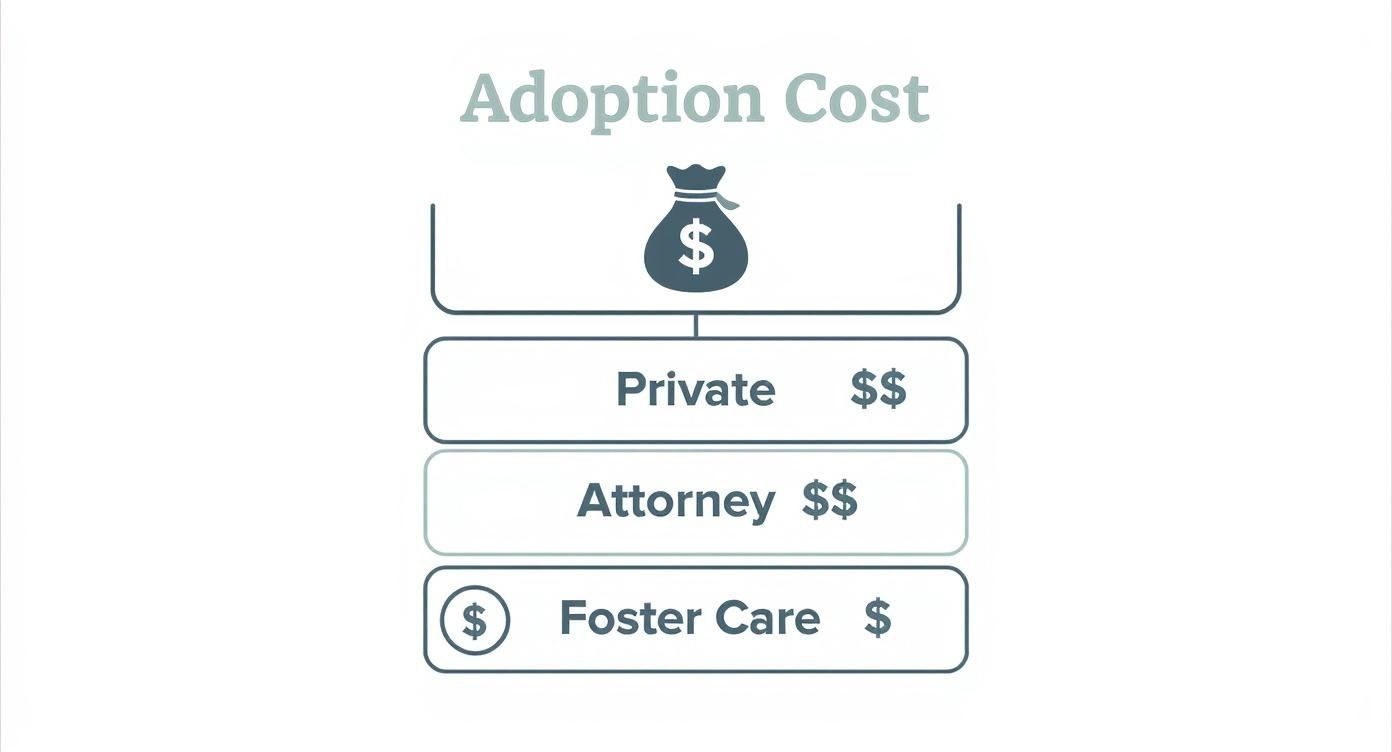
As you can see, private and attorney-led adoptions come with substantial costs, while adopting from foster care is by far the most financially accessible option.
Think of a private adoption less as a single, massive bill and more as a series of professional services you pay for along the way. Knowing this helps you ask the right questions when talking with agencies and attorneys, so you're not caught off guard by unexpected costs later on.
Core Agency and Program Fees
The biggest chunk of the adoption in texas cost for a private adoption is almost always the agency or program fee. This is the engine that drives your entire adoption journey, funding the absolutely essential services that make it all happen.
So, what does that big number actually cover?
- Advertising and Outreach: This is how agencies connect with expectant mothers who are considering making an adoption plan for their child.
- Screening and Matching: A crucial step where professionals carefully vet both hopeful adoptive parents and birth mothers to create matches that are stable, ethical, and built to last.
- Counseling and Support: This provides vital emotional and practical support for the birth mother—not just during her pregnancy, but throughout the birth and postpartum period as well.
- Administrative and Staffing Costs: This covers the day-to-day operations of the agency, ensuring your case is managed effectively from the moment you sign on until finalization day.
This fee is often the largest because it pays for the professional expertise and infrastructure needed to navigate the complex, emotional world of adoption safely and ethically for everyone involved.
Home Study and Legal Expenses
Before you can be approved to adopt a child in Texas, you have to complete a home study. A licensed social worker will conduct a thorough assessment to make sure your home is a safe, stable, and suitable place for a child. The cost for a home study usually falls somewhere between $1,500 and $3,000.
Legal fees are another unavoidable and critical part of the budget. You'll need an experienced adoption attorney to handle all the legal heavy lifting, from the termination of parental rights (TPR) to the finalization hearing in court. These fees can vary quite a bit, but they often land in the $2,000 to $5,000 range.
It's smart to budget for potential legal hiccups. If, for example, the birth father's rights are contested or he's difficult to locate, your legal expenses could climb higher than you initially planned.
You are also legally required to pay for the birth mother’s own independent lawyer. This is a non-negotiable step that ensures she gets unbiased advice and fully understands her rights—a critical protection for her, for you, and for the child.
Supporting the Birth Mother
Texas law allows adoptive parents to help cover a birth mother's "reasonable and necessary" living expenses. This isn't a payment for the baby; it's a compassionate way to ensure she's safe and healthy during one of the most vulnerable times in her life.
This financial support can go toward things like:
- Housing: Rent or mortgage payments
- Utilities: Electricity, water, and gas
- Food and Groceries: Making sure she has access to healthy food
- Transportation: Gas money or rides to get to doctor's appointments
- Maternity Clothing: A few essential items for her changing body
Every single one of these expenses has to be carefully documented and approved by the court. This maintains total transparency and ensures everything is handled ethically. The amount can vary wildly depending on the birth mother’s specific situation. All told, the adoption in texas cost for a private domestic infant adoption typically ranges from $60,000 to $65,000, accounting for all these professional and support services. You can explore a more detailed cost breakdown to get further insights into what you can expect to pay.
Exploring Foster Care Adoption: A Rewarding and Affordable Path
When you're looking to grow your family, the adoption journey should feel supportive and clear, not like another legal hurdle. While private adoptions can come with a hefty price tag, adopting from the Texas foster care system is a different story altogether. It’s a path that’s not only deeply rewarding but also incredibly affordable, designed to put the focus where it belongs: on finding loving, permanent homes for children.

The main reason it's so affordable is simple: the state of Texas steps in to cover most of the costs. Through the Department of Family and Protective Services (DFPS), the state’s primary goal is to find stable, permanent families for kids, not to create financial roadblocks for the wonderful people ready to open their homes. This means many of the big-ticket items that drive up costs in private adoptions are either paid for or reimbursed.
Why Are Foster Care Adoption Costs So Low?
If you’ve researched private adoption, you know the costs can add up quickly—agency fees, birth mother expenses, extensive legal work. With foster care adoption, the financial landscape is completely different. The state prioritizes finding a stable home for a child who has been through a lot, so Texas provides significant financial support to make that happen.
This state-funded approach means major expenses are handled right from the start. For example, the home study—a mandatory step that can cost thousands privately—is provided at no cost to you. Legal fees to finalize the adoption are also almost entirely covered or reimbursed.
All in, adopting through the Texas foster care system will typically cost between $0 and $2,500. The main out-of-pocket expenses you might see are court filing fees, which usually land somewhere between $300 and $500. You can find more details about how these adoption costs are broken down in Texas to see the full picture.
Post-Adoption Financial Support and Benefits
Here’s something many people don't realize: the state's financial support doesn't stop the day the adoption is finalized. Texas provides ongoing assistance to make sure your family has what it needs to thrive long-term. This is a crucial difference that makes foster care adoption a uniquely stable and supported journey.
The state of Texas recognizes that children adopted from foster care may have unique needs. The post-adoption support system is designed to provide a long-term safety net, ensuring both the child and their new family can thrive together.
This ongoing support comes in several forms, building a strong foundation for your family's future. The table below outlines the key financial programs available to Texas families who adopt from foster care.
Financial Support for Texas Foster Care Adoptions
| Type of Support | Description | Typical Amount/Benefit |
|---|---|---|
| Monthly Adoption Assistance | A monthly payment to help cover the costs of a child's needs. The amount is determined based on the child's specific level of care. | Varies by child's needs, but provides consistent monthly financial support. |
| Medicaid Coverage | Children adopted from foster care automatically receive full Medicaid health coverage until they turn 18. | Covers medical, dental, vision, and mental health services, offering significant peace of mind. |
| College Tuition Waiver | Adopted children are eligible for a tuition and fee waiver at any state-supported college or university in Texas. | An incredible benefit that removes the financial barrier to higher education for your child. |
These programs work together to create a powerful support system.
The combination of minimal upfront costs and substantial long-term benefits makes adopting from foster care a realistic and empowering option. It frees you to focus on what truly matters: providing a safe, loving, and permanent home for a child who needs one.
Navigating International Adoption Costs from Texas
Adopting a child from another country while living in Texas is a life-changing journey, but it comes with a financial and legal landscape all its own. If you're starting down this path, it’s easy to feel overwhelmed. Unlike domestic adoption, this process requires you to navigate the laws of two different nations, so a clear understanding of the costs is absolutely essential.
So, what's the bottom line? The total cost for an international adoption can swing dramatically, typically landing somewhere between $30,000 and $60,000, though some can be higher. This wide range comes down to the specific country you choose, its unique legal hurdles, and the agency you partner with.
U.S. Agency and Foreign Country Program Fees
Your financial journey really begins with two major categories of fees. First, you'll have the fees for your U.S.-based, Hague-accredited adoption agency. These cover the critical groundwork: your home study, parent education, and expert guidance to get you through the inevitable mountain of paperwork.
The second—and usually larger—expense is the foreign country program fee. This is paid to the authorities or partner agencies in your child's home country. It’s not just one thing; it covers a host of necessary services, including:
- Your child's care before the adoption is finalized
- Court and legal fees within the foreign country
- Translation services for all your official documents
- Donations or mandatory contributions to the orphanage or child welfare system
Without a doubt, the country you adopt from is the single biggest factor influencing this cost. Some nations simply have more complex government and legal systems, which translates to higher fees.
Immigration, Travel, and Dossier Expenses
Beyond the agency and country fees, a few other significant costs are unique to adopting internationally. You'll need to file specific applications with U.S. Citizenship and Immigration Services (USCIS) to be approved to adopt and to secure your child's visa. Each of these filings has its own government-mandated fee.
Travel is another major line item, and it's one that can fluctuate wildly. Most countries require you to travel at least once, but some mandate multiple trips or extended stays that can last for weeks. Your budget needs to account for:
- Round-trip airfare (for one or both parents)
- Hotels and food for your entire stay
- Transportation while you're in the country
- The cost of a local guide or translator, which is often essential
One of the most critical and often underestimated costs is preparing your dossier. This isn't just a folder of documents; it's a comprehensive legal file required by the foreign government. Each paper must be notarized, state-authenticated, and sometimes apostilled for international use, with every stamp and signature adding to the final bill.
Finally, don't forget about post-adoption reporting. Many countries require these updates for a set period after you bring your child home. These reports, usually prepared by a social worker, assure the foreign government of your child’s well-being and come with their own service fees. Planning for these distinct costs is the first, most important step toward building a realistic financial plan to bring your child home.
How You Can Fund Your Adoption Journey
Looking at the total cost of adoption all at once can feel overwhelming. Let's be honest, it's a big number. But it's crucial to remember that this figure doesn't have to be a roadblock on your path to growing your family. Many hopeful parents get stuck on the financial part, but there are so many resources out there designed specifically to make adoption a real, affordable possibility.
With a bit of planning and strategy, you can build a financial approach that truly works for you. From major tax benefits to grants and even help from your employer, there are plenty of avenues to explore. Let’s walk through the most effective ways to fund your adoption, giving you practical steps and real information to move forward with confidence.
The Federal Adoption Tax Credit
One of the most significant financial tools you have at your disposal is the federal adoption tax credit. This isn’t just a simple deduction that lowers your taxable income; it's a powerful, dollar-for-dollar credit that directly cuts down what you owe the IRS. It was created for the sole purpose of making adoption more accessible for families just like yours.
This tax credit is a game-changer for offsetting the high costs of adoption in Texas. Each year, the amount is adjusted for inflation, but it typically offers a credit of up to $15,000 for qualified expenses. This applies to both domestic and international adoptions, though stepparent adoptions have some different rules.
So, what counts as a "qualified expense"? Generally, it includes:
- Reasonable and necessary adoption fees
- Court costs and attorney fees
- Travel expenses, including what you spend on meals and lodging
- Other costs that are directly tied to the legal adoption of a child
It’s important to know this is a nonrefundable credit. That means it can wipe out your tax liability down to zero, but you won't get the leftover amount back as a cash refund. The good news? You can carry forward any unused portion of the credit for up to five years, giving you plenty of time to use its full value.
Exploring Grants and Employer Benefits
Beyond the tax credit, you'll find a whole world of other resources that can seriously reduce your out-of-pocket expenses. Many incredible organizations are dedicated to helping build families through adoption, and they do it by offering grants.
Adoption grants are essentially financial gifts—you don't have to pay them back. Various non-profits offer them, and while the application process can be competitive, winning a grant can make a massive difference in your budget.
Securing dedicated Texas grants for low-income families can be a huge relief. Plenty of organizations focus entirely on helping prospective parents fund their adoptions. You should absolutely make researching and applying for these grants a core part of your financial plan.
Also, don’t forget to check a resource that might be right under your nose: your job. More and more companies are offering adoption assistance as part of their benefits packages. These benefits often include:
- Direct Financial Reimbursement: Your employer might reimburse you for a chunk of your adoption expenses, often up to a set amount like $5,000 or $10,000.
- Paid Leave: Some forward-thinking companies offer paid adoption leave, just like maternity or paternity leave. This gives you precious time to bond with your new child without the financial strain.
- Unpaid Leave: Even without a specific paid leave policy, you’re still protected by the Family and Medical Leave Act (FMLA), which guarantees unpaid, job-protected time off.
Your first step should be a conversation with your HR department to see what your company offers. This is an often-overlooked but incredibly valuable way to help fund your adoption. It’s also helpful to understand how legal fees fit into this, as some benefits can be applied directly to them.
Frequently Asked Questions About Texas Adoption Costs
Thinking about the financial side of adoption can feel overwhelming, and it's natural to have a lot of questions. Getting clear, straightforward answers is the best way to build a realistic budget and move forward with confidence. Let's tackle some of the most common questions we hear from families just like yours.
Are Birth Mother Expenses Legally Capped in Texas?
One of the biggest areas of uncertainty for adoptive families is the cost of supporting a birth mother. It's common to wonder what's legally allowed and how those expenses are handled.
Here’s the thing about Texas law: there's no specific dollar limit on birth mother expenses. Instead, the law uses a standard of "reasonable and necessary." This simply means you can provide financial support to cover a birth mother's essential living and medical needs during her pregnancy and for a short time afterward.
This isn't a payment for the child. It's a compassionate way to make sure she stays healthy and stable during a critical time. Every single expense has to be carefully documented and submitted to the court for approval. This transparency is a key safeguard in the Texas legal system, ensuring the adoption is ethical and that no one is being improperly influenced.
The "reasonable and necessary" standard is the cornerstone of ethical adoption in Texas. It ensures support is given out of genuine care for the birth mother's well-being, with every dollar accounted for before a judge to protect the integrity of the process.
Complete honesty with the court isn't just a suggestion—it's absolutely essential for a smooth and legally sound adoption.
Does Health Insurance Cover Any Adoption Costs?
It's a logical question many families ask: can my health insurance help with these significant costs? While it would be nice, the answer depends on what kind of cost you're talking about.
Generally, your health insurance will not cover the administrative and professional fees that make up a large part of the adoption process. This includes things like:
- Agency program fees
- Home study costs
- Attorney and legal fees
- Advertising and matching services
Think of these as professional service fees, not medical care, which is why they fall outside what a typical health insurance policy covers.
Where your insurance does become crucial is after placement. Once your new child is legally placed with you, you can add them to your policy, and it will cover their medical care just like it would for a biological child. In some cases, your insurance might also help with the birth mother's medical bills if she's uninsured, but this really depends on the specifics of your plan.
How Much Should I Budget for Unexpected Adoption Costs?
No matter how carefully you plan, adoption can throw a few curveballs your way. Legal proceedings might take longer than you thought, or you might need to make an extra trip to meet the birth mother. Having a financial cushion isn't just a good idea—it's a critical part of a responsible budget.
We always recommend setting up a contingency fund just for these "what ifs." A good rule of thumb is to set aside an extra 10-15% of your total estimated adoption budget. So, if you're planning for a $50,000 adoption, a contingency fund of $5,000 to $7,500 would give you a solid safety net.
This fund can cover all sorts of unexpected situations:
- Extended Legal Proceedings: If there are hiccups in terminating parental rights or other legal hurdles, your attorney fees could go up.
- Additional Travel: You might need to make more trips than you first planned or stay in another city longer when the baby is born.
- Unexpected Medical Needs: The baby or birth mother could require specialized care that isn't covered by other means.
- Post-Placement Support: You might decide to invest in extra counseling or other services to help your new family adjust.
Building this buffer into your budget from the start provides incredible peace of mind. It means you can handle the unexpected without adding a ton of financial stress to an already emotional journey. To get a deeper understanding of how these different factors can influence the final price tag, you can explore our detailed guide on the cost for adoption in Texas.
If you believe the court made a mistake in your family law case, our appellate attorneys can help you seek a fair outcome. Contact The Law Office of Bryan Fagan today for a free consultation.