If you have been through a difficult family law trial and believe the court's decision was unfair, the thought of hiring another attorney can be daunting. One of the first questions that arises is about the cost. In Texas, the average retainer fee for a lawyer handling a complex family law appeal typically falls between $3,000 and $7,500, though this can vary based on the specifics of your case.
It is critical to understand that a retainer is not the total cost of your appeal. Instead, it is best understood as a down payment or an initial investment. This fee secures a dedicated appellate attorney who will immediately begin the strategic work required to seek justice and correct the errors made in your trial.
The Retainer: Your First Step Toward a Fair Outcome
You may feel your case was handled unfairly, and the prospect of paying more legal fees is understandably stressful. However, it helps to view the retainer not as another expense, but as the foundational investment in correcting a wrongful outcome. Your retainer empowers your legal team to fight for the fairness you were denied.
This money is not paid directly to the law firm. It is held in a special, secure trust account, as required by the State Bar of Texas. Funds are only drawn from this account as your appellate team performs the critical, upfront work essential for building a strong appeal.
A retainer allows the process to begin immediately. This early stage is vital and involves:
- Acquiring the Trial Record: We gather every official document, hearing transcript, and piece of evidence from your original trial. This is the complete file that the appellate court will review.
- Initial Case Analysis: Your attorney will meticulously review the record to identify reversible errors—legal mistakes made by the trial judge that likely led to an improper judgment.
- Legal Research: We conduct in-depth research into Texas appellate law and case precedent to build a compelling argument that supports your grounds for appeal.
- Filing the Notice of Appeal: We file the necessary legal documents with the court to formally begin the appeals process and meet strict deadlines under the Texas Rules of Appellate Procedure.
Placing Texas Retainer Fees in Context
So, where do Texas family law retainers fit in the bigger picture? The cost can vary wildly depending on the type of law. Looking at national data gives us a solid benchmark to see how family law stacks up.
The infographic below shows what you can expect to pay on average across several common legal fields.
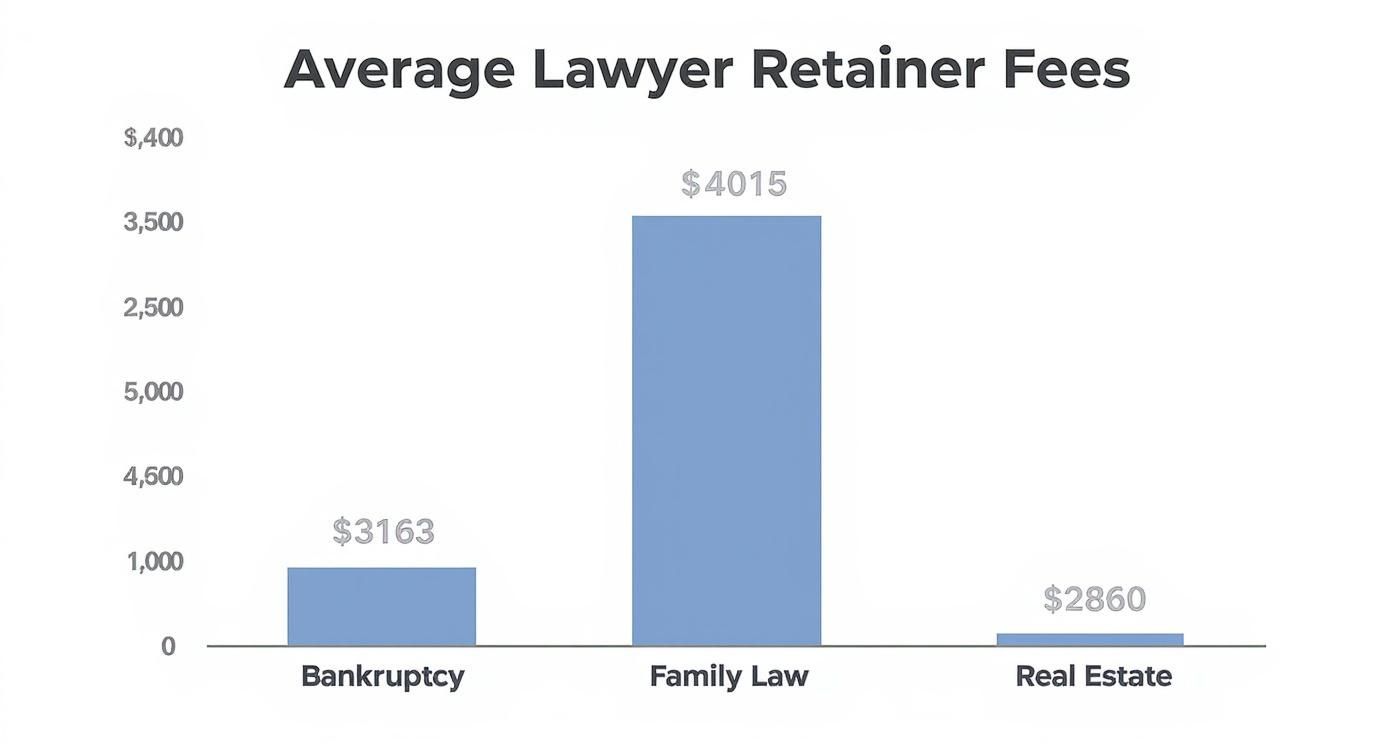
To add more context, let's look at some specific averages from recent industry data. The table below breaks down the typical retainer fees for different legal practice areas in the U.S. as of 2023.
| Practice Area | Average Retainer Fee |
|---|---|
| Bankruptcy | $4,015 |
| Family Law | $3,163 |
| Criminal Defense | $3,000 |
| Estate Planning | $2,708 |
This data shows that while family law retainers are a significant investment, they are right in line with—and sometimes even more moderate than—other complex legal fields that demand a lot of detailed work from the very beginning.
This comparison helps illustrate that family law costs aren't an outlier. Reports from within the legal industry back this up. A 2024 benchmark study noted that the average family law retainer in 2023 was $3,163, while bankruptcy cases averaged higher at $4,015. You can read the full report on law firm finances to see a complete breakdown.
Ultimately, understanding these numbers confirms that your initial investment is a standard and essential part of the legal process. This is especially true for the intensive work required by a Texas family law appeal attorney. Your retainer is what empowers your legal team to build the strongest possible foundation for your appeal.
How a Legal Retainer Agreement Actually Works
Once you decide to move forward with your family law appeal, the first step is paying the retainer. But where does that money go? It’s best to think of it less like a direct payment and more like pre-loading a dedicated account just for your legal services.
That money doesn't go into our firm's operating bank account. Instead, it’s deposited into a special, highly regulated account called an Interest on Lawyers' Trust Account (IOLTA). This account is kept completely separate from our business operations. This is not just our policy; it is a critical protection for you, mandated by Texas State Bar rules to keep your funds safe and secure.

The Billing Process and Transparency
As our appellate attorneys perform the meticulous work your case requires—from analyzing the trial record to drafting the complex legal brief—they track their time carefully. We believe transparency is the bedrock of a strong attorney-client relationship.
Every month, you'll receive a detailed, itemized invoice. This document provides a clear breakdown of all work performed, showing:
- Who performed the work: The specific attorney or paralegal.
- What they did: A clear description of the task, such as "Legal research on 'abuse of discretion' standard for property division."
- How long it took: The exact time spent on the task.
- The resulting fee: The time multiplied by that legal professional's hourly rate.
We then pay that invoice from the funds held in your trust account. You will see exactly where every dollar is going, with no guesswork involved. For law firms, keeping these records organized is crucial, which is where effective document management for law firms becomes essential.
Replenishing and Refunding Your Retainer
In a complex appeal, the initial retainer may not cover the entire process. If the balance in your trust account runs low, we will ask you to "replenish" it with additional funds. This is a standard practice, and our transparent invoicing ensures you will always see it coming and understand why it's necessary.
This system ensures your legal team has the resources to continue fighting for you without interruption—something that’s absolutely critical when you’re up against strict appellate court deadlines. It is an investment in maintaining your case's momentum.
What happens if your case concludes and there is still money left in your trust account? The remaining funds are returned to you. Once all final work has been invoiced, we are legally and ethically required to promptly refund every penny of the remaining balance. You only ever pay for the work that was actually performed on your case.
What Factors Determine the Retainer Fee?

It is common to wonder why one attorney may request a $3,000 retainer while another asks for $10,000. After an unfair trial outcome, facing another significant financial decision can feel overwhelming.
A retainer fee is not an arbitrary number. It is a calculated estimate based on the unique details and complexity of your case. It serves as a down payment for the time, strategic planning, and legal expertise your attorney anticipates needing to launch a powerful appeal.
Understanding the Standard of Review
The single biggest driver of an appellate retainer is complexity. An appeal is not a second trial. We cannot introduce new evidence or re-argue facts. Instead, our focus is on identifying legal errors made by the trial judge. The difficulty of proving these errors depends on the standard of review the appellate court will apply.
For example, proving an "abuse of discretion"—a common standard in family law where the trial judge's decision was arbitrary or unreasonable—requires a deep dive into the record and a highly persuasive legal argument. Cases involving complex property division, high-conflict child custody disputes, or protective orders often have multiple potential errors, increasing the upfront work required.
Here are a few common reversible errors that can increase the complexity—and thus the retainer:
- Improper Characterization of Property: The court incorrectly classified separate property as community property, or vice-versa.
- Misapplication of Child Custody Laws: The judge failed to properly consider the best interest of the child factors outlined in the Texas Family Code.
- Evidentiary Errors: The court improperly admitted or excluded key evidence that likely affected the outcome.
- Procedural Due Process Violations: A party was denied a fair opportunity to present their case.
The Attorney's Experience and Strategy
The attorney you choose is a critical factor. A board-certified appellate specialist with a proven track record of success will command a higher fee than a general practitioner. You are not just paying for their time; you are investing in their deep knowledge of the Texas Rules of Appellate Procedure, their strategic insight, and their ability to craft a powerful legal brief that persuades the higher court.
These factors cause retainer fees to vary. While a typical retainer for a family law case in the U.S. might fall between $2,000 and $5,000, retainers for incredibly complex appeals can climb significantly higher. You can discover more insights about retainer fees on Clio.com.
When you understand what goes into it, the retainer starts to look less like a barrier and more like a strategic investment. It's the fuel that allows your legal team to hit the ground running and fight for the outcome you deserve.
This initial fee is just one piece of the puzzle. Getting a handle on the overall cost of divorce in Texas can give you a much better picture of the total financial commitment.
Retainers Versus Other Legal Fee Structures

When you are facing the consequences of an unjust court decision, understanding your financial options is a critical first step. The retainer model is standard for Texas family law appeals, but it is not the only way attorneys are compensated. Let's examine other common fee structures to understand why the retainer model is best suited for the intense, detailed work an appeal demands.
Other Ways Lawyers Bill for Their Time
You might encounter a flat fee arrangement for more predictable legal tasks, such as drafting a simple will or handling an uncontested adoption. The scope of work is clearly defined from the outset, making a single, upfront price practical.
Then there is the contingency fee, commonly used in personal injury cases. Here, the attorney's payment is a percentage of the money recovered in a settlement or court award. If there is no recovery, the attorney does not get paid a fee. This model is prohibited in most Texas family law matters, including divorce and child custody cases.
Why the Retainer Model is Standard for Appeals
Family law appeals are fundamentally different. The retainer model, where an upfront deposit is billed against at an hourly rate, is structured for the unpredictable nature of appellate litigation.
An appeal is not a straightforward task. The amount of work can fluctuate significantly based on factors outside your attorney’s control.
The legal strategies employed by opposing counsel, the condition of the trial record, and the novel legal questions that arise can all drastically alter the hours required. A retainer gives your legal team the flexibility to dedicate the necessary resources precisely when needed, without having to stop work to renegotiate fees.
Understanding the different ways to cover legal costs is empowering. To get a fuller picture of the financial landscape, it's helpful to know what is legal funding and how it works, as it represents another avenue for managing the costs of a legal fight.
To put it all in perspective, here’s a quick breakdown of how these fee structures stack up.
Comparing Legal Fee Structures
| Fee Structure | How It Works | Common Practice Areas |
|---|---|---|
| Hourly Against Retainer | An upfront deposit is paid, and the lawyer's hourly work is billed against it. | Family Law, Appeals, Business Litigation |
| Flat Fee | A single, fixed price for a clearly defined legal service. | Simple Wills, Uncontested Divorce |
| Contingency Fee | The lawyer receives a percentage of the monetary award if the case is won. (Not used in TX family law) | Personal Injury, Medical Malpractice |
As you can see, the retainer system is the most practical and ethical fit for family law appeals. It ties the cost directly to the work performed, providing a transparent and fair approach to navigating a complex case toward a just resolution.
Your Retainer Is an Investment in a Fair Outcome
It is understandable to view legal fees as another burden, especially after an exhausting trial. However, when facing a court decision that feels fundamentally wrong, it is more accurate to see the retainer as an essential investment in seeking justice. The appeals process is the specific legal path designed to correct those wrongs and restore balance.
Paying a retainer is what gives your attorney the green light to begin that critical journey. This initial payment secures the focused, uninterrupted time and resources your legal team needs to build a powerful appeal from day one. The work is intense and heavily front-loaded.
What Your Retainer Immediately Funds
So, where does that money go? Your retainer allows your appellate attorney to dive straight into the most critical first steps of your case. These actions lay the foundation for everything that follows.
- Meticulous Record Review: Your lawyer must analyze every page of the trial record—transcripts, evidence, and rulings—to pinpoint where legal errors occurred.
- Identifying Reversible Errors: The goal is not to re-argue facts but to find a "reversible error"—a legal mistake so significant that it likely caused the wrong outcome. This could be a misapplication of the Texas Family Code or an "abuse of discretion" by the judge.
- Exhaustive Legal Research: Your attorney will research case law and legal precedent to build a rock-solid argument that proves the trial court's decision was legally flawed and must be overturned.
- Drafting the Appellate Brief: The retainer covers the immense time needed for "briefing." This is the formal, persuasive legal document submitted to the court of appeals, detailing precisely what went wrong and why the decision must be reversed or modified.
This commitment of resources is what allows your legal team to construct the strongest possible case for why the original outcome must be reconsidered. It's the fuel for the fight for fairness.
Even in cases that seem straightforward, like those in a no-fault state, legal complexities can still lead to major errors. You can learn more about how this applies in our guide to divorce proceedings in a Texas no-fault state. The average retainer fee for a lawyer in an appeal directly reflects the sheer volume of this specialized work—work that’s necessary to give your case the second chance it deserves.
Common Questions About Texas Retainer Fees
https://www.youtube.com/embed/MUPeLV8xNNg
When you are considering an appeal, having questions about the financial commitment is completely normal. You deserve clear, direct answers, and our goal is to be fully transparent about what the average retainer fee for a lawyer entails and how the process works.
Feeling confident about the finances allows you to focus on what truly matters: seeking justice for your family. This process is about restoring fairness, and that begins with open communication about costs.
What Happens if My Retainer Runs Out During My Case?
It is common for the work involved in a complex family law appeal to exceed the initial retainer. If your retainer funds are depleted, we will ask you to “replenish” the trust account.
This is a normal part of the process, particularly if an appeal requires extensive legal writing or must respond to unexpected motions from the other side. Through our detailed monthly invoices and proactive communication, you will always know if a replenishment is needed and see exactly what work was performed.
Are Retainer Fees Negotiable?
While our attorneys' hourly rates are set, the initial retainer amount is carefully calculated based on the anticipated needs of your specific case. It is not an arbitrary figure.
During our consultation, we will explain the factors informing that calculation, such as the complexity of the trial record and the specific legal errors we intend to challenge. Our priority is to set a retainer that adequately funds the crucial first stages of your appeal, giving your case the strongest possible start.
Is the Initial Consultation Fee Part of the Retainer?
No, the fee for your initial case evaluation is separate. This consultation is a dedicated strategy session where our appellate attorneys analyze the details of your trial, provide an initial legal assessment, and outline your potential appellate options.
It is your opportunity to determine if our firm is the right fit to handle your appeal. If you decide to move forward, we will then prepare a separate retainer agreement to officially begin our work on your case.
A key protection for all clients is the handling of unused funds. At the conclusion of your case, any money remaining in your trust account is rightfully yours. We are legally and ethically bound to promptly return the full remaining balance to you once the final invoice is settled. This ensures you only pay for the legal services you actually received.
If you believe the court made a mistake in your family law case, our appellate attorneys can help you seek a fair outcome. Contact The Law Office of Bryan Fagan today for a free consultation. Visit us at our website to get started.