Skip to content
You may feel your case was handled unfairly. After pouring your heart, soul, and savings into building a business, the divorce decree from the trial court can feel like a devastating blow. The judge may have misunderstood the value of your company, mislabeled your separate property, or ordered a division that threatens the very survival of your livelihood.
When a court's decision seems fundamentally unjust, it's easy to feel overwhelmed and defeated. But it is critical to understand that the trial court's ruling does not have to be the final word. The Texas appellate process was specifically designed to correct these kinds of significant legal errors and restore a fair and just balance.
What You Can Appeal in a Texas Divorce Case Involving a Business

It’s completely normal to feel like the initial court ruling was unfair. Perhaps the valuation felt off, or the asset division threatens the very core of your operations. An appeal is not a second trial or a chance to present new evidence. Instead, it is a focused, strategic review of the trial record to determine if the judge made a reversible error—a legal mistake so significant that it likely led to an improper outcome.
Protecting what you've built requires a specific legal approach focused on appellate advocacy. This guide is designed to provide a clear roadmap for understanding your rights and options when appealing a decision involving your business.
Common Reversible Errors in Texas Family Courts
When your personal and professional worlds collide this forcefully, the fallout is tangible. A recent study found that among divorcing entrepreneurs, 57% saw their company take a direct financial hit, and a staggering 70% admitted their focus at work suffered significantly. The strain is so real that, on average, business owners see a $4,000 decline in monthly revenue during the divorce. Tragically, for nearly 5%, the economic pressure becomes too much, and they're forced to shut down the business entirely. You can read more about these findings on Fortune.
When a business is involved, an unfair divorce decree can cripple a vital asset. A successful appeal is about preserving that asset and ensuring the court's decision is based on fair, accurate, and legally sound principles as required by the Texas Family Code.
Shifting from Defense to a Strategic Appeal
An appeal requires a different playbook than a trial. It is a technical, rules-driven process focused on the law, not the facts. A skilled appellate attorney will analyze the record for specific legal errors, such as:
- Mischaracterization of Property: The court incorrectly labeled your separate property business as community property, leading to an unjust division.
- Adopting a Flawed Valuation: The judge relied on a business valuation that was based on improper methodology or failed to follow Texas law regarding personal goodwill.
- Abuse of Discretion: The judge’s final division of property was so arbitrary or unreasonable that it violated the "just and right" standard.
If you are reading this because you feel a court has already made a critical error in one of these areas, remember this: the fight for a just outcome isn’t over. The appeals process exists for this exact reason—to correct legal mistakes and ensure fairness.
How Texas Law Defines Your Business Assets
When appealing a divorce decree, one of the most common grounds is that the trial court incorrectly characterized the business. Under the Texas Family Code, every asset must be labeled as either community or separate property before it can be divided. This initial step, characterization, is the bedrock of the entire property division, and getting it wrong is a significant legal error.
The law begins with the community property presumption. This means any property acquired by either spouse during the marriage—including a business—is presumed to belong to the marital estate. If you claim the business is your separate property, the burden was on you at trial to prove it with clear and convincing evidence.
The Critical Distinction: Community vs. Separate Property
Understanding the difference between these two categories is non-negotiable for evaluating a potential appeal. This distinction determines what was legally on the negotiating table.
- Separate Property: This is anything you owned before the marriage. It also includes assets acquired during the marriage as a gift or inheritance. A business you started and fully owned before the marriage is your separate property.
- Community Property: This is all property, other than separate property, acquired by either spouse during the marriage. A business launched after you were married is almost always community property, regardless of whose name is on the legal documents.
It sounds straightforward, but the reality of running a business while married often blurs these lines, creating complex legal issues that trial courts can get wrong.
When Separate Property Gets Complicated
Even if your business was established before the marriage, it is rare for it to remain 100% separate. If community funds (money earned during the marriage) were used to pay business debts or fund growth, the community estate may have a financial interest. This can lead to a reimbursement claim, where the marital estate is entitled to be paid back for its contributions to the separate property business.
The legal cornerstone here is the inception of title rule. An asset's character as separate or community is determined at the moment it is acquired. However, the value and equities can shift over time through the investment of community time, effort, and money, which can complicate the final division.
How a Business Can Be Both Separate and Community
One of the thorniest issues we see on appeal is when a separate property business increases significantly in value during the marriage. If that growth was due to the "time, toil, and talent" of either spouse, a court can rule that the increase in value is community property.
Think of it this way: the original business is your separate property "tree," but the "fruit" it produced during the marriage—thanks to community effort—belongs to the marital estate. Unpacking this requires sophisticated analysis, often from forensic accountants. You can explore more of these crucial divorce and business insights on DivorceAnalytics.com.
Here’s a quick breakdown of how Texas law might view different scenarios:
Community vs. Separate Property Business Claims in Texas
| Business Scenario | Likely Characterization | Key Legal Consideration |
|---|---|---|
| Business started during the marriage with marital funds. | Community Property | Inception of title occurred during the marriage. Presumed to be part of the marital estate. |
| Business owned before the marriage, with no marital contributions. | Separate Property | Inception of title was prior to the marriage. Spouse must provide clear proof of this. |
| A pre-marital business that grew significantly due to a spouse's efforts. | Mixed Character | The original business is separate, but the increase in value due to community labor is community property. |
| Funds from a joint account are used to pay a pre-marital business loan. | Separate with a Claim | The business remains separate, but the community estate has a reimbursement claim for the funds it contributed. |
| A spouse receives a business as an inheritance during the marriage. | Separate Property | Property acquired by gift, devise, or descent is legally defined as separate property in Texas. |
Properly characterizing your business isn't just a legal formality. If a trial court gets this wrong and mislabels your separate property as community, it is a major legal error and one of the most common reasons for a successful appeal in Texas.
Understanding the Standard of Review for Business Valuations
An inaccurate business valuation can create a fundamentally unfair property division. This is another common reason people seek justice through the appellate process. A proper valuation requires a deep, methodical analysis from a qualified expert, and if the trial court relied on a flawed one, it may be grounds for reversal.
An appeal is not a chance to get a new valuation. Instead, your appellate attorney will review the trial record to see if the valuation the judge accepted was legally sound and based on established principles.
The Three Core Valuation Methods
When an expert values a business for a divorce, they typically use one of three established approaches. The method must be appropriate for the type of business.
- Asset-Based Approach: Calculates the value of the company's assets minus its liabilities. It is best for asset-heavy businesses like real estate holding companies.
- Market-Based Approach: Compares the business to similar companies that have recently sold. This works best when there is sufficient sales data for comparable businesses.
- Income-Based Approach: Focuses on the business’s ability to generate future income. This is the go-to method for service-based businesses with a strong history of profitability.
Using the wrong method can produce a wildly inaccurate number. For instance, using an asset-based valuation for a successful law firm would ignore its most significant asset: its income stream and reputation. This is precisely the kind of clear error an appellate court can correct.
The infographic below shows how a business's legal status can evolve, shifting from separate property to a marital asset requiring division.
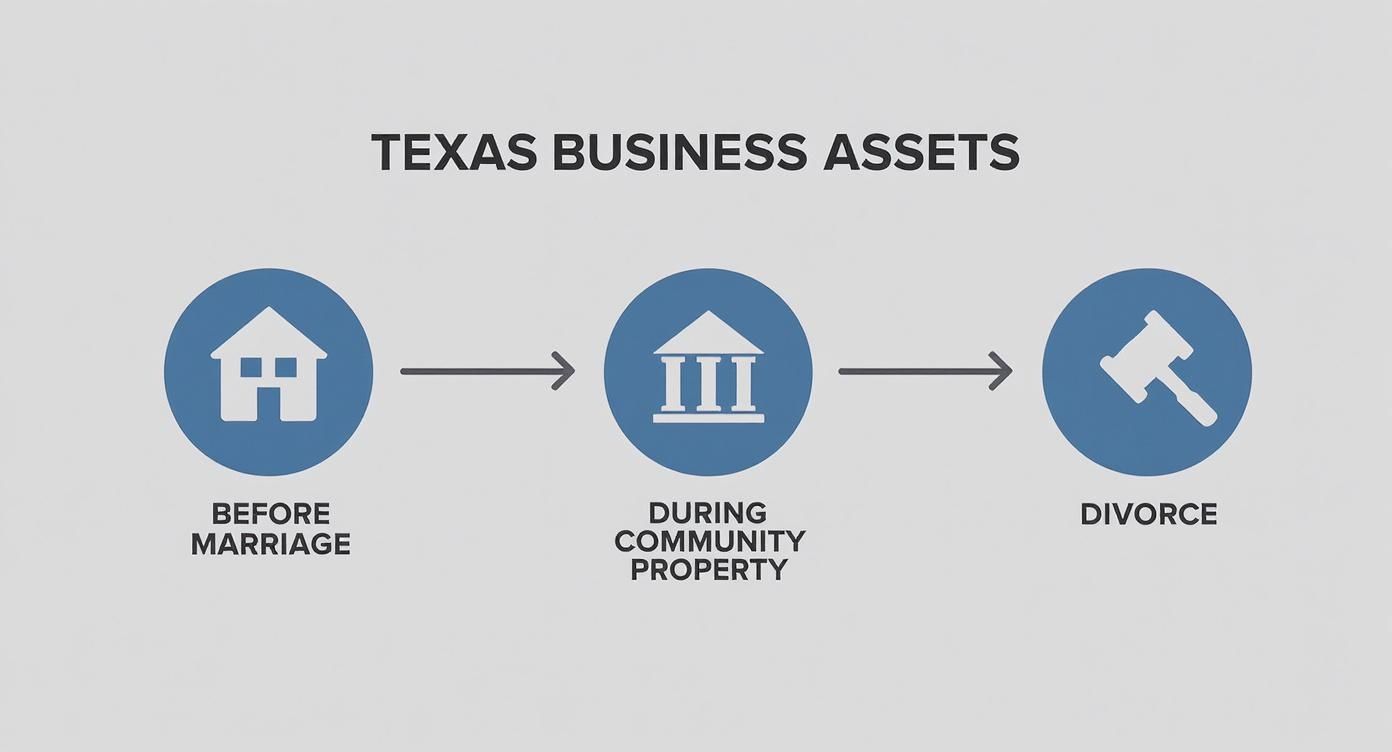
This journey from separate to community property is why a precise, legally compliant valuation is so critical—it’s the only way to fairly untangle what belongs to each estate.
The Goodwill Dilemma: Personal vs. Enterprise
One of the most complex issues in divorcing with a business is handling "goodwill"—the intangible value of a company's reputation. Texas law makes a crucial distinction that can dramatically impact the final property division.
- Personal Goodwill: This is the value tied directly to your skills, reputation, and client relationships. Because this value is inseparable from you, it is legally your separate property.
- Enterprise Goodwill: This value belongs to the business itself, independent of any single person. It includes brand recognition, customer lists, and established operational systems. This is a community asset that can be divided.
A credible valuation must separate personal from enterprise goodwill. If the trial court's valuation expert failed to do so and the judge adopted that flawed number, it unfairly inflated the marital estate. This is a strong argument for a reversible error on appeal. To see how our appellate attorneys analyze these nuances, you can review our resources on business valuation appeals in Texas divorces.
Reversible Error (Plain English): This is a legal mistake made by a judge during a trial that was serious enough to have likely changed the final outcome. Proving this type of error is the key to winning an appeal.
Why a Certified Expert Is Non-Negotiable at Trial
In a high-stakes divorce, the credibility of the valuation expert is paramount. A trial judge must decide which expert's testimony is more reliable. You need a certified business appraiser or forensic accountant who specializes in litigation support. Their reports must be able to withstand intense cross-examination and judicial scrutiny. You can learn more about the importance of professional business valuation services in legal disputes.
If you feel the court's final decision was based on a flawed valuation, an appellate attorney can review the record for errors and help you fight for the fair outcome you deserve.
Strategic Options for Dividing Business Assets

Once a business is characterized and valued, the court must order a "just and right" division. Sometimes, the method of division ordered by the court is itself unworkable, unfair, or legally improper, which can be another basis for an appeal. The goal is to find a path that is both legally sound and practically feasible, preserving the business as a going concern whenever possible.
The Buyout: The Most Common Solution
For most entrepreneurs divorcing with a business, the cleanest resolution is a buyout. In this scenario, one spouse keeps the business and compensates the other for their share of the community property interest. This is often structured by trading other community assets, such as equity in the marital home or retirement accounts, to avoid draining the business of essential operating cash. A key advantage is finality, allowing both parties to move forward independently.
Co-Ownership After Divorce: A Risky Path
Another option, though rarely advisable, is for the ex-spouses to continue as business partners. This path is filled with potential conflict and should only be considered if the relationship is exceptionally amicable. If a court orders co-ownership, it must be structured with a detailed and ironclad operating or shareholders' agreement that clearly defines:
- Roles and responsibilities
- Decision-making authority
- Dispute resolution procedures
- Exit strategies
An order forcing co-ownership without such protections could be challenged on appeal as an abuse of discretion.
Selling the Business: The Last Resort
When a buyout isn't feasible and co-ownership is not an option, the court may order the business to be sold and the proceeds divided. This is often seen as a last resort because it means dismantling a valuable, income-producing asset. A forced sale under the pressure of a divorce timeline often results in a lower sales price, harming both parties financially.
The core principle in dividing a business is to find a solution that is both legally fair and practically workable. A judge's primary duty is to achieve a 'just and right' division, but a poorly structured division that cripples the business serves no one's long-term interests.
Advanced Considerations for International Businesses
The complexity skyrockets when a business operates across international borders. Dividing a multinational company presents unique challenges related to legal jurisdiction, fluctuating currency exchange rates, and complex tax implications across different countries. You can get more insights into these challenges when dividing an international business on fordfriedmanlaw.com.
If you feel the trial court ordered an unworkable division—such as a forced sale, an impractical co-ownership arrangement, or a buyout based on a flawed valuation—you may have grounds for an appeal. These are precisely the kinds of legal or factual errors that appellate review is designed to correct.
If you believe the court made a mistake in your family law case, our appellate attorneys can help you seek a fair outcome. Contact The Law Office of Bryan Fagan today for a free consultation.
Appealing an Unfair Property Division Ruling
You have been through a long and difficult trial. You presented your evidence and waited anxiously for the judge's final decision. When the divorce decree arrived, your heart sank. The court's division of your business and other assets feels fundamentally wrong and disconnected from the facts presented in court.
That sense of injustice is a heavy burden, but the trial court's ruling is not necessarily the final word. The Texas appellate process provides a path to correct significant legal errors made by the trial court. It is important to understand that an appeal is not a second trial. You cannot introduce new evidence. An appeal is a highly technical review of the trial record to identify legal mistakes that led to an unfair result.
Understanding the Standard of Review in Property Division
When you're divorcing with a business, Texas law requires property to be divided in a "just and right" manner. This standard gives trial judges significant discretion. Because of this, an appellate court does not simply substitute its own judgment for the trial judge's. It reviews the decision through a specific legal lens called the standard of review.
For property division cases, the standard is almost always abuse of discretion. This legal term is key to any appeal.
Abuse of Discretion (Plain English): This does not mean the judge acted with bad intentions. Legally, it means the judge's decision was arbitrary, unreasonable, or made without referencing guiding legal rules and principles. An appellate attorney's job is to prove to a higher court that the judge’s ruling crossed that line.
The appellate court will meticulously review the trial transcript and all submitted evidence. They are looking to answer two key questions: Did the trial judge have sufficient information to make a ruling, and did the judge apply the law correctly to the facts?
Common Reversible Errors in Business Division Cases
Not every mistake a judge makes is grounds for a successful appeal. The error must be a reversible error—one so significant that it likely caused the court to issue an improper judgment. In complex cases involving a business, common reversible errors include:
- Mischaracterization of Property: The court incorrectly treats your separate property business as community property, improperly subjecting it to division.
- Adopting a Flawed Valuation: The judge accepts a business valuation that used an incorrect methodology, ignored key financial data, or wrongly included personal goodwill as a divisible community asset.
- Making an Unjust Division: Even if the property was characterized and valued correctly, the final division was so disproportionate and unfair under the circumstances that it constitutes an abuse of discretion.
- Ignoring Key Evidence: The court disregarded credible, relevant evidence without a valid reason, leading to a decision unsupported by the facts in the record.
For a more detailed look at the procedures and timelines, our guide on how to appeal a family court decision in Texas breaks down the essential steps.
The Appellate Process Step by Step
Challenging a judge's ruling is a methodical, rules-driven process governed by the Texas Rules of Appellate Procedure. It begins by filing a Notice of Appeal, and the deadline is strict—typically 30 days from the date the final judgment is signed. Missing this deadline will likely forfeit your right to appeal forever.
Next, the appellate record is prepared. This includes the clerk’s record (all documents filed in the case) and the reporter’s record (the word-for-word transcript of all hearings and the trial). Your appellate lawyer will scrutinize this record to identify reversible errors.
The core of the appeal is the briefing. This is a formal legal document where your attorney crafts a persuasive argument, citing case law and statutes, to explain to the appellate justices exactly where and how the trial judge erred. The other side will file a response brief, and your attorney may file a final reply. This process is built on precise legal analysis and persuasive writing, not emotion.
If you believe the court made a mistake in your family law case, our appellate attorneys can analyze your situation to determine if you have grounds to seek a more just outcome. Contact The Law Office of Bryan Fagan today for a free consultation.
What If the Court Gets It Wrong? Protecting Your Business on Appeal
When you are in the midst of a divorce involving a business, you trust the legal system to produce a fair and equitable outcome. But sometimes, the court makes a significant mistake.
It happens more often than people realize. A judge might misapply the law on business valuation, mischaracterize separate property as community, or issue a ruling based on a misunderstanding of your business's finances. These are not minor oversights; they are errors that can fundamentally alter your financial future and the viability of the business you have worked so hard to build.
This is precisely why the appellate process exists. It is not about getting a "do-over," but about correcting legal errors that led to an unjust result. If a judge misapplied Texas law or made a decision that was an abuse of discretion, you have the right to challenge that decision.
An experienced Texas family law appeal attorney can conduct a thorough review of your case, meticulously analyzing the trial record, transcripts, and evidence for reversible errors.
You do not have to accept an unfair outcome as the final word. A successful appeal can protect your life's work and provide the fair resolution you are entitled to under the law.
If you are looking at a divorce decree that feels fundamentally wrong, do not simply accept it. Get a second opinion on your appellate options. Contact The Law Office of Bryan Fagan today for a free consultation to see if an appeal is the right next step for you.
Common Questions on Divorce for Business Owners
When you have poured everything into building a business, divorce brings a unique level of complexity. We have guided countless entrepreneurs through the appeals process, and a few key questions consistently arise.
Can My Spouse Get Half My Business If I Started It Before Marriage?
This is a primary concern for any entrepreneur. The short answer is no, not directly half of the entire business. In Texas, a business you owned before marriage is your separate property. However, the analysis does not stop there.
If community funds (money earned during the marriage) were used to pay business loans or fund growth, the marital estate has a right to be paid back through a reimbursement claim. More importantly, if your business's value increased significantly during the marriage due to your labor or your spouse's contributions, that increase in value can be classified as community property subject to a "just and right" division. If a trial court failed to properly trace these assets, it could be a reversible error.
What Is Personal Goodwill and Why Does It Matter?
Goodwill is the intangible value of your business's reputation. Texas law divides it into two distinct types, and a court's failure to distinguish between them is a critical error.
- Enterprise Goodwill: This value is tied to the business itself (brand name, customer lists). It is a community asset and is divisible in a divorce.
- Personal Goodwill: This value is attached directly to your unique skills and personal reputation. Because it cannot be sold and would leave with you, it is your separate property.
A proper business valuation must separate personal from enterprise goodwill. When a court adopts a valuation that improperly includes your personal goodwill in the community estate, it unfairly inflates the divisible property and is a common basis for a successful appeal.
What Happens If We Disagree on the Business Value?
It is nearly certain that you and your spouse will disagree on the business's worth. At trial, this becomes a "battle of the experts," where each side presents testimony from a certified valuation professional. The judge then weighs their credibility and decides on a final value.
If you believe the judge made a significant mistake—for example, by accepting a valuation based on a flawed methodology or ignoring critical evidence—that decision could be challenged on appeal as an abuse of discretion.
Abuse of Discretion (Plain English): This is a legal standard where an appellate court finds that a trial judge's decision was so arbitrary or unreasonable that it amounted to a clear error of judgment.
It is also important to remember the financial impact beyond asset division. Be sure to understand the various tax considerations during divorce, as they can have a significant long-term effect.
Do I Have to Sell My Business?
No. A forced sale is a drastic measure and is almost always a last resort for Texas courts. The most common solution is a buyout, where one spouse keeps the business and trades other community assets (like equity in the home or retirement funds) to compensate the other spouse for their share.
If a court orders a sale or another unworkable division without properly considering less drastic alternatives, its decision might be appealable as an abuse of discretion.
If you believe the court made a mistake in your family law case, our appellate attorneys can help you seek a fair outcome. Contact The Law Office of Bryan Fagan, PLLC today for a free consultation at https://familylawcourtappeals.com.