You may feel your Texas family law case was handled unfairly, and the final judgment doesn’t reflect what is right or just. When a judge’s ruling feels fundamentally wrong, it's easy to think the fight is over. But a trial court's order isn't always the final word. An appeal in law is a structured path to seek justice, asking a higher court to review the decision for legal errors that may have led to an unfair result.
It's important to understand that an appeal is not a do-over of your trial. You don't get to present new evidence or have witnesses testify again. Instead, the process is a strategic legal argument focused entirely on whether the trial judge made a significant mistake that changed the outcome of your case.
Your Path to Justice After an Unfair Ruling

When a judge’s ruling in your family law case feels fundamentally wrong, it's easy to think the fight is over. But a trial court's order isn't always the final word. An appeal offers a crucial, structured path to challenge that decision by asking a higher court to check for legal errors that may have led to an unjust result.
It's important to understand, though, that an appeal is nothing like the original trial. You don't get to present new evidence or have witnesses testify again. Instead, the entire process shifts to a technical, strategic argument aimed at convincing a panel of appellate judges that a critical legal error tainted the final judgment.
Correcting Mistakes and Seeking Fairness
At its core, the goal of an appeal in law is to correct a trial judge's mistake. We’re not talking about small procedural hiccups; we’re looking for a “reversible error,” which is a mistake so serious that it likely caused the court to issue the wrong judgment. Think of the appellate court as a quality-control check on the trial court’s work, focused on restoring fairness and balance.
An appellate court’s review is laser-focused on a few key areas under the Texas Rules of Appellate Procedure:
- The Law: Did the judge properly interpret and apply the Texas Family Code to the facts of your case?
- The Procedure: Were all court rules followed correctly to protect your rights to due process?
- The Evidence: Was critical evidence wrongly kept out, or did the judge consider something they shouldn't have?
A successful appeal can completely change your situation. It might lead to the higher court reversing the decision, ordering an entirely new trial, or simply modifying one part of the judgment, like an unfair child custody order or an inequitable property division.
Challenging a ruling demands meticulous preparation and a deep, practical knowledge of appellate law. The journey always begins with one question: Is there a valid legal error worth appealing? An experienced appellate attorney can give you the clear answer you need.
If you believe the court made a mistake in your family law case, our appellate attorneys can help you seek a fair outcome. Contact The Law Office of Bryan Fagan today for a free consultation.
What You Can Appeal in a Texas Family Law Case
When a trial judge issues a final order in your Texas family law case, it can feel like the end of the road. But what if the judge made a serious legal mistake? That's where an appeal comes in. An appeal is not a second chance to argue the facts. It is your first and only chance to argue that the trial judge got the law wrong.
An appeal isn’t a do-over or a second trial. Instead, it’s a formal request to a higher court—the court of appeals—to review the trial court’s decision for significant legal errors. You're essentially asking a panel of experienced judges to look at how the law was applied in your case, based on the Texas Rules of Appellate Procedure and the Texas Family Code.
The Appellate Court's Role: Reviewing the "Game Tape"
Think of the trial as the game itself and the trial judge as the referee on the field. The appellate court, in this analogy, is the review booth. Its job isn't to replay the game with new evidence or different witnesses. Its purpose is to look at the "game tape" and determine if the referee made a call that violated the rules so badly it may have changed the outcome.
Because the appellate judges weren't in the courtroom to see the witnesses or hear the testimony firsthand, they give a great deal of respect to the trial judge's decisions on facts—like who seemed more credible. Their focus is almost entirely on finding mistakes in the law.
The "game tape" they review is called the "appellate record." This is the complete, official file from your trial, and it's the only evidence the higher court will consider. It includes:
- The Reporter's Record: A word-for-word transcript of everything said during the trial.
- The Clerk's Record: Every document filed in your case, from the initial petitions to motions and the final judgment.
- Exhibits: All the evidence that was officially admitted, such as bank statements, emails, or photos.
Finding a "Reversible Error"
To win an appeal, you have to prove more than just a simple mistake. You must show the trial court made a “reversible error.” This is a legal blunder so significant that it likely caused the court to issue an improper judgment. A minor, harmless oversight won't be enough to overturn the original decision.
As the person filing the appeal, you are known as the "appellant." The other party is the "appellee." Your appellate lawyer’s task is to comb through the appellate record and build a powerful written argument, called a "brief," that pinpoints the judge’s error and clearly shows how it harmed your case. This process is known as briefing.
This is a critical backstop in our legal system. Family law cases, from divorce to child custody battles, make up a massive part of the judicial workload. With so many cases, judges can, and do, make mistakes that undermine fairness.
An appeal is not a second chance to win on the facts. It is your first and only chance to argue that the trial judge got the law wrong.
Whether your case involved a complex property division or a contentious protective order, if you suspect a critical legal error tainted the outcome, an appeal might be your only path to a just result.
If you believe the court made a mistake in your family law case, our appellate attorneys can help you seek a fair outcome. Contact The Law Office of Bryan Fagan today for a free consultation.
Understanding How an Appeal Differs From a Trial

To have any chance at correcting an unjust court ruling, you first have to grasp a critical concept: an appeal is not a do-over of your trial. Many people believe an appeal is a second chance to tell their story. This is a fundamental and often costly misunderstanding of how our legal system provides for due process.
The trial court’s job is to figure out the facts—to answer the question, “What happened?” This is where you see witnesses take the stand, new evidence get introduced, and a judge or jury weigh competing stories to decide what’s true. An appellate court, on the other hand, does something entirely different. Its job is to review the law and answer the question, “Did the trial judge apply the law correctly?”
The Focus Shifts from Facts to Legal Errors
Think of your trial as the main event. Your attorney presents a narrative, backs it up with evidence, and asks witnesses questions to build your case. The entire process is about establishing facts. Did a spouse intentionally hide assets during a divorce? Is a specific custody schedule truly in the child's best interest? The judge makes a decision based on the evidence presented in that courtroom, at that time.
An appeal in law changes the game completely. The appellate court isn't interested in hearing new testimony or looking at new evidence. Instead, a panel of judges will pour over the "appellate record"—a complete collection of every transcript, document, and exhibit from your original case—to hunt for legal mistakes made by the trial judge.
Your argument is no longer about the personal details of your situation. You’re not there to prove you’re a better parent. You're there to prove the judge committed a legal error, like ignoring a crucial piece of evidence or misinterpreting a specific section of the Texas Family Code when making a child custody ruling.
An appeal is a highly technical, strategic argument focused on legal precision. It is an intellectual debate with the appellate court, conducted almost entirely through written arguments called briefs, about whether the trial process was fair and legally sound.
Understanding the Standard of Review
Here’s where things get really challenging. A huge difference between a trial and an appeal is something called the “standard of review.” This is the level of respect, or deference, the appellate court is required to give the trial judge’s decision. For most Texas family law cases, that standard is “abuse of discretion.”
So what does that actually mean?
In plain English, abuse of discretion means you have to prove the trial judge made a decision that was unreasonable, arbitrary, or completely disconnected from the facts or the law. It’s not enough to argue that the appellate judges might have made a different choice. You have to show the trial judge’s decision was so far outside the bounds of the law that it was indefensible.
Proving this is a very high bar to clear. It’s why you need an appellate attorney who knows how to frame the issue not as a simple disagreement, but as a clear-cut legal error that the higher court is compelled to fix to ensure fairness.
Trial vs. Appeal: Key Differences in Texas Family Law
| Aspect | Trial Court | Appellate Court |
|---|---|---|
| Purpose | To establish facts and apply the law to them for the first time. | To review the trial court’s actions for legal errors. |
| Decision-Maker | One judge (or sometimes a jury). | A panel of three or more judges. |
| Evidence | New evidence, testimony, and exhibits are presented. | No new evidence is allowed. The court only reviews the existing "record." |
| Key Question | "What happened?" | "Did the trial judge make a reversible legal error?" |
| Primary Argument | Based on presenting facts and witness credibility. | Based on written legal analysis of statutes and case law. |
Getting a handle on these distinctions is the first step toward building a winning appellate strategy. An appeal demands a total shift in mindset—from telling a personal story to proving a technical, legal mistake. It’s a precise and demanding process, but it’s often the only path to correcting an unjust outcome from a complex property division or other family law matter.
If you believe the court made a mistake in your family law case, our appellate attorneys can help you seek a fair outcome. Contact The Law Office of Bryan Fagan today for a free consultation.
Common Grounds For an Appeal in Texas Family Law
Not every disappointing outcome in a Texas family court is grounds for an appeal. A gut feeling that the judge’s ruling was simply "unfair," unfortunately, isn't enough to get a higher court to step in. A successful appeal in law has to be built on something much more specific: identifying a significant legal mistake the trial judge made.
We call these "reversible errors"—mistakes so serious that they very likely caused the judge to reach the wrong conclusion. Figuring out if one of these errors occurred in your case is the first, most critical step. These errors usually fall into a handful of key categories. An appellate attorney's job is to comb through every page of the trial record, looking for evidence of these mistakes to build a compelling case for the higher court.
Abuse of Discretion in Family Law Rulings
By far, the most frequent reason for appealing a family law case in Texas is abuse of discretion. This is the standard used to review most of the judge’s biggest decisions—things like who gets custody, how property is divided, or whether someone receives spousal support.
But what does that actually mean in plain English?
Abuse of discretion happens when a judge makes a decision that is arbitrary, unreasonable, or completely disconnected from the guiding rules and legal principles they are supposed to follow. The question isn't whether the appellate court would have decided differently. The question is whether the trial judge’s decision was so far off the rails that it was legally indefensible.
Think of it this way: imagine a judge handling a child custody case. There’s documented evidence of one parent's ongoing substance abuse, but the judge ignores it entirely and gives that parent significant time with the child simply because they have a higher income. This decision would almost certainly be an abuse of discretion. Why? Because the judge failed to apply the most important guiding principle in the Texas Family Code: the best interest of the child.
Here are a few common reversible errors that might qualify as an abuse of discretion:
- Ordering a 50/50 possession schedule when there's overwhelming evidence that one parent is unstable and poses a risk to the child's safety or emotional well-being.
- Awarding a wildly lopsided share of the community property in a divorce without any factual or legal reason to justify such an unequal split.
- Refusing to award spousal maintenance even when the spouse asking for it clearly meets all the legal requirements under the Texas Family Code and the other spouse has the ability to pay.
Misinterpretation of the Law or Evidence
Another major ground for appeal is when the trial judge simply gets the law wrong. This is a bit different from abuse of discretion. It’s not about an unreasonable judgment call; it's about a black-and-white legal error. The judge might have misunderstood a statute in the Texas Family Code or failed to apply a binding precedent set by a higher court.
For example, during a property division, a judge might mistakenly label an inheritance—which is almost always separate property—as community property and divide it between the couple. That's a direct misapplication of Texas law and a very strong basis for an appeal.
An appeal can also arise from a judge's mishandling of evidence. This can cut both ways:
- Improperly Admitting Evidence: The judge let the other side introduce evidence that should have been thrown out, like unreliable hearsay or irrelevant details that did nothing but unfairly prejudice your case.
- Improperly Excluding Evidence: The judge refused to let you present crucial evidence you needed to make your case, such as vital financial records or testimony from an expert witness.
For any of these mistakes to matter on appeal, they must have been harmful—in other words, the error probably caused the court to issue an improper judgment. As you can see, understanding the many potential grounds for appeal in family court requires a deep knowledge of both trial procedure and the substance of family law.
If you believe a serious mistake was made in your family law case, our appellate attorneys can analyze the record and help you explore your options. Contact The Law Office of Bryan Fagan today for a free consultation.
Navigating the Texas Appellate Process and Timelines
When you decide to appeal a court's decision, you're stepping onto a path with a very strict and unforgiving schedule. The Texas Rules of Appellate Procedure set the entire timeline, and missing a single deadline can permanently shut the door on your case. Knowing these rules isn't just a good idea; it's everything.
The whole process starts with one critical action: filing the Notice of Appeal. This document is your official entry ticket into the appellate system. It's a straightforward filing that lets the trial court and the other side know you're challenging the judge's final order.
The Countdown Begins: The Notice of Appeal
In most Texas family law cases, the clock is ticking loudly from day one. You have just 30 days from the date the judge signed the final judgment to file your Notice of Appeal. This is your first and most critical deadline.
Now, there's a small exception. If you file certain post-judgment motions, like a Motion for New Trial, that window can be extended to 90 days. But using this strategy has to be a calculated decision. If you miscalculate and file the Notice of Appeal even one day late, the court will almost certainly dismiss your appeal, no matter how strong your arguments are.
Once the Notice of Appeal is properly filed, the next job is to gather all the evidence for the higher court. This is known as preparing the record. Your attorney will order the official court reporter's transcript (the Reporter's Record) and gather all the documents filed with the court clerk (the Clerk's Record). This collection becomes the only evidence the court of appeals is allowed to look at.
The Briefing and Argument Stage
With the record filed, the real heart of the appeal work begins: briefing. This is where your appellate lawyer crafts a detailed, persuasive written argument—the appellate brief. This document is the absolute cornerstone of your case.
The briefing process unfolds in a few key steps:
- Appellant's Brief: First, your attorney files the opening brief. This document lays out the facts of your case, points out the specific, reversible errors the trial court made, and cites legal precedent to argue why the decision needs to be overturned.
- Appellee's Brief: The other party then gets their turn to respond, defending the trial court's decision and trying to poke holes in your arguments.
- Reply Brief: Finally, your attorney often gets one last shot to file a shorter reply brief, directly addressing the points the other side just made.
After all the briefs are in, the court might schedule an oral argument. This is a formal, in-person hearing where your lawyer stands before a panel of three appellate judges to present your case and answer their questions on the spot. It's an intense and valuable opportunity, but not every case gets one. Many appeals are decided solely on the written briefs.
An appeal is a marathon, not a sprint. While the initial deadline is tight, the entire process—from filing the notice to receiving a final decision—can often take a year or more. You can learn more about how long it takes to process a divorce and related legal actions in our detailed article.
This timeline illustrates the critical grounds an attorney looks for when reviewing a case for a potential appeal.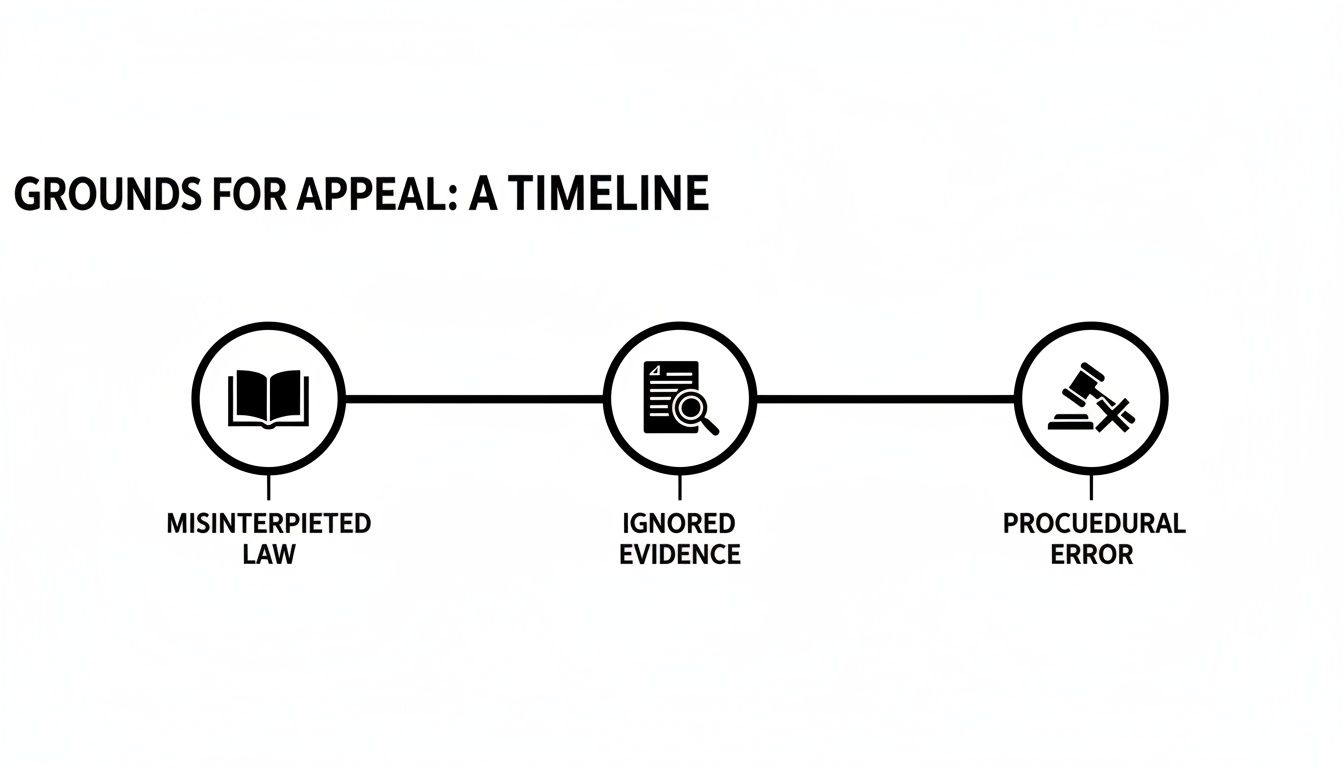
Finding these kinds of errors—where the judge misinterpreted the law, ignored crucial evidence, or failed to follow proper procedure—is what gives an appeal a real chance of success.
Once the briefs are submitted and any oral argument is finished, the case is "submitted" to the court for a decision. The appellate judges then take all the information—the record, the written arguments, and their notes—and get to work on a formal written opinion. That opinion will either affirm the trial court's judgment, reverse it, or modify it in some way.
Family law appeals are tough. They often hinge on very specific legal issues, like proving a judge misapplied a statute or abused their discretion. In Texas, your case goes to one of 14 regional courts of appeals, and while they all follow the same main rules, each has its own local flavor. The national odds are sobering: fewer than 20 percent of civil appeals actually succeed, which shows why precision and deep legal expertise are non-negotiable.
If you believe the court made a mistake in your family law case, our appellate attorneys can help you seek a fair outcome. Contact The Law Office of Bryan Fagan today for a free consultation.
Why a Specialized Appellate Attorney Is Essential

Winning a trial and winning an appeal in law are two completely different games, played on different fields with different rules. A fantastic trial lawyer is a storyteller, an expert at weaving facts, evidence, and testimony into a compelling narrative for a judge or jury. Their world is the live, dynamic courtroom.
Once the final gavel falls, however, that world disappears. An appeal isn't a second trial; it’s a deep, academic dive into the legal mechanics of the first one. The victory here doesn't depend on witness testimony or dramatic reveals. Instead, it’s won or lost based on the quality of a highly technical, meticulously researched written document called a brief. This is where an appellate specialist steps in.
A Different Arena Requires a Different Expert
Think of an appellate lawyer as a legal scholar and a detective rolled into one. Their job is to sift through every page of the trial record—the transcripts, the exhibits, the motions—looking for the critical legal mistakes that could turn the case around. They aren't there to re-tell the story; they're there to prove the judge got the law wrong.
This specialized focus gives them a critical edge:
- Objective Error Spotting: An appellate attorney brings a fresh set of eyes. Unburdened by the emotional history and daily battles of the trial, they can objectively identify legal errors that the original lawyer, deep in the trenches, might have overlooked.
- Mastery of Persuasive Legal Writing: Writing a brief is an art form. It’s about building a sophisticated argument designed to convince a panel of experienced judges that a specific, reversible error occurred. This is a far cry from a closing argument to a jury.
- Navigating Procedural Minefields: The Texas Rules of Appellate Procedure are notoriously complex. From filing the initial Notice of Appeal to preparing the record and hitting strict briefing deadlines, one wrong move can get your entire appeal dismissed before it's even heard.
The Hard Truth About Pro Se Appeals
It's tempting to try and handle an appeal on your own, but the odds are stacked against you. In U.S. federal courts, a large number of new appeals are filed by individuals representing themselves (pro se), but this path is treacherous. The system is filled with procedural traps that often prove fatal to a case.
For parents and spouses in Texas already facing tight deadlines and emotional stress, going it alone is an enormous gamble. You can see the raw numbers for yourself in the judicial business statistics from the U.S. Courts.
Simply put, a trial lawyer’s job is to build the house. An appellate lawyer’s job is to inspect the foundation for cracks. They are distinct professions that demand different expertise, and hiring the right specialist for an appeal is the most important strategic decision you can make.
An experienced https://familylawcourtappeals.com/family-law-appeal-attorney/ brings another invaluable asset: local knowledge. They understand the unique dynamics of Texas's 14 different courts of appeals, the tendencies of the judges, and how to frame arguments that will resonate most effectively with a specific judicial panel. This insider's perspective can make all the difference.
If you believe a serious legal error was made in your family law case, you have the right to seek a different outcome. Contact The Law Office of Bryan Fagan today for a free consultation to understand your options.
Take The First Step Toward a Fair Outcome
If you’re reading this, chances are you’ve just been through a difficult Texas family law case and the result feels fundamentally wrong. When you believe the court made a serious error that led to an unjust outcome, you don’t have to simply accept it. That ruling isn't necessarily the end of the road.
The first step is to get a clear, honest evaluation of your case to see if you have grounds for an appeal in law. We know how frustrating and disheartening it is to be in your position, and our job is to help you understand your options without the guesswork.
An appeal is a different beast entirely from a trial. The focus shifts from the emotional details and witness testimony to a cold, hard look at the legal and procedural mistakes that may have happened in the courtroom. Our work involves digging into the case record, hunting for those specific, reversible errors, and then building a technical legal argument that will persuade a panel of appellate judges. It's about getting back to the letter of the law.
Your Advocate for a Just Resolution
It’s important to understand that an appeal isn't a do-over or a second chance to argue the facts. To win, you can't just be unhappy with the outcome; you have to prove the trial court made a legal error that actually impacted the final decision.
Whether you're dealing with a devastating child custody order, an unfair property division, or a wrongful protective order, our attorneys have the highly specific skills required to fight these battles in the Texas appellate system.
An appeal is your right to hold the system accountable and ensure the law was applied correctly in your case. It’s a fight to make sure you received due process. We bring the focused, strategic thinking needed to give your case the strongest possible voice before the court of appeals.
The first step toward justice is understanding your rights and options. A free consultation with an experienced appellate attorney can provide the clarity you need to move forward.
The deadlines for filing an appeal are incredibly strict and non-negotiable. You have a very short window to act. If you miss it, you lose your right to challenge the judgment forever. Don’t let a bad decision dictate your family's future.
If you believe the court made a mistake in your family law case, our appellate attorneys can help you seek a fair outcome. Contact The Law Office of Bryan Fagan today for a free consultation.