Skip to content
You may feel blindsided. A divorce decree, custody order, child support ruling, or property division was signed without your side ever being heard, and now you're staring at a default judgment that seems final.
It may not be.
In Texas family cases, default judgments often fall apart for procedural reasons, not because the other side had a stronger case. Appealing a default judgment in Texas family court is often less about retelling your story and more about proving that the court entered judgment without the process the law requires. That distinction matters. It changes panic into a plan.
An appeal is not a new trial. The appellate court won't take new witnesses or hear fresh evidence. It reviews the written record, the hearing transcript if one exists, the pleadings, and the trial court's rulings to decide whether a reversible error happened. A reversible error is a legal mistake serious enough to justify changing the result. In family law, those mistakes often involve notice, service, pleadings, and proof.
If you're dealing with a default order right now, the first question is not “Was this unfair?” The first question is “What deadline am I up against, and which remedy is still open?”
What to Do When You Receive a Default Judgment
Most clients in this position describe the same first reaction. Shock, then anger, then confusion. They knew a case existed, or maybe they only learned about it after the order was signed. Then they read a decree that affects conservatorship, possession, support, or property, and they assume they've already lost.
That's often the wrong conclusion.
One study of Texas Courts of Appeals found a 54% reversal rate for appeals from no-answer default judgments, compared with 21% in family cases overall, and the most common reason was a service defect that meant the court may have lacked jurisdiction from the start, according to the Houston Law Review's analysis of reversal reasons in Texas appeals. In plain English, many default judgments are vulnerable because something went wrong in the process that led to them.
Practical rule: A default judgment is not proof that the other side's requests were legally sound. It may only show that the court proceeded without a response from you.
Start with the order and the signing date
Your first task is simple and urgent. Get the signed judgment, decree, or order. Confirm the exact date the judge signed it. That date controls nearly everything that happens next.
Then gather the papers that were supposedly served on you, if you have them, along with any envelopes, emails, text messages, process server paperwork, hearing notices, and docket notices. Don't edit anything. Don't annotate it. Save it.
The first questions an appellate lawyer asks
Before anyone talks strategy, these are the questions that matter:
- Were you properly served with the petition and citation?
- Did you file an answer before the default was taken?
- Did you attend the hearing or otherwise participate?
- What relief did the petition request?
- What deadlines are still open right now?
Those answers determine whether the right move is a motion for new trial, a direct appeal, a restricted appeal in Texas family court, or, in narrower situations, a bill of review.
Don't lead with emotion
Your frustration is real, but appellate judges don't reverse because an order feels harsh. They reverse when the record shows legal error. That's why the next move has to be deliberate. Preserve deadlines first. Build the argument second.
Your First Move The Motion for New Trial
If the judgment was signed recently, this is usually the first remedy to evaluate. In Texas, you generally must file a Motion to Set Aside Default Judgment within 30 days of the date the judge signed the order, as explained by Texas Law Help's guide to setting aside a default judgment. If you miss that deadline, your immediate options narrow fast.
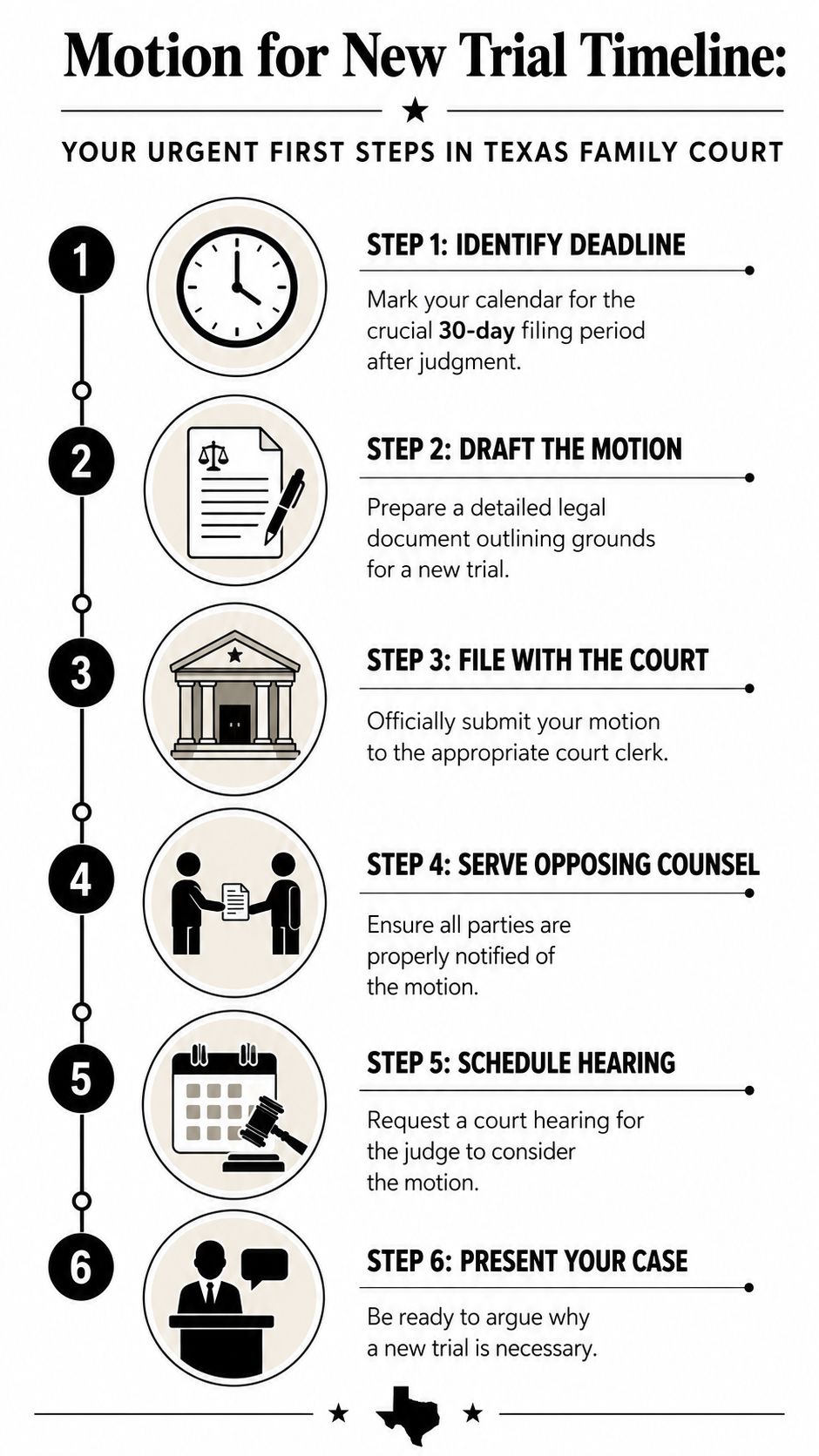
A motion for new trial asks the same trial court to undo the default and reopen the case. That matters because the trial judge still has authority for a limited time to correct what happened. In many family cases, that's the fastest and most practical route to relief.
For people trying to understand this process in more detail, this overview of a motion for new trial in Texas family law is a useful companion to the strategy discussion here.
What the motion needs to do
A strong motion for new trial doesn't just say, “I didn't know,” or “This is unfair.” It must give the judge a legal reason to set the judgment aside and enough supporting proof to justify a hearing.
Texas lawyers often analyze these motions under the Craddock factors. In plain English, the motion usually needs to show:
Your failure to answer wasn't intentional or consciously indifferent.
The court wants to know why no answer was filed. Mistake, confusion about service, misunderstanding what had happened, or other non-deliberate reasons may matter. Silence with no explanation usually doesn't help.You have a meritorious defense.
That means you must identify a real defense or disputed issue worth trying. In family court, this may involve custody facts, support calculations, property characterization, reimbursement claims, or the scope of requested relief.Granting a new trial won't unfairly prejudice the other side.
Delay by itself isn't always enough. But your motion should show readiness to move the case forward promptly and responsibly.
A motion for new trial is not a place for vague objections. It's where you lay out facts, attach sworn support when needed, and show the judge that reopening the case serves justice without causing legal harm.
What works and what doesn't
What works is specificity. Dates. Documents. Affidavits when appropriate. A direct explanation of how the default happened and what the trial court didn't hear.
What doesn't work is a broad complaint that the result feels one-sided. Appellate and post-judgment courts look for legally significant error, not just a hard outcome.
A useful checklist includes:
- Check the signing date immediately. The clock usually starts when the judge signs.
- Request the hearing quickly. Filing alone isn't always enough if no one pushes the matter toward a ruling.
- Collect proof, not just memories. If service was defective or notice was delayed, documents and sworn statements matter.
- Identify the defense clearly. Say what issue would change the result if the case were reopened.
- Preserve appellate options. A denied motion for new trial may shape what happens next in the court of appeals.
Two deadline exceptions people often miss
Texas Law Help also notes two important timing exceptions in some cases. If notice of the judgment was delayed, the motion deadline cannot start more than 90 days after signing, creating a latest filing point of 120 days in that scenario. If service was by publication, the party has 2 years from the judgment date to seek a new trial. Those are narrow rules, and they need careful analysis before relying on them.
Understanding Your Main Appellate Options
When the trial court signs a default judgment, the right remedy depends on where you are in the timeline and how much participation occurred. Many people make a costly mistake at this point. They assume “appeal” is one single path. It isn't.
The two most common paths after a family-law default are a motion for new trial and a restricted appeal. A traditional appeal may also follow if a motion for new trial is denied and the deadlines are preserved. The choice isn't just procedural. It changes what the appellate court can review and how the case must be framed.
Remedy Comparison
| Criteria | Motion for New Trial | Restricted Appeal |
|---|---|---|
| When it is used | Usually right after the default judgment is signed | Usually after the short post-judgment window has passed |
| Basic timing | Generally must be filed within the short trial-court deadline discussed earlier | Available for up to six months after the judgment for qualifying parties, as described in this discussion of restricted appeal and improper service |
| Who decides first | The trial judge | The court of appeals |
| Participation issue | Can be used by a party seeking trial-court relief from the default | Typically for a party who did not participate in the hearing that led to the judgment |
| Type of showing | Usually requires an explanation for the failure to answer and a defense worth trying | Requires error apparent on the face of the record |
| Common fit | Cases where quick trial-court correction is still possible | Cases where the initial deadline was missed but the record itself shows a clear defect |
What a restricted appeal really is
A restricted appeal is not a second chance to tell the trial court what happened. It's a narrow appellate remedy for someone who did not participate in the hearing and can show a clear error from the record itself.
That phrase, error on the face of the record, matters. It means the appellate court looks at the clerk's record and reporter's record, if one exists, and asks whether the mistake is visible there without new evidence. Improper service is one of the most common examples. So is a judgment that grants relief broader than the petition allowed.
Trade-offs that matter in real life
A motion for new trial can be more flexible because it gives the trial court a chance to fix the problem quickly. It may also allow factual explanations that don't appear in the existing record. But it has one major weakness. The deadline comes fast, and missing it modifies the circumstances.
A restricted appeal keeps a door open longer, but it's narrower. If the record is incomplete or the problem depends on facts outside the record, this remedy may not work. That's why clients sometimes hear an uncomfortable answer: “You may still have a path, but it depends on what the file shows.”
How appeals differ from trials
People often expect an appeal to work like a do-over. It doesn't.
A trial decides facts. An appeal reviews whether the trial court committed legal error. The appellate court applies a standard of review, which is the rule it uses to judge the trial court's decision. In family law, one common standard is abuse of discretion. That means the appellate court asks whether the trial judge acted outside the range of reasonable legal choices.
A briefing is the written legal argument filed in the appellate court. It explains the facts shown in the record, states the issues presented, cites the governing law, and argues why the judgment should be reversed, modified, or remanded.
The appellate court won't rescue a weak record. It decides the case from what was preserved, filed, and transcribed.
How to Build a Winning Argument for Reversal
Winning these cases usually starts with discipline, not drama. The appellate court wants a clean theory of error supported by the record. That means the clerk's record, the reporter's record, the petition, returns of service, notices, exhibits, and the signed judgment all have to be read together.
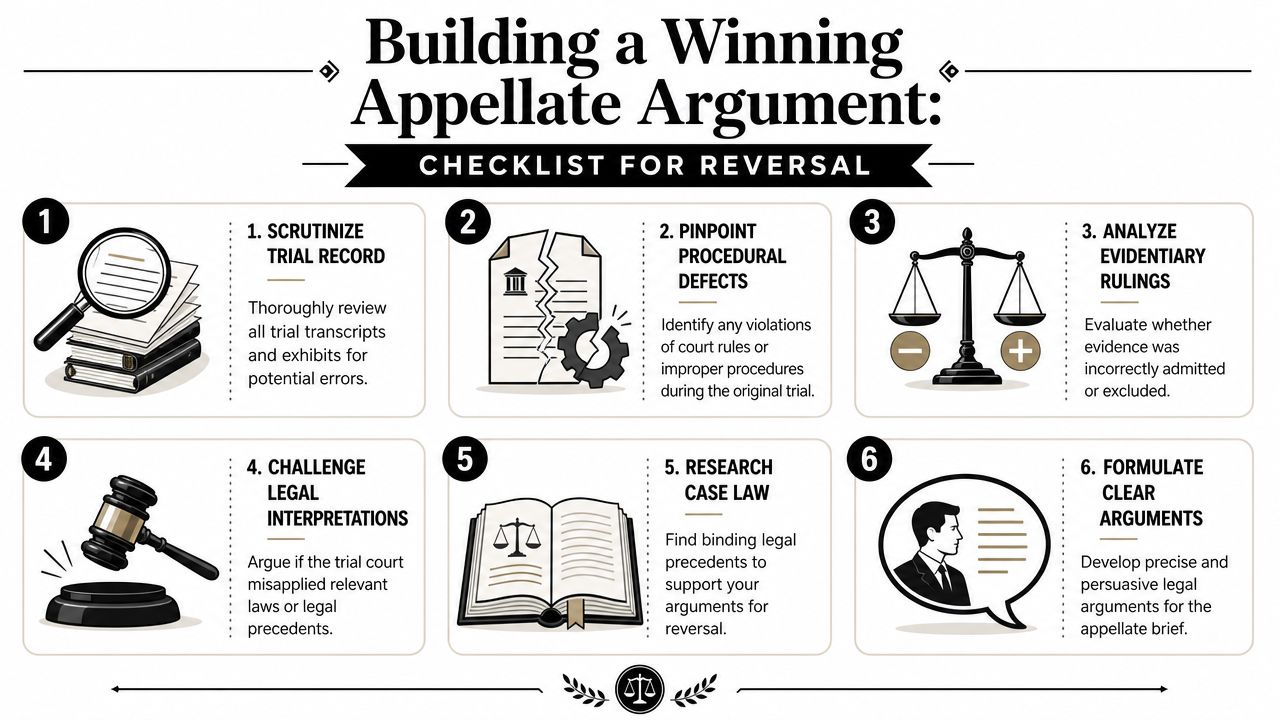
In an appellate office, this review is methodical. A lawyer identifies every possible issue, then narrows the case to the strongest few. A focused statement of issues on appeal in a Texas family case often matters more than a long list of weak complaints.
Start with service and the face of the file
The strongest attacks are often technical. Texas guidance emphasizes that the record must affirmatively show proper service and that proof of service must have been on file for at least 10 days before default relief is proper, as discussed in this Williamson County family-law presentation on default judgments. A recital in the judgment saying service was proper may not carry the day if the file itself doesn't support it.
Then examine the relief the petition requested
This is the issue many people miss. Even if service was valid, a default judgment can still be reversible if the final order grants relief that wasn't specifically requested in the petition. That principle is especially important in SAPCR, custody, and divorce cases, where the consequences affect parenting time, decision-making rights, support, and property.
The guiding question is simple: Did the pleading give fair notice of the relief the court awarded?
One example illustrates the problem. A petition may request a standard possession order, but the final default decree may impose supervised visitation without pleadings to support that restriction. Texas appellate courts continue to treat that kind of mismatch as a live basis for reversal, as discussed in this Texas custody default judgment article from McClure Law Group.
A default doesn't let the court award anything the petitioner wants. The pleadings still set the boundaries of the judgment.
Evidence still matters in a default
A default on liability or appearance does not eliminate the need for proof on every family-law issue. If the petitioner asked for child support, property division, reimbursement, restrictions, or other specific relief, the record still needs evidence to support those rulings.
That creates several common appellate themes:
- Unsupported property division when the evidence in the hearing doesn't support the decree entered.
- Child-related terms without proof when the order includes restrictions or conditions that the record doesn't substantiate.
- Overbroad language in final decrees that goes beyond the evidence offered at the prove-up.
What a persuasive reversal argument looks like
A strong appellate argument usually does three things at once:
- It identifies the exact legal rule the trial court had to follow.
- It points to the exact place in the record showing the rule was not met.
- It explains why the error mattered to the judgment entered.
That is what lawyers mean by reversible error. Not every mistake qualifies. The mistake has to be real, preserved or apparent in the correct posture, and significant enough to justify appellate relief.
Common and Costly Pitfalls to Avoid
Some default judgment challenges fail before the court reaches the merits. The reason is usually procedural. Appellate law rewards precision, and family cases move fast.

Missing the right deadline
The most common error is assuming there's plenty of time. There usually isn't. One missed filing date can move a case out of the motion-for-new-trial posture and into a much narrower appellate posture. Another missed date can close even that door.
If you think you may be appealing a default judgment in Texas family court, treat the signing date as urgent and verify the available remedies immediately.
Trying to add new evidence on appeal
Clients often say, “I can prove what happened now.” That may be true, but the appellate court usually won't consider new material that wasn't part of the trial-court record. Appeals are built from the existing file and transcript.
That is why record preservation matters so much. If the strongest facts exist only in your memory and never made it into the record at the right time, the appeal becomes harder.
Arguing fairness instead of legal error
Many self-represented litigants frequently lose traction. They explain why the outcome feels unfair, but they never identify the legal defect. Texas guidance on default judgments emphasizes that the strongest challenge is often a record-based attack on service, notice, or evidentiary support, not a broad fairness argument.
A few recurring examples:
- “I never got notice” without record support. The file has to show the problem.
- “The judge was biased.” That claim requires a proper legal basis and record support, not frustration alone.
- “The order hurts my relationship with my child.” That may be true, but the appeal must tie the harm to a reviewable legal error.
For a practical overview of what can go wrong in this process, this video gives useful context:
Handling an appellate matter without appellate counsel
Trial work and appellate work overlap, but they are not the same practice. Appeals involve standards of review, record citations, preservation rules, briefing requirements, and remedy analysis. A strong trial lawyer may still bring in appellate counsel for this reason.
That doesn't mean every case requires a full appeal. Sometimes the right move is a trial-court motion. Sometimes it is a restricted appeal. Sometimes it is a frank assessment that the available record is too thin. The point is that someone has to make that call strategically, not guess.
Schedule a Consultation to Protect Your Rights
A parent often learns about a default judgment at the worst possible moment. Wage withholding starts. A pickup schedule appears in an order you have never seen. Property has been divided without your input. At that point, the case usually turns on one question. What remedy is still available today?
A useful consultation should answer that question quickly and with precision. The first things to pin down are the date the judgment was signed, whether you filed any post-judgment papers, whether you took part in the case in any way, and what the clerk's record and reporter's record show. Those facts often decide whether the smarter move is a motion for new trial, a restricted appeal, or a different trial-court remedy.
The choice is strategic, not cosmetic.
A motion for new trial can be the better option if the deadline is still open and the facts outside the existing record matter. It may give you a faster path back to the trial court and more room to explain why the default happened. A restricted appeal can be powerful when the party did not participate and the error appears on the face of the record, but it is narrower by design. Many people lose both paths by waiting too long while trying to decide which one sounds better.
I tell clients to focus on four practical issues:
- What deadline expires first? Family cases move fast after a default judgment.
- Did any prior participation cut off a restricted appeal? Even limited involvement can matter.
- Is the strongest issue inside the record, or would it require outside proof? That difference often points toward one remedy over another.
- What outcome do you need most? Speed, a broader factual hearing, or a record-based reversal are not the same objective.
Filing the wrong paper can make a bad situation harder to fix. Filing nothing is often worse.
If your case involves custody, child support, a divorce decree, property division, or a protective order, public legal information can help families recognize deadline problems sooner. For a look at how law firms make that information easier to find, see Polaris Marketing Solutions' legal SEO insights.
The Law Office of Bryan Fagan, PLLC handles Texas family-law appeals and post-judgment review involving custody, support, divorce, property division, protective orders, and related orders. If you are trying to decide between a motion for new trial and a restricted appeal, get that analysis done before another deadline passes. More information is available at https://familylawcourtappeals.com.
A default judgment changes the posture of the case fast. It does not always end your options.