Skip to content
You may feel blindsided if you learned about a Texas family court judgment only after wages were withheld, parenting terms changed, or enforcement started. That reaction is reasonable. A court order entered without proper notice raises one of the most basic fairness concerns in the legal system.
The short answer is yes, you may be able to challenge or appeal a judgment if you were not properly served in Texas. The harder question is which remedy fits your facts. In these cases, timing matters, the court record matters, and your level of participation matters.
Family law cases make this especially serious. A default judgment can affect custody, child support, property division, or enforcement. If service was defective, the law may provide a path to undo the result. But that path isn't automatic, and not every complaint about notice becomes a winning appellate issue.
Why Proper Service Is a Cornerstone of Justice
A parent learns about a default order only after child support withholding starts or a possession schedule has already changed. At that point, the first question is usually, "How could the court do this without hearing from me?" The answer often turns on service.
Proper service is the procedure that gives the court authority to act against a party who has not appeared. It is also the foundation for any later challenge to a default judgment. If service was valid, the strategy usually looks very different than if service was defective. That is why the first job is not to argue fairness in the abstract. It is to identify exactly how notice was attempted, what the record shows, and which procedural remedy still fits the timeline.
In Texas family law, that distinction has real consequences. Orders about custody, support, enforcement, and property can all be entered by default if the responding party does not answer. But a default judgment entered without proper service is vulnerable in a way many clients do not realize. Courts expect strict compliance with the rules for issuance, service, and proof of service. Close enough is often not enough.
This is also where clients can lose time by focusing on the wrong issue.
Some people were served and did not appreciate the deadline. Others received papers informally, signed something they did not understand, or relied on conversations with the other side instead of the court file. A signed waiver of service in Texas family cases can change the analysis completely, and so can even limited participation after judgment. Those details matter because they often determine whether the right tool is a motion for new trial, a restricted appeal, or a bill of review.
A defective-service case is not a technicality argument. It is a record-based challenge to whether the court had a proper basis to proceed without your participation. If service failed, Texas procedure provides a path to attack the judgment. The hard part is choosing the correct path before a deadline closes or a procedural requirement knocks out the better option.
The Critical Role of Service of Process in Family Law
Service of process is the formal delivery of lawsuit papers. In most Texas family cases, that means the responding party must receive both the citation and the petition. The citation is the court's official notice telling you that you've been sued and when you must answer. The petition is the document that tells you what the other side is asking the court to do.
Think of it this way. The citation tells you, "You must show up in this legal fight." The petition tells you, "Here is what the fight is about."

What counts as legal service
Texas law recognizes formal methods of service. Depending on the case and court orders, service may occur through personal delivery, and in some situations through substituted methods approved by the court. What matters is not whether you somehow heard about the case. What matters is whether service complied with the rules.
An ex-spouse's text message usually isn't enough by itself. A forwarded PDF from a relative usually isn't enough either. Informal notice and valid service are not the same thing.
Why family cases create extra confusion
Family cases produce a lot of contact outside court. Parents may text every day. Lawyers may exchange drafts. Parties may know a divorce or custody filing is coming. That background can create false confidence.
Courts do not treat casual awareness as a replacement for proper procedure. If the other side seeks orders affecting conservatorship, possession, support, or property rights, the service history still matters.
Receiving papers informally can create urgency, but it doesn't automatically cure defective service.
Why the service record matters later
Service issues don't only affect defaults. They can also affect limitations arguments in some civil contexts. If a plaintiff filed suit within limitations but did not complete service within the limitations period, the claim can still be time-barred unless the plaintiff shows diligence in attempting service. Texas courts have treated "bring suit" in practice as including filing plus effecting service within the statutory period or promptly after it with documented diligence, as discussed in Holland & Knight's analysis of Texas service and limitations diligence.
That principle matters for one reason above all. Service records become evidence. Dates, returns, affidavits, and certificates often decide whether a judgment stands or falls.
Key service terms in plain English
- Citation. The court-issued notice that tells you a lawsuit exists and warns you to answer.
- Petition. The filing that states what relief the other party wants.
- Jurisdiction. The court's legal authority to act over the person and the case.
- Substituted service. An alternative court-approved way to serve someone who can't be reached by standard methods.
- Return of service. The filed proof showing when, where, and how service supposedly happened.
If you're asking, can you appeal if you were not properly served in Texas, these definitions aren't academic. They are often the difference between an avoidable judgment and a viable path to relief.
Your Menu of Legal Remedies for Improper Service
A parent finds out about a default custody order after the pickup schedule has already changed. A spouse learns wages are about to be garnished on a judgment tied to a divorce case they never knew existed. At that point, the first question is not just whether service was defective. The first question is which procedural path is still open.

Three facts usually control the choice. When was the judgment signed. Did you participate in the case in any meaningful way. Can the service defect be proven from the court's existing file, or will it take outside evidence.
Those answers matter because the remedies are different tools for different records. Picking the wrong one can waste the shortest deadline you have.
Motion for new trial
If you learned about the judgment quickly, a motion for new trial is often the first remedy to evaluate. It keeps the fight in the trial court and can be the fastest way to reopen the case.
This option works best when there is still time to act promptly, the service problem can be explained clearly, and the trial judge has room to correct the judgment without forcing an appeal. In practice, that can be a good fit when the return is defective, notice never reached the right address, or the surrounding facts need to be developed through affidavits or testimony.
The trade-off is speed and discretion. Deadlines come fast, and the trial court is not required to agree with your view of what happened. A good motion for new trial is usually built like an appellate record from day one. Dates, affidavits, the clerk's file, and a clean explanation of prejudice all matter.
Restricted appeal
A restricted appeal is often the strongest option in a true no-answer default case, but only for the right client and the right record. It is an appellate remedy for a party who did not participate in the hearing that produced the judgment and can show error from the face of the record.
That last point drives many strategic decisions. If the clerk's file, citation, return, order for substituted service, or judgment itself shows the service defect, a restricted appeal may be the most direct path. If you want a closer look at that route in family court, see this guide to a restricted appeal in Texas family court.
Participation is where people get tripped up. An informal effort to deal with the case, a filing made without counsel, or attendance at the wrong hearing can affect whether this remedy is still available. That is why early file review matters. The question is not whether you knew about the case in some general sense. The question is whether the procedural record preserves this appellate path.
Bill of review
A bill of review is usually the last remaining remedy after ordinary deadlines have expired. It is a new lawsuit that asks the court to set aside the old judgment.
This route is slower and harder than a restricted appeal, but sometimes it is the only realistic option. That is especially true when the service problem cannot be proven from the face of the original record, or when the facts that show lack of notice exist outside the clerk's file.
A bill of review also changes the litigation posture. You are no longer arguing from a fixed appellate record. You are building a new evidentiary case. That can be useful, but it also means more time, more proof, and more resistance from the other side.
A quick decision map
| Remedy | Best fit | Main limitation |
|---|---|---|
| Motion for new trial | You discovered the judgment quickly and can return to the trial court promptly | Short deadlines and trial-court discretion |
| Restricted appeal | You did not participate and the defect appears in the record | Limited to errors shown by the existing record |
| Bill of review | Ordinary deadlines have passed or proof requires outside evidence | Higher burden and separate litigation |
The best remedy is usually the one that fits the record you can prove today.
In family cases, the right choice depends on what needs to happen next. A parent challenging a default conservatorship order may value speed above everything else. A spouse attacking a default property division may need to preserve a cleaner appellate issue. In enforcement cases, the better argument may involve service, notice of hearing, or a broader due process problem. Those are not interchangeable theories, and they should not be treated as if they are.
Deep Dive The Restricted Appeal
The restricted appeal is one of the cleanest answers to the question, can you appeal if you were not properly served in Texas. But it is also one of the most misunderstood remedies. It is not a do-over. It is a narrow appellate path with specific gatekeeping requirements.
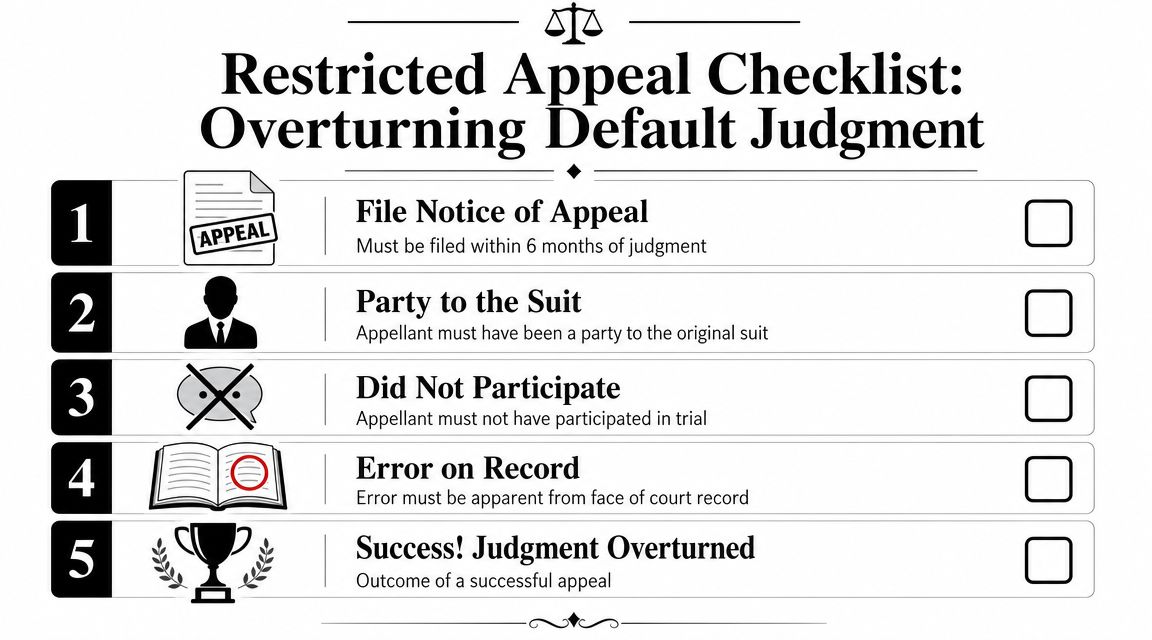
Texas defendants can use a restricted appeal to challenge a default judgment if four elements are met: the notice is filed within six months of judgment, the appellant was a party to the case, the appellant did not participate in the hearing or file qualifying post-judgment motions, and error is apparent on the face of the record. Improper service shown in the court's own paperwork can satisfy that last element, as explained in this discussion of restricted appeals based on improper service.
The four requirements
Filed within six months
This deadline is strict. If the notice is late, the appellate court may never reach the service problem. That is why early file review matters. You need the signing date, not just the date you personally learned about the order.
You were a party to the case
That sounds obvious, but it still matters. The person filing the restricted appeal must have been an actual party to the underlying lawsuit.
No participation in the hearing and no disqualifying post-judgment action
Participation can become the hardest issue in real life. Some people appeared for one setting, communicated with the court, or filed papers without understanding the consequences. Whether that conduct counts can affect eligibility for this remedy.
A restricted appeal is designed for the party who was effectively absent from the proceeding that produced the judgment.
Error appears on the face of the record
This is the defining feature. The court is not deciding whose version of events is more believable based on new witnesses. It is examining the official file.
What "face of the record" means in practice
An appellate lawyer in a service case starts with documents such as:
- The citation. Was it issued correctly, directed correctly, and tied to the right pleading?
- The return of service. Does it show the required details, or does it contain a defect on its face?
- Orders authorizing substituted service. If substituted service was used, does the file support it?
- The petition and later pleadings. Was the judgment based on claims for which service was never completed?
- Certificates and e-service entries. Do they line up with what the file says happened?
If the paperwork itself shows the defect, a restricted appeal can be powerful. If the paperwork looks clean but reality was different, the case may belong in a bill of review instead.
Why restricted appeals work well in family defaults
Family law defaults often produce a paper trail that can be tested carefully. A court may have signed orders on support, conservatorship, or property based on assumptions about notice that the file does not support. In that setting, the restricted appeal focuses the court on the official documents, not on after-the-fact explanations.
That makes the remedy efficient in the right case, but unforgiving in the wrong one. If the record appears regular, an appellate court usually won't receive new proof to fix the gap.
Appeals are not retrials
People often expect to tell the appellate court, "I never knew about this case," and then explain the facts live. That is not how this process works. Briefing is the written argument filed in the appellate court. It identifies the legal errors, cites the record, and explains why the judgment should be reversed.
Two more family-law terms help here:
- Reversible error means a legal mistake serious enough to justify changing the judgment.
- Abuse of discretion is a standard of review used often in family cases. It asks whether the trial court acted outside the zone of reasonable legal choices.
A restricted appeal based on improper service often focuses less on discretionary decision-making and more on whether the court had a valid procedural basis to proceed at all. If you want a deeper look at this remedy in the family-law setting, review this guide to a restricted appeal in Texas family court.
When a Bill of Review Is Your Only Option
Some bad-service cases do not fit into the neat frame of a restricted appeal. Maybe more than six months have passed. Maybe the clerk's record looks regular, even though the actual service facts were not. Maybe electronic notice went to the wrong place, but the file doesn't make the defect obvious.
That is when lawyers start looking hard at a bill of review.
How it differs from a restricted appeal
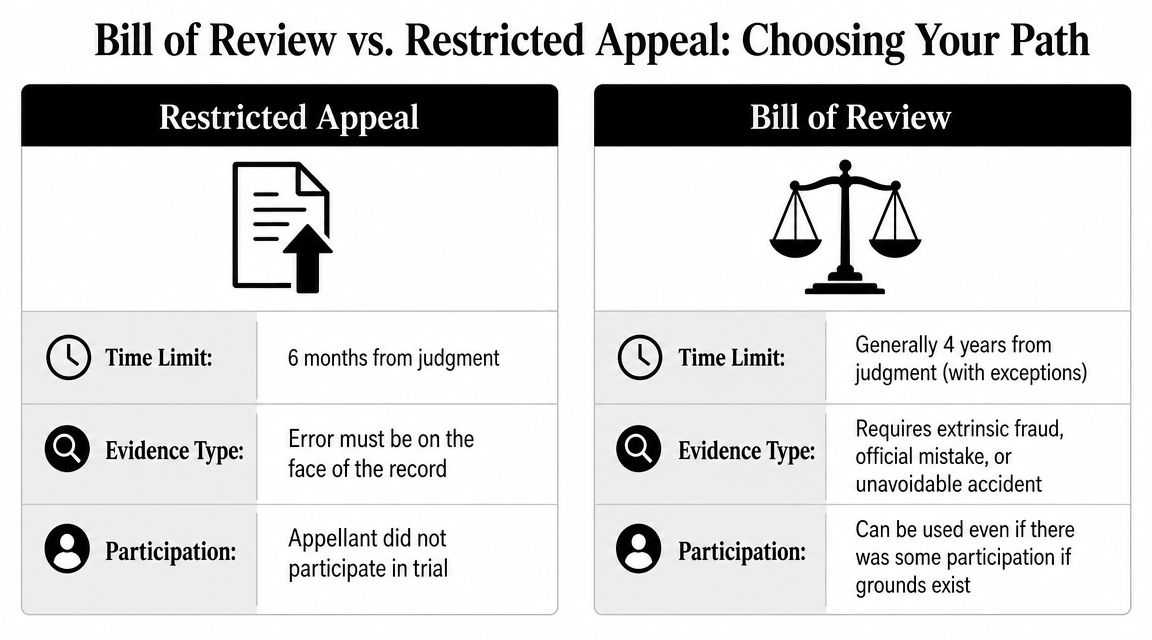
A bill of review is not just another notice filed in the old case. It is a new equitable proceeding that asks the court to set aside the prior judgment.
That difference changes everything. A restricted appeal lives or dies on the existing record. A bill of review can allow evidence outside the original file. That may include proof about what really happened with service, what address was used, what email account was involved, or whether a return was misleading in practice.
Texas appellate guidance notes that a litigant who missed the normal appeal deadline may file a restricted appeal within six months if the litigant did not participate in the hearing. That remedy is distinct from other post-judgment remedies, which is why choosing the correct path depends on procedural posture, as discussed in this Texas appeals FAQ on restricted appeals and deadlines.
Why the burden is higher
Bill of review cases are harder because the law expects final judgments to stay final unless there is a strong reason to disturb them. In practice, the petitioner usually must show more than simple dissatisfaction with the outcome.
Common issues include:
- Lack of fault. You generally need to show the judgment wasn't the result of your own negligence.
- A meritorious position. Courts often want to know that reopening the case would matter.
- Prevention from presenting your case. This often involves wrongful conduct, accident, or official mistake, depending on the facts.
Not every service complaint supports that showing. That is one reason self-diagnosis is risky.
When this remedy makes strategic sense
A bill of review is often the right lane in situations like these:
- The file appears regular. The return says service happened, but outside proof suggests otherwise.
- Electronic service problems. The certificate exists, but the email address was wrong or the notice trail is incomplete.
- The six-month restricted-appeal window has passed. The record may still support relief, but not through a restricted appeal.
A bill of review is often less about spotting one fatal document and more about assembling a coherent proof package.
Side-by-side decision factors
| Question | Restricted appeal | Bill of review |
|---|---|---|
| Is timing narrow? | Yes | Usually used after ordinary appellate timing problems arise |
| Can you use new evidence? | No, the court reviews the existing record | Often yes |
| Is non-participation important? | Yes | The analysis is different and more fact-specific |
| Is the remedy simple? | More streamlined when the record shows the problem | More demanding and litigation-heavy |
In family law, this can be the difference between a direct procedural attack and a broader equitable one. Parents dealing with an old custody default, spouses contesting an old property judgment, and parties facing enforcement based on defective notice often need that distinction explained in practical terms. This comparison of a bill of review versus appeal in Texas is a useful starting point for that analysis.
How an Appellate Attorney Fights a Default Judgment
A parent learns there is already a signed order affecting custody or support. A spouse finds out wages are being withheld under a divorce judgment they never answered. At that point, the question is not whether the result feels unfair. The question is which procedure is still available, what proof fits that procedure, and how quickly the court must be asked to act.
That triage drives the whole case.
An appellate attorney starts by pulling the clerk's record and, if a hearing occurred, the reporter's record. Those materials show what the trial court had before it when the default judgment was signed. In a service challenge, small details matter. The citation may be defective on its face. The return may not strictly comply with the rules. A substituted-service order may authorize one method while the file shows another. In other cases, the record looks clean, which changes the strategy and may push the case toward a bill of review rather than a restricted appeal.
The first pass through the file usually focuses on a few practical questions:
- Was the judgment a default? Prior participation can affect whether a restricted appeal is available.
- Does the defect appear in the record itself? If yes, that points toward direct appellate remedies.
- Will proof outside the record be needed? If yes, a bill of review may be the better fit.
- What deadline is still open? A strong service argument can still fail if the wrong vehicle is chosen too late.
- What relief did the judgment grant? The answer matters in family law because conservatorship, support, property division, and protective orders raise different practical risks while the challenge is pending.
Texas courts treat service as a due-process issue, but winning one of these cases usually turns on disciplined record work, not broad accusations. Public guidance from Texas Court Help's discussion of service and response issues helps people understand the problem. The harder task is matching the problem to the correct remedy.
That is often where the case is won or lost.
A careful review also tests the points clients often miss:
- Identity and capacity. Was the correct person served, and were they served in the proper legal capacity?
- Timing. Did the service date, answer date, and default date line up under the rules?
- Pleadings. Did the final judgment award relief that was never properly served?
- Electronic notice issues. Do the e-filing entries and certificates support notice, or do they expose gaps?
- Procedural posture. Did anything filed before judgment change the available path to relief?
For families facing a default order, the legal problem is only part of the problem. A client may need to stop enforcement, protect parenting time, or address property transfers while the challenge is pending. Those trade-offs affect how an appellate lawyer approaches the case. Sometimes the fastest available remedy is not the one with the broadest evidentiary record. Sometimes the broader remedy takes longer and costs more, but it is the only path that fits the facts.
The Law Office of Bryan Fagan, PLLC handles Texas family law appellate matters by reviewing the record, identifying procedural error, and matching the case to the proper post-judgment remedy.
If you believe a Texas family court entered judgment against you without proper service, do not assume every option is still available. A focused review should answer three questions early. Can the defect be shown from the existing record, is outside evidence needed, and which deadline controls the next move.
If you believe the court made a mistake in your family law case, our appellate attorneys can help you seek a fair outcome. Contact The Law Office of Bryan Fagan, PLLC today for a free consultation.