Skip to content
You may feel like the judge got it wrong and your own lawyer helped it happen.
That reaction is common after a custody ruling, divorce decree, support order, or property division that leaves you stunned. Maybe your lawyer stayed silent when harmful testimony came in. Maybe key documents never made it into evidence. Maybe deadlines were missed, your position was poorly explained, or the final hearing felt disorganized from start to finish.
The hard truth is that Texas appellate courts don't reverse family court decisions just because your lawyer performed badly. But that doesn't mean you're out of options. Some lawyer mistakes can support an appeal. Some are waived forever because they weren't preserved in the trial court. Others may point away from an appeal and toward a separate malpractice claim.
If you're asking whether can you appeal if your lawyer made mistakes in Texas family court, the answer is this: sometimes yes, often not for the reason people think, and always under a tight deadline.
Feeling Unfairly Judged After Your Texas Family Law Case
A lot of clients come in with the same story. The hearing ends, the order is signed, and then the full weight of what happened starts to sink in. They replay the trial in their minds and keep coming back to one thought: "My lawyer didn't protect me."
That feeling matters. It usually points to something real. But you need to sort emotion from legal strategy fast.
In Texas family cases, there is a difference between a result you hate and a result the appellate court can correct. A judge may have ruled against you for reasons the law allows. Or the judge may have made a legal mistake that could support appellate relief. Or your lawyer may have made serious errors that damaged your case without creating an appealable issue.
The question you should ask first
Don't start with "Was my lawyer bad?"
Start with this: Did anything happen in the courtroom that created a reviewable legal error in the record?
That shift changes everything. It moves you from blame to analysis.
A useful starting point is learning the valid grounds for appeal in Texas family court. Once you understand what appellate judges review, your options become much clearer.
You don't need a second opinion on whether the hearing felt unfair. You need a record-based opinion on whether the law gives you a path forward.
If you're distressed right now, focus on speed and clarity. Save the final order. Save your emails with trial counsel. Write down exactly what happened while it's still fresh. Then get the case evaluated by someone who handles appeals, not just trials.
Appeals Are Not Retrials Understanding the Basics
If you expect an appeal to be a new trial, you'll misread your chances from the start.
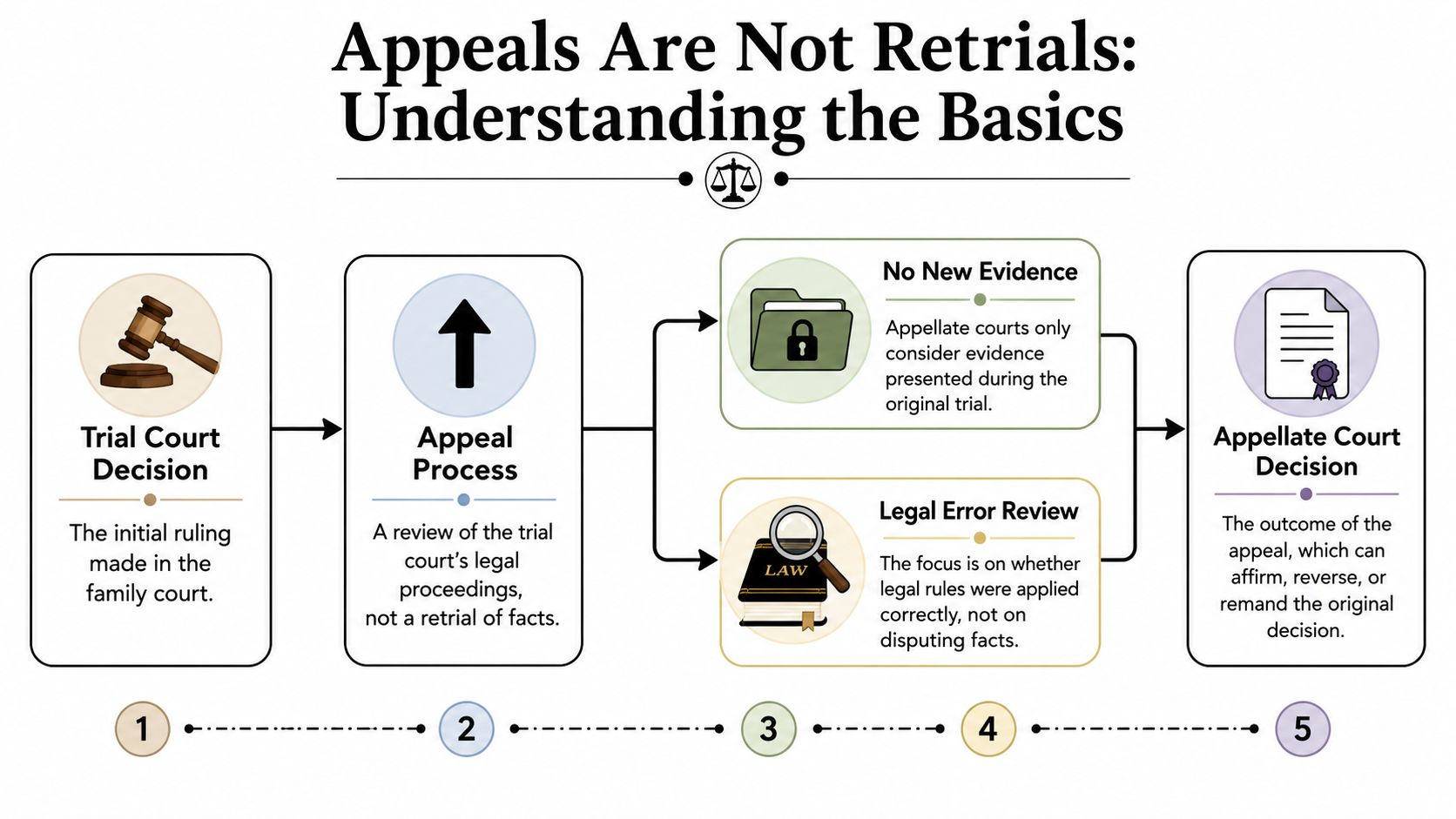
An appeal is a record-based review. In Texas family court, the appellate court reviews whether the trial judge committed legal or procedural error. It does not hear new testimony, and it does not retry custody, property, or support issues, as explained in this Texas family appeal overview.
What the appellate court actually reviews
Think of the appeal like a referee reviewing game footage for rule violations. The court isn't replaying the game. It's checking whether the rules were followed.
That means the judges look at the record. In plain English, the record is the file created in the trial court. It usually includes the pleadings, admitted exhibits, written orders, and the reporter's transcript of what witnesses, lawyers, and the judge said in court.
If something isn't in that record, it usually doesn't exist for appeal purposes.
Three terms you need to understand
Here are the core terms that matter in almost every family appeal:
| Term | Plain-English meaning | Why it matters |
|---|---|---|
| Record | The official trial court file and transcript | The appellate court is limited to this material |
| Standard of review | The rule the appellate court uses to evaluate the trial judge's ruling | Some rulings are hard to overturn because trial judges get discretion |
| Briefing | Written legal arguments filed in the court of appeals | This is where the appeal is won or lost most of the time |
One important standard is abuse of discretion. In plain English, that means the appellant argues the trial judge made a decision outside the range the law allows. Family courts often have discretion, especially in custody and property matters, so this standard can be demanding.
Another key term is reversible error. That means a legal mistake serious enough to justify changing the judgment. Not every mistake counts. The error has to matter.
Practical rule: Appeals are about legal error that affected the judgment, not about whether the trial felt frustrating or the judge seemed unsympathetic.
What realistic expectations look like
You should also know that reversal is uncommon. A published analysis in the Houston Law Review reported that in appeals following bench trials in family-law cases, the reversal rate was 20%, discussed in this Houston Law Review analysis of reversals in Texas courts of appeals.
That doesn't mean your appeal is hopeless. It means you need discipline. The strongest appeals isolate a specific legal error, tie it to the record, and show why it likely affected the outcome.
When a Lawyer's Mistake Becomes an Appealable Issue
Most clients phrase the problem this way: "Can I appeal because my lawyer messed up?"
Usually, that's not how the court sees it.
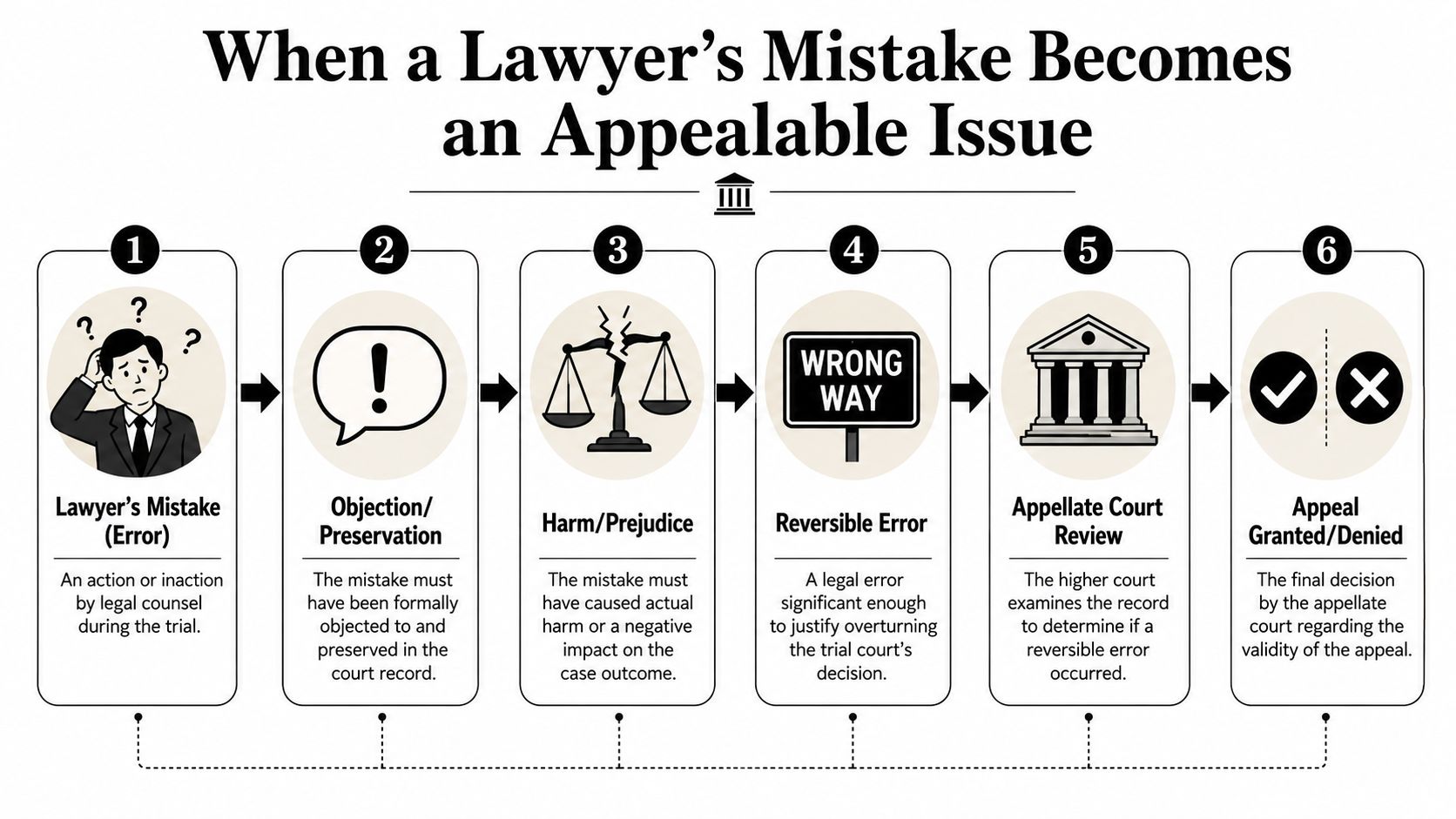
The appellate court doesn't sit to grade your lawyer's performance. It reviews the trial court's rulings. So a lawyer's mistake matters on appeal only when it helped create a preserved, reversible issue in the record.
Preservation is the hinge point
Texas appellate practice has a technical rule that changes everything. The complaining party generally must make a timely, specific objection or other complaint in the trial court, and the judge must make an adverse ruling. If trial counsel failed to object, the issue may be waived and become unreviewable on appeal, as outlined in this Texas appeal discussion of objections required to preserve appeal.
That means silence can kill an appeal.
If opposing counsel offered improper evidence and your lawyer said nothing, the appellate court often won't reach the issue. If the judge used the wrong procedure and no one objected, that problem may be gone for appellate purposes. If your lawyer complained vaguely instead of specifically, that may not preserve anything either.
The trial judge has to be given a fair chance to fix the problem in real time. If that chance never came, the appellate court often treats the issue as waived.
Here is a simple way to consider it:
- A mistake happens at trial
- Counsel objects clearly and on time
- The judge overrules or refuses the request
- The mistake affects the outcome
- The appellate court reviews that ruling
Without steps two and three, step five may never happen.
A short video can help if you want a more practical explanation of how appellate issues develop in family cases:
What this means for your case
You don't appeal "bad strategy" in the abstract. You identify a ruling, omission, or procedure in the record that the appellate court can legally review.
That distinction is why some awful lawyering still doesn't produce a viable appeal. A lawyer can prepare poorly, ask weak questions, and present the case badly. If no preserved legal issue appears in the record, the court of appeals may have nothing to correct.
On the other hand, if your lawyer did object properly and the judge still admitted improper evidence, excluded critical evidence, or applied the wrong legal standard, now you're in appellate territory.
Common Lawyer Mistakes That Can Lead to Reversal
Some lawyer errors are just bad lawyering. Some can help produce a reversible issue if they were handled correctly in the moment. The difference usually comes down to the record.
Custody and visitation mistakes
A common example in a custody dispute is harmful testimony that should have been challenged. Say a witness starts repeating out-of-court accusations about a parent, and the lawyer either objects properly or makes a clear offer of proof after the judge excludes the response. If the ruling allowed unreliable material to shape the court's view of parental fitness, that may support an appellate issue.
Another recurring problem is using the wrong legal lens. If the case turns on a custody decision and the trial court applies the wrong standard, or refuses to consider required legal factors after the issue is raised, the damage can be significant. That's the kind of error an appellate lawyer looks for in the transcript and final order.
Property division and divorce decree problems
Property cases often go wrong because the evidence was mishandled. One spouse says an asset is separate property. The other side challenges that claim. Trial counsel fails to authenticate a key document, fails to object to a flawed exhibit, or fails to secure a ruling on a disputed classification issue.
If the judge then signs a decree based on a legally flawed record, the appeal may focus on the court's ruling rather than the lawyer's poor preparation.
A trial lawyer's mistake becomes useful on appeal only when you can connect it to a legal ruling that distorted the judgment.
Support and protective order scenarios
Child support cases can produce appealable issues when the court uses the wrong financial inputs or follows an improper procedure and the problem is clearly raised below. Protective order hearings can raise due process concerns if a party wasn't allowed to present admissible evidence or respond to critical allegations after the issue was brought to the judge's attention.
Here are examples that often deserve immediate review:
- Excluded defense evidence: The court kept out evidence that directly addressed custody, safety, income, or property classification after counsel tried to admit it properly.
- Improperly admitted evidence: The judge allowed objectionable testimony or exhibits over a specific objection.
- Incorrect legal framework: The ruling appears to rest on the wrong legal standard.
- Unclear or conflicting order language: The final order doesn't match the oral rulings or contains legal defects that affect enforcement.
If your case involves child custody appeals, divorce decree appeals, property division appeals, or protective order appeals, the specific error pattern matters. So does the exact wording in the order.
Appeal vs Malpractice Understanding Your Path to Justice
Clients often assume appeal and malpractice are the same thing. They aren't. They solve different problems.
An appeal tries to fix the family court result. A malpractice case seeks compensation for harm caused by the lawyer. A motion for new trial asks the same trial judge to reconsider the outcome.
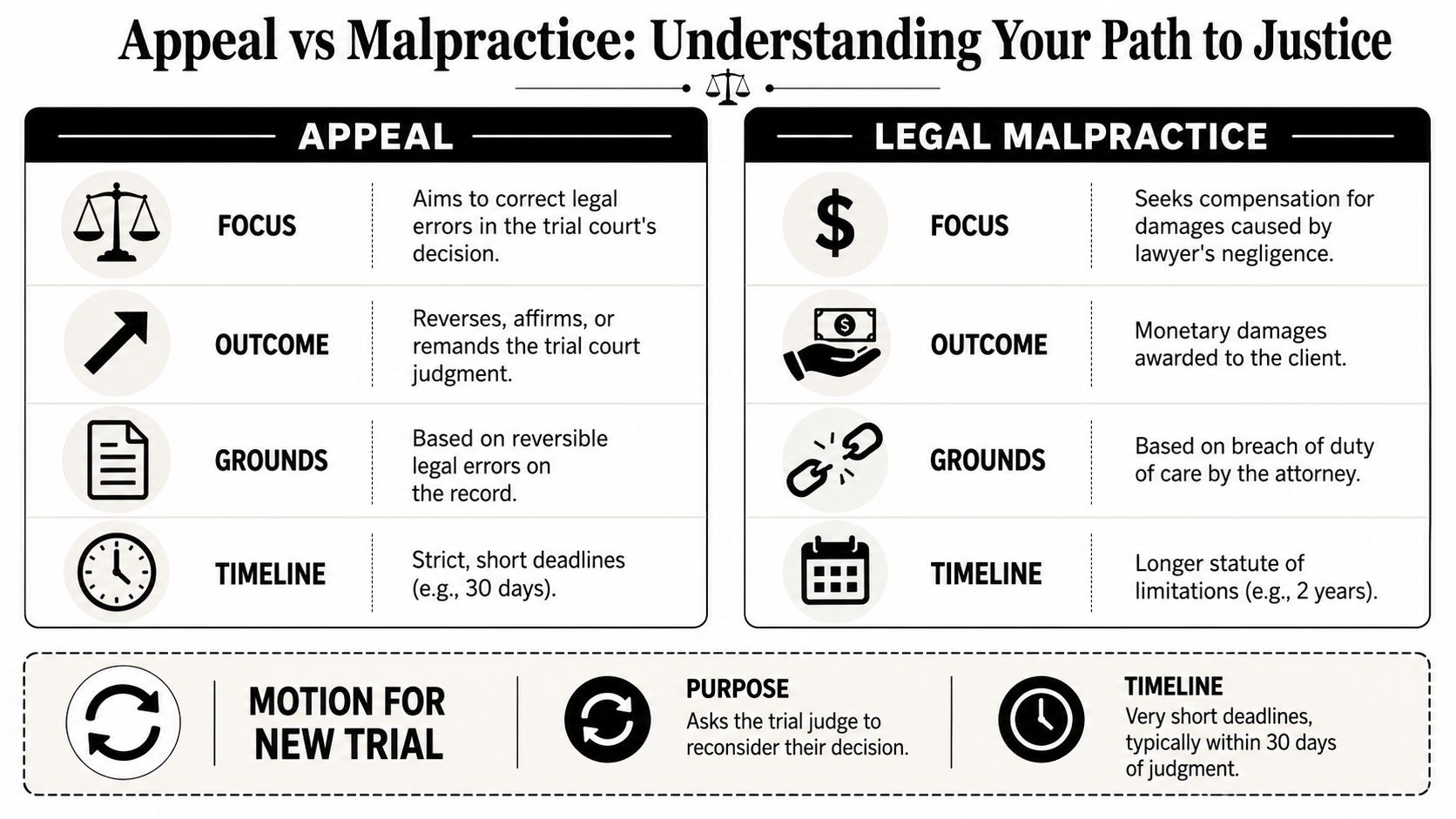
A key distinction is this: appeals review the trial court record for legal error, while malpractice claims require proving substandard performance by the attorney and resulting financial harm in a separate lawsuit, as described in this overview of appeals versus legal malpractice.
Side-by-side comparison
| Path | Main goal | What must be shown | Likely result |
|---|---|---|---|
| Appeal | Correct the judgment | Reversible legal or procedural error in the record | Affirm, reverse, or remand |
| Motion for new trial | Ask the trial judge to reconsider | A valid reason recognized in post-judgment practice | New hearing or denial |
| Malpractice claim | Recover damages from the lawyer | Substandard performance and provable financial harm | Money damages if successful |
When an appeal makes sense
An appeal is the right lane when the trial record shows an identifiable legal problem. That might include an improper ruling on evidence, use of the wrong legal standard, or an abuse of discretion that was preserved and harmed the outcome.
If your goal is to change custody terms, challenge a property ruling, or undo an unfair support order, the appeal is the tool aimed at the judgment itself.
When malpractice may be the real issue
Sometimes the trial record doesn't contain a reviewable issue because counsel failed to preserve anything. In that situation, the appeal may be weak even if the lawyering was terrible.
That can point toward malpractice instead. The question becomes whether the lawyer's conduct fell below the required standard and caused measurable financial harm. That's a separate lawsuit. It doesn't function like an appeal and it won't automatically reopen your family case.
If the record gives the appellate court nothing to review, your complaint may still be valid. It may just belong in a different courthouse.
When both paths should be evaluated quickly
These routes aren't always mutually exclusive. You may need immediate appellate review to protect the judgment deadline while also assessing whether the lawyer's conduct created a separate damages claim.
A focused consultation is vital. An appellate attorney can review the order, transcript status, objections, and post-judgment options. The Law Office of Bryan Fagan, PLLC handles Texas family law appeals involving custody, divorce, property division, child support, protective orders, and related judgments, which is one option for that kind of record-based review.
The main point is simple. Don't assume "my lawyer messed up" automatically answers the remedy question. It doesn't.
The Unforgiving Clock Procedural Steps and Deadlines
If you think you may appeal, time is your biggest immediate problem.
Texas family law appeals are governed by a strict procedural rule. A notice of appeal is generally due within 30 days after the final judgment is signed, as explained in this Texas notice of appeal deadline guide.
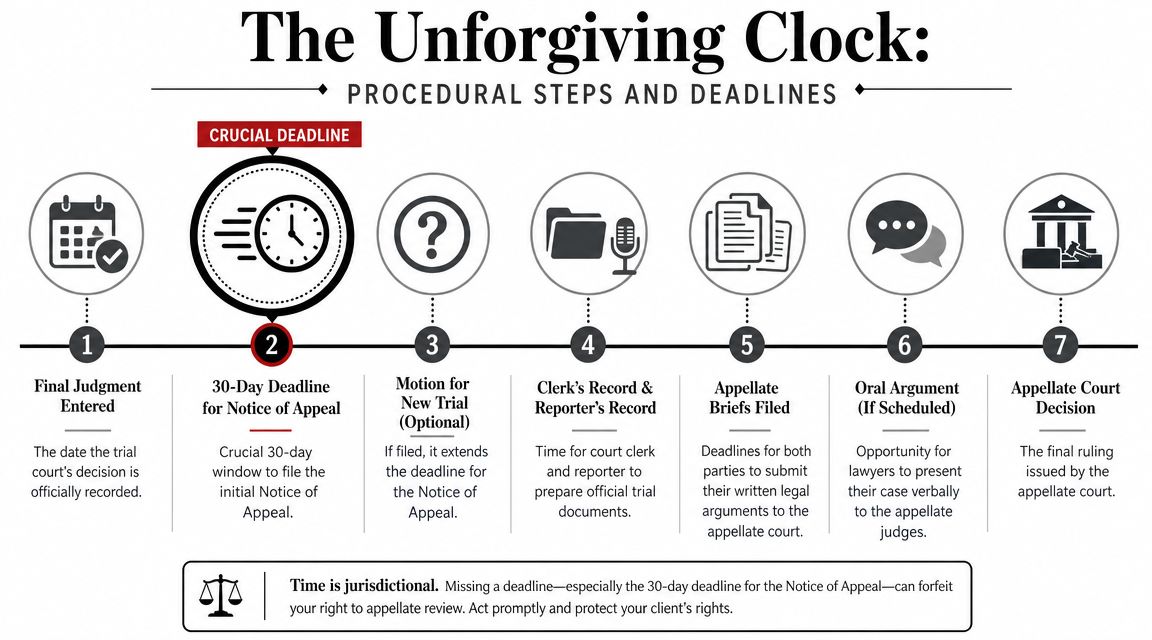
Miss that deadline and you can permanently lose the right to challenge the judgment. That is true even if the trial was messy, the judge was wrong, or your lawyer clearly underperformed.
The usual path after judgment
Once a final order is signed, the process typically moves through a series of procedural steps:
Notice of appeal filed
This tells the court and the other side that you're appealing.Clerk's record and reporter's record prepared
These materials create the universe the appellate court can review.Briefing begins
Your opening brief explains the legal errors, the supporting record cites, and the relief requested.Response and possible reply
The other side answers. Your lawyer may file a reply to address those points.Oral argument in some cases
If the court sets argument, the lawyers answer the panel's questions.Opinion issued
The court may affirm, reverse, or send the case back for further proceedings.
What you should do immediately
Don't wait for your former trial lawyer to "see what can be done." Get an appellate opinion now.
Here is the immediate checklist I recommend:
- Get the signed final order: Not the draft. Not the email summary. The signed order.
- Confirm the signing date: The appellate timeline usually runs from that date.
- Request your full case file: Include pleadings, exhibits, motions, emails, and hearing settings.
- Write down the key moments: Especially objections, rulings, excluded evidence, and missed deadlines.
- Ask for a transcript assessment quickly: You need to know what the record will show.
Delay doesn't create leverage in an appeal. It usually destroys options.
This is one area where calm urgency is the right mindset. Not panic. Not denial. Action.
Your Next Steps Preparing to Challenge an Unfair Outcome
If you believe your lawyer's mistakes contributed to a bad result, do these things in order.
First, gather every document you have. That includes the signed final order, pleadings, exhibits, notices, correspondence with counsel, billing records, and any hearing transcripts or audio information you can access. Don't sort it perfectly. Just collect it.
Second, write a clean timeline. List what happened at each hearing, what your lawyer did or didn't do, what the judge ruled, and why you think the result was legally wrong. Keep it factual. Dates, events, rulings, and missed objections matter more than anger.
The most useful questions to bring to a consultation
Bring questions like these:
- Was there a preserved error in the record?
- Did the judge make a legal or procedural mistake that likely affected the judgment?
- Should I file a notice of appeal right away?
- Is a motion for new trial worth considering?
- Does this also need a malpractice review?
Third, get the case in front of an appellate lawyer immediately. Not because every case should be appealed, but because every potentially appealable case needs to be screened fast. A good appellate review gives you clarity on three issues: whether there's a viable appellate point, whether anything has already been waived, and what deadline controls your next move.
If you're still asking whether can you appeal if your lawyer made mistakes in Texas family court, the answer depends on the record, the rulings, and the clock. Those three things decide almost everything.
You don't need false hope. You need a precise read on what can still be saved.
If you believe the court made a mistake in your family law case, our appellate attorneys can help you seek a fair outcome. Contact The Law Office of Bryan Fagan, PLLC today for a free consultation.