When the judge signs your final divorce decree, you expect to feel a sense of closure. But what if, instead, you are left with a profound sense of injustice? You may feel your case was handled unfairly, and it’s a disheartening moment. While you cannot appeal a court’s decision simply because you are unhappy with it, the Texas legal system provides a clear path forward when a judge has made a serious legal error. This process is your chance to seek justice and fight for a fair outcome when the trial court’s ruling is fundamentally flawed.
What It Means to Appeal an Unfair Divorce Ruling

It is deeply frustrating when your final divorce decree feels wrong. Perhaps you are looking at a property division that seems to ignore your separate property contributions. Maybe it is a child custody order that you know is not in your child’s best interest, or a spousal support award that seems entirely disconnected from the facts.
Those feelings are valid, and it is critical to understand that you have rights that extend beyond the trial court.
An appeal is not a second trial or a “do-over.” You do not get to introduce new evidence or re-argue your case. Instead, an appeal is a formal, structured review of what happened in the trial court, conducted by a higher court—the court of appeals. This entire process is strictly governed by the Texas Rules of Appellate Procedure and the Texas Family Code.
How an Appeal Differs from a Trial
The appellate court’s job is not to re-weigh the facts or decide which witness was more believable. Its sole focus is to determine if the trial judge made a significant legal mistake, something called a reversible error. This is a crucial distinction.
In a trial, you present evidence and testimony to a judge, who then makes a decision. In an appeal, your attorney presents a detailed written legal argument, called a brief, to a panel of appellate judges. The goal is to show exactly how the trial judge failed to properly apply the law to the facts that were presented, based only on the existing trial record.
Common examples of reversible errors include:
- The court incorrectly classifying your separate property (like an inheritance) as community property, leading to an unfair division.
- The judge ignoring mandatory legal factors they were required to consider when making a child custody decision.
- The court misapplying child support guidelines or issuing a protective order without sufficient evidence.
A key concept in family law appeals is the “abuse of discretion” standard of review. This means the appellate court will only reverse a decision if it finds the trial judge acted unreasonably, arbitrarily, or without reference to any guiding legal rules. It’s a high but necessary standard to meet.
Successfully appealing a divorce decree demands specialized knowledge of appellate procedure and the skill to build a compelling argument based only on the trial record. The focus shifts from telling your personal story to proving that a specific legal injustice occurred—one that the higher court must correct. This strategic, detail-oriented process is the key to restoring balance and achieving the fairness you were denied.
Grounds for Appealing Your Divorce Decree
When your final divorce decree is issued, it is normal to feel disappointed if the outcome feels wrong. However, an appeal is not a second chance to re-argue your case or present new evidence.
An appeal is a focused challenge to a specific legal mistake made by the trial judge. The appellate court’s role is not to second-guess the trial judge’s factual decisions but to determine if a significant legal error occurred that likely caused an improper outcome.
This means that simply being unhappy with your property division or custody schedule is not enough to file an appeal. Your entire case must be built on what is known as reversible error—a mistake of law or procedure so significant that it probably led to the wrong result. Understanding this concept is the first and most critical step in the process.
What Is a “Reversible Error” in a Texas Divorce?
A reversible error is not a minor technicality. It is a serious flaw in how the judge applied the law or followed procedure. The Texas Family Code and established case law provide clear rules for judges. When a judge deviates from these rules, you may have grounds to appeal.
Common examples of reversible errors include:
- Property Mischaracterization: The judge incorrectly labels your separate property—such as an inheritance or a business owned before marriage—as community property and divides it.
- Child Support Miscalculations: The court orders child support that deviates from statutory guidelines without making the specific findings required by law to justify the deviation.
- Ignoring Required Factors: A judge makes a custody decision without properly considering all the legally mandated “best interest” factors.
- Procedural Mistakes: The court wrongfully prevents you from presenting critical evidence that should have been allowed, and that evidence could have changed the outcome.
Identifying these mistakes requires a thorough review of the entire trial record—every transcript, exhibit, and motion. An experienced appellate lawyer knows the specific red flags to look for. You can find a more in-depth look at what qualifies as valid grounds for an appeal in our detailed article.
Understanding the “Abuse of Discretion” Standard
In Texas family law, you will often hear the phrase “abuse of discretion.” This is the standard of review for most issues in a divorce appeal, and it is vital to understand what it means. It does not suggest the judge was rude or acted with bad intentions.
In legal terms, abuse of discretion means the judge made a ruling that was arbitrary, unreasonable, or made without reference to guiding legal rules and principles. It is a decision so far outside the bounds of the law that it cannot be justified.
A trial judge has a certain amount of latitude to weigh evidence and make decisions. As long as their ruling falls within a reasonable range of outcomes, an appellate court will not disturb it. But when a decision ignores established law, it crosses the line into an abuse of discretion.
When an Appeal Is Not an Option
It is equally important to know when you cannot appeal. If your divorce was finalized through a Mediated Settlement Agreement (MSA) or you signed an Agreed Final Decree of Divorce, your ability to appeal is extremely limited.
By signing these agreements, you are entering into a binding contract and telling the court you agree to the terms, thereby waiving your right to appeal them later.
Attempting to overturn a signed agreement is an uphill battle. You would have to prove something like fraud or coercion, which requires showing you were intentionally deceived or forced to sign. The standard of proof is incredibly high and rarely met. For this reason, most divorces resolved by agreement are truly final. This underscores why obtaining sound legal advice during negotiations is just as critical as having a skilled lawyer for a trial.
Understanding Texas’s Strict Post-Trial Deadlines
The moment the judge signs your final divorce decree, a clock starts ticking—and you cannot ignore it. When it comes to appealing a divorce, the window of opportunity is brief, and the deadlines under the Texas Rules of Appellate Procedure are firm. If you miss a deadline, the door to your appeal can close permanently, no matter how strong your case is.
This is a phase where you cannot afford to wait. You must act decisively to preserve your rights. The most critical deadline is for filing a Notice of Appeal.
The 30-Day Rule and a Strategic Exception
As a general rule, you have only 30 days from the date the final judgment is signed to file your Notice of Appeal. This document officially informs the court and the other party that you intend to challenge the ruling.
However, a powerful tool can extend this timeline: filing a Motion for New Trial. This is a formal request asking the trial judge to reconsider and correct their own mistakes. Filing this motion within the initial 30-day window automatically extends your deadline for the Notice of Appeal to 90 days from the date the judgment was signed.
While it is rare for a trial judge to grant a new trial, filing the motion is almost always a smart strategic move. It gives your appellate attorney more time to analyze the case, gather the court records, and prepare for the appeal, all while protecting your right to do so.
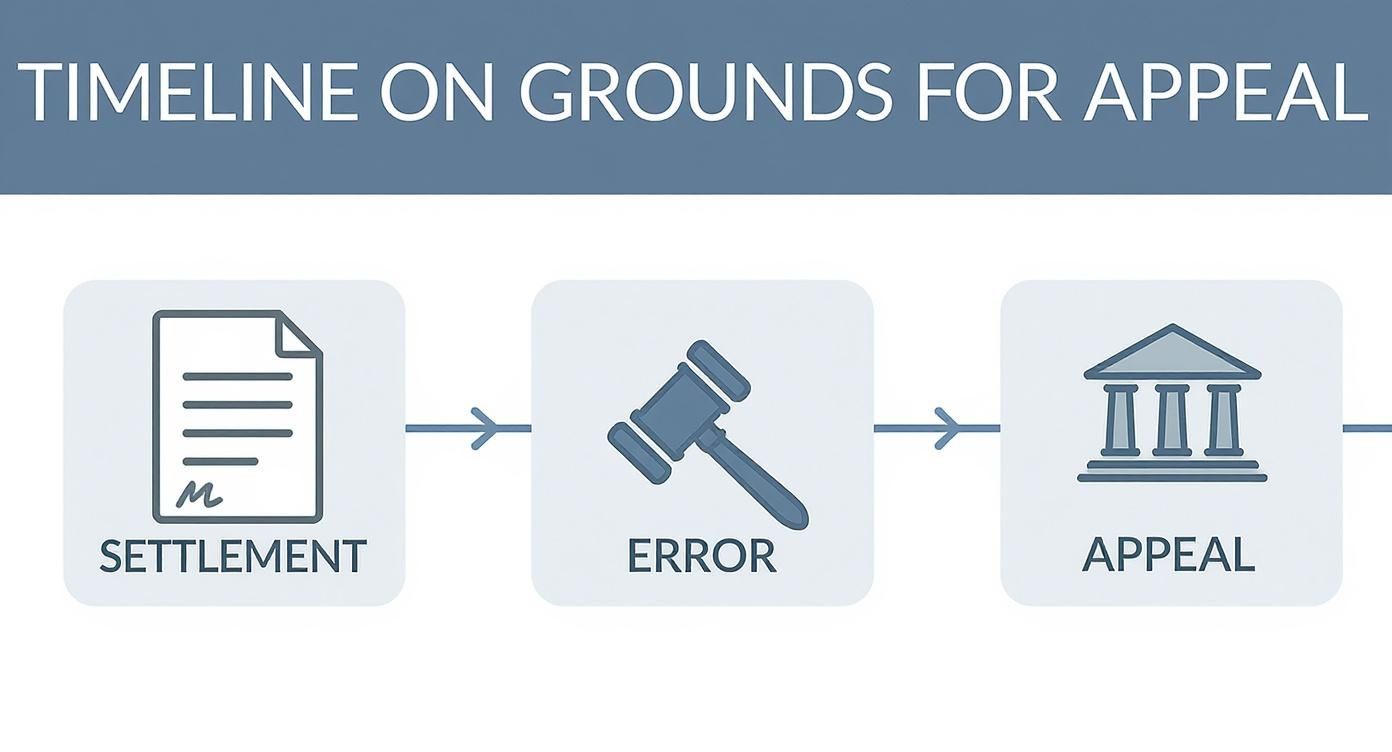
As this timeline shows, a settlement is typically final. An appeal only becomes possible after a trial where a judicial error may have occurred.
Key Texas Appellate Deadlines After Final Judgment
This table summarizes the most critical post-judgment deadlines. Timing is everything, and understanding these dates is the first step toward a successful appeal.
| Action | Standard Deadline | Deadline if Motion for New Trial is Filed | Purpose |
|---|---|---|---|
| Motion for New Trial | 30 days from signed judgment | N/A | Asks the trial judge to reconsider their ruling; extends other key deadlines. |
| Notice of Appeal | 30 days from signed judgment | 90 days from signed judgment | Formally initiates the appeal process with the appellate court. |
| Request for Findings of Fact | 20 days from signed judgment | 20 days from signed judgment | Asks the judge to provide the specific factual and legal reasons behind their decisions. |
| Payment for/Arrangements for the Record | When Notice of Appeal is filed | When Notice of Appeal is filed | Notifies the court clerk and reporter to begin preparing the official record for the appellate court. |
Missing any of these deadlines can be fatal to your case, which is why working with an experienced appellate attorney from day one is so important.
Building Your Case: The Appellate Record
An appeal is built entirely on the official appellate record—the collection of every document and transcript from your trial. This record is the only thing the court of appeals will review.
The appellate record consists of two parts:
- The Clerk’s Record: A compilation of all documents filed in your case, including petitions, motions, and final orders.
- The Reporter’s Record: The word-for-word transcript of everything said in court during your hearings and trial.
Your appellate lawyer must formally request these records. A complete and accurate record is essential. Without it, you cannot prove an error occurred. If it is not in the record, then for the purposes of the appeal, it never happened.
Key Takeaway: The appellate court is confined to the trial court record. No new evidence, testimony, or documents can be introduced. This is why preserving error and ensuring every detail is documented during trial is so critical.
Appealing a divorce is a methodical, timeline-driven process. For more context on procedural steps, you can learn about how long it takes to process a divorce in Texas. Navigating these post-trial deadlines requires immediate action and skilled guidance to ensure your chance for a just outcome is not lost.
The Heart of the Appeal: Briefing and Arguments
Once deadlines are met and the record is prepared, the core work of the appeal begins. This stage, known as briefing, is a formal, academic debate fought almost entirely on paper.
The appellate brief is the single most important document in your appeal. It is a detailed, persuasive legal argument written by your attorney that connects the facts from the trial record with relevant Texas laws and past court decisions to prove the trial judge made a reversible error.
This is not just a summary of the trial. It is a carefully constructed narrative designed to convince a panel of judges that a mistake was made and that this mistake resulted in an unfair outcome. The brief must pinpoint the exact errors, cite the controlling law, and show precisely how those errors harmed your case.
Crafting the Persuasive Appellate Brief
Your attorney begins by filing the “appellant’s brief,” which presents your arguments. This document must follow the strict formatting rules of the Texas Rules of Appellate Procedure.
A strong brief typically includes:
- A Statement of the Case: A clear overview of what happened at trial and how the case reached the court of appeals.
- Issues Presented: Direct questions the appeal asks the court to answer, framed to highlight the trial judge’s potential errors. For example, “Did the trial court abuse its discretion by mischaracterizing separate property as community property?”
- The Argument and Authorities: The core of the brief, where your lawyer meticulously links facts in the record to specific laws and past court decisions to prove an error occurred and why it matters.
After your brief is filed, your ex-spouse (the “appellee”) files a responsive brief arguing why the trial judge’s decision was correct. Your attorney may then file a “reply brief” to counter those arguments. This exchange of written arguments is what briefing is all about. You can get a deeper look at this process in our guide explaining what an appellate brief is.
Understanding Oral Argument
After all briefs are filed, the court of appeals may schedule an oral argument. Many cases are decided based on the written briefs alone.
If your case is selected, oral argument is a formal proceeding where your attorney argues your case in person before a panel of (usually three) judges.
This is not another trial. Oral argument is a structured conversation between your attorney and the judges, who have already read the briefs and reviewed the record. They come prepared with specific questions about the legal arguments.
The goal is to clarify complex points and allow the judges to challenge each side’s arguments. The time is extremely limited, usually just 20-30 minutes per side. A skilled appellate lawyer uses this time to focus on the most critical issues and address the judges’ concerns directly.
Ultimately, the court’s final decision will be based on its review of the briefs and the official record. Oral argument is a final, valuable opportunity to advocate directly to the decision-makers and ensure they fully understand why the original outcome was unjust.
Potential Outcomes of Your Divorce Appeal
After the appellate process, which can take a year or more, the court of appeals will issue its decision. Winning an appeal does not always mean a complete victory where you receive everything you originally wanted.

The outcome of your case will fall into one of three main categories, dictated by the Texas Rules of Appellate Procedure. The result depends on the type of error the trial judge made and the evidence in the record.
Let’s break down what these outcomes mean for you.
Outcome 1: Affirm
This is the most straightforward and disappointing result. An affirmance means the appellate court reviewed your arguments and the trial record and found no “reversible error.”
Essentially, the divorce decree stands exactly as the trial judge wrote it. The higher court has concluded that the original decision was legally sound. To succeed on appeal, you must prove the judge made a legally wrong and harmful decision, not just one you disagree with.
Outcome 2: Reverse and Render
A reversal and rendition is the best possible outcome—a complete win.
In this scenario, the appellate court not only agrees that the trial judge made a major legal mistake but also has everything it needs in the existing record to fix the problem itself. The court “renders” the judgment that the trial court should have made, providing a final resolution without returning to the trial court.
- Example: If the trial court miscalculated child support due to a clear mathematical error and all financial documents are in the record, the appellate court can correct the calculation, reverse the incorrect order, and render a new judgment with the proper amount.
Outcome 3: Reverse and Remand
The most common outcome for a successful appeal is a reversal and remand. Here, the appellate court finds a significant error but does not have enough information in the record to issue a final judgment.
“Remand” means the case is sent back down to the same trial court with specific instructions on how to correct the mistake. This could involve a new hearing or a limited retrial focused only on the appealed issue.
This is your second chance to get it right. While it does not guarantee your desired result, it ensures the decision is made again, this time following the correct legal rules.
For example, if the judge wrongly excluded crucial evidence about the value of a business during the property division phase, the court of appeals would likely remand the case. It would order the trial judge to hold a new hearing, admit the evidence, and issue a new, more informed property division.
Statistically, the odds of a successful appeal on elliottfrazierlaw.com hinge entirely on proving clear, documented legal errors. Success is not a matter of chance; it is the result of strategy, preservation of error, and compelling legal arguments.
Each of these outcomes demonstrates why a skilled appellate lawyer not only identifies errors but also works to build a trial record that paves the way for the most beneficial outcome for you on appeal.
Common Questions About Texas Divorce Appeals
Facing the possibility of appealing a divorce decree can bring up many questions. Understanding the practical aspects of the process can provide the clarity needed to decide on your next steps. Here are some of the most common questions we hear from clients.
We aim to provide straight, clear answers to these real-world concerns, from costs to timelines.
How Much Does Appealing a Divorce Decree Cost?
The total cost of an appeal varies depending on the complexity of your case. Generally, expenses fall into three categories: court filing fees, the cost of preparing the official appellate record, and your attorney’s fees.
The cost of the record can be significant. You must pay the court clerk to compile every document filed in your case (the Clerk’s Record) and the court reporter for a verbatim transcript of the trial (the Reporter’s Record). Since appellate work is heavily focused on in-depth legal research and persuasive writing, attorney’s fees are also a major part of the budget. We provide a transparent breakdown of expected costs during our consultation so you can make an informed financial decision.
Can the Original Order Be Paused During the Appeal?
Yes, it is sometimes possible to “pause” parts of the divorce decree while the appeal is pending. This is legally known as “superseding” the judgment. For example, you might want to stop the forced sale of your home or prevent your ex-spouse from liquidating an investment account awarded to them.
To pause a financial part of the judgment, you typically have to post a supersedeas bond, which acts as a security deposit for the court. For non-financial orders, such as custody arrangements, you would file specific motions with the appellate court asking for temporary orders to maintain the status quo. This is a complex, time-sensitive process that requires an experienced appellate lawyer.
What Happens if My Ex-Spouse Appeals a Ruling I Won?
If you won at trial but your ex-spouse has filed an appeal, your role reverses. You become the “appellee,” and your job is to defend the trial judge’s decision. Your appellate attorney will draft a responsive brief arguing why the judge’s ruling was correct and that no reversible error occurred.
Defending a favorable ruling is just as important as challenging a flawed one. It requires a mastery of appellate procedure and the ability to demonstrate to the higher court that the original outcome was fair, just, and legally sound.
How Long Does a Texas Divorce Appeal Usually Take?
Appeals are not quick. From the date the Notice of Appeal is filed to a final decision from the court of appeals, the process often takes nine months to well over a year.
Several factors can affect the timeline:
- The size of the record: A lengthy trial generates more transcripts and documents, which takes more time to review.
- Legal complexity: Cases involving novel or difficult legal issues require more time for research and writing.
- Court caseloads: The workload of the court of appeals can affect how quickly your case is heard.
- Requests for extensions: Attorneys on either side may request extensions to file their briefs, adding to the timeline.
An appeal requires patience and a long-term perspective. It is a marathon, not a sprint, but it is the only path to correct a serious legal error and achieve the just outcome you deserve.
If you believe the court made a mistake in your family law case, our appellate attorneys can help you seek a fair outcome. Contact The Law Office of Bryan Fagan today for a consultation to evaluate your case.