You may feel the judge got it wrong. The division may look lopsided to you, or it may ignore the property you brought into the marriage, the income gap you’re facing now, or the way key evidence was handled in court.
That reaction is common. It’s also not enough, by itself, to win an appeal.
In Texas, appealing unequal property division means shifting from frustration to precision. The question isn’t whether the result felt unfair. The question is whether the trial court made a legal mistake that the appellate court can correct. That takes a different kind of analysis. It’s about deadlines, the trial record, standards of review, and whether the decree rests on a reversible error instead of a hard call the trial judge had authority to make.
Here, many people lose time. They spend days re-arguing the facts instead of identifying the exact ruling, objection, exhibit, or missing finding that could support an appeal. If you’re trying to organize financial records, trial exhibits, and decree language, tools that explore various legal use cases for document automation can help you sort large case files faster before an appellate attorney evaluates the record.
A strong appeal starts with clear eyes. Some unequal divisions are lawful. Some are not. The difference usually turns on what the judge was allowed to do, what the record shows, and whether error was preserved before the decree was signed.
Introduction When a 'Just and Right' Division Feels Wrong
You walk out of court with a decree that gives your spouse more of the retirement account, more of the equity, or less of the debt. On paper, the judge calls it a just and right division. To you, it looks like the court missed what mattered.
That reaction is real. It also starts the wrong analysis if the goal is an appeal.
A Texas divorce court does not have to divide property equally. Under Texas Family Code § 7.001, the court must divide the community estate in a manner it considers just and right. Trial judges have wide discretion inside that standard, and appellate courts usually respect that range of choice. A client who wants to appeal needs to know where that discretion ends, because a successful appeal usually turns on a specific legal or evidentiary failure, not on the fact that the split feels lopsided.
What "just and right" means on appeal
Texas is a community property state, but that does not require a 50/50 result. If you need a basic primer on that framework, this overview of whether Texas is a community property state helps explain the starting point.
Judges may consider factors recognized in Murff v. Murff, including earning capacity, health, fault, and the needs tied to custody. That gives the trial court room to make an unequal division when the record supports it. It also means an appeal rises or falls on the record, not on the disappointed spouse's sense that the judge should have weighed the facts differently.

The cases that have a real chance on appeal usually involve a narrower problem. The court may have treated separate property as community property without legally sufficient support. The decree may assign values that do not match the admitted exhibits. The judge may have excluded testimony or documents after a proper objection and offer of proof. Those are appellate issues because they give the court of appeals something concrete to review under the abuse of discretion standard.
By contrast, many unequal divisions are affirmed even when one spouse strongly disagrees with the outcome. Texas appellate courts often uphold disproportionate divisions if the trial record contains evidence the judge could reasonably rely on. That is the trade-off built into an appeal. A broad fairness argument is emotionally compelling, but a targeted record-based argument is what gives you a chance to reverse the decree.
The first question to ask
The useful question is not whether the division was unequal. The useful question is whether the decree rests on a reversible error that was preserved in the trial court and can be shown from the existing record.
That is why I tell potential clients to stop re-trying the marriage and start auditing the file. The decree, inventory, exhibits, reporter's record, objections, and requested findings matter more now than any new explanation of what happened at trial. If you are sorting financial records and trial materials before an appellate review, tools that explore various legal use cases for document automation can help organize a large file faster.
A property division appeal is won with precision. The strongest cases usually involve misclassification, preservation, and a record that shows the trial court crossed a legal line.
Identifying Reversible Error in Your Divorce Decree
The phrase reversible error sounds technical, but the idea is straightforward. It means a mistake that likely affected the result in a way the appellate court can correct.
That mistake has to appear in the record. Appellate courts don’t hear new witnesses, accept new bank statements, or let you rebuild a case after trial. They examine what was filed, what was admitted, what objections were made, and what the judge ruled.

The errors that matter most
Property division appeals usually turn on a small group of recurring problems.
- Misclassification of property: A premarital asset, inheritance, or other separate property gets labeled community property without adequate factual support.
- Valuation mistakes: The court assigns a value that doesn’t match the admitted evidence, or the math in the decree produces an unsupported distribution.
- Exclusion of key evidence: The judge keeps out documents or testimony that were important to the characterization or value of property.
- Punitive division untethered to the record: The division appears to punish a spouse without sufficient legal and evidentiary support.
- Procedural error: A ruling or process failure prevented a fair presentation of the property case.
Misclassification is often the strongest issue
The misclassification of separate property is a frequent basis for appeal in Texas. For business owners or spouses with premarital assets, proving that the trial court incorrectly characterized property as community without adequate factual support can be central to the appeal, especially where even modest errors in a high-value estate can matter (discussion of misclassification appeals).
That issue comes up often with:
- Inherited funds that were deposited into mixed accounts
- Premarital real estate refinanced during the marriage
- Business interests formed before marriage but grown during marriage
- Retirement accounts with both premarital and marital components
If your decree awards property away from you because the court treated separate property as community, the appeal may focus less on fairness and more on characterization. That’s a stronger frame because it asks a legal question grounded in evidence.
If you’re reviewing exhibits, inventories, and account statements for these issues, it helps to efficiently search for words in a PDF so you can locate account numbers, deed references, tracing language, and valuation dates across a large appellate record.
What misclassification looks like in real life
A spouse may say, “That account was always mine before marriage.” That statement alone usually won’t carry an appeal.
A stronger appellate issue looks more like this:
- The account existed before marriage.
- Trial exhibits showed the opening date and balances.
- Tracing documents were admitted.
- The decree still treated the entire account as community.
- The court made no findings that explain the characterization.
That sequence gives an appellate court something concrete to review.
The best property appeals are built from documents, objections, exhibits, and findings. They are not built from anger.
Other signs the decree needs a close review
Some errors are less obvious until an appellate attorney compares the decree to the actual record.
Decree language that doesn’t match the evidence
Sometimes a decree awards an asset that wasn’t proven to exist in the form described, or assigns debt in a way inconsistent with the trial exhibits.
That can matter if the mismatch changed the practical division.
Omitted assets or double counting
A retirement account may be counted once in a spreadsheet and again in a QDRO-related allocation. A debt may be assigned to one spouse while the corresponding asset value was already reduced to account for that debt. These are not always appellate issues, but they should be investigated.
To see how lawyers explain common property issues in divorce, this video offers a useful overview before you compare your decree to the record.
Excluded proof
If the trial court excluded a tracing summary, a business valuation exhibit, or testimony needed to explain separate property, the appeal may turn on whether your trial lawyer made the right objection or offer of proof.
That’s one reason this related discussion of separate and community property in Texas divorce can be useful. Characterization fights often begin long before the decree is signed.
Understanding the Abuse of Discretion Standard
The hardest part of appealing unequal property division texas is the abuse of discretion standard. In plain English, that means the appellate court gives the trial judge room to decide difficult issues. The appellate court won’t reverse just because another judge might have ruled differently.
A useful way to think about it is a referee. If the referee makes a close call within the rules, the call usually stands. If the referee ignores the rulebook, applies the wrong rule, or makes a call with no support in what happened on the field, review becomes more realistic.
What the appellate court is asking
The court is not asking whether the decree feels harsh.
It is asking questions like these:
- Did the trial court apply the correct legal standard?
- Did the record contain evidence supporting the characterization and division?
- Did the judge rely on guiding legal principles, including the factors recognized in Texas law?
- Did the appellant identify a specific ruling that crossed the line from discretion into abuse?
Appeals often fail because the appellant does not point to or define a clear abuse of discretion. General claims of unfairness usually go nowhere. Success requires identifying specific points where the trial court’s decision became unreasonable (discussion of this problem).
For a deeper look at how courts use this framework, this guide on the abuse of discretion standard is a good companion.
What doesn’t work
Clients often want to argue from outcome alone. That usually sounds like one of these:
- “The judge favored my spouse.”
- “I deserved half.”
- “The judge should have believed me.”
- “The result ruined my finances.”
Those concerns may be understandable. They are not, by themselves, appellate arguments.
Credibility is a major obstacle on appeal. Trial judges see the witnesses. Appellate judges read transcripts. If your issue depends on the appellate court deciding that the trial judge should have believed different testimony, the path gets much narrower.
What does work better
A stronger abuse-of-discretion argument usually has three parts working together.
| Element | What it looks like |
|---|---|
| Legal rule | The judge had to characterize property correctly and divide the estate in a just-and-right way |
| Record cite | The admitted exhibits or testimony showed a fact the decree ignored or contradicted |
| Harm | The mistake changed the property division in a meaningful way |
That structure matters because appellate judges need a rule, a record cite, and a reason the error mattered.
Practical rule: If your argument can’t be tied to a page in the clerk’s record or reporter’s record, it probably isn’t ready for appeal.
The burden is high, but it isn’t imaginary
The standard is demanding. It is not impossible.
Property appeals become stronger when the decree reflects one of these patterns:
- a legal characterization error,
- a factual finding with no adequate support in the admitted evidence,
- a procedural ruling that blocked important proof,
- or a division that cannot be justified under the governing framework.
That’s why experienced appellate review often looks slow at the beginning. The work is not dramatic. It is careful. Lawyers read the decree against the exhibits, the objections, the findings, and the transcript until the actual issue comes into focus.
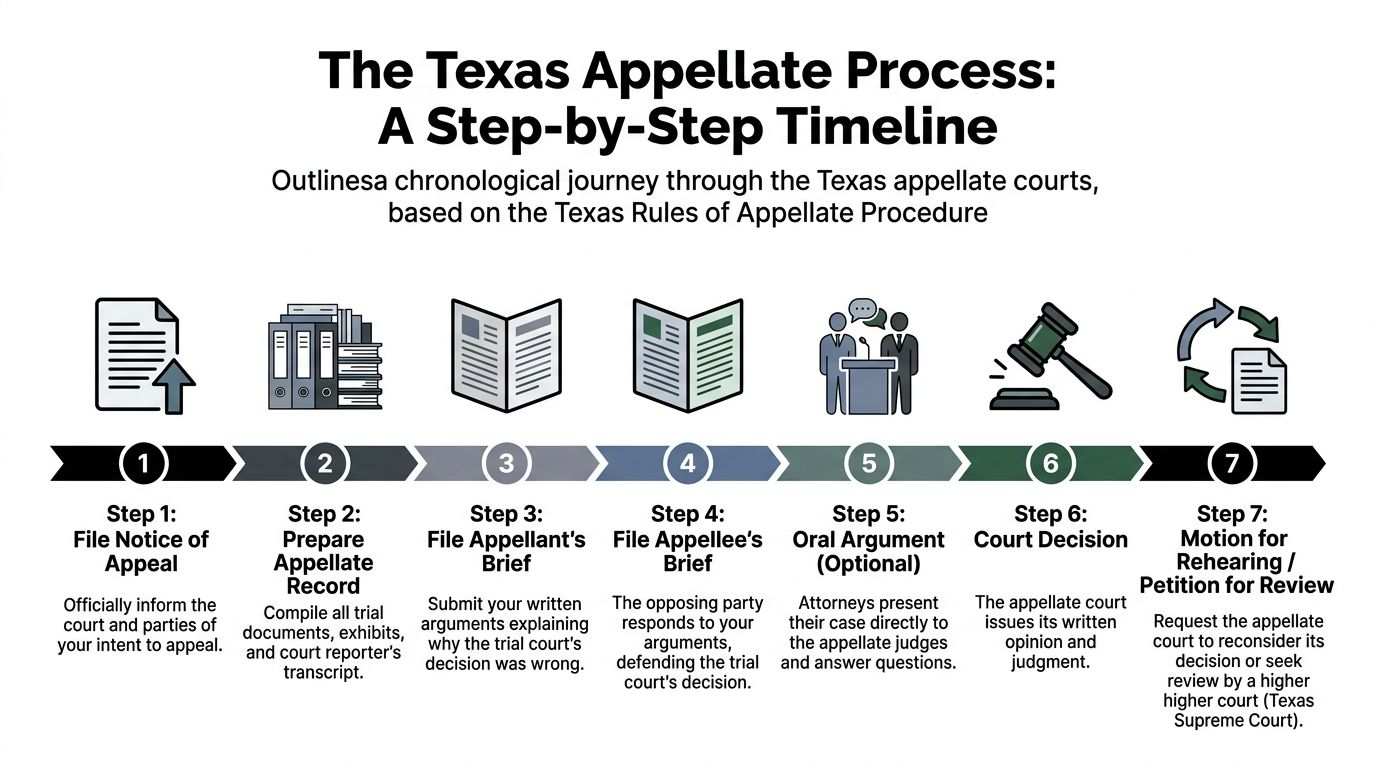
The Texas Appellate Process A Step-by-Step Timeline
A common call comes a few days after the decree is signed. The client has read the property division three times, still believes the house, retirement account, or business interest was handled wrong, and wants to know whether the court of appeals can fix it. The answer depends less on how unfair the result feels and more on what was preserved, what made it into the record, and whether the error can be shown under the abuse of discretion standard in a Texas family law appeal.
The timeline starts immediately. Once the final divorce decree is signed, appellate deadlines begin to run, and they do not pause while you decide how to proceed.
A notice of appeal is generally due within 30 days after the final decree is signed. If a timely motion for new trial or certain other post-judgment motions is filed, that deadline is usually extended to 90 days. Miss the deadline, and the appeal may be gone before the court ever reaches the merits.
The case shifts from testimony to record
Trial is about presenting evidence. Appeal is about working from a closed file.
That file usually has two main parts:
- Clerk’s Record: pleadings, motions, orders, the decree, requested findings, filed exhibits that were included in the record, and other papers on file with the court.
- Reporter’s Record: the transcript of testimony, objections, rulings, and hearings.
This shift matters in unequal property division appeals because many of the strongest issues are record-specific. If the complaint is that the court misclassified separate property as community property, the appellate court will look for tracing evidence, admitted exhibits, objections, and findings. If the complaint is that the judge assigned a value with no support in the evidence, the court will look for testimony and exhibits showing the numbers presented. New documents and new explanations do not get added on appeal.
Briefing is where appeals are usually won or lost
Clients often expect oral argument to be the main event. In most family law appeals, the briefs carry the case.
A persuasive appellant’s brief stays disciplined. It does not retell the marriage or revisit every grievance from trial. It isolates the ruling that can be reversed, cites the exact part of the decree, identifies the controlling law, and walks the court to the pages of the record that show both error and harm.
In property cases, that often means doing careful work on issues such as:
- whether an asset was characterized correctly as separate or community property,
- whether the evidence supports the valuation the court used,
- whether requested findings help expose the basis for the ruling,
- and whether the claimed error probably affected the overall division.
That last point is where many appeals get weaker than clients expect. Showing a mistake is not always enough. The briefing must also explain why the mistake changed the just-and-right division in a meaningful way.
What the timeline usually looks like
The sequence is straightforward. The work inside each step is not.
| Stage | What happens | Why it matters |
|---|---|---|
| Notice of appeal | The appellant files the notice within the deadline | Late filing can end the appeal |
| Post-judgment motions | A motion for new trial or request for findings may be filed, depending on the issues | These filings can affect deadlines and sharpen appellate issues |
| Record preparation | The clerk’s and reporter’s records are requested, prepared, and filed | The appellate court reviews this record, not new evidence |
| Appellant’s brief | The appellant sets out the issues, record cites, legal authorities, and requested relief | This frames the case for review |
| Appellee’s brief | The other side responds and argues the decree should stand | This often focuses on preservation, harmless error, and deference to the trial court |
| Oral argument | The court may set argument in some cases | Judges test the legal theory, the record support, and the requested remedy |
| Opinion and judgment | The court issues its decision | The decree may be affirmed, reversed in part, or sent back to the trial court |
Oral argument has a narrower role than clients expect
Oral argument can help. It rarely saves a weak record or a poorly framed issue.
There are no witnesses, no new exhibits, and no second chance to build proof that was missing at trial. The judges usually press on three points. What rule controls, where the record supports your position, and what remedy the court can legally give you. In a property division appeal, that last question matters because even a strong showing of misclassification or unsupported valuation often leads to remand for a new division rather than an appellate court recalculating the estate itself.
Possible outcomes
An appeal does not usually produce instant final relief.
The court may affirm the decree and leave the property division intact. It may reverse and remand for the trial court to divide the estate again under the correct legal framework. It may issue a partial reversal if only part of the property division is affected. In more limited situations, it may modify part of the judgment.
Clients should understand that a successful appeal often buys another round of litigation, more delay, and more cost. Sometimes that is the right move. Sometimes the better strategy is a focused post-judgment motion, a settlement discussion, or a narrower appeal aimed at the error that changed the outcome.
Preserving Your Right to Appeal Before It Is Too Late
You read the signed decree, see the property split, and know something went wrong. Then you learn the harder truth. Some of the strongest appellate issues are lost before the notice of appeal is ever filed.

That problem is called error preservation. An appellate court usually reviews only complaints that were properly raised in the trial court, with enough clarity for the judge to rule on them. If the record does not show the objection, the ruling, or the substance of excluded evidence, the issue may be waived even if the trial court was wrong.
Many property division appeals break down due to this. Clients often focus on the unfair result. Appellate courts focus on the record. In unequal division cases, that difference matters most when the issue involves misclassified separate property, weak tracing proof, excluded valuation testimony, or a decree that does not match the evidence admitted at trial.
Preservation is how you prove abuse of discretion
“Abuse of discretion” is not a label you attach after the fact. It has to be built from the trial record.
If the court treated separate property as community property, the record must show the documents, testimony, or tracing analysis that established the separate character of the asset. If the judge excluded that proof, the record must also show what the excluded evidence would have said. If counsel never made that record, the appellate court may have no basis to decide whether the ruling probably caused an improper division.
The same problem comes up with valuation disputes. A party may believe the court used the wrong number for a business, retirement account, or real estate interest. On appeal, the question becomes narrower. What valuation evidence was admitted, what objection was made, and where did the court reject or disregard competent proof?
Trial steps that protect an appeal
General complaints about fairness do not preserve much. Specific procedural steps do.
Timely objections
Objections have to be made when the problem occurs, and they have to state the legal basis with enough precision to alert the trial judge. If testimony about characterization, reimbursement, or valuation comes in without objection, the complaint may be gone.
Offers of proof
When a judge excludes evidence, counsel should make an offer of proof or bill of exception that shows the substance of the excluded testimony or exhibit. Without that step, an appellate court often cannot evaluate harm. In practical terms, that can end the issue.
Requests for findings
In a bench trial, Findings of Fact and Conclusions of Law often matter more than clients realize. They can show whether the court misclassified property, relied on a particular valuation theory, or based the unequal division on facts that lack record support. They also help frame the issues on appeal with more precision.
Post-judgment motions
A motion for new trial or other post-judgment filing can serve a real strategic purpose. In some cases, it preserves complaints that would otherwise be difficult to raise, gives the trial court a chance to correct a specific error, and extends certain appellate deadlines. For a more detailed explanation, see this guide on preserving error for appeal in Texas family court.
What to gather for appellate review
If the decree has already been signed, there is still useful work to do. An appellate lawyer can usually assess preservation much faster if you collect the materials that show where the issue arose and how it was handled.
Gather:
- The final decree and any amended decree
- Any requested findings of fact and conclusions of law
- Post-trial motions and rulings
- Exhibit lists, admitted exhibits, and any excluded exhibits if available
- A hearing or trial date timeline tied to the disputed property issues
- Notes identifying objections, excluded testimony, and disputed valuations or tracing evidence
I often start with a simple question: where, exactly, is the error in the record?
That question sounds narrow. It decides whether an appeal is merely frustrating or winnable.
Conclusion Your Path to a Fair Outcome
A common end point looks like this. The decree gives your spouse a larger share of the estate, the judge calls it just and right, and you are left asking whether an appeal can fix it.
Sometimes it can. Often it cannot. The difference is rarely how unfair the result feels. It is whether the record shows a specific legal or evidentiary error that probably affected the division.
In these cases, the strongest appellate issues are usually concrete ones: separate property treated as community property, valuation findings that are not supported by admitted evidence, excluded proof that was properly offered and preserved, or findings and rulings that do not line up with the decree itself. Those are the pressure points appellate courts can review.
That is also why clients need a candid assessment early. An appeal is not a second trial, and it is not a chance to submit cleaner tracing, better appraisals, or new financial records. The court of appeals reviews what was preserved, what was admitted, and what the judge did with it.
A sound appeal usually turns on a short list of questions:
- Was there a clear misclassification, valuation error, or other legal mistake tied to the property division?
- Does the reporter's record and clerk's record show that error plainly?
- Was the complaint preserved through an objection, offer of proof, requested findings, or post-judgment motion where required?
- Can appellate counsel explain why the error probably caused an unjust division under the abuse of discretion standard?
Even a successful appeal has limits. In many cases, the remedy is reversal and remand for a new property division rather than a rewritten decree from the appellate court. For some clients, that is still the result that matters most. It removes a decree built on a defective record or legal mistake and gives the case another lawful review.
If you are considering an appeal, act quickly and get the file reviewed by counsel who handles family law appeals. The first job is to identify the issue, locate it in the record, and tell you plainly whether the case is appealable. Contact The Law Office of Bryan Fagan today for a free consultation.