You may feel like the judge heard your case but didn’t follow the rules that were supposed to guide the outcome. That feeling is common after a child support order that seems disconnected from the statutory guidelines, or a custody ruling that doesn’t reflect what the evidence showed about your child’s needs.
In Texas family law, that reaction matters. Sometimes the problem is not that the result feels wrong. The problem is that the trial court deviated from legal guidelines without making the findings the law requires, relied on the wrong legal standard, or entered an order the record doesn’t support.
That is where an appeal can matter. An appeal is not a new trial. You don’t get to bring in new witnesses or fix evidence that was never introduced. Instead, a higher court reviews the existing record to decide whether the trial court committed reversible error, meaning a legal mistake serious enough to justify correction.
For families searching for answers about challenging deviation from guidelines texas appeal, the most important truth is this. A strong appeal starts long before the notice of appeal is filed. It starts with what happened in the courtroom, what objections were made, what findings were requested, and what made it into the written record.
Your Family Law Case Was Decided Unfairly What Now
Many parents reach this point after doing everything they thought they were supposed to do. They showed up. They brought documents. They testified. They trusted the court to apply the Texas Family Code fairly.
Then the final order arrives.
Maybe the child support amount doesn’t match the guideline framework, and the order doesn’t clearly explain why. Maybe the possession schedule seems to skip over facts that mattered. Maybe the ruling reads like the judge made a decision first and worked backward later. When that happens, people often assume they’re stuck with it. They aren’t always.
What an appeal really asks
An appeal asks a narrower question than most clients expect. It does not ask whether the appellate court would have made a different call if it had been the trial judge. It asks whether the trial court followed the law, applied the correct standards, and based its ruling on the record.
That difference matters because many frustrated litigants focus on fairness in the broad sense. Appellate judges focus on legal error.
A useful plain-English definition helps here:
- Reversible error means a mistake that likely affected the outcome.
- The record means the papers filed in the case and the hearing transcripts.
- An appeal is a legal review of that record, not a second chance to build a new one.
A good appeal doesn’t repeat trial testimony with more emotion. It isolates the ruling, the rule the court should have followed, and the place in the record where the error appears.
There is real reason for cautious hope. A Texas appellate study discussed in this review of perfecting the appeal in Texas courts reported a 32% reversal rate in family law cases from bench trials, and child support cases showed a 42% reversal rate. That does not mean every disappointed parent should appeal. It does mean appeals can work when the trial court departs from the law.
The first question to ask yourself
Before anything else, ask this: What exactly did the judge do that violated a rule?
If you can answer that clearly, you may have the beginning of an appellate issue. Common examples include:
- Child support deviation without findings
- Custody rulings that skip required best-interest analysis
- Property division rulings based on the wrong legal premise
- Protective order or enforcement rulings entered without proper procedural safeguards
If you can only say, “The judge didn’t believe me,” the path is harder. Appeals usually don’t correct credibility disputes alone. They correct legal mistakes.
Laying the Groundwork for a Successful Appeal at Trial
Appeals are often won or lost in the trial court. That sounds backward to clients, but it’s true. The appellate court can only review what was preserved, requested, admitted, and recorded.

Preserving error is not optional
Preserving error means giving the trial judge a fair chance to correct the problem when it happens. Under the Texas Rules of Appellate Procedure, an appellate court usually won’t consider a complaint that was never properly presented to the trial court.
That is why vague objections rarely help. “I object” is usually not enough. The objection must identify the legal problem with enough specificity to match the issue later raised on appeal.
In a guideline-deviation case, counsel should tie the objection to the statute involved. If the court departs from child support guidelines, the objection should make clear that the ruling deviates from the statutory framework and that required findings must be made.
Child support deviations need findings
Texas Family Code §154.130 is a frequent fault line in these cases. When a trial court orders child support that deviates from the guidelines, written findings are critical. As noted in this discussion of preserving and presenting appellate issues in Texas family cases, failure to provide the required written findings upon request can be reversible error, and appeals based on that failure succeed in approximately 25% to 35% of properly preserved cases.
That practical point shapes trial strategy.
If a deviation is on the table, trial counsel should:
- Object specifically to the deviation and identify the legal basis.
- Request findings of fact and conclusions of law when the rules and statutes call for them.
- Watch the deadlines after judgment if findings are not included.
- Make sure the reporter’s record captures the request and the ruling.
Here is the practical reason. If the judge never explains why the order departed from the guidelines, the appellate court is left with a gap. In some settings, that gap is exactly what makes the order vulnerable.
Custody deviations present a similar issue
In custody and visitation disputes, the language is different but the lesson is the same. If the court’s ruling strays from the statutory best-interest framework, counsel should identify the missing factors and request findings that show the court’s reasoning.
That doesn’t guarantee reversal. It does force clarity. And clarity is what an appeal needs.
Practical rule: If the trial judge’s reasoning is not in the written order, not in findings, and not clearly reflected in the record, your appellate lawyer starts from a weaker position.
A short explanation of key terms helps:
| Term | Plain-English meaning |
|---|---|
| Objection | Telling the court, on the record, what legal mistake is happening |
| Findings of fact | The judge’s written explanation of what facts the court believed |
| Conclusions of law | The judge’s written statement of the legal rules applied |
| Preserved error | An issue raised correctly in the trial court so it can be reviewed later |
A useful overview for clients who want a visual explanation is below.
The deadlines begin immediately
Many people lose viable issues because they wait too long after judgment. The appellate timeline is strict. In broad terms, the notice of appeal is due quickly, and certain post-judgment filings can affect that deadline.
You don’t need to master the rule numbers on your own, but you do need to act fast enough for counsel to review:
- The final order
- Any findings that were entered
- Whether findings were requested
- Whether a motion for new trial should be filed
- Whether the hearing was recorded and can be transcribed
In a challenging deviation from guidelines texas appeal, the window for smart action is short. Delay makes everything harder.
Understanding the Standard of Review in a Texas Appeal
The standard of review is the rule that tells the appellate court how much deference to give the trial judge. Clients usually expect the appeal to ask, “Who was right?” That’s not the usual question. More accurately, the question is often, “Did the trial judge make a decision no reasonable judge should have made under the governing law and the actual record?”
Abuse of discretion in plain English
In many family law appeals, the standard is abuse of discretion. That phrase sounds technical, but the basic idea is simple. The trial judge gets room to make judgment calls. The appellate court does not step in just because it might have decided things differently.
To prove an abuse of discretion, you usually need to show the ruling was arbitrary, unreasonable, or made without reference to guiding legal principles.
That is why appeals based only on “the judge should have believed me” are difficult. Trial judges see the witnesses live. Appellate judges read a paper record.
A more detailed discussion appears in this article on the abuse of discretion standard in Texas family law.
Why findings can change the appeal
In this context, missing findings become powerful. In custody cases involving deviation from the statutory best-interest analysis, the problem is not only the outcome. The problem is that the appellate court cannot safely infer why the judge ruled as he or she did.
According to this discussion of challenging final custody and divorce orders on appeal, to win a custody appeal based on deviation from the best-interest standard under Texas Family Code §153, the appellant must show clear abuse of discretion, but appeals based on missing required findings on statutory factors succeed at over 35%.
That tracks with everyday appellate reality. A trial court has discretion. It does not have discretion to skip required legal steps.
A simple comparison
| Issue on appeal | What the appellate court usually asks |
|---|---|
| Abuse of discretion | Did the judge act outside the range the law allows? |
| Legal sufficiency | Is there any legally valid evidence supporting the finding? |
| Factual sufficiency | Is the finding so against the weight of the evidence that it cannot stand? |
The choice of standard affects everything. It changes how the brief is written, what issues deserve emphasis, and what arguments are worth dropping.
If the standard is abuse of discretion, the strongest briefs usually focus on the legal rails the trial court left, not on re-arguing every factual disagreement from trial.
That is why experienced appellate counsel often narrows a case. The client may feel ten things went wrong. The court of appeals may only care about one or two issues that fit the governing standard cleanly.
Building Your Case on Paper The Appellate Brief
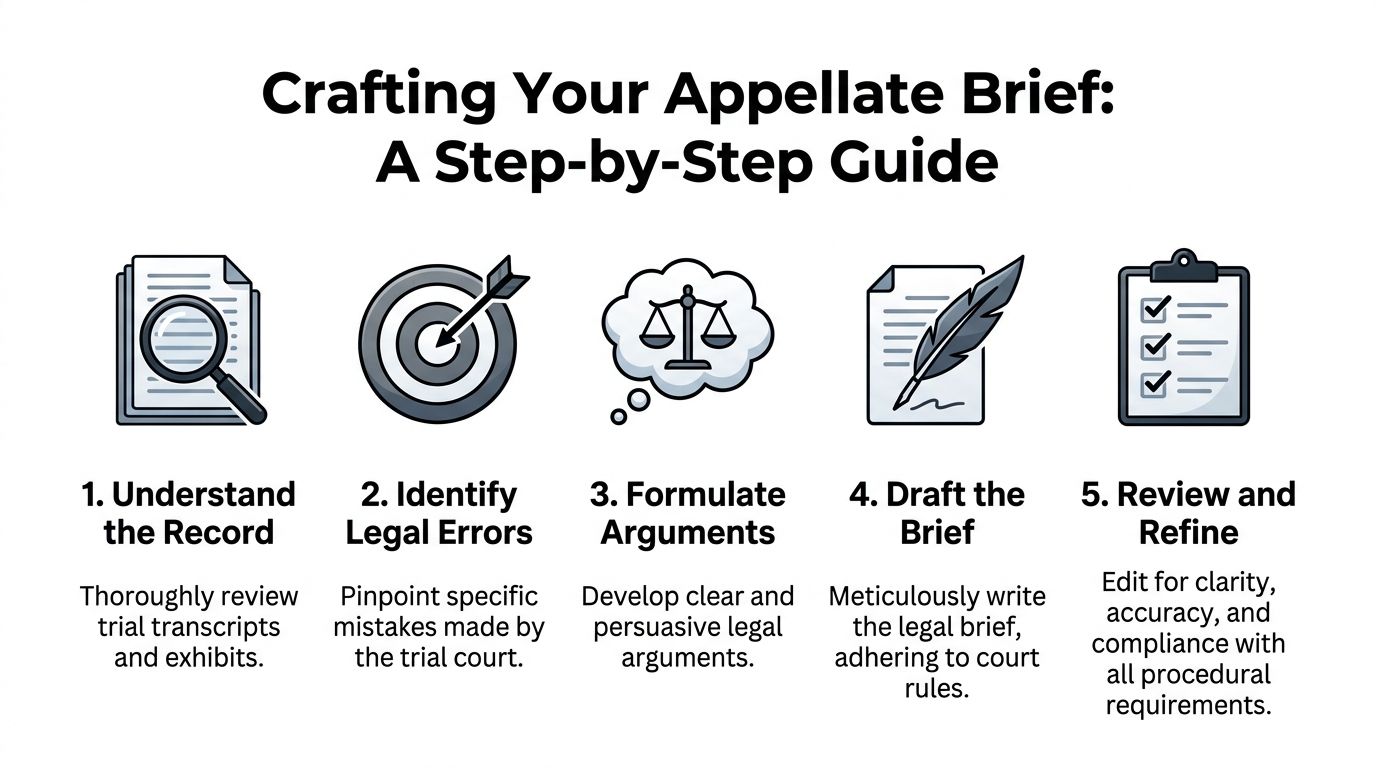
Most appeals are decided on writing. The appellate brief is where the case becomes disciplined, precise, and judge-focused. If the trial record contains a real error, the brief has to present it in a way that an appellate panel can act on.
The appeal lives inside the record
The first practical step is collecting the appellate record. That usually includes two main parts:
Clerk’s Record
The filed papers. Petitions, motions, orders, requests for findings, notices, and other case documents.Reporter’s Record
The transcripts. This is the word-for-word record of hearings and trial testimony.
No new evidence comes in at this stage. If a bank statement, text message, or witness never made it into the trial record, it usually cannot rescue the appeal later.
That can be frustrating, but it also creates discipline. The appellate lawyer’s job is not to rebuild the case. It is to identify what the existing record already proves.
What a strong brief does
A strong brief does more than complain. It answers four questions clearly:
- What did the trial court do?
- What rule should the court have followed?
- Where in the record does the error appear?
- Why did that error probably affect the judgment?
That fourth point is easy to underestimate. An appellate court does not reverse for harmless error. The brief must show harm.
In a guideline-deviation appeal, harm may be straightforward. If the court entered a child support amount that departed from the statutory framework without required findings, and that omission prevented meaningful review or supported an unsupported order, the brief should show that directly and cleanly.
Precision matters more than volume
Many losing briefs have the same flaw. They are too broad. They throw in every complaint from trial, mix standards of review, and bury the best issue under pages of frustration.
Better briefing is selective.
A well-built brief often includes:
- A concise statement of the case that accurately frames the dispute
- Issues presented that are narrow enough to win
- A statement of facts tied closely to the record
- An argument section that applies the correct standard of review
- A remedy request that tells the appellate court exactly what action is sought
For readers who want to understand how facts should be presented without turning the brief into advocacy overload, this article on the statement of facts in a Texas family appeal is a useful companion.
Briefing means legal writing with discipline
Briefing is the process of writing the formal appellate argument submitted to the court. In plain English, it is the written case for why the order should be affirmed, reversed, or sent back.
Good briefing is not dramatic. It is controlled.
Here is what usually works in practice:
| What works | What usually fails |
|---|---|
| Quoting the order and the statute side by side | Repeating that the ruling was unfair |
| Citing exact record pages | Summarizing testimony without record cites |
| Matching the issue to the correct standard of review | Mixing abuse-of-discretion and sufficiency arguments without structure |
| Asking for a specific remedy | Asking the court to “fix everything” |
The judges reading your brief were not in the courtroom. They know the case only through the record and your writing. If the writing is vague, the issue often becomes invisible.
Who should prepare the brief
Some trial lawyers handle their own appeals well. Some don’t. Appeals require a different kind of advocacy. The work is heavily rule-driven, deadline-sensitive, and writing-intensive.
That is why parties sometimes bring in separate appellate counsel after trial. The Law Office of Bryan Fagan, PLLC handles family law appeals by reviewing the trial record, identifying preserved issues, and preparing appellate briefs focused on Texas Family Code and Texas Rules of Appellate Procedure errors. In many cases, outside appellate review helps separate strong issues from emotional but unwinnable ones.
The brief is not the place to say everything. It is the place to say the few things that can change the result.
Key Strategic Considerations in Your Texas Appeal
Even when the core issue is strong, strategy still matters. Appeals are shaped by timing, by what happened after judgment, and by whether the issue can realistically produce relief.
A motion for new trial can matter
A motion for new trial is a request asking the trial court to reconsider its judgment. It is not often granted. Still, it can be important.
Why? Because it may do two useful things:
- It can extend the appellate timetable in the right circumstances.
- It can help sharpen the complaint and preserve the record around post-judgment issues.
This does not mean every case needs one. Sometimes filing it adds little. Sometimes it is a prudent move because the order is unclear, findings are missing, or counsel needs to lock down specific complaints while the trial court still has plenary power.
Timing is better than most clients expect
Clients often fear that an appeal means years of waiting with no movement. Texas appellate courts are more efficient than many people realize. According to the Texas courts of appeals performance report, the average disposition time for civil cases was 7.6 months, the courts issued over 10,500 opinions, and each justice averaged 132 opinions. That same report notes the courts handle 10,000 to 12,000 appeals each year.
That does not mean every family appeal moves at the same speed. Record preparation, extensions, and the complexity of the issues can change the pace. But a properly developed appeal usually does not sit idle forever.

Venue disputes got harder to appeal early
One issue many families don’t expect is venue. If a case was heard in the wrong county, clients often assume they can immediately appeal that mistake before the case finishes. That is now much harder.
A separate recent authority discussed later narrowed interlocutory appeals for venue disputes. In practical terms, many family law litigants now have to preserve the issue and wait for a final judgment before seeking review.
That changes strategy. Counsel should be careful about preserving venue complaints early, because the opportunity for immediate correction is limited.
A realistic strategy asks narrower questions
In challenging deviation from guidelines texas appeal cases, it helps to ask practical questions before spending time and money:
- Can the issue be reviewed on the existing record?
- Was the complaint preserved clearly enough?
- Would a win change the order in a meaningful way?
- Is remand useful, or would it only send the parties back into the same fight?
That last point is important in support cases. A remand can be valuable if the trial court failed to make findings or applied the wrong legal framework. It may be less useful if the likely result after remand is the same order with better wording.
For parents focused on support issues, this page on appealing child support calculation in Texas can help frame what makes a challenge practical versus theoretical.
Fees and cost trade-offs are part of the decision
Appeals involve filing fees, transcript costs, and attorney time. That does not make them unwise. It means the legal issue should be measured against the likely remedy.
A disciplined appellate review often saves clients money in the long run by answering one key question early. Is there a real appellate issue, or just a painful result?
Navigating the Final Stages and Potential Outcomes
After briefing is complete, clients usually ask the same thing. What happens now?
The answer depends on the court, the issues, and whether the panel wants oral argument. But the final stages are less mysterious than they appear from the outside.
Oral argument is not another hearing
Oral argument is a short hearing before the appellate justices. The lawyers answer questions about the briefs, the record, and the law. No new evidence comes in. No one retells the whole case from scratch.
In many appeals, oral argument is not granted. When it is, the value usually lies in clarification. A justice may ask where the preservation occurred, whether the requested remedy is remand or rendition, or why the missing findings matter under the governing statute.
That means the best oral arguments are focused and responsive. They are not emotional closing statements.
By the time oral argument happens, the judges have usually read the briefs. The lawyer’s job is to answer the court’s hardest questions directly.
The appellate court’s written opinion
The court eventually issues a written opinion. That opinion explains whether the judgment is affirmed, reversed, modified, or sent back.
The most common outcomes include:
Affirmance
The trial court’s judgment stands.Reversal and remand
The appellate court sends the case back for further proceedings consistent with its opinion.Reversal and rendition
The appellate court changes the result and renders the judgment that should have been entered.
For family law appeals involving deviation from guidelines, reversal and remand is often the practical remedy. If the problem is missing findings, use of the wrong legal framework, or failure to explain a deviation, the court of appeals may send the issue back so the trial court can correct the error under the proper rules.
Venue and waiting for final judgment
One procedural change deserves special attention. In April 2024, the Texas Supreme Court in Rush Truck Centers v. Sayre narrowed interlocutory appeals for venue disputes. As explained in this analysis of the decision and its effect on interlocutory review, family law clients challenging a case being heard in the wrong county will now usually have to wait for a final judgment before seeking appellate review.
That matters because some clients spend too much energy trying to force immediate review where the law no longer allows it. The better course is often to preserve the issue carefully and prepare for a post-judgment appeal if necessary.
What a win can realistically look like
A successful appeal does not always mean instant vindication. Sometimes a win means:
| If you win on appeal | What that may mean in practice |
|---|---|
| Missing findings issue | The case returns to the trial court for proper findings or further proceedings |
| Wrong legal standard | The trial court must reconsider the issue under the correct law |
| Unsupported deviation | The challenged portion of the order may be vacated and revisited |
| Clear legal error | In narrower cases, the appellate court may render the correct result |
That is still meaningful. Appellate work is about restoring lawful process. In family law, lawful process often changes outcomes.
Let Our Appellate Team Fight for a Fair Outcome
If your final order departed from the rules that were supposed to guide the court, you may have more than frustration. You may have an appellate issue.
That issue has to be evaluated carefully. The questions are practical and legal at the same time. Was the error preserved? Are the findings missing or defective? Does the record show a true deviation from the governing standard? Would a successful appeal likely produce a useful remedy?
Those questions deserve a disciplined review, not guesswork.
Appeals are demanding because they require precision at every stage. The notice has to be timely. The record has to be complete. The issues have to be framed under the correct standard of review. The brief has to connect the statute, the order, and the record with enough clarity that the court can act.
That is why many families benefit from appellate counsel even after trial representation has ended. The focus shifts from proving facts to identifying reversible error and presenting it persuasively to a higher court.
If you believe the court made a mistake in your family law case, our appellate attorneys can help you seek a fair outcome. Contact The Law Office of Bryan Fagan today for a free consultation.
If you believe a Texas family court deviated from child support guidelines, best-interest standards, or other required legal rules, a focused appellate review may reveal a path forward. The appellate team at The Law Office of Bryan Fagan, PLLC helps clients evaluate the trial record, identify preserved errors, and pursue fair relief through the Texas courts of appeals.