Skip to content
After a difficult divorce process, receiving the final decree can feel like the end of a long road. But what if you read the order and believe the outcome was fundamentally unfair? You may feel your case was handled incorrectly, that the judge misunderstood the facts, or that a critical legal mistake was made. This is a deeply frustrating experience, but it is not the end of the story.
Texas law provides clear pathways to address an unjust or unworkable divorce decree. The first, most critical step is to determine whether you need to update the decree because life has changed, or challenge the original decision because of a legal error. This distinction will guide your entire legal strategy and determine whether you should seek a modification or an appeal.
Understanding Your Options: Modification vs. Appeal
When a divorce decree no longer serves your family or was flawed from the beginning, Texas law offers two primary solutions: modification and appeal. Grasping the difference is essential because they address completely different problems and operate on separate legal tracks with strict deadlines.
Your strategy depends on one key question: Has a major life event made the old order unworkable, or do you believe the judge made a legal error during the trial? This flowchart illustrates the two paths forward.
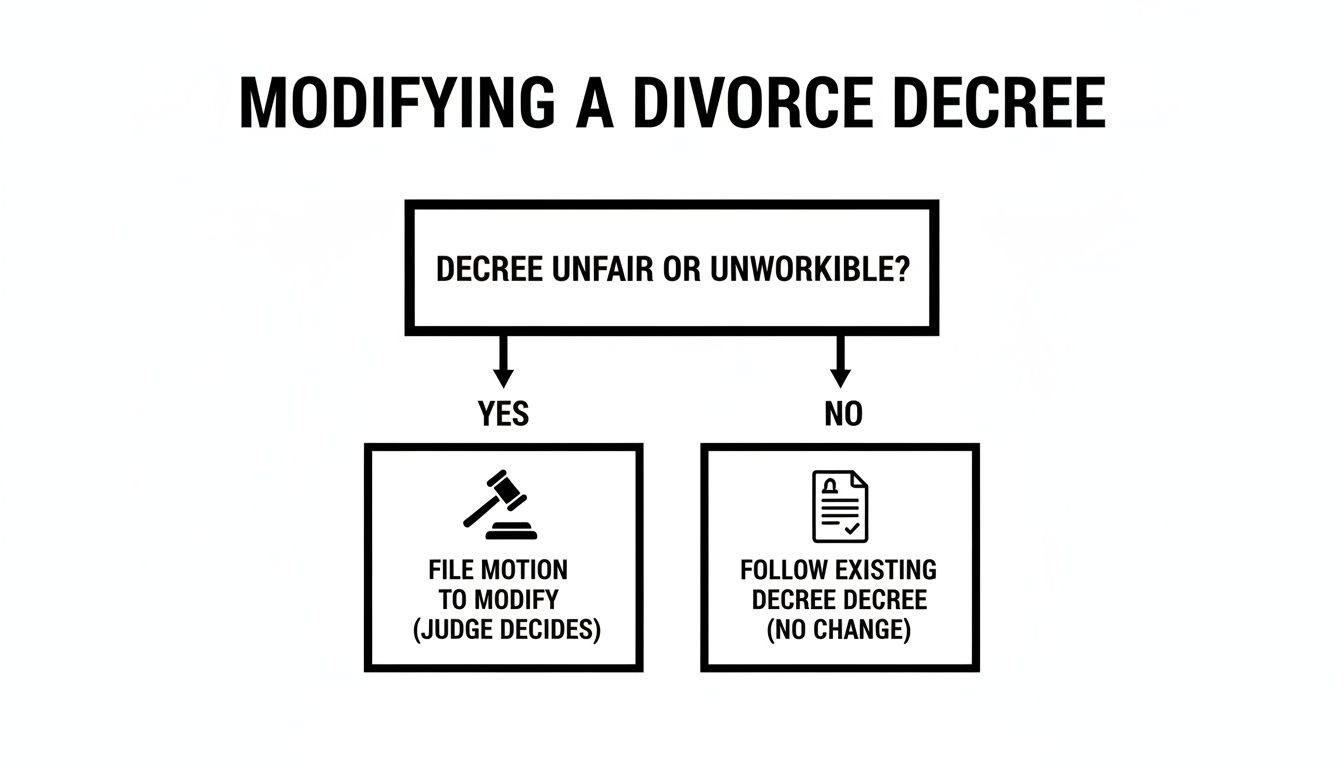
As you can see, your starting point is determining if the decree was flawed from the start or if it has simply become outdated due to new circumstances.
Modification: Adapting to New Circumstances
A modification is the legal process used to update certain parts of a divorce decree when there has been a material and substantial change in circumstances since the judge signed the original order. It is almost exclusively used for ongoing issues related to children and financial support. For example, if a parent receives a major job relocation, it may be necessary to modify the custody, visitation, and child support orders.
- What you can modify: Child custody, visitation schedules, child support, and sometimes spousal maintenance.
- What you cannot modify: The division of property and debt. This part of your decree is final and cannot be changed through a modification.
Appeal: Correcting Legal Errors
An appeal is the process for challenging the trial court’s original judgment because you believe the judge made a legal or procedural mistake. An appeal is not a new trial or a chance to present new evidence. Instead, you are asking a higher court (the court of appeals) to review the trial record for a "reversible error"—a mistake so significant that it likely led to an unjust outcome. If you are asking, "can you appeal a divorce decree?", the answer depends on whether a specific legal error can be proven from the record of your trial.
Pathways to Change Your Texas Divorce Decree
This table summarizes the primary legal methods for altering a final divorce decree in Texas and outlines when each path is appropriate.
| Method | What It Can Change | Primary Requirement |
|---|---|---|
| Modification | Custody, visitation, child support, spousal maintenance | A material and substantial change in the circumstances of a child or a person affected by the order. |
| Appeal | Any part of the final decree, including property division | A reversible legal error was made by the trial court judge during the proceedings. |
| Post-Judgment Motions | Any part of the decree | Usually filed to preserve error for appeal, point out a legal flaw, or introduce newly discovered evidence. |
Each of these avenues has its own strict deadlines and legal standards under the Texas Family Code and Texas Rules of Appellate Procedure. At The Law Office of Bryan Fagan, our appellate attorneys focus on identifying and correcting judicial errors to restore fairness and help you achieve the just result you deserved from the start.
Modifying a Decree When Life Changes

Life does not stand still after a divorce is finalized, and Texas law acknowledges this reality. The most common way to update a decree is through a modification, a formal legal action designed to ensure court orders remain practical and serve the best interest of the child as your family evolves.
Think of your divorce decree as having two parts. The property division is written in permanent ink, while orders concerning children and ongoing support are written in pencil—they can be changed. A modification is the official process for asking the court to update those terms.
The Standard for Modification: “Material and Substantial Change”
You cannot ask the court to change an order because of a minor disagreement or inconvenience. To succeed in a modification action, you must prove that a “material and substantial change in circumstances” has occurred since the last order was signed.
This is a specific legal standard. “Material and substantial” means the change is significant and impacts the effectiveness or appropriateness of the current order. The court must be convinced that because of these new developments, the old orders are no longer workable or in the child’s best interest. You can discover more insights about family dynamics from recent data to see just how much families can change over time.
What Parts of a Decree Can Be Modified?
In Texas, you can typically ask the court to modify these key areas:
- Child Custody and Visitation: As children age, their needs and schedules change. A possession schedule that worked for a toddler is often unworkable for a teenager involved in school and extracurricular activities.
- Child Support: Incomes change, jobs are lost, and children may develop new health or educational needs. When these financial shifts occur, child support can often be adjusted.
- Spousal Maintenance: In some cases, alimony payments can be modified if the financial circumstances of either former spouse change dramatically.
These orders are designed to be flexible because they address the ongoing welfare of children and the financial realities of post-divorce life.
The One Thing You Almost Never Can Change: Property Division
It is critical to remember this rule: the division of your marital property and debt is final and generally cannot be modified. Once the judge signs the decree dividing the house, retirement accounts, business assets, and debts, that division is set in stone.
The legal principle behind this finality is to ensure a clean financial break between former spouses. Reopening a property division years later would create endless legal disputes and uncertainty.
While there are rare exceptions, such as proving fraud or hidden assets, these are not addressed through a standard modification. They require a separate, complex lawsuit known as a Bill of Review. If you believe the court made a legal error in how it divided your property, your only remedy is to file a timely appeal of the original judgment. A skilled property division appellate attorney can analyze your decree for reversible errors.
Challenging an Unfair Judgment Through an Appeal

Sometimes the problem isn’t that your life has changed, but that the judge’s decision was wrong from the start. You may feel that the judge overlooked critical evidence, misapplied Texas law, or issued a ruling that is not supported by the facts presented at trial.
When you believe the outcome was legally unjust, Texas law provides specific post-judgment remedies to correct the error. These are not do-overs; they are technical legal procedures designed to fix significant mistakes that occurred during the trial itself. This is where the focus shifts from adapting the decree to correcting it.
Understanding Post-Judgment Motions and Appeals
If you believe a legal mistake tainted your divorce decree, a modification is not the solution. Instead, you must use one of the specific legal actions designed to challenge the final judgment. Each has a distinct purpose and, crucially, comes with strict deadlines that cannot be missed.
Your main routes for challenging a final judgment in Texas are:
- Motion for New Trial: This is your first opportunity to ask the trial judge to reconsider their decision. It must be filed within 30 days of the decree being signed.
- Appeal: This is the primary path for correcting a judge’s legal errors. An appeal asks a higher court—the court of appeals—to review the written record of your trial for mistakes that led to an improper judgment.
The right choice depends on the type of error and how much time has passed since the judgment was signed. An experienced appellate attorney can evaluate your case and determine the most effective strategy. You can learn more in our guide to the Motion for New Trial in Texas.
The Motion for New Trial: Your First Step
A Motion for New Trial is a formal request filed with the same judge who heard your case, asking them to set aside their judgment and grant a new trial. This motion essentially states that a significant error occurred and must be corrected.
Common grounds for a Motion for New Trial include:
- The judge’s decision is against the great weight and preponderance of the evidence.
- Newly discovered evidence has come to light that could not have been found before trial.
- The judge made a clear error of law in their ruling.
Filing this motion is also a critical procedural step, as it extends the deadline for filing an appeal from 30 days to 90 days. This additional time is vital for preparing a strong case for the appellate court.
Seeking Justice Through the Appellate Process
If a Motion for New Trial is denied or is not the appropriate remedy, a formal appeal is the primary avenue for correcting a flawed divorce decree. An appeal is not a new trial. No new evidence is presented, and no witnesses testify.
Instead, a panel of appellate judges meticulously reviews the trial record—the court reporter’s transcript, admitted exhibits, and all filed motions—to identify a reversible error.
Plain English Definition: Reversible Error
A reversible error is a legal mistake made by the trial judge that was so significant it probably caused an improper judgment. It’s not a minor disagreement; it is a fundamental error in the legal process that changed the outcome of your case.
An appeal is successful when your attorney can demonstrate that the trial court abused its discretion or misapplied Texas law. With the realities of divorce statistics showing how many families are impacted by these decisions, ensuring the law is applied correctly is paramount. If you believe the court made a mistake, the appellate process is your opportunity to fight for a fair and legally sound outcome.
How an Appellate Court Reviews Your Case
An appeal is your opportunity to seek justice when a trial court’s decision feels wrong, but it’s important to understand how the process works. It is not a second trial where you can re-argue your case. Instead, the appellate court acts like a referee reviewing the official record of your trial. Their job is to determine if the judge made a legal mistake that unfairly changed the outcome. The entire process is governed by the Texas Rules of Appellate Procedure.
The Standard of Review: Finding Legal Errors in the Record
The biggest difference between a trial and an appeal is the standard of review. This is the specific lens the appellate judges use to evaluate the trial judge’s decisions. Because they were not present in the courtroom to hear testimony or observe witness demeanor, appellate courts give significant deference to the trial court’s findings of fact.
The appellate court’s task is to review the official trial record—which includes the court reporter’s transcript and all admitted evidence—and identify legal errors. The question is not, “Would we have ruled differently?” but rather, “Did the judge make a legal mistake that led to this decision?”
Plain English Definition: Standard of Review
A standard of review is the level of proof required to convince an appellate court that the trial judge made a mistake. It determines how significant the error must be for the higher court to intervene and correct it.
Understanding “Abuse of Discretion”
In Texas family law appeals, the most common standard of review is “abuse of discretion.” This standard gives trial judges considerable latitude in making decisions, especially in matters like child custody and property division. An appellate court will only reverse a decision for an abuse of discretion if the trial judge acted unreasonably, arbitrarily, or without reference to any guiding rules or principles.
This is a high bar to clear. It means showing the trial judge’s decision was more than just a judgment call you disagree with; it was a decision made outside the bounds of the law or with no support in the evidence. For a detailed explanation, please read our article on the abuse of discretion standard.
What Is a Reversible Error in Plain English?
Not every mistake made by a judge will result in a successful appeal. The error must be a “reversible error,” meaning it was so harmful that it probably caused an improper outcome. A minor procedural issue that did not affect the final judgment will be considered a “harmless error” and will not be grounds for reversal.
Examples of common reversible errors include:
- Mischaracterizing Property: The judge incorrectly classifies separate property (like an inheritance) as community property and divides it between the spouses.
- Excluding Critical Evidence: The judge refuses to admit relevant and credible evidence about an important issue, such as a parent’s history of substance abuse in a custody case.
- Misapplying the Law: The judge uses the wrong legal standard to decide an issue, such as applying an incorrect formula to calculate child support.
Proving these errors requires a deep understanding of Texas law and appellate procedure. Just as legal documents follow strict rules, like those outlined in Contract Interpretation Principles, appellate arguments must be precise and grounded in the record. This is where a skilled appellate attorney becomes essential—they know how to dissect a trial record, identify these critical mistakes, and build the persuasive legal argument needed to win on appeal.
Common Reversible Errors in Texas Divorce Cases
When you receive a divorce decree that feels fundamentally unjust, it is not enough to argue that the outcome was “unfair.” To win on appeal, you must identify a specific “reversible error”—a legal mistake made by the trial court that directly led to an improper judgment.
An appeal requires shifting your focus from what you hoped would happen to analyzing how the judge reached their decision. This is precisely what an appellate attorney does. We meticulously review the trial record to find legally recognized mistakes, which in Texas divorce cases often fall into a few key categories.
Errors in Property Division
Some of the most common and financially devastating errors occur during the division of the marital estate. Texas law requires a “just and right” division of community property, but when a court makes a mistake in fact or law, the result can be anything but. This is a primary reason to challenge a property division on appeal.
Common examples of reversible errors in property division include:
- Mischaracterizing Separate Property: The court incorrectly classifies property you owned before marriage, or received as a gift or inheritance during the marriage, as community property subject to division. For example, if your separate property inheritance was used to purchase an asset that was then divided, this could be a clear error.
- Failing to Value Assets Correctly: The court accepts a valuation for a major asset, like a family business or real estate, that has no basis in the evidence, leading to an inequitable division.
- Ignoring Reimbursement Claims: The court fails to recognize a valid claim for reimbursement when one marital estate (such as your separate property) confers a benefit upon another (the community estate), like when you use your separate funds for the down payment on the marital home.
These are not minor oversights; they are significant legal errors that can impact your financial future for years to come, making them strong grounds for an appeal.
Errors Involving Children
Nothing is more important than ensuring court orders protect the well-being of your children. When a decree is based on a legal error, it can cause lasting harm to your family. An appeal is not just about winning; it is about protecting your children and your parental rights.
Reversible errors in child custody and support cases often include:
- Disregarding Evidence of Family Violence: The Texas Family Code requires judges to consider evidence of family violence when making custody decisions. Ignoring credible evidence of abuse is a serious legal error that can be grounds for reversal.
- Incorrectly Calculating Child Support: The court miscalculates a parent’s net resources, misapplies the statutory child support guidelines, or fails to properly account for a child’s proven special needs.
- Imposing an Unworkable or Harmful Possession Order: The judge creates a visitation schedule that is not in the child’s best interest, is so impractical that it undermines the parent-child relationship, or improperly restricts a parent’s access without sufficient cause.
Plain English Definition: Briefing
Briefing is the process of writing the formal legal argument that is submitted to the court of appeals. This document, called a “brief,” explains the facts of the case, identifies the trial court’s errors, and uses statutes and prior case law to persuade the appellate judges to reverse the decision.
If you suspect your decree contains one of these fundamental flaws, that feeling of unfairness may be a valid legal argument. An appellate review is the only way to have the error corrected.
How Our Appellate Attorneys Can Fight for a Fair Outcome
It is a deeply frustrating experience to leave a divorce trial believing the judge made a serious mistake. While a trial court’s decision may feel final, the Texas legal system provides a powerful mechanism for correcting judicial errors: the appeal. This process is not a second trial; it is a focused, technical challenge designed to ensure the law was applied correctly and fairly in your case.
At The Law Office of Bryan Fagan, our appellate team is dedicated to this specific and demanding area of family law. We offer a strategic approach that is laser-focused on the unique requirements of the appellate process.
A Strategic Approach to Restoring Justice
Appeals are not won on emotion but on meticulous preparation and compelling legal arguments drawn directly from the trial record. Our process is built around what appellate courts require to reverse an unjust decision.
Here’s how we approach an appeal:
- Meticulous Record Review: We conduct an exhaustive review of your trial record—every page of testimony, every exhibit, and every ruling. This is where we identify the reversible errors that form the foundation of a successful appeal.
- Persuasive Legal Briefing: Our attorneys are skilled legal writers who excel at briefing. We transform complex legal issues into a clear, persuasive narrative that shows the appellate judges exactly where the trial court erred and why that error led to an improper judgment.
- Deep Procedural Knowledge: We are experts in the Texas Rules of Appellate Procedure and the Texas Family Code. We manage every detail and deadline with precision to protect your right to have your case heard and decided fairly by a higher court.
Our sole focus in an appeal is to restore balance and ensure due process was served. We believe a fair outcome is not only possible but is what the law demands when a clear error has occurred.
Your Path Toward a Just Resolution
Challenging an unfair judgment requires a specialized skill set that is different from that of a trial lawyer. You need an appellate advocate. Whether the judge made a mistake in your divorce property division or misinterpreted critical evidence in a custody dispute, our team has the experience to identify the error and build a powerful case to have it corrected. Your fight for a fair outcome does not have to end with a flawed decree.
Frequently Asked Questions About Changing a Divorce Decree
Once a divorce decree is signed, many people assume it can never be changed. However, life circumstances evolve, and sometimes the original judgment was flawed from the start. This can lead to many questions about your legal options. Here are answers to some of the most common questions we receive.
How Long Do I Have to Appeal a Divorce Decree in Texas?
In Texas, the deadlines for filing an appeal are extremely strict. If you miss them, you will likely lose your right to challenge the decision forever.
Generally, you must file a Notice of Appeal within 30 days from the date the judge signed your final decree.
There is an important exception: if you file a timely post-judgment motion, such as a Motion for New Trial, this deadline is extended to 90 days from the date the decree was signed. Because these timelines are absolute, it is critical to contact an appellate attorney immediately if you believe a legal error was made in your case.
What Is the Difference Between an Appeal and a Modification?
This is a common point of confusion, but the distinction is clear. An appeal and a modification are different legal tools for different situations.
- An appeal challenges the past. It argues that the trial judge made a significant legal mistake during your original case, and it asks a higher court to review the record and correct that error.
- A modification addresses the future. It is used when a “material and substantial change” in circumstances has occurred since your divorce was finalized, making the old orders for child custody or support unworkable.
In short, you appeal a decision you believe was legally wrong from the day it was made. You modify an order that was once appropriate but no longer fits your family’s current reality.
Can My Ex-Spouse and I Agree to Change Our Decree?
Yes, you can agree to change the terms of your decree. In fact, reaching a mutual agreement is often the most efficient way to make updates. However, a verbal or informal written agreement between you and your ex-spouse is not legally enforceable.
To make your new agreement official, it must be drafted into a formal legal document called an Agreed Order of Modification, filed with the court, and signed by a judge. Only then does it become a new, binding court order. An attorney can help you prepare and file this order correctly to ensure your updated terms are legally sound.
Understanding the potential costs of legal services is also an important part of the process. For general information on this topic, you can review this guide on the lawyer consultation fee.
If you believe the court made a mistake in your family law case, our appellate attorneys can help you seek a fair outcome. Contact The Law Office of Bryan Fagan today for a free consultation.