Skip to content
In Texas, you generally can't introduce new evidence in a direct appeal, and a notice of appeal is generally due within 30 days of sentencing, though a motion for new trial can extend that deadline to 90 days in the criminal context noted below (Blizzard Law Firm summary of Texas timing rules). But that isn't the end of the story. If important evidence surfaced after trial, Texas procedure has other tools designed for that problem.
You may be reading this after a final family court order that feels wrong. Maybe the judge entered custody orders without seeing messages that change the safety picture. Maybe you found financial records after the divorce decree was signed. Maybe a witness who stayed silent during trial is finally willing to speak.
The hard part is that many people use the word appeal to mean any effort to fix an unfair judgment. Texas procedure is more exact. A direct appeal asks a higher court to review what happened in the trial court. A request based on evidence that wasn't in the record usually requires a different procedural key.
That distinction matters because the right remedy can keep your options alive, while the wrong one can waste precious time. In family law, the most common paths are a direct appeal, a motion for new trial, and, in some cases, a bill of review. Each serves a different purpose. Each has different timing pressures. And each depends on a different kind of proof.
Feeling the Judgment Was Unfair You Are Not Alone
A lot of clients arrive at this question in the same way. Trial ends. The judge signs orders. Everyone tells them the case is over. Then something surfaces that should have been in front of the court from the start.

In a custody case, it might be a chain of texts showing a parent concealed dangerous conduct. In a divorce, it might be an account statement, business record, or transfer history that points to hidden property. In a protective-order matter, it might be a witness who now confirms what really happened. People usually ask the same question in plain English: Can you appeal based on new evidence in Texas?
The honest answer is two-part. On a regular appeal, usually no. As a broader strategy question, sometimes yes, but only if you use the correct post-judgment procedure.
Why people get misled by the word appeal
The word sounds broad. In ordinary conversation, it means asking another court to fix what went wrong. In practice, Texas courts separate that request into different channels. One channel reviews legal mistakes already shown by the trial record. Another allows the trial court, or a separate proceeding, to consider facts that weren't presented before.
New evidence may support relief, but it usually doesn't enter the case through a standard appellate brief.
That difference can be frustrating at first. It can also be reassuring. A closed door on direct appeal doesn't always mean the courthouse is closed. It may mean you're standing at the wrong entrance.
Family law cases often turn on facts discovered late
Family law has a way of producing late-discovered facts. People hide income. They minimize substance abuse. They delete messages. They pressure witnesses. A parent may not realize until after trial that school records, medical records, or financial documents tell a very different story than the one presented in court.
When that happens, the practical question isn't just whether the evidence matters. It's whether the court can still receive it, and through what procedure.
That is where strategy matters most. Some remedies move fast and require immediate action. Others are narrower and harder to win, but they may still offer a path if the evidence came to light after the usual deadline.
Understanding the Closed Record Rule on Appeal
A direct appeal isn't a second trial. It is a review of the appellate record, meaning the clerk's record, the reporter's record, admitted exhibits, and the rulings made in the trial court.
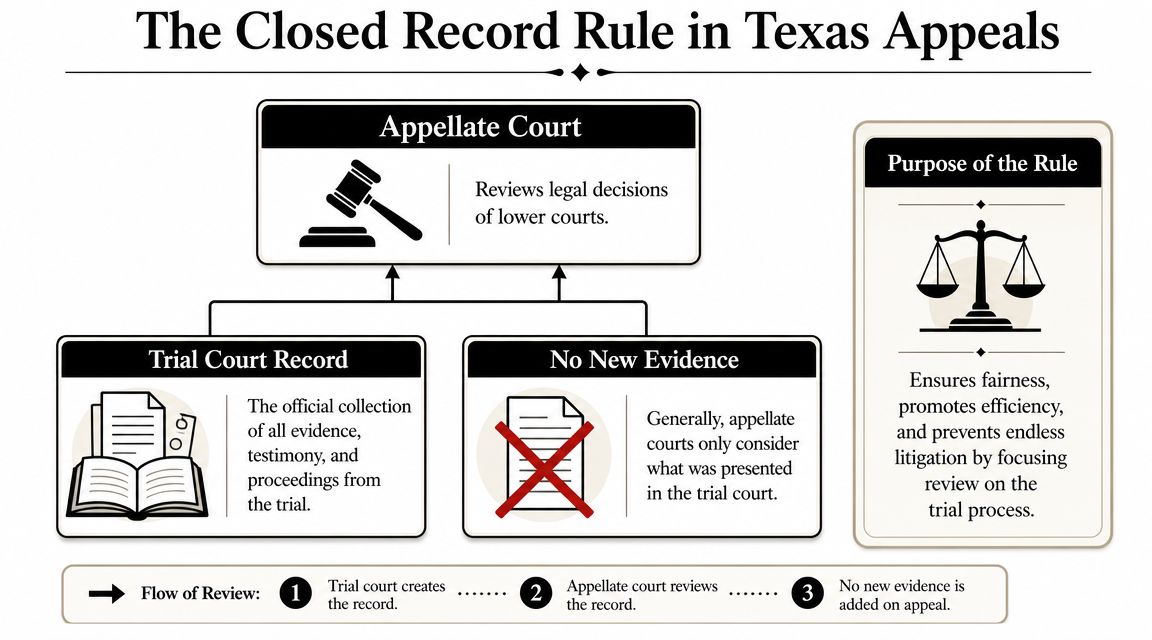
A useful way to think about it is this. The appellate court acts like a referee reviewing game film. It looks at what happened on the field. It doesn't add a new witness, admit a fresh document, or replay the entire case with extra facts.
Texas appellate guidance makes that procedural wall clear. The Supreme Court of Texas and other appellate courts don't accept new evidence and decide cases based solely on the appellate record created in the trial court, which is why choosing the right post-judgment remedy is so important (Broden & Mickelsen on motions for new trial based on new evidence).
If you're unsure what belongs in that record, this guide on what the appellate record is in Texas and why it matters is a good place to start.
What appellate courts actually review
On appeal, the court usually asks questions like these:
- Did the judge apply the correct law: For example, did the court use the proper legal standard in a custody or property ruling?
- Did the judge abuse discretion: In plain English, abuse of discretion means a decision was so unreasonable, arbitrary, or unsupported by the record that it crossed the line from judgment into legal error.
- Did the error matter: A reversible error is a mistake serious enough that it likely led to an improper result.
Plain-English terms that matter
A few appellate terms sound abstract until you translate them.
- Briefing: This is the written legal argument filed in the appellate court. It explains what the trial court did, what law applies, where the error appears in the record, and what relief should be granted.
- Standard of review: This is the rule the appellate court uses when evaluating the trial judge's ruling. Some rulings get closer review than others.
- Preservation of error: In many situations, the complaint must have been raised properly in the trial court or the appellate court may refuse to consider it.
Practical rule: If your argument depends on a document, message, or witness the trial court never received, a direct appeal usually isn't the tool that can use it.
That doesn't make new evidence unimportant. It means new evidence usually belongs in a different procedural vehicle.
Your First and Best Option The Motion for New Trial
If new evidence appears shortly after judgment, the motion for new trial is often the strongest first move in a family law case. It is filed in the same trial court that signed the order. Instead of asking an appellate court to review the old record, it asks the trial judge to set aside the judgment and grant a new hearing.
The timing is strict. In Texas practice materials discussing newly discovered evidence, a motion for new trial based on new evidence must usually be filed within 30 days of judgment, and the evidence must be new, not previously discoverable, and material enough to potentially change the outcome (Hunter, Lane & Jampala on criminal appeals and new evidence).
For a family law overview focused on this remedy, see motion for new trial in Texas family law.
What the court will want to see
A good motion for new trial does more than attach documents and say, "This changes everything." The court will want a developed explanation.
The evidence is new
It wasn't available at trial.You acted with reasonable diligence
You must show it couldn't have been discovered earlier with reasonable effort.The evidence matters
It isn't minor, repetitive, or just more of the same.It could change the result
The new information must be strong enough that a different outcome is realistic.
What works and what usually doesn't
Some filings fail because they confuse important evidence with late-organized evidence. If a party had the bank records before trial but didn't gather or present them, calling them "new" won't solve the problem. The same is true for witnesses known all along but contacted too late.
What tends to work better is evidence that was genuinely unavailable. Examples include concealed financial records that only surfaced after judgment, digital communications recovered after trial, or third-party records that were hidden or inaccessible despite effort.
The court is looking for more than surprise. It is looking for a legally meaningful reason the evidence wasn't available before, and a credible explanation for why it could change the judgment.
Why speed matters
The short deadline changes how these cases are handled. You often need affidavits, records, and a coherent legal theory almost immediately. Waiting to "see what happens" can close the cleanest path for getting the evidence before a court.
In some cases, parties pursue both tracks at once. They preserve appellate deadlines while evaluating whether a motion for new trial offers the more effective route. That kind of coordination matters because family law cases often involve overlapping issues about the final order, the record, and the remedy being requested.
Alternative Paths When the New Trial Deadline Has Passed
When the new-trial window is gone, people often assume they have no options left. That's not always true. The available paths are narrower and more technical, but they can still matter in the right case.
Bill of review
A bill of review is not a standard appeal. It is a separate proceeding used to attack a final judgment in limited circumstances. In family law, it often comes up when someone learns after the fact that the judgment was shaped by fraud, accident, wrongful conduct, or official mistake, and the complaining party was not negligent in failing to present the issue earlier.
A common example is a divorce where one spouse later discovers hidden assets or false financial disclosures. Another is a case where a party never had a fair opportunity to present a meritorious claim or defense because something outside their control interfered with the process.
If you want a deeper comparison, this article on bill of review versus appeal in Texas lays out the distinction.
Motion to reopen evidence
A motion to reopen evidence can sometimes help if the court hasn't yet signed a final judgment or if the procedural posture still allows the trial court to receive more proof. This isn't a general fix for all late evidence. Its usefulness depends on the exact stage of the case and whether the court still has authority to hear additional facts.
In practice, this can matter when a party discovers key evidence after the hearing but before the order becomes final. Timing and trial-court control are everything here.
Extraordinary writs
An extraordinary writ, such as mandamus, serves a different purpose. It is not a method for introducing new evidence to retry facts. Instead, it asks a higher court to correct a clear abuse of discretion or require a trial court to perform a legal duty when no adequate ordinary remedy exists.
That makes mandamus powerful but limited. If your complaint is, "I found new documents," mandamus usually isn't the answer. If your complaint is, "The trial court acted outside its authority and ordinary appeal won't fix the harm," then it may be relevant.
Choosing the right lane
These remedies exist because courts recognize that not every unfair judgment can be addressed in the same way. But they are not interchangeable.
- Use a bill of review when the judgment itself may have been corrupted by fraud, mistake, or wrongful circumstances that kept the truth from the court.
- Consider reopening evidence only when the trial court still has procedural room to hear it.
- Reserve extraordinary writs for exceptional legal errors, not factual do-overs.
One practical step can be gathering records fast. In cases involving missing relatives, absent witnesses, or people who may hold critical information, clients sometimes use public-record and skip-tracing tools to locate them. A plain-language example is this guide from BatchData on finding family members, which shows how investigative leads can sometimes help identify someone who may have records or testimony relevant to a family dispute.
The deeper point is simple. The question isn't only whether the evidence exists. The question is what procedure can still legally receive it.
Comparing Your Legal Options for Introducing New Evidence
A parent leaves court believing the judge never heard the facts that mattered most. Two days later, the missing school records arrive. A week later, someone finds the hidden account statements. At that point, the central question is not whether the evidence matters. The question is which procedure can still legally receive it.
That distinction decides cases. Texas appellate courts review the record that already exists. New evidence usually has to enter through a different procedural door, and each option serves a different purpose.
Texas post-judgment remedies at a glance
| Remedy | Purpose | Key Deadline | What You Must Prove | Best For |
|---|---|---|---|---|
| Direct appeal | Correct legal errors based on the existing trial record | Deadline depends on the procedural posture and should be evaluated immediately | The trial court committed reversible error shown in the record | Wrong legal standard, improper ruling, procedural error, or abuse of discretion shown by the existing record |
| Motion for new trial | Ask the trial court to set aside the judgment and hear the case again | Usually must be filed within 30 days of judgment | The evidence is new, could not have been found earlier with reasonable diligence, is material, and could change the result | Newly found texts, financial records, witness testimony, or other facts discovered shortly after judgment |
| Bill of review | Challenge a final judgment through a separate proceeding | Timing depends on the facts and should be reviewed promptly | A strong basis to challenge the judgment, often involving fraud, accident, wrongful conduct, or official mistake, without your own negligence | Hidden assets, false disclosures, lack of notice, or other serious defects discovered after the new-trial deadline |
| Motion to reopen evidence | Ask the trial court to receive additional proof before the case is fully closed | Available only in limited procedural circumstances | The court still has authority to reopen the proof and fairness supports doing so | Important evidence discovered after hearing but before the case reaches finality |
| Mandamus or other extraordinary writ | Correct a clear legal wrong when no adequate ordinary remedy exists | Case-specific and often urgent | A clear abuse of discretion and no adequate remedy by appeal | Exceptional trial-court rulings causing immediate harm |
The practical takeaway
Clients often use the word appeal to mean any effort to fix an unfair result. In practice, that word can obscure the right strategy.
If the problem is legal error already captured in the record, a direct appeal may be the right path. If the problem is evidence discovered right after judgment, the first question is whether the motion-for-new-trial deadline is still open. If the judgment itself was affected by concealment, lack of notice, or similar wrongful circumstances, a bill of review may be the more realistic option.
This is also where speed matters. Good evidence can still be unusable if it reaches the court through the wrong procedure or after the deadline expires.
In some family cases, locating a witness or missing source of records is part of the work. BatchData on finding family members gives a plain-language example of how people sometimes track down relatives or contacts who may hold documents, testimony, or leads that matter. But finding the evidence is only half the job. Admitting it requires the correct procedural vehicle.
New Evidence in Practice Texas Family Law Examples
Legal rules make more sense when you see how they play out in real family cases.
Custody and visitation
A parent loses at a final custody hearing. Two weeks later, a third party provides messages and records suggesting the other parent concealed serious conduct that affects the child's safety. That is usually not a direct-appeal issue because the appellate court won't take fresh evidence. It is the kind of situation where a timely motion for new trial may be the better fit.
The same logic can apply in visitation disputes. If school records, medical records, or communications come to light right after trial and materially affect the best-interest analysis, the first question is whether the new-trial deadline is still open.
Property division in divorce
A spouse signs off on a divorce decree believing the marital estate was fully disclosed. Later, account records, business documents, or transfer histories suggest assets were hidden. That often points away from a direct appeal and toward a bill of review or another targeted post-judgment strategy, depending on the facts.
In practice, these cases often depend on proving more than mere suspicion. The court will want a coherent paper trail and a credible explanation for why the concealment wasn't discovered sooner.
Support and maintenance
Child support and spousal maintenance disputes sometimes involve late-discovered income information. A parent may learn after judgment that the other side withheld payroll information, business distributions, or account activity. If that information arrives quickly, counsel may evaluate whether a motion for new trial is still available. If it arrives much later, the strategic conversation becomes more complex.
Protective orders and witness issues
Protective-order cases move fast, and witness problems are common. A witness may refuse to appear, then later agree to provide testimony. That testimony might feel decisive, but the procedural question remains the same: can the court still receive it through the current vehicle?
Sometimes locating a witness becomes part of the case strategy. Family-law matters occasionally involve estranged relatives, missing parents, or former household members who have relevant knowledge. In those situations, investigative work can matter as much as legal drafting.
One reason these examples matter is that they show the same core truth across different family disputes. New evidence may be powerful, but power alone doesn't make it usable. The remedy must fit the facts, the timing, and the court's authority.
Your Next Step Seeking Justice Through Appellate Advocacy
A parent often calls after finding the document, message, or financial record that would have mattered at trial. The first question is usually, "Can I appeal now?" The better question is, "What procedure still lets a Texas court consider this evidence?"

That distinction changes strategy.
A direct appeal usually stays confined to the record already made in the trial court. Newly discovered evidence usually has to be presented through a different procedural path, and the right path depends on timing, the type of order, and why the evidence was not presented earlier. In some cases, counsel should protect appellate deadlines while also evaluating a motion for new trial, a restricted appeal, or a bill of review.
The Law Office of Bryan Fagan, PLLC handles Texas family law appeals and post-judgment strategy, including review of trial records for legal error and evaluation of whether another remedy fits a new-evidence problem better than a standard appeal.
What skilled review can change
Early review often answers the questions that matter most under pressure:
- Which deadline controls. A motion for new trial, notice of appeal, restricted appeal, and bill of review each operate on different timelines.
- Whether the court can receive new proof. An appellate court generally cannot. A trial court may be able to, but only through the correct filing.
- What evidence is usable. Judges usually need more than a claim that something important turned up late. They want affidavits, records, witness details, and a clear timeline showing diligence and materiality.
- Whether filing one remedy affects another. A rushed filing can preserve rights, but it can also frame the case poorly if counsel has not matched the facts to the proper procedure.
That last point matters. Clients understandably focus on the new evidence itself. Courts focus on procedure first.
If you'd like a plain-language overview before meeting with counsel, this video gives helpful context on family law appellate issues:
The immediate next step is a focused case review. Bring the signed order, the date you received notice, the trial filings, and the new evidence with any emails, metadata, or other proof showing when and how it surfaced. That lets counsel assess two separate issues at once: whether the judgment contains appealable error on the existing record, and whether a different post-judgment procedure offers a realistic way to present what the court has not yet seen.
If you believe the court made a mistake in your family law case, our appellate attorneys can help assess the available procedural options and the strongest path toward a fair result. Contact The Law Office of Bryan Fagan, PLLC today for a free consultation.