A judge signs an order that lets your child move away. Or the judge refuses the move and your plans collapse overnight. Either way, the moment after a relocation ruling often feels the same. You're stunned, angry, and trying to figure out whether the decision is final.
That's usually when clients ask the question in the plainest possible way. Can you appeal a relocation decision in Texas custody cases? Yes, sometimes you can. But the answer is more complicated than most articles admit.
An appeal isn't a chance to tell the court your side one more time with better wording. It's a focused review of whether the trial court made a legal mistake, and whether that mistake was preserved in the record. That distinction matters because many parents have strong feelings about what happened in court, but not every unfair-feeling result is an appealable error.
If you're reading this right after a relocation hearing, the practical concerns are probably immediate. Can the move happen now? Is there a deadline? Does the appeals court hear new evidence? What if the judge ignored important facts? Those are the right questions. The answers can shape what you do next, sometimes within days.
When the Court's Decision Feels Wrong
A relocation case can leave both parents feeling unheard.
One parent may believe the court treated a genuine opportunity like a selfish decision. The other may believe the court discounted the damage that distance will do to a close parent-child relationship. In either position, the ruling can feel personal because it is. These cases affect school, routines, travel, holidays, and everyday contact with your child.
Texas law does allow appeals in custody-related relocation disputes, but it doesn't hand out a fresh trial. In many Texas relocation disputes, the parent seeking to move must seek a modification of the existing order and prove a substantial change in circumstances rather than relying on personal preference alone. Texas family appeals are also generally reviewed under an abuse-of-discretion standard, and appeals generally must be filed within 30 days of the order. Temporary custody orders are generally not appealable, which often makes the first final order the critical point for any challenge, as discussed in this overview of Texas relocation and appeal timing.
That combination surprises people. They assume the unfairness of the result is enough. Usually, it isn't.
Practical rule: A strong appeal starts with a specific legal error tied to the trial record, not just a painful outcome.
If you're trying to decide what to do next, the first question isn't whether you disagree with the ruling. The first question is whether the trial court made an error that an appellate court can review and correct.
An Appeal Is Not a Second Trial
A lot of parents call my office expecting the court of appeals to hear the story again, look at new school records, or give them a fresh chance to show why the move will help or hurt their child. That is not how this process works in Texas.
An appeal works more like a legal audit of what happened in the trial court. The judges review the file that already exists and decide whether the trial judge made a reviewable legal mistake. They do not hear new witnesses. They do not accept updated evidence about a new job, a new school, or how the parenting schedule has gone since the ruling. In a relocation case, that difference matters because the facts often keep changing while the appeal is pending.

That leads to the practical question clients should ask early. What exactly can the appellate court look at?
What the appellate record includes
The appellate record usually includes two main parts:
- Clerk's record. The pleadings, motions, orders, exhibits filed with the court, and other papers from the trial court.
- Reporter's record. The transcript of the hearing or trial, including testimony, objections, rulings, and oral statements made on the record.
If a fact was never admitted into evidence, the appellate court usually cannot consider it. If a lawyer did not object when the problem happened, the appellate court often cannot fix it later. And if a parent has strong new evidence after trial, that may point toward a future modification request rather than an appeal.
That is the part many articles skip. An appeal is not merely about whether the result feels unfair. It is about whether the trial court made a legal error that was preserved in the record and mattered to the outcome.
Plain-English terms that matter
A few appellate terms shape almost every relocation appeal:
| Term | Plain-English meaning |
|---|---|
| Abuse of discretion | The trial judge made a decision outside the range the law allows. |
| Reversible error | A mistake that likely affected the result enough to justify reversal. |
| Briefing | The written arguments filed in the court of appeals. |
Briefing deserves more attention than it gets. Appellate judges usually experience your case through paper first. They read the record citations, the legal authorities, and the framing of the issues. A weak brief can waste a good issue. A precise brief can turn a complicated hearing transcript into a clear argument the court can rule on.
Relocation cases also overlap with other family-law appeals, including appeals involving child custody rulings, divorce judgments, property division disputes, and protective-order findings. The legal rules may differ, but the same constraint applies in all of them. The appeal rises or falls on the record that was made in the trial court.
The Standard for Overturning a Relocation Decision
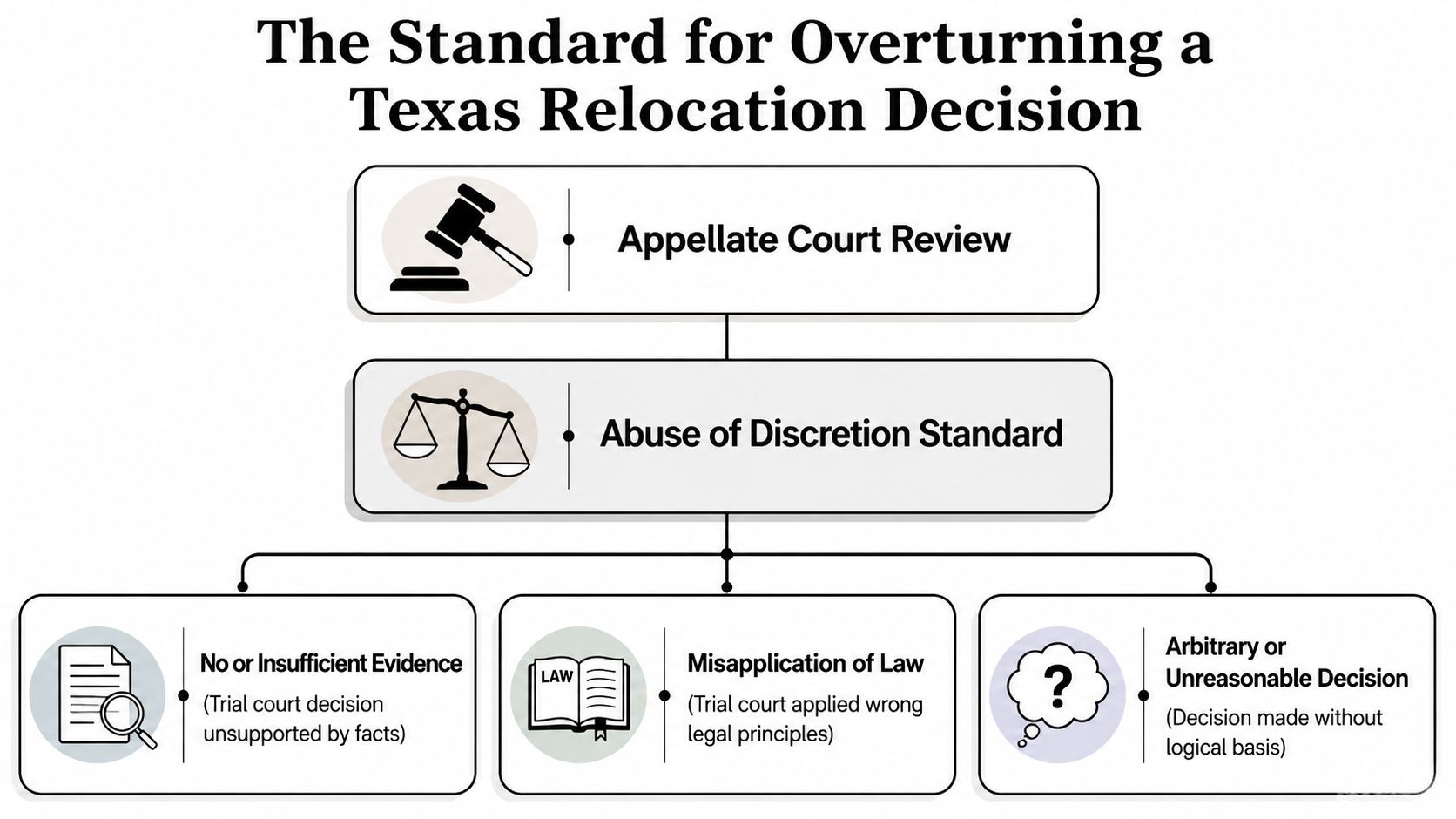
Even when a parent can appeal, the bar for winning is demanding. Texas appellate courts don't reverse a relocation order just because another judge might have decided the facts differently.
What abuse of discretion means
Abuse of discretion means the appellate court asks whether the trial court acted unreasonably, arbitrarily, or without reference to guiding legal principles. That standard is narrow. It gives the trial judge room to make judgment calls, especially in child custody cases where witness credibility and family dynamics matter.
That has two practical consequences.
- The appellate court won't re-try the evidence.
- The appellate court won't reweigh credibility just because one side thinks the judge believed the wrong witness.
The question on appeal usually isn't, “Was this decision harsh?” It is, “Did the judge reach it in a way the law allows?”
Why relocation cases use a balancing approach
Relocation disputes don't turn on a simple pro-move or anti-move rule. Family-law scholarship shows that American courts moved away from rigid anti-relocation rules and toward multi-factor balancing tests that weigh the relocating parent's reasons, the child's welfare, and the impact on the nonmoving parent's relationship. The same scholarship explains that the empirical research does not support a simple presumption that moving is better for children under the best-interests standard used in the states. For Texas parents, the practical point is that the moving parent needs concrete evidence that the move will improve the child's life enough to justify reduced contact with the other parent. That background is discussed in this peer-reviewed review of parental relocation law and research.
How that affects a Texas appeal
In a Texas relocation appeal, one central issue is whether the trial court properly applied the governing best-interest analysis, including the Lenz factors often discussed in relocation litigation. Those factors focus the court on subjects like:
- The reasons for the move
- The child's welfare and day-to-day needs
- The effect on the other parent's relationship with the child
- Whether the claimed benefits are concrete rather than speculative
An appellate court doesn't require a trial judge to write the perfect explanation for every ruling. But the record should show that the judge applied the correct legal framework, considered the relevant factors, and had evidence supporting the result.
What usually works and what usually doesn't
The arguments that tend to have traction on appeal are specific and record-based.
| Often stronger appellate points | Usually weaker appellate points |
|---|---|
| The judge applied the wrong legal standard | “The judge just didn't understand me” |
| Relevant evidence was wrongly excluded | “I had more proof later” |
| The ruling lacks support in the admitted record | “I would testify better now” |
| The court failed to consider required best-interest analysis | “The other parent is a bad person” without preserved record support |
If you're evaluating whether you can appeal a relocation decision in Texas custody cases, this is the hard truth. A persuasive story is not enough by itself. A viable appeal usually depends on a legal error you can point to, line by line, in the record.
Preserving Error The Foundation of Your Appeal
Many appeals are lost before they start because the issue wasn't preserved in the trial court.
Preserving error means the trial lawyer raised the problem at the right time, in the right way, and got it into the record. If that didn't happen, the court of appeals may say the issue was waived. That can be frustrating for clients because they remember the unfairness clearly, but appellate judges can only review what was properly presented.
The rule clients need to know
If it isn't in the record, it often doesn't exist for appeal.
That applies to a lot of situations in relocation cases. A judge excludes an important exhibit. A lawyer fails to explain why the exhibit matters. A damaging statement comes in without objection. A party complains later that the court ignored a point that was never clearly presented. Those problems can limit or destroy an appeal.
What preservation can look like in real life
Preserving error may involve actions like these:
- Making a timely objection when improper evidence comes in.
- Offering excluded evidence so the record shows what the judge refused to consider.
- Requesting findings when the facts and legal basis of the ruling need clarification.
- Stating the legal ground clearly instead of making a vague complaint.
For families trying to understand this issue in more detail, preserving error for appeal in Texas family court is often the hidden hinge between a difficult ruling and a real appellate option.
A parent may have a legitimate complaint about the hearing. The appeal still turns on whether the record captures that complaint in a way the appellate court can review.
Why appellate review starts with the transcript
The first serious appellate task is usually a detailed review of the hearing and trial transcripts. That review isn't just about finding a bad result. It is about locating preserved objections, excluded evidence, legal arguments, and rulings that matter under appellate standards.
Sometimes that review reveals a viable path forward. Sometimes it shows that the strongest issue isn't the one the client expected. And sometimes it leads to a candid answer that the problem feels real, but probably isn't reversible under Texas appellate rules.
That honesty matters. Good appellate advice doesn't promise a do-over. It identifies whether the trial record gives you a lawful basis to seek one.
The Appellate Timeline Critical Deadlines and Procedures
In relocation cases, timing can be as important as legal merit.
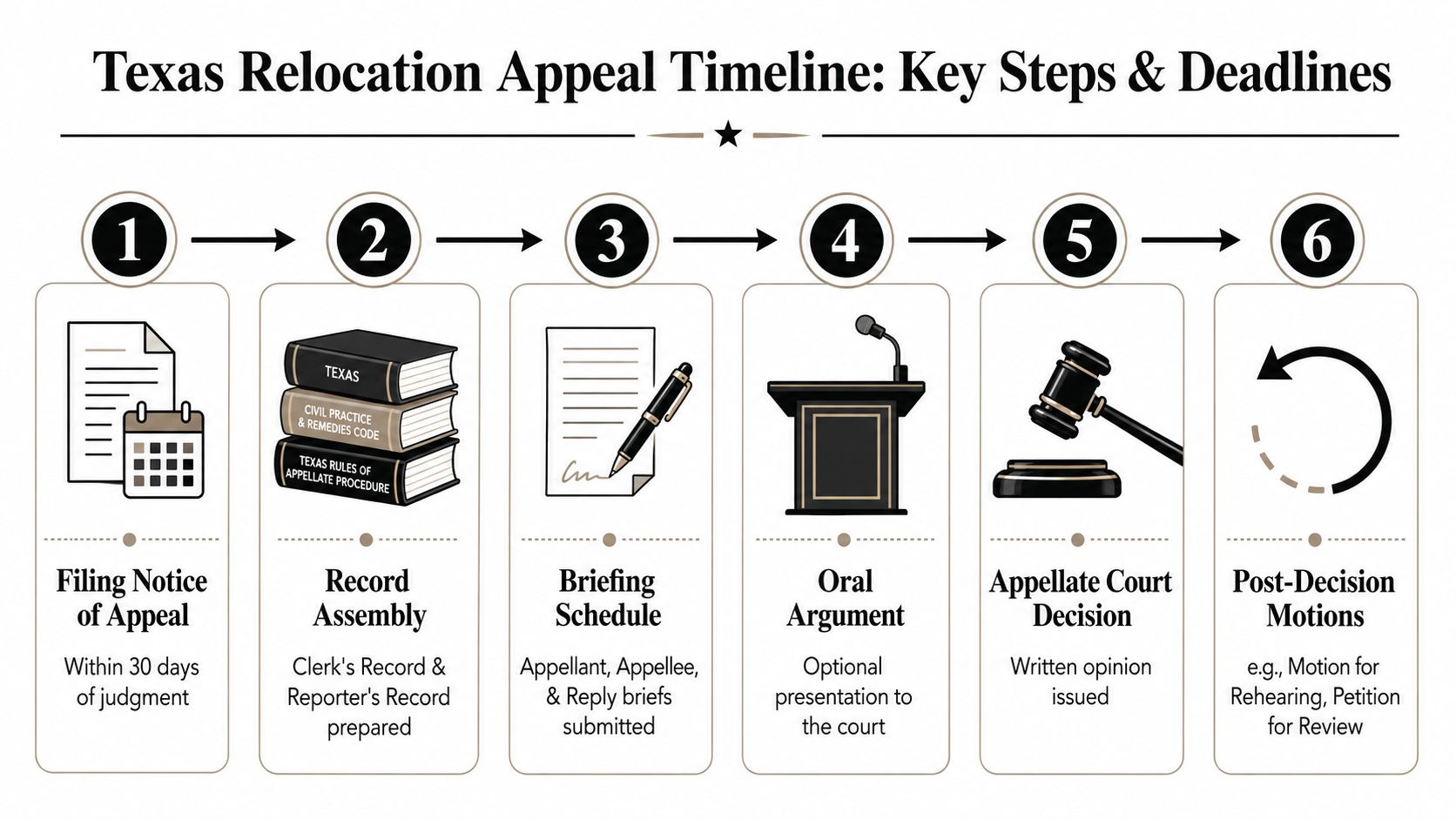
A parent may be focused on the fairness of the order while the appellate clock is already running. Texas family-court appeals generally must be filed within 30 days of the order, and a notice of appeal does not automatically stay enforcement in many custody contexts. That means the practical question may become whether the appellant can obtain stay or supersedeas-type relief from the trial or appellate court to stop the move while the appeal is pending, as explained in this discussion of Texas custody relocation timing and stays.
The first moves after the order
Right after a final relocation order, several decisions may need attention at once.
- Confirm that the order is final and appealable. Temporary custody orders are often treated differently.
- Calculate the deadline immediately. The filing deadline is not flexible even if the parties are overwhelmed.
- Evaluate emergency relief. If the move may happen before the appeal can be heard, a stay issue may become urgent.
A missed deadline can end the appeal before it begins. Families who want a clearer sense of those procedural traps often start with what deadlines can destroy your Texas family law appeal.
Here is a helpful overview of the process in video form:
What happens after the notice of appeal
Once the notice is filed, the case moves into a different kind of litigation.
| Stage | What it usually involves |
|---|---|
| Record preparation | The clerk's record and reporter's record are assembled for the appellate court |
| Briefing | The appellant files a written brief, the other side responds, and a reply may follow |
| Oral argument | Sometimes the court allows lawyers to answer judges' questions in person |
| Decision | The court issues a written opinion and judgment |
The practical question many parents miss
The issue clients ask most often is not really procedural. It is immediate and personal.
Can my child move while the appeal is pending?
The filing of the appeal alone often doesn't answer that question. In many family-law contexts, it does not automatically pause enforcement. That is why emergency relief can matter so much in a relocation case. If the order permits the move and no stay is in place, the appeal may continue while the family is already living with the effects of the ruling.
Urgency point: In relocation cases, the right appellate filing without the right stay strategy may not protect the status quo.
That is one reason appellate planning in family cases often needs to start as soon as the final order is signed, not weeks later.
Common Reversible Errors in Relocation Custody Cases
A relocation appeal becomes stronger when the complaint is concrete. Broad claims that the judge was unfair rarely help by themselves. Specific legal mistakes can.

Errors tied to evidence and procedure
Some reversible issues arise from how the hearing was handled.
- Relevant evidence was excluded. A parent may have offered proof about the child's school options, family support in the new location, or the burden on the nonmoving parent's access, and the court may have kept it out despite its importance.
- Critical evidence was admitted over proper objection. Sometimes the record shows unreliable or improper material shaped the ruling.
- Requested findings were missing or inadequate. In some cases, the absence of clear findings makes it harder to understand whether the court applied the right law.
These are not automatic winners. The appellate court still looks at harm and preservation. But they are the kinds of issues appellate lawyers look for because they connect directly to reviewable error. For a broader discussion, see reversible error in Texas family court.
Errors tied to the legal standard
Other cases turn on the court's reasoning rather than the evidence itself.
A judge may focus too narrowly on one point, such as the moving parent's new job, while failing to meaningfully weigh the child's relationship with the other parent or the practical consequences of distance. In another case, the court may speak as if relocation should be allowed because the moving parent has understandable reasons, even though the legal issue is whether the move serves the child's best interests under the governing framework.
A few realistic examples
Consider a few familiar patterns.
| Scenario | Why it may matter on appeal |
|---|---|
| The judge prevents testimony about how the move would affect regular parent-child contact | The excluded evidence may have been directly relevant to best-interest analysis |
| The court bases the ruling on assumptions not supported by admitted evidence | A decision without record support may be vulnerable |
| The judge applies the wrong legal lens to the relocation request | Misapplication of law is a classic appellate issue |
| The court ignores preserved objections and proceeds on a flawed record | The appellate court may review whether that affected the result |
Not every mistake leads to reversal. Some errors are harmless. Others are legally important but weren't preserved. Still others may show poor courtroom management without meeting the standard for appellate relief.
That's why issue selection matters so much. The strongest appeals are usually disciplined. They don't throw every frustration into a brief. They identify the clearest preserved errors and explain why those errors affected the outcome.
How Our Appellate Attorneys Can Help You Seek a Fair Outcome
You may leave the courthouse convinced the judge got it wrong and still have no clear appeal. That is the hard part many lawyers do not explain early enough. A strong appellate review starts with a practical question. What can still be done, on this record, before a deadline closes?
Our job is to answer that question with precision. In a relocation case, the key issues are whether the order can be appealed now, whether trial counsel preserved the complaint, whether the ruling can be defended under the applicable standard of review, and whether immediate relief should be requested to address the move while the appeal is pending.
Effective appellate help usually includes:
- A close review of the clerk's record and reporter's record to identify preserved error, excluded evidence, faulty findings, and rulings that may have affected the outcome
- A deadline analysis for the notice of appeal, post-judgment motions, findings requests, and any accelerated timetable that may apply
- A stay or temporary-relief assessment if the child may be moved before appellate review has a chance to matter
- Brief writing built for appellate judges that focuses on legal error, record citations, and the specific relief the court can grant
The Law Office of Bryan Fagan, PLLC handles family-law appellate matters involving child custody, divorce decrees, property division, protective orders, and post-judgment disputes. In a relocation case, that often means making an early judgment call. Is this an appeal with a real legal issue, or is another strategy more likely to protect the parent-child relationship?
Clients usually need candor more than optimism.
Sometimes the right answer is to file quickly and pursue emergency relief. Sometimes the better course is a motion practice strategy in the trial court, a modification case, or a targeted post-judgment filing that fixes a problem an appeal cannot. An experienced appellate lawyer should be able to tell the difference and explain why.
If you believe the court made a legal mistake in your family law case, our appellate attorneys can help you seek a fair outcome. Contact The Law Office of Bryan Fagan today for a free consultation.
If you believe a Texas judge made a legal mistake in your relocation or custody case, a prompt appellate review can tell you whether you have a real path forward. The attorneys at The Law Office of Bryan Fagan, PLLC can evaluate the order, the record, and the deadlines to determine whether an appeal, emergency relief, or another post-judgment strategy makes sense. Schedule a free consultation to get a clear, practical assessment of your case.