You may feel like the judge missed something central in your case. Maybe the ruling on custody doesn't reflect what happened in court. Maybe the property division doesn't line up with what you believe the law required. Maybe a support order seems built on a mistake that will affect your finances for years.
That feeling matters, but it isn't the legal test for an appeal.
In Texas family law, an appeal can be the right move when the trial court made a reversible legal or procedural error. It is not a second trial, and it is not a chance to present new evidence or tell the story again in a better way. It is a focused review of what already happened in the trial court record. That distinction is what makes some appeals strong and many others poor bets.
An Unfair Ruling Is Not the Final Word
You leave court with a final order in hand. Conservatorship terms do not match what you expected. The support numbers will strain your budget for years. The property division looks lopsided. At that point, the question is usually not just whether the result felt unfair. The question is which remedy fits the problem, and whether the likely benefit justifies the cost.
Texas law gives parties several ways to challenge a bad result, but each tool does a different job. An appeal asks a higher court to review the trial court record for legal error, procedural error, or an abuse of discretion. A motion for new trial asks the same trial court to reconsider while it still has power to do so. Mandamus is different again. It is reserved for narrower situations where a trial court order needs immediate correction and an ordinary appeal will not provide an adequate remedy.
That choice matters early. In many family cases, clients come in focused on the unfairness of the outcome. My first concern is more practical. What does the record show, what relief is available, and what will it cost to pursue it?
Practical rule: If you want to add new evidence or fill gaps in the proof, an appeal is usually the wrong vehicle. The better question is whether the existing record already shows a reversible mistake.
This is also where cost-benefit analysis starts, not later. Appeals take time, require transcripts and briefing, and often do not stop the order from affecting daily life while the case is pending. Sometimes the smarter move is a targeted post-judgment motion. Sometimes it is mandamus. Sometimes the hard answer is that the order may be disappointing but still difficult to reverse on appeal.
A prompt case review is important because deadlines arrive fast, and the best strategy often depends on decisions made in the first days after the order is signed.
Understanding the Grounds for a Texas Family Law Appeal
The order is signed. You leave the courthouse convinced the judge got it wrong, and your first instinct is to tell the higher court what really happened. In most family-law appeals, that instinct runs into a hard limit. The appellate court works from the existing record and asks a narrower question: did the trial court make a legal mistake that justifies reversal?
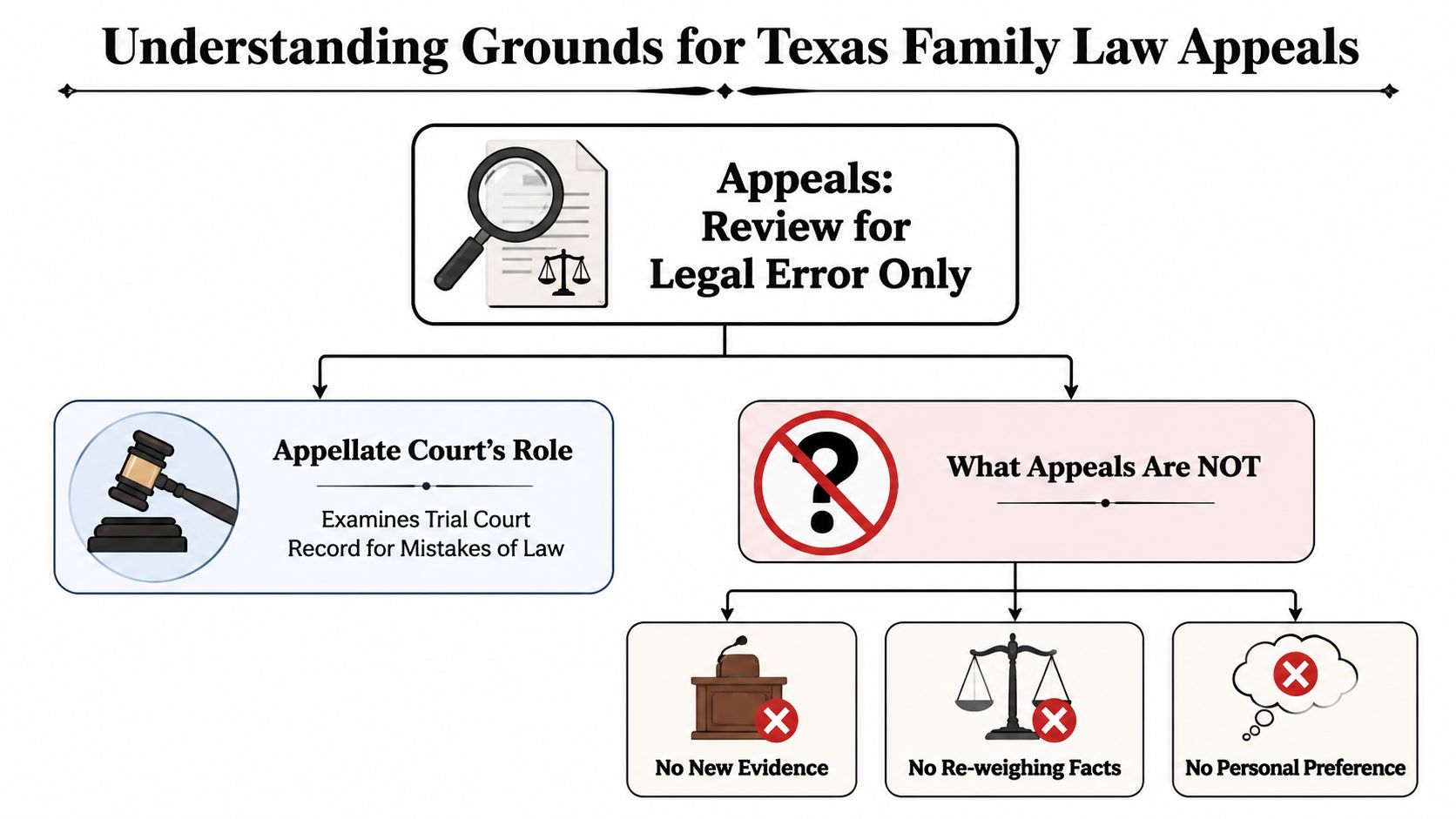
That distinction matters because it affects both strategy and cost. If the problem is missing evidence, a poorly developed record, or facts that never made it into testimony, an appeal usually will not fix it. In that situation, the better path may be a motion for new trial, if the rules and the facts support one. If the problem is an order that needs immediate correction and waiting for a normal appeal would not be an adequate remedy, mandamus may be the better tool. If the problem is a legal ruling already preserved in the record, an appeal may be worth the investment.
What counts as a valid appellate issue
A viable appeal usually starts with one of three things: legal error, procedural error, or an abuse of discretion that probably affected the result. Texas appellate courts give trial judges a fair amount of room in family cases, especially in conservatorship, possession, support, and property division. That does not mean every ruling stands. It means the issue has to be framed in a way appellate judges can act on.
Clients usually need three terms translated into plain English:
- Reversible error means a mistake significant enough that it probably led to an improper judgment.
- Abuse of discretion means the judge made a ruling outside the range the law permits, based on the record before the court.
- Briefing means the written argument that identifies the error, points to the exact places in the record that show it, and explains why reversal is legally justified.
A strong appellate issue is usually specific. The judge applied the wrong legal standard. The court admitted or excluded evidence under the wrong rule. The final order grants relief no one pleaded for. Required findings were ignored. A party preserved an objection, and the ruling likely mattered.
Those are appeal issues. General unfairness is not.
What abuse of discretion means in practice
Family-law clients hear this phrase often, and it can sound more flexible than it is. A judge does not abuse discretion just because another judge might have ruled differently. The question is whether the decision falls outside the choices the law allows.
That is why record quality matters so much. If some evidence supports the ruling and the judge used the correct legal framework, reversal becomes difficult. If the record shows the judge relied on an improper factor, ignored a controlling rule, or made a decision the evidence cannot reasonably support, the case becomes more appealing from an appellate standpoint.
This is also where economics enters the analysis. An issue can be arguable without being worth funding through transcripts, briefing, and months of delay. A good appellate issue is one that is both legally sound and important enough to justify the expense.
What usually does not justify an appeal
Many parents and spouses describe their case in ways that make sense emotionally but do not translate into reversible error:
- "The judge believed the other side."
- "My witnesses were stronger."
- "The result feels unfair."
- "If another court heard the whole story, it would come out differently."
Those reactions are common. They usually point to a fact dispute, not an appealable error.
The appellate court is not deciding who seems more believable after the fact. It is deciding whether the trial court followed the law based on the record already made.
That is often the turning point in an initial consultation. If the complaint is mainly about credibility calls or the weight the judge gave conflicting testimony, the odds of reversal are usually poor. If the record shows a preserved legal mistake tied to the outcome, the case may justify an appeal. If you are still early enough in the process to choose the right vehicle, it also helps to review the Texas family law appeal deadlines that can destroy a case, because the best legal issue in the world has no value if the deadline is missed.
The Strict Timelines and Procedures of an Appeal
Even a strong appellate issue can be lost if the procedure isn't handled correctly. In family-law appeals, timing and preservation matter almost as much as the merits.
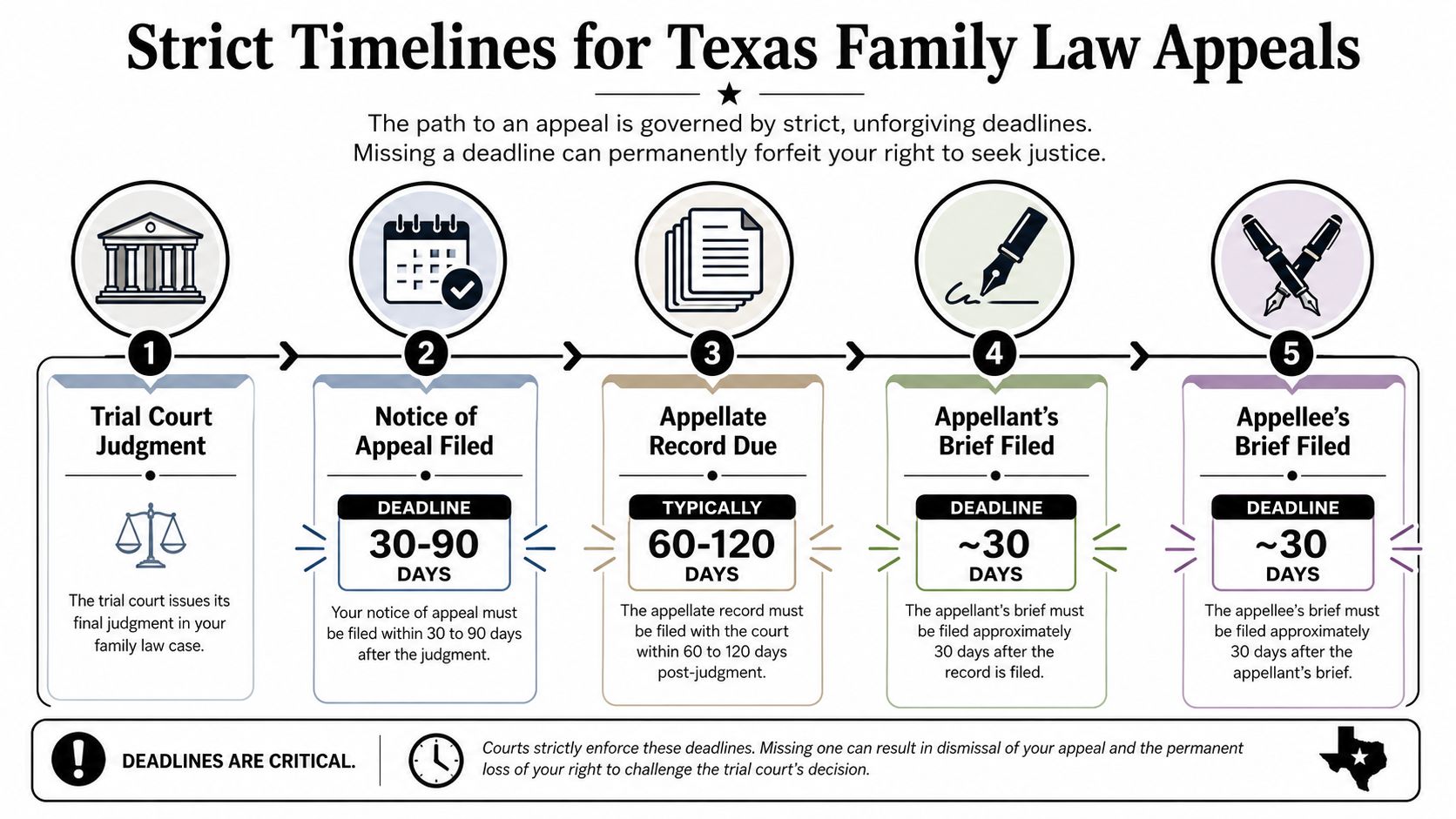
Under Texas procedure, the appeal period is generally 30 days from the final order. An appeal is a narrow review of the record, not a second trial, and the appellate court typically decides whether the trial judge abused discretion or misapplied the law (Texas family appeal deadline basics). If you want a deeper look at timing traps, this guide on Texas family law appeal deadlines that can destroy a case is useful.
What the appellate court reviews
The appellate court reviews the record. In practical terms, that usually means:
- The clerk's record, which includes filed pleadings, orders, motions, and exhibits that became part of the official file.
- The reporter's record, which includes transcripts of hearings and trial testimony.
- The briefs, where each side explains its legal position.
That structure is why appeals are writing-heavy and record-heavy. The appellate court generally won't consider new evidence. If a document wasn't admitted, if testimony wasn't offered, or if a complaint wasn't made in the trial court, it may not help you on appeal.
Preserved error decides many cases
The most technically important threshold is often preserved error. If the issue wasn't timely and specifically raised in the trial court, reversal becomes much harder. One source focused on family-law appeals emphasizes that appellate courts review only the trial-court record and generally won't consider new evidence. If the complaining party did not object, obtain an adverse ruling, or otherwise preserve the issue below, reversal is unlikely even when the result feels unfair (preserved error in family appeals).
That principle frustrates many clients because they see the mistake clearly in hindsight. Appellate courts, however, usually ask a different question: did the trial court have a fair chance to correct the issue when it happened?
If the record doesn't show a timely objection, a request, or a ruling, the appellate court may treat the issue as waived.
How the process usually unfolds
A Texas family-law appeal commonly follows this sequence:
- Final order is signed. This starts the clock.
- Notice of appeal is filed. This preserves the right to seek review.
- Record is prepared. The clerk's record and reporter's record are assembled.
- Appellant's brief is filed. This is the core written argument from the party challenging the judgment.
- Appellee's brief is filed. The opposing party responds.
- The court decides the case. It may affirm, reverse, modify, or remand.
The Texas Rules of Appellate Procedure govern these steps. The Texas Family Code often supplies the substantive law that the appellate court applies to issues like conservatorship, support, and property characterization. A viable appeal requires attention to both.
The Critical Cost-Benefit Analysis of an Appeal
A parent leaves trial convinced the judge got it wrong. The next question is not only whether an appeal can be filed. It is whether spending the time, money, and emotional energy on appellate review is likely to produce a better outcome than other tools that may work faster or cost less.

That analysis is often more important than the client's level of frustration. A legally arguable appeal can still be a poor investment. In family cases, the better question is practical: what can an appellate court realistically change, how long will it take, and what will that effort cost compared with the value of the issue at stake?
The answer turns on the kind of harm in the order. If the case involves a major property error, a support obligation that will continue for years, or a conservatorship ruling with lasting consequences, the economics may support an appeal even under a demanding standard of review. If the likely result is only a remand for another hearing, that possibility needs to be weighed carefully too.
When the upside justifies the expense
An appeal often makes sense when the order carries consequences that are substantial and hard to fix later.
Examples include:
Property classification with major financial effect
If the court mischaracterized separate property as community property, that error can affect the entire division and change the dollar value enough to justify appellate review.Support rulings with ongoing payment impact
A support error can continue month after month, affect enforcement risk, and influence later modification disputes.Custody or access rulings with long-term family consequences
Some conservatorship and possession rulings shape daily life for years. Even then, the legal basis for appeal must still be strong.Orders that create immediate pressure beyond money
Enforcement and contempt-related rulings can affect liberty, bargaining position, and future litigation strategy.
When an appeal is often a poor investment
I often advise caution when the complaint is sincere but the record does not support meaningful appellate relief.
That usually describes cases where the issue is mostly factual, the likely standard of review is highly deferential, the preserved error is weak, or a win would not materially improve the result. Some clients want a written ruling that says the trial was unfair. Appeals are not designed to provide that kind of validation. They are designed to correct legal error that probably mattered.
The available remedy matters just as much as the error itself. A reversal that sends the case back for more litigation is very different from a modification that changes the judgment now.
This short video gives a useful reminder about the central role of preserved error in appellate analysis:
Appeal, motion for new trial, or mandamus?
This is the fork in the road many articles skip.
An appeal is usually the right tool after a final order has been signed and the problem is a reversible legal error shown in the existing record.
A motion for new trial may be the smarter first move when the trial court still has a chance to correct the problem directly. It can also help clarify complaints, develop post-judgment arguments, and in some cases extend appellate deadlines. That does not mean it replaces an appeal. It means the motion may improve the client's position before the case reaches the court of appeals.
Mandamus relief is different. It is reserved for narrower situations, usually when a trial court clearly abused its discretion and waiting for a normal appeal would not provide an adequate remedy. In family law, that can matter in emergency or interim rulings where the harm will occur long before a final appeal could be decided.
Choosing the wrong procedure can waste both time and money.
Questions worth asking before you appeal
Before filing anything, a candid lawyer should be able to answer questions like these:
| Question | Why it matters |
|---|---|
| Is there a clear legal or procedural error in the record? | Without that, the appeal usually starts from a weak position. |
| Did the error likely affect the judgment? | Harmless error rarely produces relief. |
| What is the practical upside if we win? | The remedy may be reversal, modification, or a remand for further proceedings rather than an immediate final win. |
| What happens if the order stays in place during the appeal? | Some rulings create financial or parenting pressure that changes the analysis. |
| Would a motion for new trial or mandamus offer a better path? | In some cases, speed and remedy matter more than pursuing a full appeal first. |
For clients focused on budgeting, this overview of how much a Texas family-law appeal can cost is a useful starting point.
The Law Office of Bryan Fagan, PLLC can review the record, identify possible reversible error, and compare the likely cost, timeline, and possible benefit before you commit to an appeal.
Common Reversible Errors in Texas Family Law Cases
It helps to move from theory to examples. Strong appeals usually involve a specific mistake tied to a meaningful consequence. The question isn't whether the trial was disappointing. The question is whether the court made an error that could have changed the judgment.

From a risk-and-reward standpoint, appeals are often worth it when the legal error could materially change the outcome, such as an incorrect property classification, a flawed support calculation, or an evidentiary ruling that probably changed the judgment. The ruling will usually be affirmed unless the appellant shows the judge acted unreasonably, arbitrarily, or without reference to legal principles (examples of material family-law errors).
For a broader discussion of the concept, this guide on reversible error in Texas family court is a helpful companion.
Property division errors
Property issues often produce viable appeals because the legal framework is structured. If the court misclassified property, failed to apply the governing law correctly, or based the division on a legal misunderstanding, the error may be reviewable.
A common pattern is this: one spouse argues certain property was separate, the court treats it differently, and that classification affects the overall division. Not every property mistake leads to reversal, but errors in characterization can matter a great deal when they shape the full judgment.
Support and maintenance mistakes
Support appeals are not just about whether the amount feels too high or too low. A better question is whether the trial court used the wrong legal standard, ignored required statutory considerations, or made a calculation error that affected the order.
A flawed support ruling can be especially important because it often has continuing effects. If the error is embedded in the order itself, appellate review may be the cleanest way to address it.
Evidentiary and due-process problems
Some of the strongest appellate issues arise from how the trial was conducted.
Examples include:
- Improper exclusion of key evidence that should have been heard.
- Admission of evidence under the wrong legal standard when that evidence shaped the judgment.
- Restrictions on testimony or cross-examination that prevented a party from fully presenting the case.
- Notice and hearing problems that undermined basic fairness.
A bad result is not enough. A bad result connected to a legal mistake in the record is where an appeal starts to become worth pursuing.
Custody and parental-rights rulings
Custody appeals are emotionally difficult because clients often want the appellate court to reassess the child's best interest from the beginning. That usually isn't how the process works.
The stronger custody appeal points are narrower. They focus on whether the judge applied the wrong legal standard, excluded material evidence, or entered a ruling that lacks support in the record under the governing standard of review.
Exploring Alternatives to a Formal Appeal
A standard appeal is not always the right tool. In some cases, the smarter move is a motion for new trial, a different post-judgment motion, or a petition for writ of mandamus.
Many clients assume appeal is the only path. It isn't. A key question is whether you need an appeal, a mandamus, or a post-judgment motion. The choice affects timing, preservation of error, and relief available. Texas sources emphasize that the appeal clock is strict, with 30 days from the signing of the final order in ordinary cases and up to 90 days when certain post-judgment motions extend the deadline (appeal, mandamus, or post-judgment motion in Texas family law).
Motion for new trial
A motion for new trial is filed in the trial court and asks the same court to correct or reconsider the judgment. In practice, it can serve several purposes:
- It may give the trial judge a chance to fix an obvious error without full appellate proceedings.
- It can sharpen issues for later review.
- In some circumstances, it can extend appellate deadlines.
This option is often discussed when the problem is apparent soon after judgment and the trial court is still the fastest place to seek relief.
Mandamus relief
Mandamus is different. It is an extraordinary request asking a higher court to order a trial judge to correct a serious error when ordinary appellate relief is not adequate.
This comes up in some temporary-order disputes, certain due-process situations, and other procedural problems that cannot wait for a standard appeal after final judgment. Not every harsh temporary ruling qualifies. But some problems are better addressed by mandamus than by waiting.
If the real harm happened before a final judgment, waiting for a standard appeal may be the wrong move.
Appeal vs Motion for New Trial
| Factor | Motion for New Trial | Appeal |
|---|---|---|
| Where it is filed | In the trial court | In the appellate court process after notice is filed |
| Main purpose | Ask the trial court to reconsider or correct the judgment | Ask a higher court to review for reversible legal error |
| Use of new evidence | Sometimes part of the strategy, depending on the issue and procedure | Generally no new evidence because review is confined to the record |
| Speed | Often faster as an initial corrective step | Usually slower and more formal |
| Best fit | Obvious post-judgment correction issues, deadline-extension strategy, or a request for the trial court to revisit the case | Record-based legal or procedural errors that justify higher-court review |
The Texas Rules of Appellate Procedure govern much of the timeline and filing structure here. The Texas Family Code often supplies the underlying law that is said to have been misapplied. Good strategy means choosing the right procedural vehicle early, not just choosing the most familiar one.
Your Next Steps to Seek a Fair Outcome
If you believe the court made a serious mistake, don't wait to sort it out later. Family-law appeals turn on deadlines, record review, and issue selection. Delay can narrow your options quickly.
Start by gathering the documents you already have. That usually includes the signed final order, any post-judgment motions, important pleadings, hearing dates, and contact information for the court reporter if you have it. Then have an appellate lawyer review what happened, not just what feels wrong.
A useful consultation should answer a few direct questions:
- Is there a preserved error in the record?
- Did that error likely affect the result?
- Is an appeal the right vehicle, or would a motion for new trial or mandamus make more sense?
- What is the likely practical upside if the challenge succeeds?
A careful case evaluation should be honest, not flattering. Some clients need to hear that the order may stand even if it feels unfair. Others need to hear that the record shows a real legal problem and that fast action could preserve an important remedy.
If you're asking when is an appeal worth it in Texas family law, the shortest answer is this. It is worth it when the record shows a preserved, reversible error and the potential impact is significant enough that the likely benefit justifies the time, cost, and risk.
If you believe the court made a mistake in your family law case, our appellate attorneys can help you seek a fair outcome. Contact The Law Office of Bryan Fagan, PLLC today for a free consultation.