Skip to content
If a court has issued a protective order against you, you may feel your case was handled unfairly or that the judge did not hear the full story. A protective order is a powerful court order designed to prevent family violence, but when the system gets it wrong, it can unjustly disrupt your life, your relationship with your children, and your financial stability.
When an order is issued based on insufficient evidence or a legal mistake, it can turn an innocent person’s world upside down. The good news is that the Texas legal system provides a path to correct these errors. An appeal is not a second trial, but a focused review to determine if the court made a mistake that led to an unjust result.
What a Protective Order Really Means for Your Family
Being served with a protective order can feel overwhelming. You might believe your side of the story was never truly heard or that the court made up its mind before seeing all the evidence. The consequences are immediate and severe, affecting every aspect of your life.
This formal command from a judge changes your reality overnight. It places very real restrictions on your freedom, and understanding these limitations is the first step toward reclaiming your rights.
The Immediate Fallout and Restrictions
A protective order is a legally binding command, not a suggestion. Violating it carries serious penalties. While the exact terms can vary, most final protective orders include conditions that:
- Prohibit All Contact: This is a complete communication ban. You will likely be forbidden from contacting the alleged victim and even other family members, including your children. This means no calls, texts, emails, or social media messages.
- Create “Stay-Away” Zones: The order will likely require you to stay a certain distance from specific locations, such as the person’s home, workplace, and your children’s school or daycare.
- Force You Out of Your Home: You can be legally ordered to move out of your residence, even if you own the property or your name is on the lease.
- Damage Your Parental Rights: A protective order creates a legal presumption that it is not in your child’s best interest for you to have unsupervised possession. This often results in supervised-only visitation or, in some cases, a complete suspension of access to your children.
- Strip Your Second Amendment Rights: Both Texas and federal law are clear: if a final protective order is issued against you, you are prohibited from possessing a firearm or ammunition.
A protective order fundamentally alters the landscape of any family law case. It creates a significant legal hurdle that can heavily influence a judge’s decisions in a related divorce or child custody dispute, often placing you in an uphill battle to protect your parental and financial rights.
If you are certain the court made a mistake—either by misinterpreting the facts or misapplying the law—it is vital to know you have options. The legal system has a built-in process for challenging an unjust ruling: an appeal. It is a path designed to correct legal errors and restore a fair outcome.
The Different Kinds of Protective Orders in Texas
When facing a protective order in Texas, it is important to understand that not all orders are the same. This term is an umbrella for several distinct legal tools, each with its own purpose, standard of proof, and potential for appeal. Recognizing these differences is a critical first step if you believe an order was issued against you unfairly.
The court has different tools for different levels of urgency, moving from immediate emergency actions to more permanent solutions that require a full hearing where both sides can present evidence.
Magistrate’s Order of Emergency Protection (MOEP)
The most immediate type is the Magistrate’s Order of Emergency Protection (MOEP), often called an EPO. This order is typically issued by a magistrate judge immediately following an arrest for an offense involving family violence, stalking, or certain sexual offenses.
Because it is issued so quickly, the decision is based almost entirely on the circumstances of the arrest, often before the accused has had a chance to speak with an attorney. An MOEP’s purpose is to create a mandatory “cool-down” period and provide immediate protection. It can remain in effect for 31 to 91 days, depending on the alleged offense.
Temporary Ex Parte Protective Order
Next is the Temporary Ex Parte Protective Order. The key phrase here is “ex parte,” a Latin term meaning “from one side.” A judge can issue this order based on the testimony of only one person, without the other party being present or even aware of the hearing.
This is a significant measure, reserved for situations where a judge is convinced there is a clear and present danger of family violence occurring before a full hearing can be held. These temporary orders serve as a legal stopgap, typically lasting for 20 days, to provide time for both parties to appear in court for a final hearing.
The infographic below outlines the primary grounds for issuing these orders, which generally fall into the categories of family violence, harassment, and stalking.
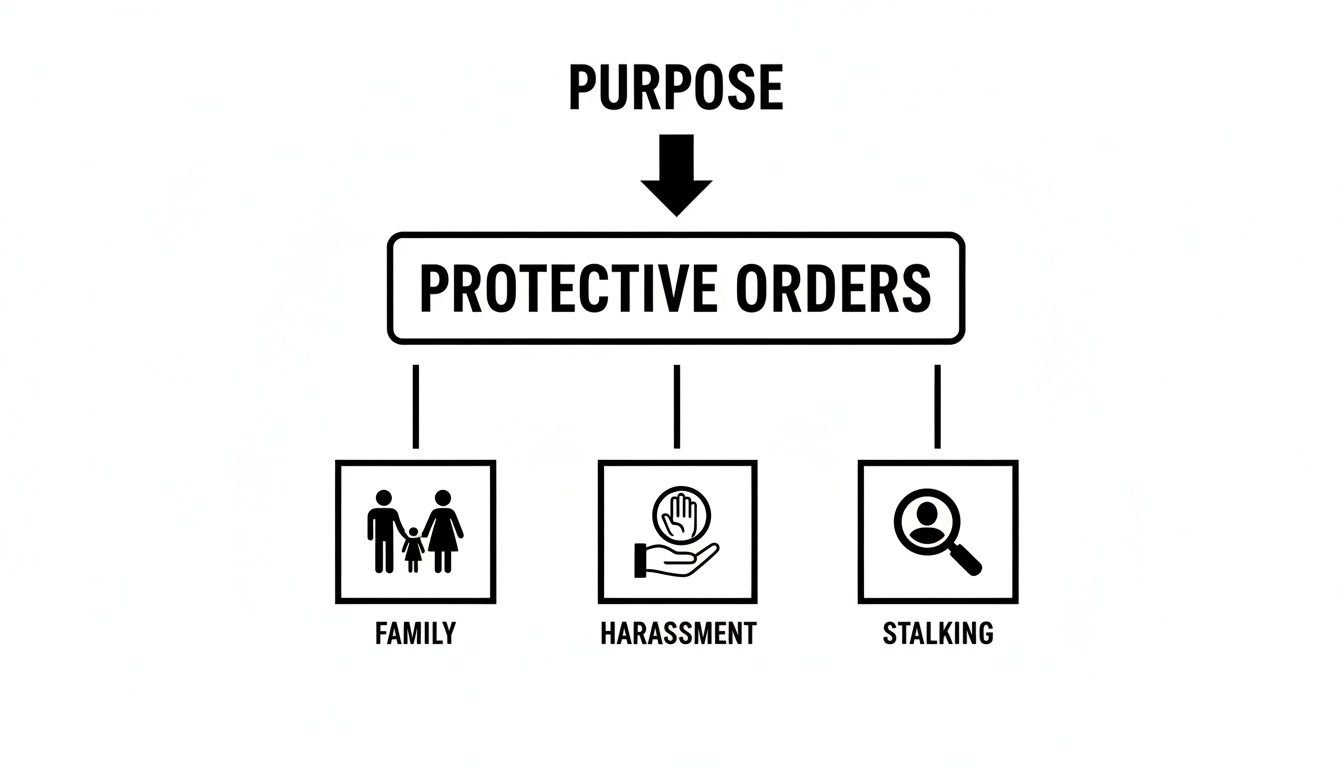
As you can see, the law addresses various forms of threatening behavior, and a judge must see specific evidence to justify issuing an order.
Final Protective Order
A Final Protective Order is the most serious and is not temporary or one-sided. It can only be granted after a full evidentiary hearing where both parties have the right to be present, submit evidence, call witnesses, and argue their case before a judge.
To issue a final order, the applicant must prove that family violence has occurred and is likely to occur again. If granted, a Final Protective Order can last for up to two years. Its impact is significant, affecting everything from your child custody arrangements and firearm rights to where you can legally live and work. Because of these severe, long-term consequences, final orders are the ones most frequently challenged in appellate courts.
It is also worth noting how these orders differ from the process of filing a restraining order in Texas, which is a related but separate civil court action.
The numbers demonstrate how frequently these orders are used. Between 2021 and 2023, Texas courts issued an estimated 162,497 protective orders. In the 2023 fiscal year alone, 68% of these were MOEPs issued by magistrates immediately following an arrest, highlighting the system’s reliance on these emergency measures.
How a Protective Order Impacts Divorce and Custody Cases
A protective order is never a standalone legal document; it sends powerful ripples across any related family law proceeding. If you are going through a divorce or child custody dispute, the existence of a protective order completely changes the dynamic. It reframes the starting point for negotiations and forces the court to view every decision through the lens of potential danger.
Even if you feel the order was granted unfairly, perhaps based on exaggerated claims or a misunderstanding, its legal effect is real. Understanding how that order creates a domino effect in your other cases is the first step toward building a strategy to correct the injustice, often through a carefully planned appeal.

The Legal Presumption Against Joint Custody
The single greatest impact of a final protective order is on child custody arrangements. Under the Texas Family Code, a finding of family violence creates a legal presumption that it is not in the child’s best interest for the person who committed the violence to be named a joint managing conservator.
This is a critical shift. Normally, Texas courts start with the presumption that naming both parents as joint managing conservators is in the child’s best interest. A protective order flips that presumption on its head.
Abuse of Discretion: This is a key legal term in appeals. It means a trial court judge made a decision that was unreasonable, arbitrary, or without reference to any guiding rules or principles. For example, if a judge ignored clear evidence that disproved a family violence claim, that could be an abuse of discretion.
The burden of proof now shifts to you. Instead of the court starting from a neutral position, you must convince the judge why, despite the order, you should still share in the fundamental rights and duties of raising your child.
How Visitation and Parental Rights Are Restricted
Even if you are not completely stripped of joint conservatorship, a protective order will almost certainly lead to severe restrictions on your time with your child. The court’s primary duty is to protect the child and it will take decisive action to ensure their safety.
These restrictions often include:
- Supervised Visitation: The court may order that you can only see your children in the presence of an approved third-party supervisor, such as a family member or a professional at a designated agency.
- Limited Possession Schedules: Standard possession schedules are often discarded. Your time may be reduced to short, infrequent visits in a highly controlled environment.
- No Overnight Stays: If a judge believes there is any risk of family violence, allowing overnight visits is highly unlikely.
- Prohibition on Decision-Making: Your rights to make decisions about your child’s education, medical care, and general welfare can be limited or given exclusively to the other parent.
For example, a father with a standard possession order might suddenly find his weekend visits replaced with two-hour supervised sessions at a family services center every other Saturday. This is a profound and damaging change. If the protective order was based on a legal error, appealing it becomes essential to restoring a meaningful parent-child relationship.
Impact on Property Division and Spousal Support
The consequences of a protective order also extend to the financial aspects of a divorce. While Texas is a community property state that aims for a “just and right” division of assets, a finding of family violence is a significant factor the court can consider.
A judge may decide that a “just and right” division means awarding a disproportionate share of the community estate to the victim of the violence. This is especially true if the abuse harmed the victim’s earning capacity or created financial strain. A history of family violence can also play a role in determining eligibility for, and the amount of, spousal maintenance.
If a court issued a protective order in Texas against you based on flawed evidence or a misapplication of the law, that single mistake can unfairly cost you your parental rights and a significant portion of your financial assets. In the legal world, we call this a reversible error—a mistake so significant that it likely led to an improper judgment. Identifying these errors is the heart of a successful appeal.
Navigating the Protective Order Hearing Process
The court hearing for a final protective order is the main event. This is not an informal discussion; it is a formal evidentiary hearing where a judge listens to both sides and makes a decision that can impact your life for years. Whether you are seeking protection or defending yourself against allegations you believe are unjust, knowing what to expect is critical.
The process can feel like it is moving at lightning speed, especially if a temporary order was granted without you being present. This hearing is your opportunity to present your side of the story, but it must be done within the formal rules of the court, supported by credible evidence and testimony.

Understanding the Standard of Proof
In a Texas protective order hearing, the person requesting the order (the applicant) must prove their case by a preponderance of the evidence. This is the standard of proof used in most civil and family law cases.
Preponderance of the Evidence: This legal standard means the applicant must convince the judge that it is “more likely than not” that family violence occurred and is likely to occur again. Think of it as tipping the scales of justice just slightly. If the evidence makes their side seem 51% true, that is enough to meet the burden.
This is a much lower standard than the “beyond a reasonable doubt” requirement in criminal trials. Because the threshold is lower, the credibility and quality of the evidence presented by each side become incredibly important.
What Happens During the Hearing
A final protective order hearing is essentially a mini-trial. While every judge manages their courtroom differently, the process generally follows a set structure to ensure both parties have a fair opportunity to be heard.
- The Applicant’s Case: The person who filed for the order presents their case first. They will testify under oath about the alleged violence and may call other witnesses to support their claims.
- Presenting Evidence: The applicant will submit evidence to the judge, such as threatening text messages, emails, photos of injuries, or police and medical reports.
- Cross-Examination: After the applicant and their witnesses have testified, the respondent (the person the order is against) has the right to ask them questions. This is a crucial opportunity to challenge their testimony and point out inconsistencies, especially after an initial temporary ex parte protective order was issued.
- The Respondent’s Case: The respondent then presents their defense. They can testify, call their own witnesses, and submit evidence that contradicts the applicant’s claims or tells a different story.
- The Judge’s Decision: After hearing all testimony and reviewing the evidence from both sides, the judge will make a final decision to either grant or deny the protective order.
Gathering and Presenting Credible Evidence
Ultimately, these hearings often come down to who presents the most credible evidence. Mere accusations are not enough; a judge needs to see proof. As you prepare for the hearing, it is also wise to understand the legality of recording a conversation without consent, as evidentiary rules can be complex and improperly obtained evidence may be excluded.
What does credible evidence look like?
- Communications: Voicemails, emails, and text messages can be powerful, especially if they show a clear pattern of behavior or contradict the other person’s claims.
- Witness Testimony: Testimony from a neutral third party—a neighbor, friend, or coworker—who witnessed an event can be very persuasive.
- Official Documents: Police reports, medical records, or dated photographs can provide objective evidence to support your side of the story.
- Your Own Testimony: Never underestimate the importance of your own testimony. Being clear, consistent, and truthful while on the witness stand is essential. Your credibility is on the line.
With such high stakes, thorough preparation is not just an advantage—it is a necessity.
How to Appeal an Unfair Protective Order
When a judge issues a protective order against you, it can feel like a final, devastating judgment. You may feel the court did not understand the full context or simply made a mistake. Thankfully, the Texas legal system provides a specific path forward when you believe a trial court committed a serious legal error: an appeal.
It is critical to understand what an appeal is—and what it is not. An appeal is not a second chance to retry your case or introduce new evidence. Instead, it is a focused review of the trial court record to identify a reversible error—a legal mistake so significant that it likely led to an incorrect outcome.
Understanding the Standard of Review in Protective Order Appeals
When an appellate court reviews a protective order, it almost always applies an “abuse of discretion” standard. This legal principle guides the entire strategy of the appeal.
In simple terms, an “abuse of discretion” occurs when a trial judge makes a decision that is unreasonable, arbitrary, or made without reference to guiding legal rules. For example, if a judge granted a protective order in Texas based on testimony that does not meet the legal definition of “family violence,” that could be a clear abuse of discretion. The appellate court is not asking if it would have ruled differently; it is determining whether the judge’s decision was legally defensible based on the law and the evidence presented at the hearing.
Reversible Error: A legal mistake made by a trial court that is serious enough to have affected the outcome of the case. Identifying a reversible error is essential for a successful appeal.
The need for appellate oversight is real. In 2022, Texas saw a 10% increase in family violence offenses, climbing from 231,207 incidents in 2021 to 254,339. While protective orders are up to 80% effective at preventing future violence, the process is not perfect. In contentious family law disputes, courts can make mistakes, creating an urgent need for skilled appellate review. You can find more data on these trends at TCFV.org.
The First Steps in the Appeals Process
The appellate process is governed by strict, non-negotiable deadlines. Missing a deadline can result in losing your right to appeal permanently. It is essential to act quickly and decisively.
The first step is filing a Notice of Appeal. This is a formal document filed with the trial court clerk that officially signals your intent to challenge the judge’s order. In most cases, you have only 30 days from the date the protective order was signed to file this notice. Our attorneys have prepared a detailed guide to walk you through the critical details of a notice of appeal.
Once the notice is filed, the official court record must be prepared. This record consists of two parts:
- The Clerk’s Record: A compilation of all documents filed in your case, including the application, motions, and the final signed order.
- The Reporter’s Record: The official, word-for-word transcript of everything said during the hearing, prepared by the court reporter.
This record is the entire universe for the appeal. The appellate court is strictly prohibited from considering any information outside of these documents.
Crafting the Appellate Brief
With the record prepared, your appellate attorney’s real work begins. They will meticulously review every page, searching for reversible errors. Did the judge misinterpret a key statute? Was important evidence improperly excluded? Was there legally insufficient evidence to support a finding of family violence?
The answers to these questions form the basis of the appellate brief. This is the formal written argument submitted to the court of appeals. It lays out the facts, identifies the judge’s specific legal errors, and uses case law and statutes to argue why the protective order should be overturned. This document is the cornerstone of your appeal.
Common Reversible Errors in Texas Protective Order Cases
Winning an appeal requires more than just disagreeing with the judge’s decision. It requires proving that the trial court made a specific legal mistake that unfairly altered the outcome. When you leave a hearing feeling that an injustice has occurred, it is often because of an identifiable error. Pinpointing these missteps is the key to a successful appeal.
These are not minor procedural issues; they are fundamental flaws that likely led to the wrong result. A skilled appellate attorney examines the court record for these precise mistakes, which can provide solid grounds for an appeal in a civil case.
Insufficient Evidence to Support the Order
One of the most common reasons protective orders are reversed on appeal is a lack of sufficient evidence. The applicant must prove two things: that family violence has occurred in the past, and that it is likely to occur in the future. Simply feeling afraid or pointing to a history of arguments does not meet this legal standard.
For example, consider a case built entirely on angry text messages about financial disputes. If those messages, however unpleasant, never cross the line into threatening physical harm, an appellate court could find that the evidence failed to meet the legal definition of “family violence.” In such a scenario, the trial judge’s decision to grant the order would be considered an abuse of discretion.
Misinterpreting the Definition of Family Violence
The Texas Family Code provides a very specific definition of “family violence.” A judge cannot apply their own personal definition. If the court issues a protective order for behavior that, while upsetting, does not legally qualify as family violence, it has committed a reversible error.
A classic example is when a judge mistakes intense verbal arguments for a genuine threat of physical harm. If the court record shows shouting matches but no evidence of an act intended to cause physical harm, injury, or assault, an appeal can be built on the argument that the judge misapplied the law.
Recent trends in court filings show how these errors can occur. Applications for protective orders jumped by 9% in 2022 and then dropped 5% in 2023, but overall family violence filings remain 44% higher than they were five years ago. With such a heavy caseload, judicial mistakes are bound to happen, making appellate review more important than ever. You can review these statistics in the Texas Judiciary’s annual statistical report.
Denial of Due Process Rights
The U.S. and Texas Constitutions guarantee you the right to a fair hearing, known as due process. In a protective order hearing, this includes the right to present your evidence, call your own witnesses, and cross-examine the person accusing you.
If the judge repeatedly cut you off, refused to hear from your key witness, or prevented your attorney from questioning the other party, your constitutional rights may have been violated. Appellate courts take such procedural failures very seriously, as they undermine the fairness of the entire hearing. A denial of due process can be a powerful basis for reversing a protective order.
Frequently Asked Questions About Texas Protective Orders
Facing a protective order is a confusing and stressful experience, and it is natural to have questions. The legal system is complex, and the outcome has enormous implications for your family, your rights, and your future. Here are plain-English answers to some of the questions we hear most often as appellate attorneys.
How Long Does a Final Protective Order Last in Texas?
A Final Protective Order in Texas is a long-term court order, but it is not permanent. In most cases, a judge will issue the order for a period of up to two years.
However, there are exceptions. If the judge finds that the family violence also constituted a felony-level offense, they have the authority to extend the order beyond the two-year mark. Additionally, the protected person can petition the court to extend the order before it expires, but they must prove there is a continuing, reasonable fear of future violence.
Can I Own a Firearm with a Protective Order Against Me?
No. Both Texas and federal law are unequivocal on this point. It is a criminal offense for any person subject to a final protective order to possess a firearm or ammunition.
The order itself will state this prohibition clearly. Being found in possession of a firearm while under a protective order can lead to new and serious criminal charges, completely separate from your family law case.
What Is the Difference Between an Appeal and a Modification?
This is a critical distinction. An appeal challenges the validity of the original court order, while a modification seeks to change the terms of a valid order due to changed circumstances.
An appeal directly attacks the trial court’s judgment. You are arguing that the judge made a significant legal mistake—a reversible error—such as misapplying the law or issuing an order without legally sufficient evidence. A modification, on the other hand, accepts that the original order was valid but argues that new circumstances justify changing its terms moving forward.
What Happens if I Violate a Protective Order?
Violating a protective order in Texas is a serious criminal offense. Even a seemingly minor or accidental violation can lead to an immediate arrest and new criminal charges.
A first-time violation is typically a Class A Misdemeanor, punishable by up to one year in jail and a $4,000 fine. If you have prior violations, the penalties become much more severe, potentially escalating to a third-degree felony with a prison sentence of two to ten years. Beyond the criminal consequences, any violation will damage your credibility in related divorce or child custody proceedings.
If you believe the court made a mistake in your family law case, our appellate attorneys can help you seek a fair outcome. Contact The Law Office of Bryan Fagan today for a free consultation.