You may feel that the judge got it wrong. In a Texas family law case, that can mean a custody schedule that doesn't fit the evidence, a property division that seems uneven, or a protective order ruling that turned on a rushed hearing and an incomplete record.
That feeling matters, but the next step isn't to relive the trial. It's to protect the appeal.
Clients often think the appeal begins when the Notice of Appeal is filed. In practice, the stronger work usually starts earlier. If you want to understand how to strengthen your appeal before filing in Texas, focus on what can still be done in the short window after judgment: preserve issues, request the right findings, secure the right records, and choose arguments that fit the standard of review.
After an Unfair Ruling What Happens Now
A common scene in family court looks like this. The judge signs the final order. One parent leaves convinced the court relied too heavily on weak testimony. The other side says the case is over. Trial counsel is already moving on to the next hearing. Meanwhile, the clock has started.
That first stretch after judgment is where control can be regained.
Many Texas appeal guides spend most of their time on filing deadlines. Those deadlines matter. But practical Texas appellate guidance also shows a different problem: a strong appeal often depends on what was done before the notice of appeal was filed, because the record must show the trial court was asked to rule on the point of error in the first place, as noted in the Texas Young Lawyers Association guidance on handling a first civil appeal.
If the trial court never ruled on your objection, or the excluded exhibit never made it into the record, or no one requested findings that would expose the judge's reasoning, the court of appeals may never reach the issue the way you hope.
Practical rule: Appeals are built from rulings, objections, motions, and records. They aren't built from a general sense that the outcome felt unfair.
In family law, that matters more than many people realize. A divorce decree may contain valuation or characterization disputes. A custody order may rest on credibility calls, evidentiary rulings, or a vague best-interest analysis. A support ruling may involve missing financial proof or an incorrect legal framework. The appellate court won't retry those facts from scratch. It will review what the trial court did and what the record shows.
That's why the immediate goal isn't speed for its own sake. The goal is disciplined preparation.
Using Post-Judgment Motions to Solidify Your Appeal
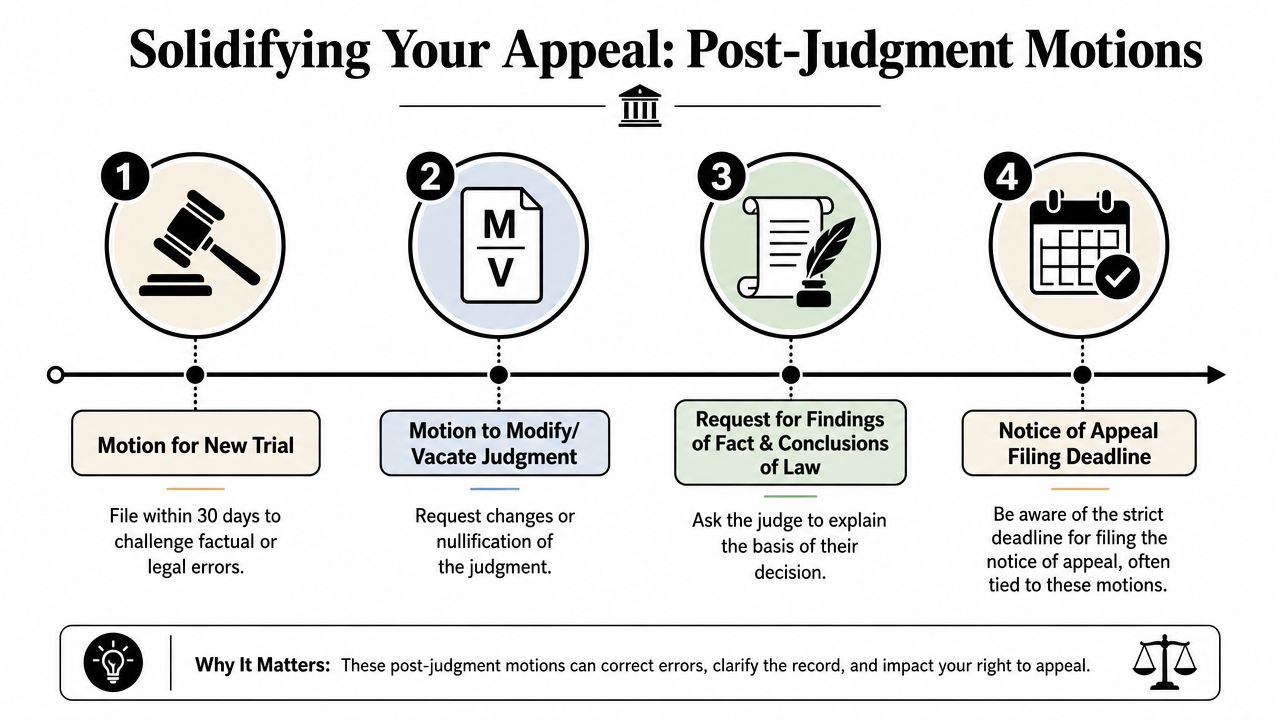
Once the judgment is signed, post-judgment motions can do more than complain about the result. Used correctly, they can sharpen issues, give the trial judge a chance to correct error, and in ordinary appeals create more time to prepare the case for review.
Why these motions matter
In practice, three post-judgment tools often deserve immediate review in a family law case:
- Motion for new trial: This asks the trial court to reconsider because of legal or factual problems.
- Motion to modify, correct, or reform the judgment: This targets specific defects in the written judgment.
- Request for findings of fact and conclusions of law: This asks the judge to explain the basis for the ruling, which can be critical in bench trials.
A timely motion can change the pace of the appeal. Texas appellate guidance recognizes a useful but often overlooked point: in an ordinary appeal, a timely post-judgment motion or request for findings can extend the notice deadline and create more time to assemble the record and refine the issues, while accelerated appeals don't get that same benefit, as described in the TYLA civil appeal guide.
That is why filing immediately isn't always the strongest move. Sometimes the better move is filing the right post-judgment paper first.
What works and what doesn't
What works is a motion tied to specific rulings. If the decree omits a requested finding, misstates property language, or relies on a contested evidentiary ruling, the motion should identify the problem clearly and preserve the complaint.
What doesn't work is a broad filing that says the result was unjust without anchoring that claim to the record. Appellate courts look for preserved legal points, not generalized frustration.
For a closer look at timing strategy, motion for new trial practice in Texas family law can be an important part of the analysis. The related resource on Post-Trial Motions Before a Texas Appeal addresses one practical point many litigants miss: how a motion for new trial can extend the appeal deadline.
Key Texas Post-Judgment Deadlines
| Action | Standard Deadline (No Post-Judgment Motion) | Extended Deadline (With Timely Post-Judgment Motion) |
|---|---|---|
| Notice of appeal in an ordinary appeal | The standard notice deadline applies under Texas appellate procedure | A timely qualifying post-judgment motion can extend the notice deadline in an ordinary appeal |
| Restricted appeal | Not applicable as a standard path if the ordinary notice is timely filed | Must be filed within six months of the judgment and is available only in limited circumstances, as noted in the Texas District and County Attorneys Association discussion of appeal timing |
A late notice can dramatically narrow options. Texas appellate materials note that missing a timely notice can leave a litigant trying to fit within a restricted appeal, which must be filed within six months and comes with stricter requirements, according to the TDCAA appellate article.
Sometimes the best pre-filing move is not filing the notice first. It's using the post-judgment window to make the future appeal cleaner.
Family law examples
In a divorce case, a motion to modify can target language that incorrectly implements the judge's oral ruling on retirement division or debt allocation.
In a custody case, a request for findings can force the court to identify the factual basis for restrictions, decision-making authority, or a possession schedule. Those findings may later reveal whether the judge applied the proper legal standard.
In a protective-order case, post-judgment action may help clarify the exact basis for relief and preserve arguments about procedure and evidence.
How to Preserve Reversible Error for Your Appeal
An appeal is not a second trial. It is a legal review of whether the trial court made a mistake that matters.
That kind of mistake is often called reversible error. In plain English, it means an error the appellate court can see in the record and that is serious enough to justify relief.
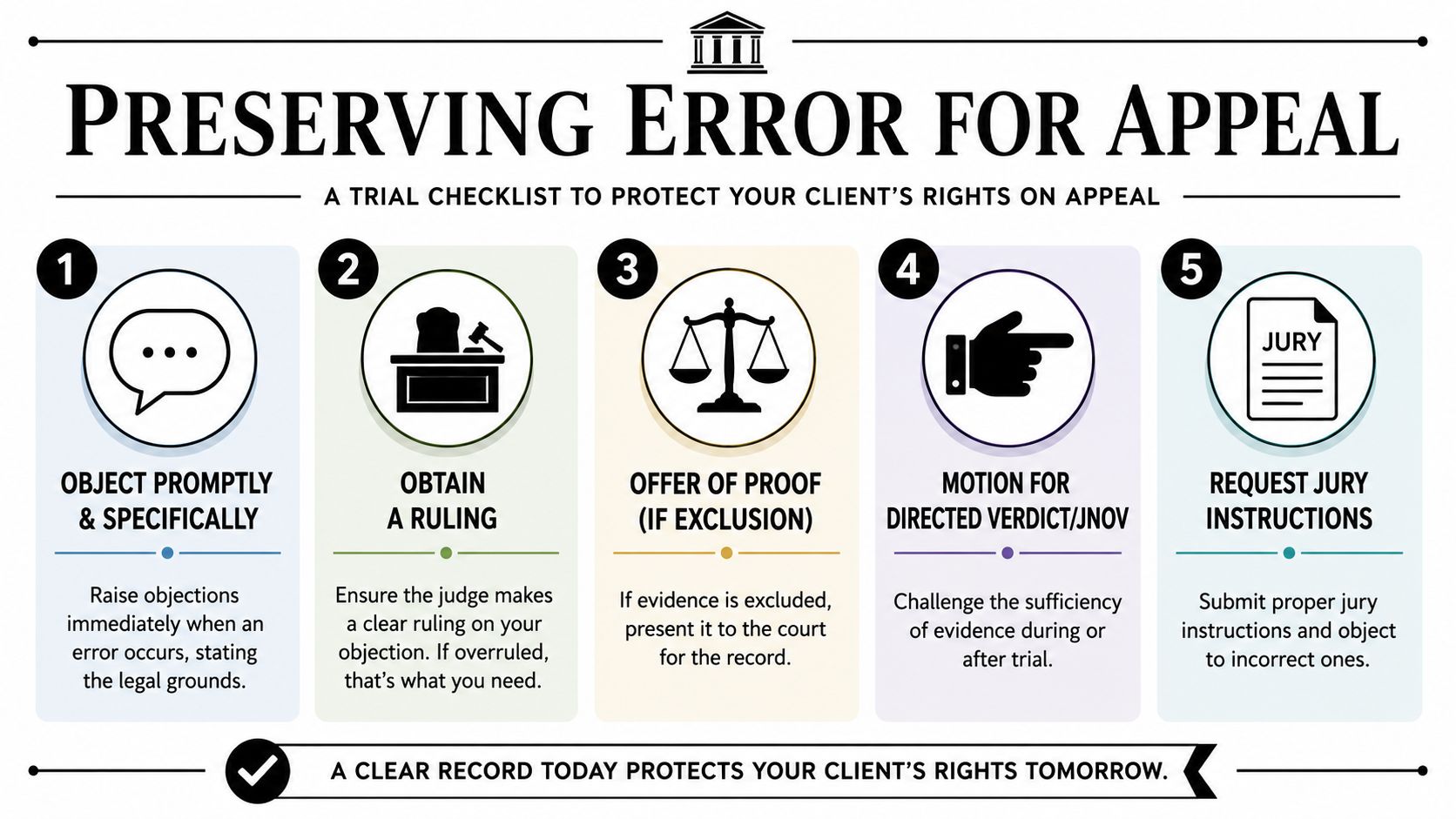
Texas appellate law starts with a simple rule: preserving error starts in the trial court, and a party generally must make the argument below, make timely requests, and properly perfect the appeal to preserve the right to challenge a ruling later, as discussed in the St. Mary's Law Journal article on Texas appellate practice.
What preserving error looks like in real life
In a family law case, preserving error usually means more than saying “objection.”
It often requires:
- A prompt objection: Counsel must object when the problem occurs, not later when the damage is done.
- A specific legal ground: The trial judge must know why the evidence, procedure, or ruling is challenged.
- A ruling: If the judge never clearly rules, the appellate court may have nothing to review.
- A record of excluded evidence: If your evidence was kept out, you may need an offer of proof or bill so the appellate court can see what was excluded.
For a practical family-court discussion, preserving error for appeal in Texas family court is often where trial and appellate strategy meet.
Common reversible errors in family court
Family law appeals often turn on a manageable set of issues, not dozens of weak complaints.
Examples include:
- Improper admission of evidence: A judge allows unreliable hearsay about a parent's behavior over a specific objection.
- Wrong exclusion of evidence: A party is blocked from presenting financial documents, messages, or witness testimony that matter to custody, support, or property issues.
- Failure to apply the correct law: The court uses the wrong legal framework in a conservatorship or property-division ruling.
- Insufficient support in the record: The ruling rests on findings that the record doesn't adequately support.
- Procedural unfairness: A party did not receive a meaningful chance to present or challenge evidence.
Findings can change the case
Findings of fact and conclusions of law are especially important in bench trials, which include many family law proceedings.
Findings of fact are the trial judge's statement of what facts the court decided were true. Conclusions of law are the judge's statement of the legal rules applied to those facts. Together, they can reveal whether the ruling rests on a valid legal theory or on reasoning that can be challenged.
If the appellate court can't see the error in the record, it usually can't fix it.
A client may say, “The judge obviously ignored this issue.” Sometimes that's true. But if no one asked the court to rule, objected with specificity, or created a record of the missing evidence, “obvious” may not be enough on appeal.
Building the Official Record Your Appeal Will Stand On
The court of appeals will not know your case the way you lived it. The judges will know it only through the appellate record.
That record usually has two core parts. The clerk's record contains filed papers such as pleadings, motions, orders, and requested findings. The reporter's record contains the transcript of what was said in court. If it isn't in one of those places, the appellate court usually won't consider it.
A solid overview of that foundation appears in what the appellate record is in Texas and why it matters.
What should be in the record
Start with a blunt question. If an appellate judge opened the file tomorrow, would that judge be able to see every step needed to evaluate your complaint?
In family cases, the answer should include items such as:
- Key pleadings and motions: petitions, responses, temporary-order requests, enforcement motions, and post-judgment filings
- Signed orders and judgments: including any modifications, findings, or clarifications
- Exhibits offered: not just documents exchanged informally between lawyers
- Hearing transcripts: especially final trial days and any critical temporary or post-judgment hearings
- Formal requests and rulings: objections, offers of proof, and requests for findings
What weakens appeals is the assumption that “everyone knows what happened.” Appellate judges don't work from memory, hallway discussions, or unfiled emails.
Fixing gaps before they hurt you
Sometimes the problem is not the legal issue. It's the missing record.
If a hearing wasn't transcribed, if an exhibit wasn't marked or admitted, or if the clerk's file omits something important, those problems need immediate attention. Counsel may need to request supplementation, verify exhibits, or preserve excluded material through the proper procedure.
A bill of exception can matter when the trial court excluded evidence and the appellate court needs to know what the evidence would have shown. Without that, the argument may collapse because the reviewing court cannot measure harm.
This short video gives a practical view of how the record drives appellate review.
Family law record problems that show up often
A few recurring examples deserve attention:
| Record problem | Why it matters on appeal |
|---|---|
| Missing transcript from a critical hearing | The appellate court may presume the omitted hearing supports the judgment |
| Exhibit discussed but never admitted | The court may treat it as outside the evidence |
| No ruling on objection or motion | There may be no preserved issue to review |
| Findings not requested when needed | The basis for the court's decision may stay unclear |
Build the record as if a judge who has never met you must decide your case from paper alone. That's exactly what happens.
If you're trying to learn how to strengthen your appeal before filing in Texas, this is one of the most concrete answers. Don't wait for briefing to discover that the record cannot carry the argument.
Strategic Issue Selection and Understanding the Standard of Review
The strongest appeals are selective. They don't throw every grievance into a brief and hope something sticks. They choose issues that are preserved, supported by the record, and matched to the right standard of review.
The standard of review is the rule the appellate court uses to evaluate what the trial judge did. In family law, many decisions are reviewed for abuse of discretion. In plain English, that means the appellate court asks whether the trial judge acted without a reasonable basis or applied the wrong legal standard.

Why issue selection matters
A client may have ten complaints after trial. An appellate lawyer may see two that are significant.
That difference is strategic, not dismissive. Weak issues can distract from stronger ones. They can also make a brief read like a replay of the trial instead of a focused legal argument.
A disciplined issue list usually asks:
- Was the issue preserved?
- Does the record clearly show the problem?
- What standard of review applies?
- Did the error probably affect the outcome?
If the answer is weak on two or three of those points, that issue may not belong in the appeal.
Plain-English definitions that matter
Here are three terms clients should understand early:
- Abuse of discretion: A deferential review standard often used in family law. The appellant must show more than disagreement. The ruling must fall outside the range the law allows.
- Reversible error: A legal mistake that appears in the record and justifies relief.
- Briefing: The written appellate presentation. Here, the parties explain the law, cite the record, and argue why the trial court should be affirmed or reversed.
What works in family law appeals
Arguments tend to gain traction when they point to a specific legal error tied to a concrete part of the record. Examples include misapplying the Family Code, entering a judgment that doesn't match the ruling, excluding key evidence over a valid objection, or making findings unsupported by the admitted proof.
By contrast, broad arguments like “the judge believed the wrong witness” are usually harder. Appellate courts rarely reweigh credibility the way clients hope.
For readers who want a broader discussion of which errors can support appellate relief, Grounds for Appealing a Texas Family Law Ruling is one available resource. When a case calls for focused review of record issues, briefing strategy, and standards of review, The Law Office of Bryan Fagan, PLLC handles Texas family law appellate matters involving custody, property division, support, protective orders, and related judgments.
Appeals are not the only path
Some urgent rulings call for a different tool, such as mandamus, when waiting for a normal appeal would not provide an adequate remedy. That analysis is highly case-specific. It depends on the nature of the order, the timing problem, and whether ordinary appellate review would come too late to correct the harm.
The central point remains the same. Strong appellate strategy is selective, not reactive.
Common Pitfalls That Can Weaken Your Appeal
Some appeals don't fail because the legal issue is weak. They fail because the groundwork was mishandled.
One problem is delay. People often assume that because they intend to appeal, their rights are protected. They aren't. Deadlines in Texas appellate practice are short and unforgiving, and procedural missteps can narrow or even eliminate available options.
The traps that show up most often
Several mistakes come up again and again in family law matters:
- Waiting to review post-judgment options: That can cost valuable time for findings, corrections, or deadline extensions available in ordinary appeals.
- Assuming the notice solves everything: The notice perfects the appeal in civil cases, but it does not by itself fix preservation problems or complete the record.
- Failing to secure a ruling: If counsel filed something important but never obtained a ruling, the appellate point may be lost.
- Ordering records too late: Transcript and clerk's record issues are easier to solve early than after briefing begins.
- Treating cost issues as an afterthought: Court costs, bonds, deposits, and waivers can affect whether the appeal moves forward smoothly.
The cost issue many people miss
For lower-income and moderate-income appellants, the financial mechanics of an appeal can be a real obstacle. Texas public guidance notes that an appellant may secure an appeal by bond, cash deposit, or a Statement of Inability to Afford Payment of Court Costs, but the rules and deadlines can vary by court and case type, creating traps for people who assume one filing handles everything, according to Texas Law Help's guide to appealing a justice court case.
That issue matters beyond justice court. The broader lesson is practical: if cost status, fee waivers, or security for costs are relevant in your case, they should be addressed early and deliberately.
A good appeal plan includes money, paperwork, service, and timing. Legal merit alone doesn't move a case through the system.
A better approach
The safer approach is to create a short action list right away. Confirm the date the judgment was signed. Identify any post-judgment motions worth filing. Determine what findings are needed. Order or designate the record promptly. Review cost requirements and waiver options before a filing deadline creates pressure.
That approach doesn't guarantee reversal. It does give the appeal a fair procedural foundation.
Your Pre-Filing Checklist and Consulting an Appellate Specialist
Before the Notice of Appeal is filed, the case needs a hard review. Not every unfavorable ruling should be appealed. But every potentially appealable ruling should be evaluated with discipline.
A practical pre-filing checklist
Use this as a working list in the days after a family court judgment:
Confirm the signed order
Make sure you have the exact signed judgment or order, not a draft or oral pronouncement.Review post-judgment motion options
Consider whether a motion for new trial, a motion to modify or reform, or a request for findings would improve the posture of the appeal.Identify preserved issues
Ask where the objection was made, what the ruling was, and where that appears in the record.Request findings when they matter
In a bench trial, findings can frame the appeal and expose legal mistakes.Secure the clerk's and reporter's records
Verify hearings, exhibits, and filings. Don't assume the file is complete.Rank the issues by appellate strength
Focus on legal error, the standard of review, and whether the error likely affected the judgment.Check practical barriers
Filing mechanics, fees, service requirements, and scheduling all matter.
Why specialized review matters
Appellate practice is a different discipline from trial practice. Trial counsel may know the facts better than anyone. An appellate lawyer brings a different skill set: record analysis, preservation review, issue framing, and judge-focused briefing.
That doesn't mean trial counsel did anything wrong. It means the job has changed. The question is no longer how to persuade the trial judge in real time. The question is how to show an appellate court, on a fixed record, that the law requires relief.
For that reason, many families benefit from an early appellate consultation even before the notice is filed. A specialist can help decide whether to pursue post-judgment motions, how to define the issues, and whether the existing record is strong enough to support the appeal. For readers comparing options, one internal resource on standards and appellate framing is this Texas family appeal review guide.
What clients should bring to that consultation
Bring the signed order, docket information, key motions, any findings or requests for findings, hearing dates, and anything that shows where objections or disputed rulings occurred. If transcripts or exhibits are already available, include those too.
A useful consultation isn't just about whether the trial felt unfair. It's about whether the record shows a reviewable legal error and what must happen immediately to protect it.
If you believe the court made a mistake in your family law case, our appellate attorneys can help you seek a fair outcome. Contact The Law Office of Bryan Fagan today for a free consultation.
If you believe the court made a mistake in your family law case, the appellate team at The Law Office of Bryan Fagan, PLLC can evaluate your order, review the record issues, and help you decide what should happen before an appeal is filed. Contact the firm today for a free consultation.