You may feel that the judge got it wrong. Maybe the final order affects where your child lives, how property was divided, whether support is fair, or whether an enforcement ruling will follow you for years.
That reaction is understandable. But deciding whether to appeal isn't just about whether the result felt unfair. It's a strategic decision about risk, timing, proof, and whether the error is one an appellate court can correct.
Cost vs benefit of appealing a family law case in Texas comes down to one question: Can you identify a meaningful legal error in the existing record that is worth the money, time, and strain of an appeal?
A calm evaluation helps. Emotion may tell you to keep fighting. Good appellate judgment asks whether the law, the record, and the likely remedy justify that fight.
Is an Appeal the Right Path for You
Most clients start in the same place. They've lived through a difficult trial, they believe the outcome was unfair, and they want a second chance to explain what really happened. In Texas, an appeal usually isn't that second chance.
An appeal is often better understood as a review of the trial court's work, not a replay of the case. The question usually isn't whether the appellate judges would have made the same decision. The question is whether the trial court made a legal mistake serious enough to justify reversal or another form of relief.
Early on, I tell clients to separate hurt, disagreement, and reviewable error. Hurt is real. Disagreement is common. Reviewable error is what matters on appeal.
| Question | If the answer is yes | If the answer is no |
|---|---|---|
| Can you point to a specific legal or procedural mistake? | An appeal may be worth deeper review. | The case may be better suited for another path. |
| Does the written record clearly show the problem? | Your position is stronger. | Appellate options narrow quickly. |
| Would a successful appeal materially change custody, property, support, or enforcement results? | The benefit may justify the cost. | The return may be too small. |
| Are you prepared for a lengthy, document-driven process? | You can make a deliberate decision. | The burden may outweigh the benefit. |
When appealing makes sense
Appeals tend to make more sense when the stakes are durable and significant. Examples include a misapplication of the law in a property division, a custody ruling affected by a serious procedural problem, or an enforcement order entered without proper legal support.
When another path may work better
Sometimes the better option is a post-judgment motion, a negotiated adjustment, or another procedural remedy instead of a formal appeal. If you're still deciding between those routes, it helps to review alternatives to appeal in Texas family court cases.
The strongest appeals usually begin with a narrow question: “What legal error changed the outcome?” Not “Why was this unfair overall?”
Understanding the Texas Appellate Process
Texas family-law appeals from district-court judgments are not a trial de novo, meaning they are not a complete redo of the case. They are decided on the written record by appellate courts, and in rare situations a case can continue to the Texas Supreme Court for final review, as reflected in the Texas courts statistical materials.
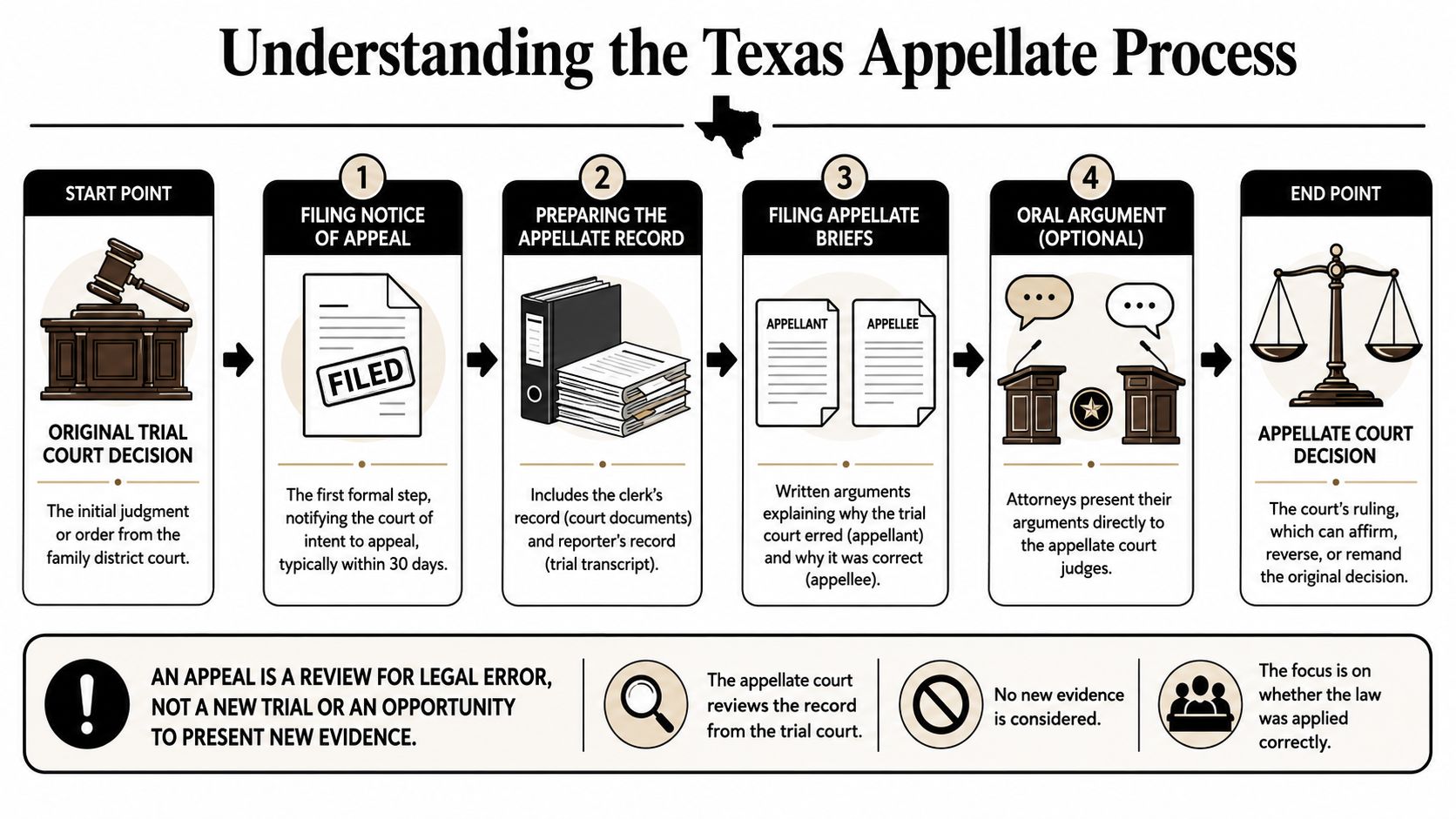
A useful way to think about an appeal is instant replay. The appellate court watches the official footage and checks whether the rules were applied correctly. It does not put new witnesses on the stand, admit new exhibits, or start over because one side believes the judge should have ruled differently.
What the appellate court actually reviews
The court reviews the record from the trial court. That usually includes the clerk's record, such as filed pleadings and signed orders, and the reporter's record, which is the transcript of what happened in court.
It also reviews the written arguments submitted by the parties. In a family appeal, the person filing the appeal is the appellant. The responding party is the appellee.
A briefing is the written legal argument filed with the appellate court. It explains what happened, identifies the claimed error, cites the law, and argues why the trial court's ruling should be affirmed, reversed, or sent back.
Plain-English definitions that matter
- Reversible error means a mistake that likely mattered to the outcome, not just a minor flaw.
- Abuse of discretion means the trial court acted outside the range of reasonable choices allowed by law.
- Preservation means the issue was properly raised in the trial court so it can be reviewed later.
For many people, the practical first step is consulting a lawyer who handles appeals regularly. A Texas Family Law Appeals Lawyer provides appellate representation challenging final family law orders for legal error.
A basic sequence
- Notice of appeal is filed.
- The appellate record is prepared.
- The parties submit briefs.
- The court may hear oral argument.
- The appellate court issues a written decision.
Appeals reward precision. A broad complaint that “the judge didn't listen” usually isn't enough. A specific, preserved legal error may be.
The Financial Costs of a Family Law Appeal
The money side of an appeal deserves blunt discussion. A Texas family law appeal can often exceed $10,000, depending on complexity, and the notice of appeal is typically due within 30 days of the judgment being signed, according to this discussion of Texas divorce appeal costs and timing.
That figure doesn't mean every appeal costs the same. It means you should treat the decision as a serious investment.
Where the money usually goes
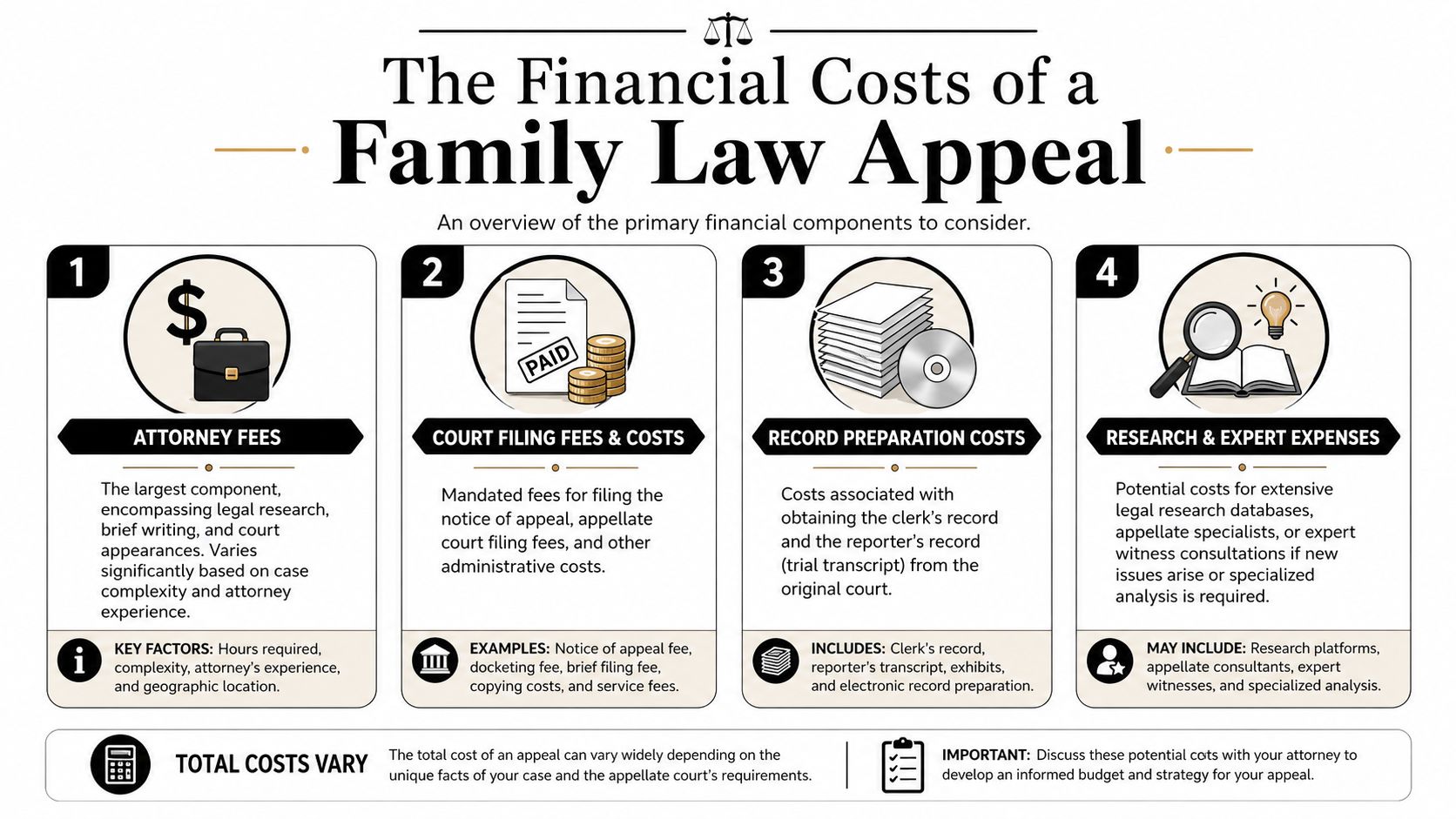
The first category is attorney's fees. Appellate work is specialized. The lawyer has to analyze the record, research the law, identify preserved issues, draft briefs, and sometimes prepare for oral argument. This is often the largest part of the expense.
The second category is court costs and filing fees. These are the charges tied to filing and processing the appeal.
Later in the process, clients also pay for record preparation. If the case involved a substantial hearing or trial, obtaining the clerk's record and reporter's record can become a meaningful expense because the appeal depends on that material.
A fourth category can involve additional legal work tied to the posture of the judgment, including requests related to staying enforcement or protecting rights while the appeal is pending.
Practical rule: Don't ask only, “Can I afford the appeal?” Ask, “If I win, what does that victory actually change, and is it worth the investment?”
To help clients see the issue clearly, I often compare cost against the value of the legal problem being challenged.
| Cost question | Why it matters |
|---|---|
| How much attorney time will this record require? | A narrow issue costs less to analyze than a sprawling trial record. |
| Is a transcript necessary? | In most appeals, the answer is yes because the court reviews the existing record. |
| What result are you trying to change? | The more meaningful the remedy, the easier it is to justify the expense. |
| Is immediate enforcement a concern? | That may affect strategy and short-term spending. |
Here's a short overview before looking deeper:
If you want a more focused discussion of budgets, billing, and what drives appellate cost, review how much an appeal costs.
The Timeline and Non-Monetary Costs
The time commitment changes the value calculation. One Texas family-law source reports that family appeals commonly take 8–24 months, which is long enough to affect planning, parenting routines, finances, and emotional health. That time range appears in the same verified discussion cited earlier about appeal cost and duration, and it matters because an appeal is rarely a quick correction.
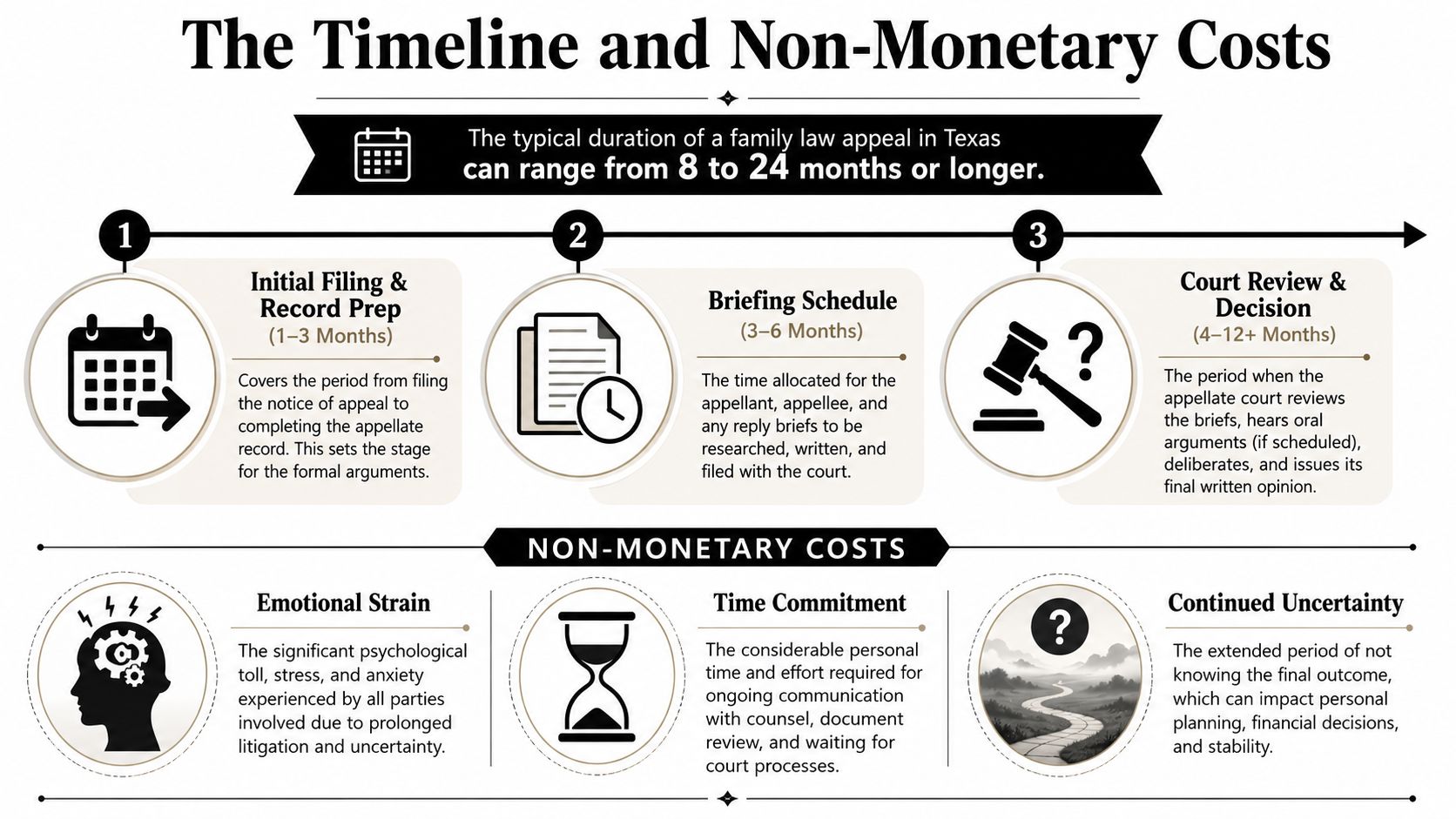
A representative appeal often feels like this. The final order is signed. You decide whether to appeal. The record is assembled. Months pass while briefing is prepared and answered. Then there is more waiting while the court reviews the case and issues a written decision.
The strain that doesn't show up on an invoice
The first hidden cost is uncertainty. You may not know for a long time whether the order will stand, be changed, or be sent back to the trial court.
The second is emotional fatigue. Even disciplined clients feel the pressure of continued conflict, especially when the case involves children, support, or a house or business that was central to the marriage.
The third is family friction. Ongoing litigation can make co-parenting harder. It can also delay the point where everyone begins adjusting to a stable routine.
Why timing changes strategy
Not every month of delay feels the same. Early in the appeal, the work is active and document-heavy. Later, the waiting becomes the challenge. Clients often tell me the hardest part is not writing the brief or gathering records. It's living with the case still open.
A long appeal can still be worth it. But the benefit needs to justify the period of uncertainty your family will live through while the court decides it.
For some people, that trade-off is acceptable because the issue affects long-term parenting rights or major property interests. For others, the emotional cost changes the analysis even when there is a plausible appellate issue.
Gauging Your Likelihood of Success The Benefit
The benefit side of the analysis turns on a legal filter called the standard of review. This is the lens the appellate court uses to decide how much deference to give the trial judge.
A key factor in an appeal's value is whether the issue is legally reviewable. Appellate review is limited to the existing record and standards such as abuse of discretion, not merely a fresh look at who seemed more credible. Deadlines can also run quickly, with many family-law appeals due within 30 days, and some extending to 90 days after qualifying post-trial motions, as discussed in this explanation of Texas appeal grounds and deadlines.
Abuse of discretion
This standard appears often in family law, especially in custody, visitation, and parts of property division. In plain English, the question is whether the judge acted unreasonably under the law.
That doesn't mean the appellate court substitutes its own preferred ruling. It asks whether the decision fell outside the range of reasonable choices. A client may dislike a conservatorship ruling, for example, but an appeal is stronger if the record shows the court ignored controlling legal principles or based the ruling on a materially flawed process.
Legal error
Sometimes the issue is not judgment but law. A legal error happens when the trial court applies the wrong legal rule, misreads a statute, or enters an order the law doesn't allow.
In a divorce case, one example can be the mischaracterization of separate property as community property. In an enforcement matter, the issue may involve whether the order was specific enough to support the relief granted. In a protective-order setting, it may involve whether the required legal framework was followed.
Sufficiency and the record
Some appeals challenge whether the evidence in the record can support a critical finding. This is often a harder path than clients expect because appellate courts generally do not re-weigh witness credibility.
That's why the record matters so much. If the strongest part of your case was testimony or evidence that never made it into the record in a usable way, the benefit of appealing drops sharply.
- Strong appellate posture: A clear ruling, a preserved objection, and a record that shows exactly what went wrong.
- Weak appellate posture: A fact-heavy complaint, no clear objection, or a record that leaves too much room for deference.
- Mixed posture: A real issue exists, but the likely remedy is narrow or the proof is incomplete.
If you want a closer look at issue selection, review valid grounds for appeal in Texas family court.
The best question isn't “Was the judge unfair?” It's “Can I identify a preserved error, under the right standard of review, that likely changed the result?”
Your Decision Framework A Checklist for Action
Emotion often pushes people toward an immediate yes or no. A better approach is to walk through a structured checklist and test the appeal like a major investment decision.
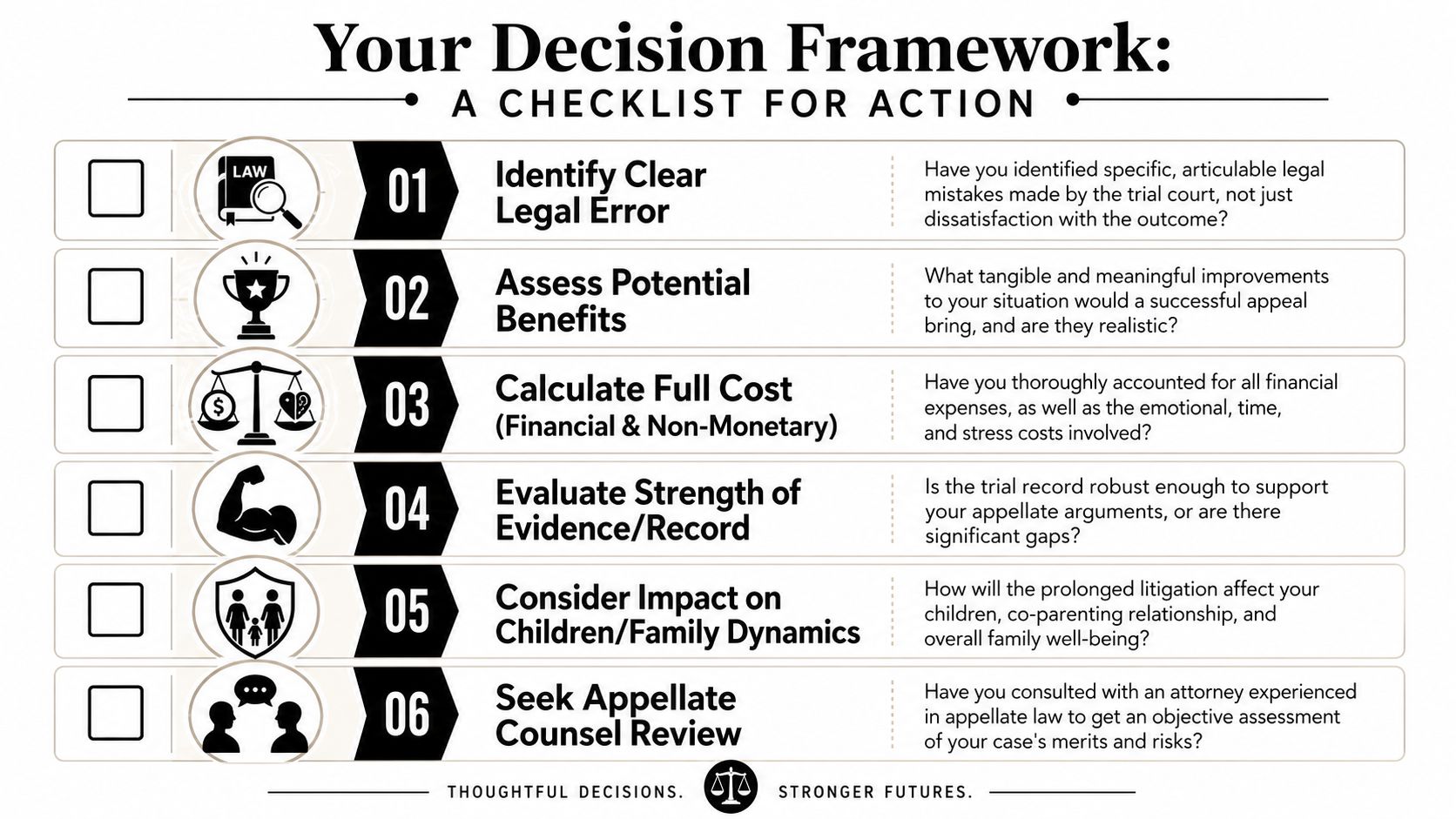
Ask these questions before you file
What specific mistake am I alleging?
“The judge got it wrong” isn't enough. You need a legal, procedural, or discretion-based issue that can be identified in the record.What would success change?
Be concrete. Would a successful appeal affect parenting time, a property division ruling, support obligations, or an enforcement result in a meaningful way?Is the likely benefit greater than the full cost?
Include attorney's fees, record costs, time away from work, emotional strain, and the stress of prolonged uncertainty.Do I have a record that supports the issue?
An appellate lawyer needs more than a strong memory of what happened. The deciding court will look at the official record.
Weigh financial and personal reality together
Some appeals make sense even when they are expensive because the order affects your family for years. Others do not, even if there is a colorable issue, because the likely remedy is too limited to justify the burden.
I often encourage clients to rate the case in three separate categories:
| Decision factor | Questions to ask |
|---|---|
| Legal strength | Is there a preserved issue and a usable standard of review? |
| Practical value | If successful, does this materially improve life after judgment? |
| Personal sustainability | Can you handle the time, conflict, and uncertainty involved? |
What tends to work and what doesn't
What works is narrow issue selection, realistic expectations, and immediate action after judgment. What usually doesn't work is filing from anger, hoping to introduce new evidence, or expecting the appellate court to “see things differently.”
Fee issues can also affect the decision. Texas guidance notes that notice deadlines are generally tight in family cases, fee requests often must be preserved at the trial level, and courts can award temporary attorney's fees during the appeal when equity and child or protected-party welfare justify it, as explained in Texas Law Help's discussion of attorneys' fees in family law cases.
How to Get a Professional Case Evaluation
A client often calls after reading the final order for the fifth time, convinced the judge got it wrong but unsure whether that means there is a real appeal. That is the right time to get an appellate evaluation. A good review does more than react to the outcome. It tests whether the record, the preserved objections, and the Texas standard of review line up well enough to justify the cost and strain of another round of litigation.
Start with the documents that let a lawyer assess the case efficiently. Bring the signed final order or decree, any findings of fact and conclusions of law, post-judgment motions, the notice of appeal if one has already been filed, and a short timeline with the key hearing and filing dates. If you have transcripts, clerk's record materials, exhibits, or written objections, include those too. Missing pieces can sometimes be obtained later, but an early assessment is stronger when the paper trail is organized from the start.
The most useful consultations are issue-driven. Counsel should identify the specific ruling you want reviewed, ask where the complaint was preserved, and explain the likely standard of review that would apply in a Texas family law appeal. That matters because the same bad result can produce very different odds on appeal depending on whether the question is legal error, factual sufficiency, or abuse of discretion.
This review should also address the remedy in plain terms. If the appeal succeeds, does that likely mean reversal and remand, a limited correction, or little practical change after months of work and expense? Clients need that answer before they decide whether an appeal is a sound investment or only an understandable reaction to a painful result.
If you are comparing lawyers, ask direct questions. Has counsel handled Texas family law appeals before. Will the lawyer personally review the record. What issues look strongest, and which ones are weak even if they feel important. A professional evaluation should narrow the case, not solely validate frustration.
The Law Office of Bryan Fagan, PLLC handles appellate review of final family law orders for legal error.
A sound evaluation gives you a realistic path. Sometimes that means filing quickly. Sometimes it means pursuing a different post-judgment remedy. Sometimes it means stopping, preserving your resources, and making peace with a result that is unlikely to change on appeal.