A judge signed an order in your divorce or custody case, and it feels wrong. Maybe the ruling ignored evidence you thought mattered. Maybe the court rushed a hearing, misunderstood a financial issue, or entered an order that doesn't work in real life.
That reaction is common. It's also where many people make their first strategic mistake. They assume the only serious response is an appeal.
In Texas family cases, that isn't always true. Some problems call for an appeal. Others call for a motion for new trial, a post-judgment motion, a petition to modify, enforcement, mediation, or in rare situations, mandamus or a bill of review. The right answer depends less on how unfair the result felt and more on what kind of problem happened.
If the judge made a legal mistake, an appeal may be the right tool. If the record is incomplete, a trial-court motion may work better. If life changed after the order, modification may be the only remedy that fits. That distinction is where good strategy starts.
What to Do When You Feel a Ruling Was Unfair
When clients call after a family court ruling, they usually ask one question: “Can I appeal this?” A better first question is: “What exactly went wrong?”
That sounds simple, but it changes everything. Texas family law gives you different remedies for different problems. If you choose the wrong one, you can spend time and money on a process that won't fix the issue you have.
Start by diagnosing the problem
Most post-ruling problems fall into one of these categories:
- Legal error: The judge may have applied the wrong rule, excluded evidence for the wrong reason, admitted improper evidence, denied required process, or entered a judgment the law doesn't support.
- Procedural problem: You may have had a notice issue, a default judgment problem, missing findings, or another mistake in how the case moved through court.
- Changed circumstances: The order may have made sense when signed, but your child's needs, work schedule, residence, or co-parenting situation changed afterward.
- Unworkable order: The language may be vague, impossible to follow, or likely to create constant conflict.
- Noncompliance: The order may be valid, but the other party isn't following it.
Practical rule: Don't ask whether the result was unfair in general. Ask whether the problem is a legal error, a record problem, new facts, or enforcement.
Gather the right materials quickly
Before any lawyer can give useful advice, the case has to be reviewed in context. That usually means collecting:
- The signed order or judgment
- The docket sheet and hearing dates
- Any reporter's record or transcript you already have
- Exhibits, motions, and written objections
- Notes about what changed after the order was signed
Deadlines in post-judgment practice can move fast. Waiting while you “see what happens” is often what closes off the best option. A strategic review early on can tell you whether you should attack the order, adjust the order, or force compliance with the order.
Why a Traditional Appeal Is Not a Do-Over
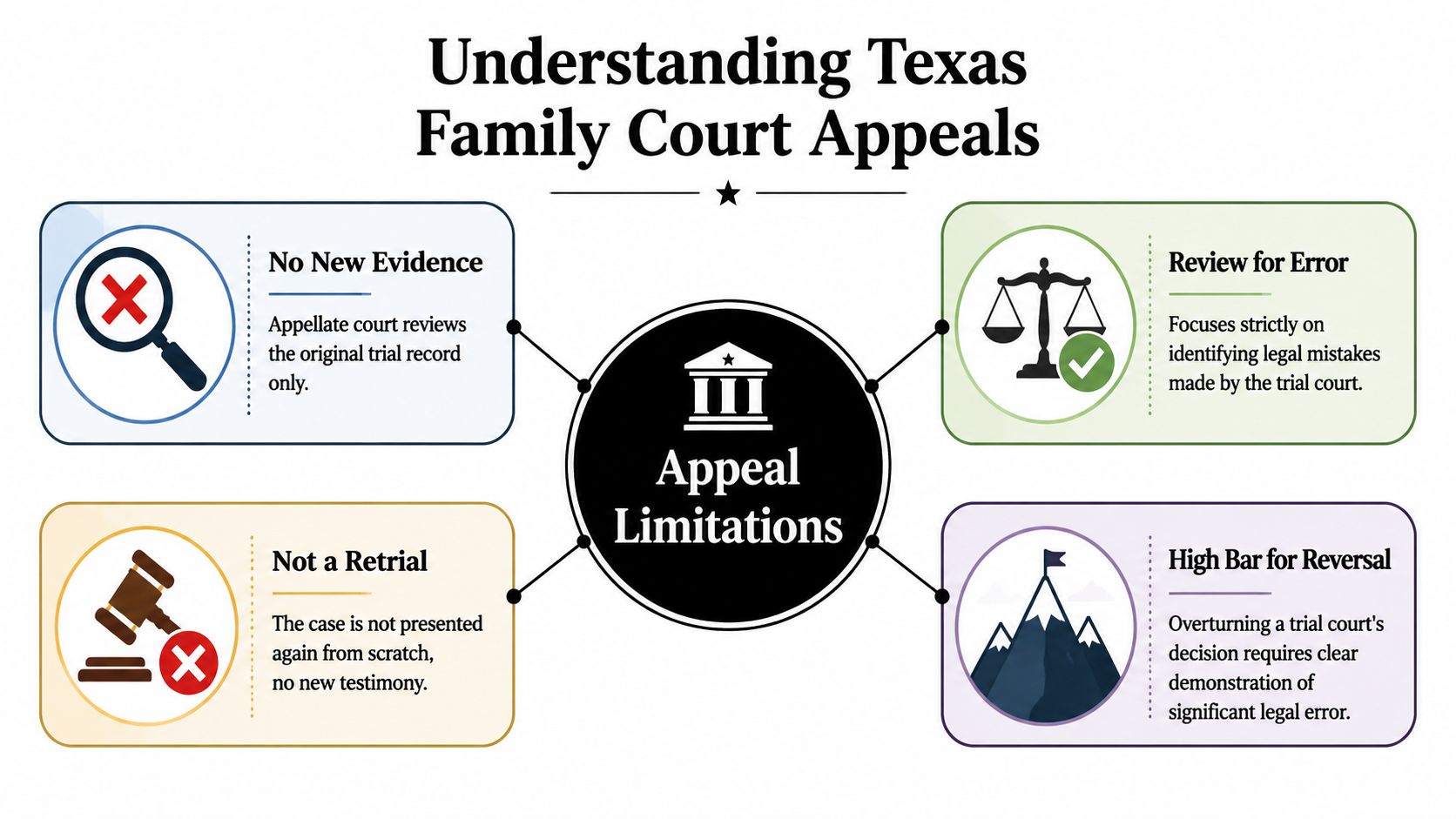
A Texas appeal is not a second trial. That is the single most important thing to understand before deciding among alternatives to appeal in Texas family court cases.
Texas legal resources explain that appellate courts review the existing record for legal error rather than rehearing the facts or taking new evidence, which is why many family-law litigants look first at trial-court remedies and other alternatives to appeal in Texas family court cases (Texas case-law guidance from the Tarlton Law Library).
What the appellate court actually reviews
The appellate court reads the record created in the trial court. That usually includes the clerk's record, the reporter's record, admitted exhibits, written motions, and the final order. The judges then decide whether the trial court made a reversible error.
Reversible error means a mistake serious enough that it likely affected the outcome or prevented a fair process. Not every mistake qualifies. Some errors are harmless. Others matter enough to justify reversal and a new hearing or a different judgment.
Plain-English terms that matter
A few appellate terms come up in almost every family case:
- Standard of review: This is the rule the appellate court uses to evaluate the trial court's decision. Some issues get closer review. Others get substantial deference.
- Abuse of discretion: In plain English, this means the trial court made a decision outside the range of reasonable choices allowed by law. Many family-law rulings are reviewed under this standard.
- Briefing: This is the written argument filed in the appellate court. Briefing doesn't retell the whole case from scratch. It identifies legal errors in the record and explains why they justify relief under the governing rules.
If your strongest argument is “the judge should have believed me instead,” an appeal may be difficult unless the record shows a legal reason the ruling can't stand.
How appeals differ from trials
At trial, witnesses testify, documents are offered, and lawyers build facts. On appeal, none of that starts over. The appellate court doesn't hear new testimony from you, your child, or your experts. It evaluates what was preserved and what the law required the trial court to do with it.
That distinction matters in family cases because custody, visitation, support, and property division often turn on fact-heavy decisions. If the complaint is really about new developments or facts that never made it into the record, a different remedy may fit better than a direct appeal.
Common examples of issues that can support appellate review include:
- Improper exclusion or admission of evidence
- Failure to provide required notice or a meaningful hearing
- Misapplication of the Texas Family Code
- Orders that exceed the relief requested
- Insufficient findings to support review in some settings
Immediate Remedies in the Trial Court
The fastest useful remedy is often still in the same courtroom where the order was signed. In Texas family cases, a post-judgment motion can be the most effective alternative when the problem is incomplete findings, an evidentiary issue, or another defect the trial court can still correct while it has plenary power (discussion of post-judgment options in Texas family appeals).

When a motion for new trial makes sense
A motion for new trial asks the trial judge to revisit what happened. That doesn't mean “please change your mind” in a general sense. It means identifying a specific legal or procedural basis for doing so.
This remedy can be useful when:
- The hearing was procedurally flawed: For example, a party didn't receive proper notice or didn't have a fair opportunity to present the case.
- The evidence issue mattered: The court excluded or admitted evidence in a way that likely affected the outcome.
- The record needs repair: A post-judgment motion may help preserve complaints, request findings, or create a clearer basis for later appellate review.
- A default or near-default situation occurred: Some unfair judgments are better attacked first in the trial court than by waiting for appeal.
A more detailed discussion appears in this guide to a motion for new trial in Texas family law.
Other post-judgment motions that may help
Not every case needs a full new-trial request. Sometimes the better move is narrower.
Consider whether the issue is one of these:
| Problem | Trial-court remedy that may fit |
|---|---|
| Order language is vague or internally inconsistent | Motion to clarify or correct |
| Findings are missing or incomplete | Request for findings or related post-judgment relief |
| Court still has authority to reconsider a discrete issue | Motion to modify, correct, or set aside within the proper window |
| Parties can resolve the dispute without full appellate litigation | Negotiated agreed order or mediation |
Case strategy matters: A focused post-judgment motion can solve a narrow problem faster than a broad appeal, especially when the real defect is in the wording of the order or the way the hearing unfolded.
What works and what doesn't
What works is precision. The motion should identify the ruling, explain why it was wrong, tie the complaint to the record, and ask for specific relief.
What usually doesn't work is filing a long, emotional motion that repeats trial themes without identifying a legal basis. Trial judges rarely grant relief because a party feels the result was unfair. They are more likely to act when the motion points to a concrete defect they can still fix.
If you're still near the judgment date, this is often the first place to look. It can preserve rights, narrow issues, and in the right case, avoid the delay and cost of an appeal altogether.
Comparing Your Strategic Options
The right remedy depends on the mismatch between your problem and the tool you choose. A traditional appeal can take time. Texas intermediate appellate courts have heavy caseloads, and one reported review noted 10,294 cases disposed, a 99% clearance rate, 9,897 opinions issued, 124 opinions per justice, and about nine months on average to resolve appeals (Texas intermediate appellate court workload and timing). In family cases, that timeline alone can make a faster remedy more practical.
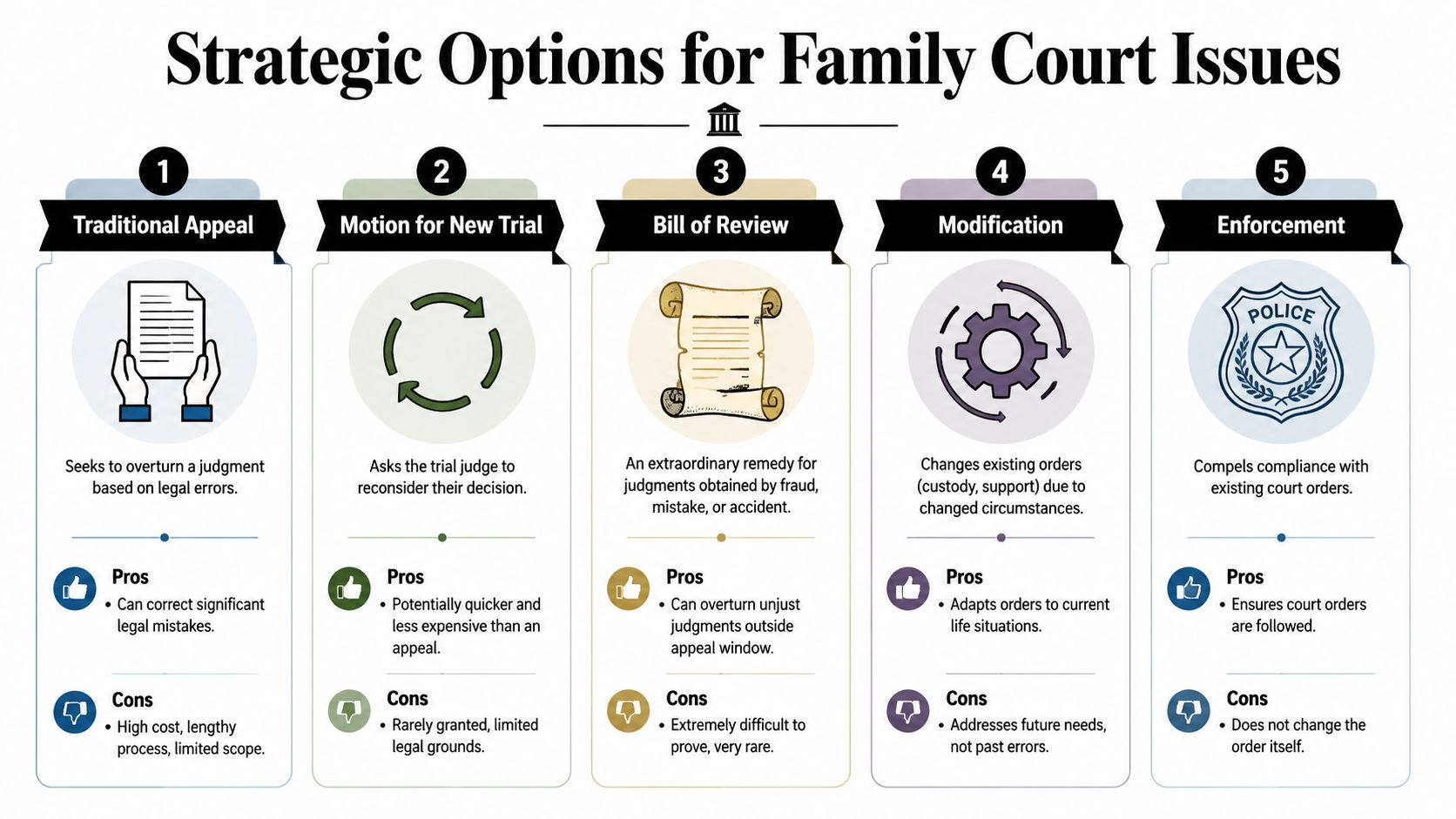
A decision framework that fits real cases
Use this kind of diagnosis when comparing alternatives to appeal in Texas family court cases:
- Choose an appeal when the central issue is a legal ruling already captured in the record.
- Choose a post-judgment motion when the judge may still correct the problem directly and quickly.
- Choose modification when circumstances changed after judgment and the old order no longer fits reality.
- Choose enforcement when the order is valid but the other side isn't following it.
- Choose negotiation or mediation when the dispute is practical and both sides may benefit from a faster reset.
Side-by-side comparison
| Option | Best for | Main limitation | Typical strategic use |
|---|---|---|---|
| Traditional appeal | Legal error in the existing record | No new evidence, no retrial | Correcting rulings on law, procedure, or preserved error |
| Motion for new trial | Immediate post-judgment defects | Must be timely and well-grounded | Asking the trial court to fix its own mistake quickly |
| Bill of review | Old judgment affected by serious injustice | Very difficult remedy | Last resort when normal deadlines are gone |
| Modification | Order became unworkable after life changed | Doesn't correct past legal error | Updating custody, possession, or support for present conditions |
| Enforcement | Violations of an existing order | Doesn't change the order itself | Forcing compliance with what the court already ordered |
A strong legal strategy isn't about choosing the most aggressive remedy. It's about choosing the remedy that matches the source of the problem.
Common family-law examples
A few examples make the distinction clearer:
- Child custody ruling after an evidentiary mistake: Appeal or post-judgment motion may fit.
- Parenting schedule that later clashes with a new work schedule: Modification is usually the better tool.
- Property division order with unclear language: A corrective motion may solve it faster than appellate briefing.
- Ex-spouse refusing to follow possession terms: Enforcement, not appeal, is the likely path.
Where clients get stuck is trying to use one remedy for every problem. Family law doesn't work that way. Different facts demand different procedures.
Extraordinary Relief Mandamus and Interlocutory Appeals
Some errors can't wait until the final decree. Texas appellate jurisdiction is technical about finality, and appellate courts usually review final judgments, with only narrow statutory exceptions for certain non-final orders. That's why a litigant may need mandamus or a limited interlocutory appeal when a major error happens mid-case (overview of Texas appellate jurisdiction in family-law matters).
When mandamus becomes necessary
A petition for writ of mandamus asks an appellate court to order a trial judge to correct a serious error when ordinary appeal isn't an adequate remedy. It isn't routine. It's reserved for situations where waiting would cause harm that can't be fixed later in a normal appeal.
Examples may include orders affecting privileged information, serious discovery abuse, refusal to perform a clear legal duty, or another ruling that distorts the case before final judgment.
If you want a fuller overview, this article on a petition for writ of mandamus in Texas family court explains the remedy in more depth.
Interlocutory appeals are narrow by design
An interlocutory appeal is an appeal from a non-final order. In family law, these are limited. You don't get one just because a temporary order feels devastating. The law has to authorize it.
That means many parties who want immediate review can't use a standard appeal at that stage. They must either proceed in the trial court, seek extraordinary relief, or wait for a final judgment and then pursue a direct appeal.
What clients often misunderstand
People often assume that any major temporary ruling can be appealed right away. Usually, it can't. The existence of harm doesn't create appellate jurisdiction by itself.
That's why timing analysis matters so much. Before filing anything, counsel has to ask:
- Is the order final or non-final?
- Does a statute authorize immediate appeal?
- Is the harm serious enough that waiting for appeal won't provide an adequate remedy?
- Would trial-court relief solve the problem faster?
These are specialized tools. Used properly, they can protect a case before the damage hardens into a final judgment. Used casually, they waste precious time.
The Bill of Review A Path to Overturn Old Judgments
Some clients don't learn the full story until long after the normal deadlines have expired. Maybe they discover hidden information. Maybe they realize they never had a fair chance to present their side. In those situations, a bill of review may become part of the conversation.
Texas self-help guidance highlights a core reality: when the appeal window is gone or the record can't address the problem, litigants may need a different post-judgment remedy, including a bill of review in appropriate circumstances (Texas Law Help discussion of appeals and remaining options).
How this remedy differs from an appeal
A bill of review is not an extension of the appeal deadline. It is a separate action asking the court to set aside an old judgment under a demanding standard.
That matters because the question is no longer, “Did the appellate court get enough in the trial record to reverse?” The question becomes whether the judgment should stand at all despite a profound defect in how it was obtained.
A realistic scenario
Take a divorce decree that divided property years ago. Later, one spouse uncovers proof that key information was concealed during the original case. An appeal won't help if the deadline has passed and the old appellate record doesn't contain the necessary proof.
A bill of review may be the procedural path worth examining in that kind of case, but only after careful analysis. It is difficult, fact-sensitive, and never something to file on instinct.
For a comparison of these remedies, see bill of review versus appeal in Texas.
Old judgments can sometimes be challenged, but courts expect a clear legal basis. Regret, delay, or a better argument discovered later usually won't be enough.
When this is worth discussing
A bill of review is usually a last-resort conversation when all or most of the following are true:
- The ordinary appeal deadline is gone
- The problem is deeper than a simple disagreement with the judge
- The original process was affected by fraud, mistake, or another serious defect
- The missing facts were not reasonably available for use in the normal process
- The injustice can't be addressed through modification or enforcement
This is one of the most misunderstood alternatives to appeal in Texas family court cases. It exists, but it isn't a shortcut. It's a narrow safety valve.
Future-Focused Solutions Modification and Enforcement
A lot of clients call after a family court ruling and say the same thing: “This order is not going to work.” That reaction matters, but the next question matters more. Is the problem that the judge made a legal error, or that life changed, or that the other side is refusing to comply?
That diagnosis usually determines the remedy.
Texas family cases often involve orders that need to function for months or years after trial. School schedules change. A parent relocates. A child's medical or educational needs become clearer. Support numbers stop matching reality. Those are usually not appellate problems. They are modification problems. By contrast, an appeal targets error in the ruling the judge signed, based on the record that already exists, not on facts that developed later, as explained in this discussion of appeal versus modification in Texas family cases.
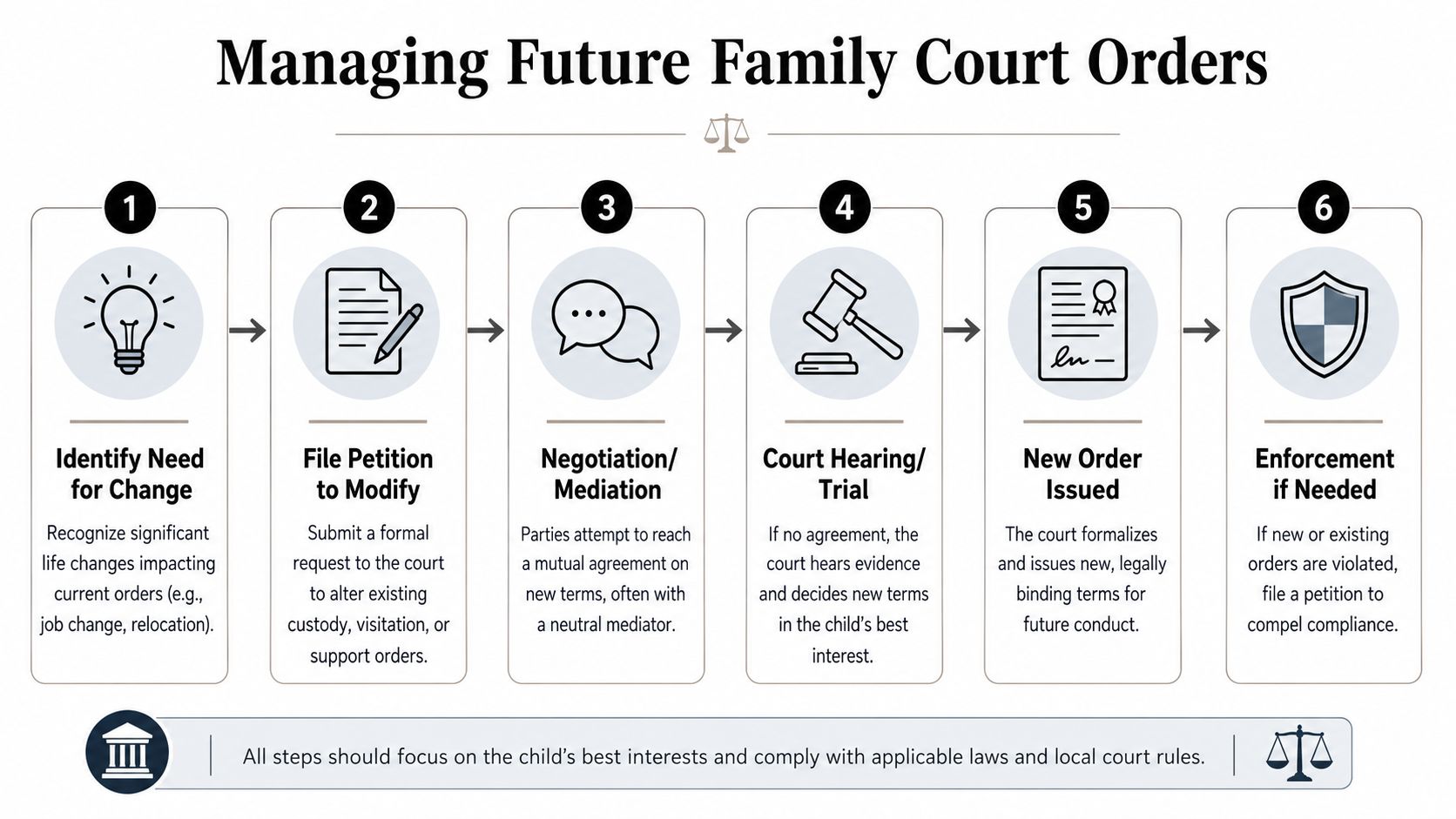
Modification solves a present-tense problem
A modification suit asks the court to replace or revise parts of an existing order because current circumstances justify a change. In practice, that often comes up in cases involving:
- Conservatorship and possession changes
- A parenting schedule that no longer fits school or work realities
- Child support that no longer reflects present facts
- A child's needs that changed after the original order
The strategic trade-off is straightforward. Modification can produce a workable order for the future, but it does not correct a past legal mistake just because the original result felt wrong. If the complaint is, “the judge misapplied the law at trial,” that points back toward appeal or a post-judgment motion. If the complaint is, “this schedule made sense then, but it is failing now,” modification is usually the better fit.
Enforcement addresses noncompliance
Some cases have a different problem entirely. The order may be valid and clear, but the other party is not following it.
That can mean denied visitation, unpaid support, failure to surrender property, or refusal to do something the order specifically requires. In those cases, the remedy is often enforcement. The court is not being asked to reconsider whether the original ruling was wise. It is being asked to require compliance and, when the law allows, impose consequences for violations.
Enforcement also depends on the wording of the existing order. If the order is too vague, enforcement may be harder than clients expect. That is one reason early case review matters.
Choosing the right next move
The best decision usually comes from matching the remedy to the problem, not from asking which option sounds strongest.
| If your problem is… | The better tool is often… |
|---|---|
| The judge made a legal mistake in the original case | Appeal or targeted post-judgment motion |
| Facts changed after the order was signed | Modification |
| The other side is ignoring the order | Enforcement |
| The order can be adjusted by agreement | Mediation or agreed order |
This framework saves time and money. A parent dealing with a possession schedule that no longer works for a child's daily life often gets more practical relief from modification than from an appellate fight over a record that does not include those later changes.
Legal help may come from appellate counsel, trial counsel, legal aid, or another lawyer who can review the order, the deadlines, and the current facts and identify which path fits.