You may feel your case was handled unfairly or that the judge’s final order simply defies the facts and the law. When a Texas family court issues a decision that feels fundamentally wrong, it is easy to feel powerless. However, the legal process does not end with the trial court’s ruling. An appeal offers a path to seek justice, but it is important to understand that it is not a second trial. It is a meticulous review of the trial record to identify significant legal errors that led to an unjust outcome.
Your Next Steps After an Unfair Ruling

After the emotional and financial strain of a trial, receiving an unfavorable ruling in your divorce, custody, or property case can be devastating. You may believe the judge overlooked critical evidence or misinterpreted Texas law. It is a frustrating position, but the Texas legal system provides a remedy for these situations: the appellate process.
It is critical to recognize that an appeal operates under a completely different set of rules than a trial. The trial court’s function was to hear evidence, listen to witness testimony, and determine the facts. An appellate court’s role is entirely different.
An appellate court does not hear new testimony or consider new evidence. Its sole purpose is to review the existing record from your trial to determine if the judge made a significant legal error that likely caused an improper judgment.
The focus of an appeal is not on retelling your story. Instead, the goal is to demonstrate precisely how the trial judge failed to follow the law, resulting in an unfair outcome. To understand this crucial shift, it helps to compare the two proceedings.
Key Differences Between a Trial and an Appeal
| Aspect | Trial Court | Appellate Court |
|---|---|---|
| Purpose | To hear evidence and determine the facts of the case. | To review the trial record for legal or procedural errors. |
| Evidence | Introduces new evidence, witness testimony, and exhibits. | Does not accept new evidence. Relies solely on the existing record. |
| Key Player | The trial judge (and sometimes a jury) makes the decisions. | A panel of appellate justices reviews the case. |
| Focus | “What happened?” | “Did the trial court apply the law correctly?” |
Understanding these distinctions is the first step toward building a sound appellate strategy.
Is Your Court Order Final and Appealable?
Before an appeal can begin, the order you wish to challenge must be final. This is a strict jurisdictional requirement under Texas law.
A final order is one that resolves all issues between all parties. For instance, a Final Decree of Divorce that settles child custody, divides all marital property, and establishes child support is a final, appealable order. In contrast, temporary orders issued while a case is ongoing—such as interim parenting schedules or temporary support—are generally not appealable. Our first task as experienced family law appeal attorneys is to analyze the court’s order to confirm it is final and to begin identifying potential grounds for an appeal.
The Critical Importance of Deadlines
The appellate process is governed by strict, unforgiving deadlines. Under the Texas Rules of Appellate Procedure, you generally have only 30 days from the date the final judgment is signed to file your Notice of Appeal. If you miss this deadline, your right to appeal is permanently lost.
This tight timeframe requires immediate action. The moment an unjust ruling is issued, the clock begins to tick. Your first step should be to seek a professional evaluation of your case to determine if a valid basis for an appeal exists. This involves a thorough review of the trial record to identify potential errors and assess the likelihood of a successful outcome.
Pinpointing the Reversible Error That Unlocks Your Appeal
An appeal is not an opportunity for a second chance to argue your case and hope for a more sympathetic judge. The success of your appeal depends entirely on proving that the trial judge made a specific, significant legal mistake. This is known as a reversible error, and identifying one is the key to a successful appeal.
The appellate justices will not rehear testimony or re-evaluate witness credibility. Their review is confined to the official record—the transcripts and evidence from your trial—to determine if the judge made a mistake that mattered. Our mission is to meticulously examine that record to find a clear legal or procedural error. It is not about disagreeing with the judge’s decision; it is about proving the process used to reach that decision was legally flawed.
What Does “Abuse of Discretion” Actually Mean?
In most Texas family law appeals, the primary legal standard is proving the trial court committed an abuse of discretion. This means we must demonstrate that the judge’s decision was arbitrary, unreasonable, or made without reference to any guiding legal principles.
A judge has a certain amount of latitude, often called a “zone of reasonable disagreement.” An abuse of discretion occurs when a ruling falls so far outside that zone that it cannot be justified by the facts or the law. It is not enough to show that another judge might have ruled differently. We must prove that this judge’s decision was legally indefensible. For example, if the court ignores a valid prenuptial agreement when dividing assets in a divorce case, that is a failure to apply the correct legal standard and a potential abuse of discretion.
Plain English Definition: An abuse of discretion occurs when a judge makes a decision that is so arbitrary or unreasonable that it is not based on the facts or the law.
Common Reversible Errors in Texas Family Courts
So, what do these critical errors look like? They are often technical legal mistakes that have a profound impact on your life. Identifying these errors is the foundation of appealing a family court decision.
Here are a few common examples of reversible error:
- Property Mischaracterization: The court incorrectly classifies separate property—such as an inheritance or a gift received during the marriage—as community property and divides it between the spouses. This is a common basis for a property division appeal.
- Improper Exclusion of Evidence: The judge refuses to admit critical evidence, such as a key financial document, an important email, or expert testimony, that could have changed the outcome of the case.
- Decisions Based on Insufficient Evidence: The court makes a significant ruling without adequate factual support. For instance, a judge might severely restrict a parent’s access to their child without any credible evidence of risk. Such a decision is vulnerable to a child custody appeal.
- Misapplication of the Texas Family Code: The judge makes a mistake in applying the law, such as miscalculating child support, misinterpreting the requirements for spousal maintenance, or failing to consider a legally mandated factor in a custody decision.
These are the types of legal mistakes that appellate courts are designed to correct. The stakes are often highest in cases involving children. Appealing a child custody order is common because so much is on the line. National data shows that nearly 10% of all custody and visitation disputes require long, drawn-out legal battles, which tells you how much is on the line. This complexity is often tied to finances, with studies revealing that only 46% of custodial parents actually get the full amount of court-ordered child support. You can read more about these family law statistics at growlaw.co. When a judge’s error threatens your relationship with your child or your financial stability, finding that reversible error is your first and most critical step toward making things right.
Navigating the Texas Appellate Procedure
Appealing a family court decision follows a highly structured path governed by the Texas Rules of Appellate Procedure. Understanding this process can transform a stressful experience into a series of clear, strategic steps. This journey demands precision from the outset, as the foundation for a successful appeal is built within the trial court proceedings.
Preserving Error: The First, Most Critical Step
Before an appellate court can review a potential error, you must show that the mistake was brought to the trial judge’s attention at the time it occurred. This is called preserving error. It is the trial attorney’s duty to make a timely and specific objection on the record when an improper ruling is made, such as allowing inadmissible testimony or excluding crucial evidence.
If no objection is made, the appellate court will almost certainly conclude that you have waived your right to complain about the error on appeal. A meticulously preserved trial record is the essential foundation of every successful appeal.
Kicking Off the Appeal: The Notice and the Record
Once it is determined that an appeal is the right course of action, the first official step is filing a Notice of Appeal. This must be done within a strict deadline, typically 30 days after the final judgment is signed. This document formally notifies the court and the opposing party that you are challenging the ruling and initiates the appellate process.
Next, we assemble the official trial court record. This involves gathering all the materials the appellate court is permitted to review. The record consists of two parts:
- The Clerk’s Record: This includes all documents filed in the case, such as petitions, motions, and the final judgment.
- The Reporter’s Record: This is the complete, word-for-word transcript of all courtroom proceedings, including testimony, arguments, and the judge’s rulings.
These two components are the entire universe of information the appellate court will consider. Their decision will be based solely on what is contained within this official record.
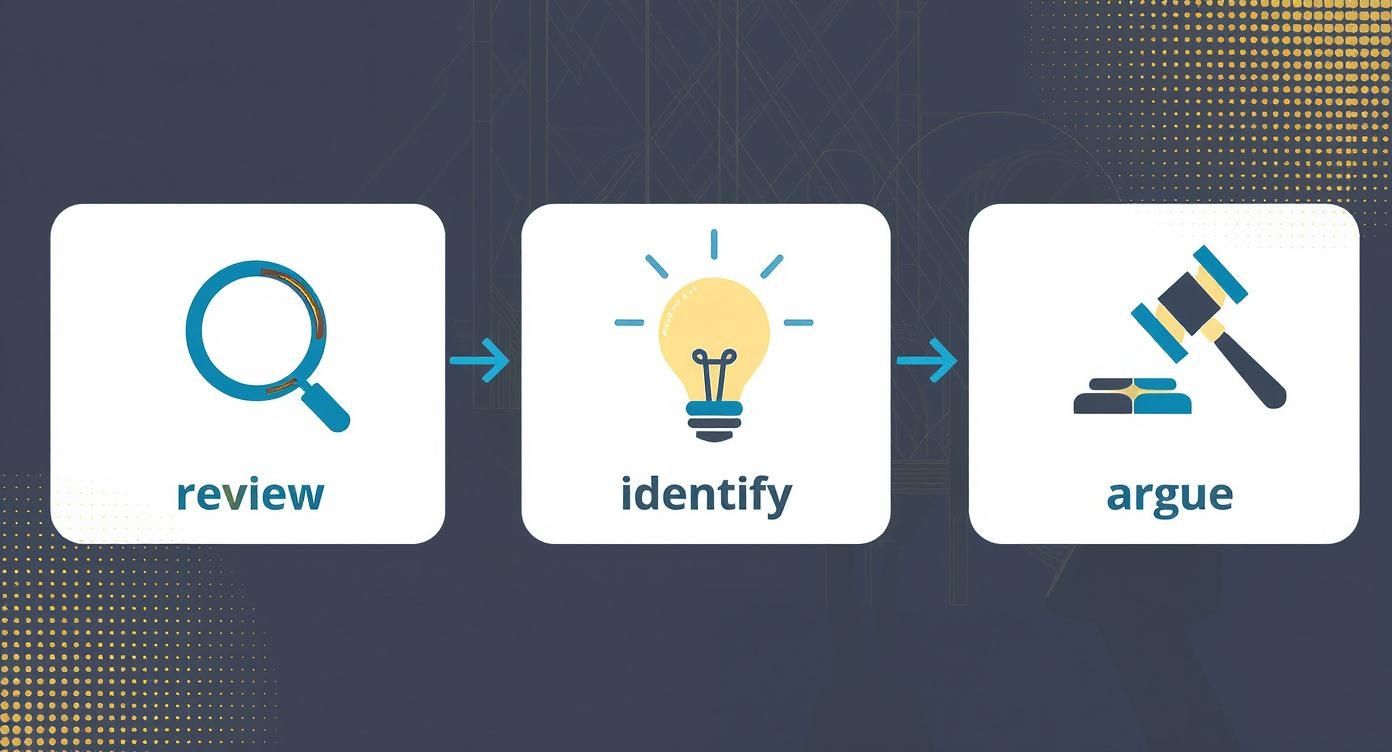
This systematic review ensures every argument we make is tied directly to the evidence and testimony in the official record—the only things that matter to the court of appeals.
The Heart of the Matter: The Briefing Stage
With the record assembled, the process of legal persuasion begins. This is the briefing stage, where we craft a detailed, powerful written argument explaining precisely how the trial court erred. We meticulously connect the facts from the record to controlling statutes and legal precedent.
Plain English Definition: Briefing is the process of writing and submitting formal legal arguments to the appellate court. These documents, known as briefs, explain why the trial court’s decision should be overturned or upheld.
Briefing is a structured exchange:
- The Appellant’s Brief: As the party bringing the appeal (the “appellant”), we file the first brief. This document presents the case, identifies the judge’s errors, and provides a compelling legal argument for why the decision must be reversed.
- The Appellee’s Brief: The other party (the “appellee”) then files a responsive brief, arguing that the trial court’s decision was correct and should be affirmed.
- The Reply Brief: We often have the opportunity to file a final Reply Brief to address the appellee’s arguments and reinforce our position.
A well-written appellate brief does more than just state facts and cite law. It crafts a persuasive narrative, guiding the appellate justices through the record to highlight the critical errors and demonstrate how those errors led to an unjust result. Crafting these documents is a specialized skill that combines deep legal knowledge with compelling advocacy. Looking at a sample legal brief format can help you appreciate how these powerful documents are put together. The quality of the written brief is often the single most decisive factor in winning an appeal.
Managing Expectations for the Appeal Timeline
One of the most challenging aspects of appealing a family court decision is the timeline. The process is not fast. An appeal is a methodical, deliberate journey that requires patience and a strategic mindset. The reality is that Texas appellate courts handle a heavy caseload, and the process is designed to be thorough, not swift.
From the filing of the Notice of Appeal, a series of procedural deadlines unfolds, mapping out a timeline that can range from several months to more than a year. The duration depends on the complexity of the legal issues and the court’s own docket.
Navigating the Waiting Period
The waiting period can be particularly difficult in cases involving children. When an unjust custody order is in effect, every day feels significant. It is natural to worry about the impact of the order on your children and your relationship with them while the appeal is pending.
Depending on the specific circumstances of your case, we can explore options for seeking temporary relief to provide stability for your family during the appeal. This is not always possible, but it is a strategic consideration we evaluate to mitigate the harm of an incorrect ruling. Understanding how long a Texas divorce can take provides context for why the subsequent appeal also requires a marathon perspective.
An appeal is a marathon, not a sprint. Preparing for this reality from the outset allows us to build a calm, confident, and strategic case without the added pressure of unrealistic time expectations. Our focus is on getting it right, not just getting it done quickly.
Court Delays and Systemic Pressures
It’s also crucial to understand that many delays are simply built into the system. Court backlogs are a reality in Texas and around the world, and they directly impact your timeline.
For a bit of perspective, other legal systems are trying new things to fix this. A pilot program in the UK, for instance, started requiring a detailed ‘Child Impact Report’ before the very first hearing. This simple change led to better initial decisions and slashed the average case time from 29 weeks to just 18 weeks in one area.
While Texas has its own procedures, this example shows how systemic issues—things completely outside of our control—can affect how long your case takes. Our job is to navigate this system with absolute precision, hitting every deadline and pushing your case forward as efficiently as the court’s framework allows. We’ll give you a realistic picture so you’re prepared for the journey ahead, knowing that steady, methodical progress is the most reliable path to a just result.
What a “Win” Actually Looks Like in a Family Law Appeal

After the briefs have been filed and arguments made, the court of appeals will issue its opinion. A victory in a family law appeal rarely means the appellate court simply rewrites the order to grant your original requests. The outcome is more nuanced and typically falls into one of three categories. Understanding these possibilities is essential for setting realistic expectations.
Affirming the Trial Court’s Judgment
The most straightforward outcome is that the appellate court affirms the trial court’s decision. This means the justices reviewed the record and concluded that no reversible error occurred—that is, no legal mistake was serious enough to justify overturning the original order. If a judgment is affirmed, the trial court’s order remains in effect. The only further recourse is to petition the Texas Supreme Court for review, a step with a very high threshold for acceptance.
Reversing and Remanding for a New Hearing
A reverse and remand is the most common form of a “win” in a family law appeal. This means the appellate court found a significant legal error in the trial judge’s decision and has effectively hit the reset button on that part of the case.
The appellate court does not issue a new order itself. Instead, it “remands” (sends) the case back to the trial court with specific instructions on how to correct the error. This often results in a new hearing on the specific issue that was appealed.
Consider these examples:
- In a property division appeal where the court improperly characterized your separate inheritance as community property, a remand would send the case back with instructions to re-divide the estate correctly.
- In a child custody case where the judge wrongly prevented you from presenting evidence, the case could be remanded for a new custody hearing where that evidence must be considered.
A remand is your second chance at a fair hearing. It sends the issue back to the trial judge, who is now bound by the higher court’s legal guidance.
Reversing and Rendering a New Judgment
A reverse and render is the rarest and most decisive outcome. This occurs when the appellate court not only identifies a reversible error but also determines that the correct legal outcome is so clear from the existing record that another hearing is unnecessary. The appellate court simply steps in and renders the judgment the trial court should have entered. For example, if a judge miscalculated child support based on undisputed financial data in the record, the appellate court might reverse the incorrect amount and render a new judgment with the proper calculation.
If you believe the court made a mistake in your family law case, our appellate attorneys can help you seek a fair outcome. Contact The Law Office of Bryan Fagan today for a free consultation.
Appealing Protective Orders and Domestic Violence Cases
Appeals involving protective orders are among the most critical and sensitive cases we handle. Whether a protective order in Harris County, Texas was wrongly issued against you or unfairly denied when you needed protection, the court’s decision has immediate consequences for safety, liberty, and parental rights.
A protective order can impose severe restrictions, including being removed from your home, losing the right to possess a firearm, and altering your relationship with your children. When appealing the imposition of a protective order, our focus is often on the lack of sufficient evidence in the record. If a judge issues an order based on mere allegations without corroborating proof of family violence, it may constitute an abuse of discretion.
Grounds for Appealing a Protective Order
Conversely, if a court denies a needed protective order despite clear evidence of abuse, an appeal can be a vital step toward securing safety. Such appeals often demonstrate that the trial court misunderstood the legal definition of “family violence” under the Texas Family Code.
Common grounds for appeal in these cases include:
- Insufficient Evidence: The record does not contain legally sufficient evidence to support the court’s finding (or lack of a finding) of family violence.
- Procedural Errors: The court failed to follow proper legal procedures, violating a party’s due process rights.
- Misapplication of Law: The judge misinterpreted or incorrectly applied the legal standards required for granting or denying a protective order.
A meticulous, line-by-line review of the trial transcript is where we start. Our job is to prove to the appellate court that the trial judge’s decision was not just wrong, but unsupported by the facts and the law, leading to an unjust outcome that puts a client’s well-being at risk.
The high volume of these cases highlights the importance of appellate review. While specific to the UK, recent data showed a staggering 8,022 domestic violence remedy applications were filed in just a single quarter. This figure highlights the immense pressure courts are under and why the appeals process is a vital backstop when they get it wrong. You can see these family court statistics on GOV.UK. Whether you are challenging an improper order or the denial of necessary protection, the appellate process is your opportunity to seek a just result.
Answering Your Questions About Texas Family Law Appeals
If you are considering appealing a family court decision, you likely have many questions. It is a complex process, and we find that clients often share similar concerns.
How Much Will an Appeal Cost?
The cost of an appeal depends on the complexity of your case and the length of the trial record. A longer trial results in a larger transcript, which increases costs. The primary expenses include:
- Court Filing Fees: Standard administrative costs.
- The Official Record: The cost of preparing the official clerk’s and reporter’s records, which can be significant.
- Attorney’s Fees: This is typically the largest component, reflecting the specialized legal research and persuasive writing required to craft a compelling appellate brief.
We provide a transparent and realistic cost estimate during our initial consultation.
Can I Bring in New Evidence on Appeal?
The answer is unequivocally no. An appeal is a review of the trial court proceedings, not a new trial. The appellate court is strictly limited to the evidence, testimony, and documents contained within the original trial record. This is why it is essential to present all your evidence at the trial level. If it was not part of the original record, the appellate court cannot consider it.
What’s the Timeline for a Texas Appeal?
Patience is essential. A Texas family law appeal is a lengthy process, often taking from several months to over a year to complete. The timeline is influenced by the complexity of the legal issues, the appellate court’s caseload, and mandatory procedural deadlines. For instance, in a custody appeal, we might have to go back and carefully analyze the court’s original reasoning on every point, from financial support down to the fine print of the possession order, which sometimes involves foundational documents like understanding what a joint custody agreement entails.
If you believe the court made a mistake in your family law case, our appellate attorneys can help you seek a fair outcome. Contact The Law Office of Bryan Fagan today for a free consultation.