Skip to content
When a business is part of your divorce, the court must assign it a value to ensure a fair property division. This process, known as business valuation, is often the most complex and contentious part of a divorce. Under the Texas Family Code, the final division of your community estate must be "just and right," making an accurate business valuation essential.
You may feel your case was handled unfairly. If you believe the trial court made a significant error in valuing your business, leading to an unjust outcome, you are not without options. The Texas appeals process is specifically designed to correct these kinds of mistakes and restore fairness.
Understanding What You Can Appeal in a Business Valuation Case

It is deeply frustrating to go through a difficult trial only to be left with a result that feels fundamentally wrong because the court misjudged your business's value. This guide will explain how to challenge that decision and how the appellate process can provide a path to justice.
Determining the value of a business is a critical piece of the property division puzzle. The final number has a massive ripple effect on your financial future, influencing everything from the allocation of assets to potential spousal maintenance. When that number is wrong, the entire divorce decree is thrown into question.
How an Appeal Differs from a Trial
It is essential to understand that an appeal is not a second trial. You do not present new evidence or call new witnesses. Instead, a panel of appellate judges meticulously reviews the existing trial record—every document, every exhibit, and every word of testimony—to determine if the trial judge made a serious legal mistake.
The Texas appellate system exists to correct errors that lead to unjust results. Our goal is to help you understand:
- How to identify potential valuation errors in the trial record.
- What is required to build a persuasive legal argument for the court of appeals.
- How an experienced appellate attorney navigates this process to fight for a fair and just outcome.
You have the right to challenge a decision that is legally flawed. The first step is to determine if the trial court committed a reversible error—a mistake so significant that it likely caused an improper judgment. This could range from applying the wrong valuation method to ignoring credible expert testimony, or making a decision that constitutes an "abuse of discretion."
Plain-English Definition: "Abuse of Discretion"
This legal term means a trial judge made a decision that was arbitrary, unreasonable, or without reference to any guiding legal rules or principles. In a business valuation case, this might occur if a judge chooses a valuation method that has no logical basis in the evidence presented at trial.
How Texas Courts Value a Business in a Divorce

To identify a legal error, you must first understand how Texas courts approach the complex task of business valuation. In a divorce, a business interest created or grown during the marriage is typically considered community property. The Texas Family Code requires a "just and right" division of this property, which is impossible without a reliable and accurate valuation.
Courts rely on evidence and expert testimony to determine a business's worth. Financial experts generally use one of three standard methods. Understanding these approaches is the first step in identifying where a judge may have made a critical mistake.
The Income Approach
The income approach is frequently used for businesses with a consistent history of profitability, such as professional practices or service firms. This method values a company based on its ability to generate future income. An expert analyzes historical earnings and cash flow to project future profits. To understand how Texas courts value a business, it is helpful to be familiar with the fundamental financial formulas such as Net Present Value (NPV) that underpin these calculations.
In divorce cases, this approach is common because it focuses on the business's earning capacity. Experts will review tax returns and financial statements, often adjusting them to separate personal expenses from true business costs—a critical step in determining an accurate value.
The Market Approach
The market approach operates similarly to a real estate appraisal. It determines a business's value by examining recent sales of comparable businesses. This method is effective when there is sufficient data on similar transactions. For example, if several local accounting firms with similar revenue have recently been sold, those sale prices can serve as a strong benchmark. However, for unique or highly specialized businesses, finding truly "comparable" sales can be difficult, creating a potential area for reversible error if the comparisons are flawed.
The Asset Approach
The asset-based approach is more direct. It calculates the business's value by summing the fair market value of its assets and subtracting its liabilities. This is often called the "liquidation value," as it answers the question: "What would be left if we closed the business and sold everything today?" This method is best for asset-heavy businesses, like manufacturing companies or real estate holdings. A detailed appraisal for divorce is crucial to ensure every asset is valued correctly.
A common judicial error is applying the wrong valuation method. For example, using the asset approach for a service-based business, whose value lies in its future earning potential rather than physical assets, is a mismatch that can lead to a flawed and appealable outcome.
Ultimately, the trial judge must weigh the evidence from all experts. While the court is not required to accept any single opinion, its final decision must be supported by the testimony and evidence in the record. If a judge ignores credible evidence or selects a value with no basis in the facts, it may be an abuse of discretion and strong grounds for an appeal.
Spotting Reversible Errors in Your Valuation Case
After a long and costly trial, you may feel certain the judge got the value of your business completely wrong. For an appeal to be successful, however, that feeling is not enough. You must identify a specific reversible error—a mistake of law or procedure by the trial court that likely led to an unfair property division.
An appeal is not a second chance to argue the facts. The appellate court acts as a reviewer, examining the trial record to ensure the judge followed the correct legal rules. In a complex business valuation, there are many opportunities for error.
Understanding the "Abuse of Discretion" Standard of Review
One of the most common grounds for appeal in Texas family law is abuse of discretion. This standard of review addresses whether the trial court acted without reference to guiding legal principles. It does not imply the judge acted with ill intent; rather, it means the ruling was arbitrary or unreasonable based on the law and the evidence.
For example, imagine two experts testify about the value of your local service business. Your expert uses a detailed income approach based on solid financial projections. The opposing expert uses a market approach comparing your business to a national franchise—an illogical comparison. If the judge, without a valid reason, adopts the flawed valuation over the sound one, that is a classic example of an abuse of discretion.
Common Reversible Errors in Valuation Rulings
When we handle an appeal, we meticulously examine the entire trial record—transcripts, exhibits, and the final decree—to find specific flaws. A single error can undermine the "just and right" division of your marital estate.
Here are some of the most frequent reversible errors we encounter:
- Using the Wrong Valuation Date: In Texas, a business should generally be valued as of the date of divorce, not the date of separation. If a business's value changed significantly during the divorce, using an incorrect date can lead to a wildly inaccurate result.
- Applying an Improper Valuation Method: A judge who insists on an asset-based valuation for a service firm with few physical assets has misunderstood the nature of the business's value, which is a clear error.
- Ignoring Key Evidence or Creating a Value from Thin Air: A judge’s decision must be based on the evidence. If an expert provides a well-supported valuation and the judge disregards it in favor of a number with no factual basis, this is a legal problem. A judge cannot simply "split the difference" between two expert opinions without evidence to support that middle ground.
Two Common Pitfalls: Goodwill and Separate Property
Two areas are particularly prone to reversible errors in business valuations: goodwill and separate property.
First, Texas law distinguishes between personal goodwill and enterprise goodwill. Personal goodwill is the value tied to an individual's reputation and skills (e.g., a renowned surgeon). Enterprise goodwill is attached to the business itself. Personal goodwill is not a marital asset and cannot be divided. If a court includes your personal reputation in the business's community value, it has committed a major legal error.
Second, the court must correctly account for separate property. If you invested pre-marital funds or an inheritance into the business, that contribution and its growth should remain your separate property. A court that fails to properly trace these funds and exclude them from the community estate has made a clear error, making the decision vulnerable on appeal. This is where forensic accounting principles are essential to untangle complex finances.
An appeal is a technical legal argument focused on errors of law, not a re-argument of facts. The appellate court asks: did the trial judge follow the law and base the decision on the evidence?
Mistakes in these areas can have a profound financial impact. The table below highlights common errors that can be overturned on appeal.
Common Mistakes in Business Valuation Rulings
This table outlines frequent errors a trial court might make during a business valuation and explains why each one could be a basis for a successful appeal.
| Potential Trial Court Error | Why It May Be a Reversible Error |
|---|---|
| Confusing Personal vs. Enterprise Goodwill | The court improperly divided personal goodwill, which is not a marital asset under Texas law, leading to an inflated community estate. |
| Failure to Trace Separate Property | The judge incorrectly included separate property contributions (like an inheritance invested in the business) in the community property to be divided. |
| Adopting a Flawed Expert Opinion | The court relied on an expert whose methodology was unreliable, based on inaccurate data, or failed to comply with professional standards. |
| Ignoring a Buy-Sell Agreement | The judge disregarded a valid shareholder or partnership agreement that specified a formula for valuing business interests, without a proper legal basis. |
If these errors resonate with your experience, do not lose hope. The path to correcting a flawed ruling begins with a thorough review of your case by an attorney who specializes in the appellate process.
Navigating the Texas Appellate Process Step by Step
You have received the final divorce decree, and you are convinced the court made a mistake in the business valuation. What happens next? The Texas appellate process provides a structured, methodical path to seek justice, but it is a fundamentally different process than a trial.
Your case does not start over. Instead, a panel of appellate judges reviews what has already happened to search for a reversible error—a legal mistake so significant that it likely caused an unjust outcome.
Step 1: Filing the Notice of Appeal
Your appellate journey begins with a critical, time-sensitive document: the Notice of Appeal. This filing officially informs the trial court and the opposing party that you are challenging the final judgment.
Timelines are strict. Under the Texas Rules of Appellate Procedure, you generally have only 30 days from the date the judge signs the final judgment to file this notice. Missing this deadline can permanently close the door to an appeal. This is why it is vital to contact an appellate attorney immediately after receiving an unfavorable ruling.
Step 2: Preparing the Appellate Record
The foundation of every appeal is the appellate record. This is the official compilation of all documents and testimony from your trial that the appellate judges will review.
The record consists of two main parts:
- The Clerk’s Record: This includes every document filed in your case, such as the original petition, motions, discovery responses, and the final decree.
- The Reporter’s Record: This is the word-for-word transcript of all court proceedings, including the testimony of all witnesses, especially the financial experts.
Your appellate lawyer will meticulously examine this record to find the trial court's missteps. Was an expert's testimony misinterpreted? Were key financial documents ignored? Did the judge apply the wrong legal standard? The answers are in the record. You can learn more about how to appeal a family court decision in Texas.
Step 3: The Briefing Stage
Once the record is prepared, the core of the appeal begins: briefing. An appellate brief is a detailed, persuasive written argument that explains to the appellate court exactly what the trial judge did wrong, why it was a legal error, and why that error requires the decision to be reversed.
Plain-English Definition: "Briefing"
Briefing is the formal process where each side submits their written legal arguments to the court of appeals. Your attorney files an appellant's brief outlining the errors, the other side files a brief in response, and your attorney may file a final reply brief. This is where the legal case for overturning the valuation is constructed.
A compelling brief must:
- Clearly identify the legal errors made by the trial judge.
- Support every argument with citations to Texas law and relevant case precedent.
- Draw a direct line from the judge’s error to the unjust outcome in your case.
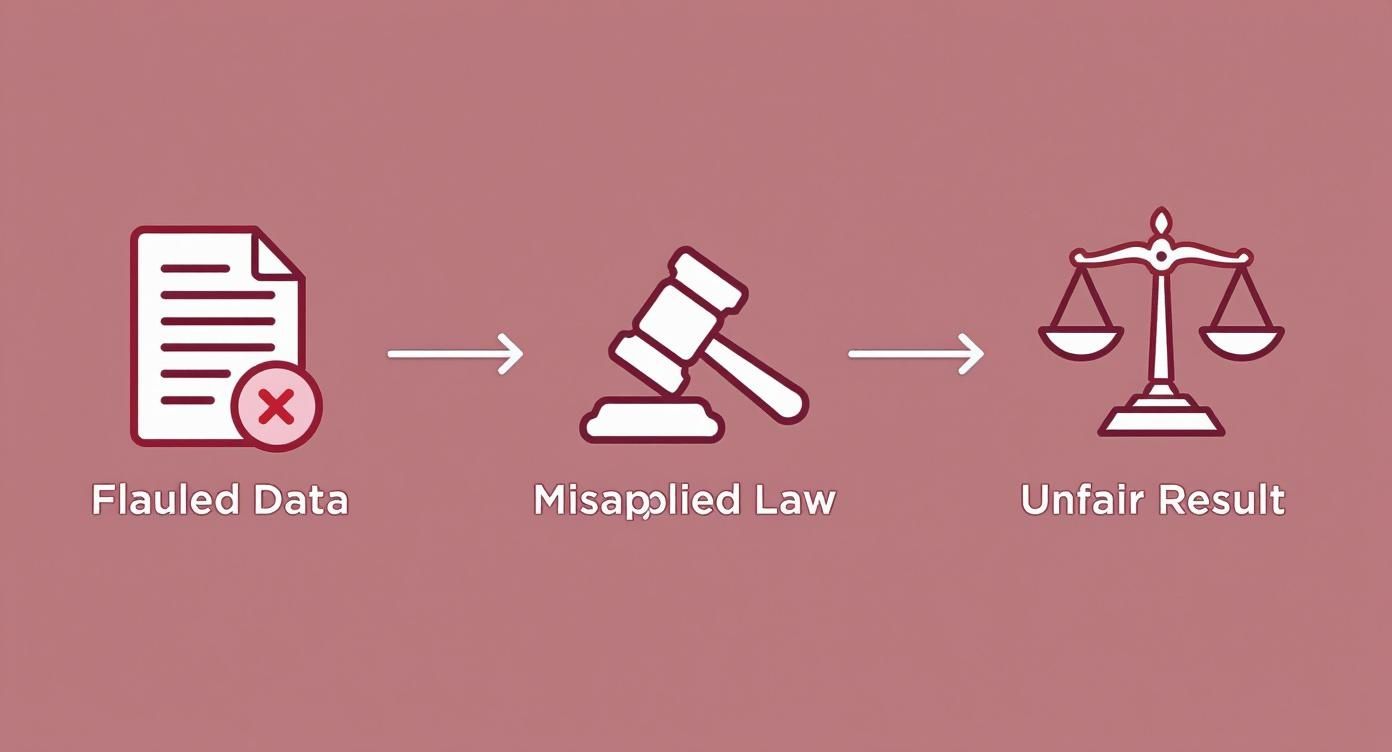
This flow illustrates the essence of an appellate argument: demonstrating the direct connection between a trial court error and the unfair property division you now face. After the briefs are filed, the court may schedule an oral argument. Finally, the appellate court will issue a written opinion that can affirm the trial court's decision, reverse it, or send the case back to the trial court for further proceedings.
How Your Expert's Testimony Is Analyzed on Appeal

When challenging a business valuation on appeal, the financial expert testimony from your trial takes center stage. No new testimony is allowed. Instead, the Texas appellate court places that original testimony under a legal microscope.
Your appellate attorney’s role is to guide the judges through the trial record, highlighting how the trial court misunderstood, improperly dismissed, or incorrectly relied on flawed financial evidence. The argument is designed to prove the judge committed an abuse of discretion.
The Expert's Credibility and Methodology
Success on appeal requires more than just showing your expert was right. It requires demonstrating that your expert's valuation was so well-supported and credible that the trial judge had no reasonable basis to disregard it.
The appellate court will examine several key questions:
- Was the expert's methodology sound? Did they use a recognized approach (income, market, or asset) appropriate for the specific business?
- Was the underlying data reliable? A valuation is only as good as its data. We focus on showing how your expert's analysis was based on thorough, accurate financials, especially in contrast to the other side's.
- Did the court accept a flawed analysis? Reversible error often occurs when a judge adopts an opposing expert's opinion based on speculation or illogical comparisons while ignoring a well-reasoned valuation.
Your appellate lawyer connects these dots for the court, drawing a clear line from your expert’s credible testimony to the hard evidence and showing precisely where the trial court’s decision deviated from the law and facts.
The Impact of Economic Conditions
A business's value is not static; it is influenced by external economic forces. If a trial court failed to properly consider these factors, it can be a powerful argument on appeal. For instance, significant market shifts can dramatically alter a company's worth, making the chosen valuation date absolutely critical. If your expert presented a compelling case showing how economic trends impacted your business's value—and the trial judge ignored it—that could constitute the reversible error needed to win your appeal.
An appellate court must be convinced that the trial judge’s decision was not just a different judgment call, but a legally unsupportable conclusion. The goal is to show the final number was arbitrary and not grounded in the facts presented at trial.
Your expert’s testimony is the evidence. Your appellate attorney’s job is to frame that evidence within the language of the law, building a persuasive case that the trial court’s decision was an abuse of discretion that led directly to an unjust property division.
Why You Need a Specialist for Your Appeal
Receiving an unjust divorce ruling involving a complex business is a difficult experience. You may feel that justice was not served. It is important to know that the legal skills required to win a trial are very different from those needed to succeed on appeal.
An appeal is not a second chance to tell your story. It is a highly technical, research-intensive process where success depends on having an attorney with a different strategic focus. The objective shifts from persuading one judge with live testimony to convincing a panel of appellate judges through a meticulously crafted written argument. An appellate specialist excels in this environment, focusing on deep legal research, identifying specific reversible errors in the record, and weaving them into a powerful legal narrative.
A Fresh and Strategic Perspective
A dedicated appellate attorney brings the crucial advantage of a fresh perspective. Unburdened by the history of the trial, their practice is built around spotting the subtle yet critical legal mistakes that trial lawyers and judges can overlook. They analyze the record to find exactly where the law was misapplied.
This specialized focus is invaluable. A skilled family law appeal attorney understands how to prove that a trial court's decision was an "abuse of discretion" and can draw a straight line from that legal error to the unfair financial outcome you face.
An appeal is your only chance to show a higher court that the trial court’s decision was legally flawed and must be corrected to ensure justice is done.
The unique combination of procedural mastery, persuasive brief writing, and sharp oral argument is what it takes to restore a fair result. An appellate lawyer’s role is to transform a complex financial dispute into a clear legal argument for why the original decision cannot stand.
Got Questions About Appealing a Valuation?
When you are facing a business valuation in your divorce decree that feels fundamentally wrong, it is natural to have questions about what comes next. The appellate path can seem intimidating, but understanding the process is the first step toward seeking a fair outcome.
How Long Do I Have to Appeal the Court's Ruling?
Time is of the essence. In Texas, the deadline to begin an appeal is extremely short. You generally have only 30 days from the date the judge signs the final divorce decree to file a Notice of Appeal. If you miss this deadline, your right to challenge the valuation may be lost forever. It is critical to contact an appellate attorney immediately if you believe a serious error occurred in your case.
Can We Bring in New Evidence During the Appeal?
This is a common misconception. An appeal is a review of the trial, not a new one. The appellate court is limited to reviewing the appellate record—which includes all documents, expert reports, and testimony presented at the original trial. The purpose is not to introduce new facts but to demonstrate that the trial court made a legal mistake based on the evidence it had before it.
What Does It Take to Overturn a Property Division Decision?
Overturning a trial court’s decision is challenging. In Texas, the standard of review for property division appeals is abuse of discretion. This means you must prove more than simple disagreement with the judge's conclusion. To win, you must show that the judge's decision was arbitrary, unreasonable, or made without reference to guiding legal rules. For example, proving the court used a valuation method that was legally inappropriate for your type of business could demonstrate an abuse of discretion. It is about showing a fatal flaw in the legal process, not just dissatisfaction with the result.
If you believe the court made a mistake in your family law case, our appellate attorneys can help you seek a fair outcome. Contact The Law Office of Bryan Fagan today for a free consultation.