Skip to content
When an emergency custody order is issued, it can feel as if your world has been turned upside down, especially if you believe the decision was unjust. You may feel your case was handled unfairly, based on incomplete or false information. This is a moment where understanding your appellate rights is critical. An emergency order, while intended to protect a child, is a drastic measure that can sometimes be the result of a legal error by the trial court.
The Texas appeals process exists to correct these mistakes. It is not a new trial, but a careful review of the trial court's decision to determine if a significant legal error occurred. If you believe the judge abused their discretion in granting or denying an emergency custody order, a skilled appellate attorney can help you navigate the complex path to seek a fair and just resolution.
Understanding the Grounds for an Emergency Custody Order Appeal

Appealing a court decision is fundamentally different from the initial trial. In an appeal, you are not presenting new evidence. Instead, your appellate counsel argues that the trial court made a significant legal mistake—a reversible error—that led to an improper outcome. For an emergency custody order, this often centers on whether the judge correctly applied the high legal standard required by the Texas Family Code.
The court of appeals will examine the trial record to determine if the judge committed an abuse of discretion. This legal term means the judge made a decision that was unreasonable, arbitrary, or without reference to any guiding rules or principles. In the context of an emergency order, the core question is whether there was sufficient evidence of a clear and present danger to the child's physical or emotional well-being.
Common Reversible Errors in Emergency Custody Cases
Let's be clear: a Texas trial court has broad discretion, but that power is not unlimited. An appellate court will step in if the decision was fundamentally unfair or legally flawed. The high standard for an emergency order exists because it temporarily removes a parent's rights without a full hearing, a serious step reserved for true emergencies.
Common reversible errors that could form the basis of an appeal include:
- Insufficient Evidence: The judge granted the order without concrete, compelling evidence of a clear and present danger to the child's physical or emotional well-being. Disagreements over parenting styles or unsubstantiated claims are not enough.
- Procedural Errors: The court failed to follow the strict procedural requirements under the Texas Rules of Appellate Procedure, such as providing proper notice or holding a follow-up hearing within the mandated timeframe (usually 14 days).
- Misapplication of the Law: The judge misinterpreted the Texas Family Code, applying the wrong legal standard or basing the decision on factors outside the scope of imminent harm.
- Denial of Due Process: A parent was not given a meaningful opportunity to present their side of the story and challenge the allegations at the follow-up evidentiary hearing.
To give you a quick snapshot, here’s a breakdown of what these orders are about and the high bar required.
Emergency Custody Order at a Glance
| Characteristic | Description |
|---|---|
| Purpose | To protect a child from immediate physical or emotional harm. |
| Nature | Temporary. It is a short-term solution, not a final custody determination. |
| Legal Standard | Very high. Requires evidence of a clear, present, and significant danger. |
| Process | Ex Parte. Often granted based on one parent's evidence, without the other present. |
| Follow-Up | A full hearing must be scheduled quickly (usually within 14 days) to review the order. |
Successfully appealing an emergency order requires demonstrating that the trial court's decision was a reversible error. This is a crucial part of navigating Texas child custody law at the appellate level.
What You Can Appeal in an Emergency Custody Order Case
You might feel the trial court's decision was profoundly unfair, but it's important to understand what aspects of the order can be challenged on appeal. The appellate court is not there to re-weigh the evidence or decide which parent they believe more. Their role is to review the trial record for legal errors.
The appellate court looks for situations where a child faces an imminent threat of physical or emotional harm. A judge must be persuaded by evidence that an immediate order is necessary to prevent significant, potentially irreversible, damage. An appeal challenges whether that high burden of proof was actually met based on the evidence presented in the trial court.
Grounds for an Emergency Order
The Texas Family Code outlines the specific circumstances that justify such an urgent intervention. An appeal will scrutinize whether the evidence presented at trial legitimately fell into one of these categories of serious concern.
The most common reasons a judge will grant an emergency order include:
-
Physical or Sexual Abuse: There must be credible evidence presented to the court showing a child has been physically harmed or abused.
-
Severe Neglect: Evidence must demonstrate a failure to provide basic necessities—like food, shelter, or medical care—to the point that it creates a dangerous environment.
-
Parental Substance Abuse: The evidence must link a parent's drug or alcohol use directly to creating a harmful situation for the child.
-
Credible Threats of Abduction: The record must contain specific, credible threats of abduction, not just general fears or disagreements.
If an emergency order was granted without sufficient evidence of these grounds, it may represent an abuse of discretion and a strong basis for an appeal.
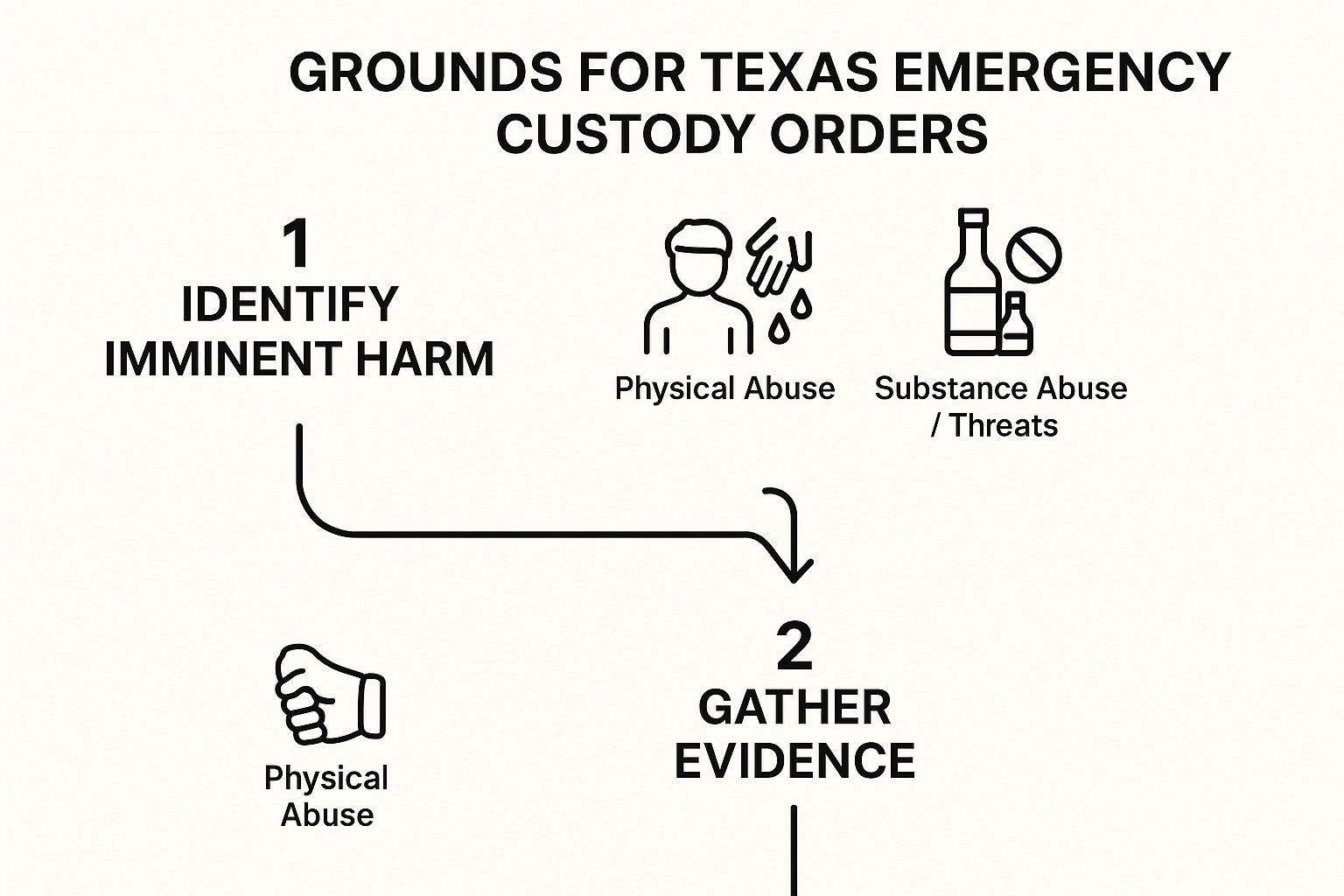
As you can see, the process begins with identifying imminent harm, followed by gathering proof. If the trial court issued an order without this foundation, an appeal is designed to correct that error.
The Texas Appeals Process for a Custody Order

If you believe the court erred in its decision, the appellate process provides a structured path for seeking justice. It is a methodical and deadline-driven process that requires deep knowledge of the Texas Rules of Appellate Procedure. Unlike a trial, an appeal is a scholarly legal argument focused entirely on the existing record.
Having an experienced appellate attorney is essential. They ensure every deadline is met, the trial record is properly prepared, and the legal arguments are framed persuasively to demonstrate reversible error to the court of appeals.
Step 1: Filing the Notice of Appeal
The first step is filing a "Notice of Appeal." This is a formal document filed with both the trial court and the court of appeals that declares your intent to challenge the order. In Texas, you have a very strict and short deadline to file this notice, typically 30 days from the date the order was signed. Missing this deadline can permanently forfeit your right to appeal.
Step 2: Preparing the Appellate Record
Once the appeal is initiated, the next phase is to assemble the "appellate record." This is the official collection of all documents and testimony from the trial court, including transcripts of hearings, evidence that was submitted, and all motions and orders. The appellate court will review only what is in this record; no new evidence is allowed. Your attorney's job is to ensure the record is complete and accurate, as it forms the entire basis for your appeal.
Step 3: Legal Briefing and Oral Argument
This is the heart of the appeal. Your attorney will write a detailed legal document called an "appellate brief." This brief methodically outlines the facts from the record, cites relevant laws and past court cases, and constructs a powerful argument explaining exactly how the trial judge committed a reversible error. The opposing side will then file their own brief in response. In some cases, the court of appeals may schedule an "oral argument," where the attorneys appear before a panel of appellate judges to argue their points and answer questions directly. After reviewing the briefs and hearing arguments, the appellate court will issue a written opinion that either affirms (upholds) or reverses (overturns) the trial court's order.
How the Standard of Review Affects Your Appeal

To succeed in an appeal, it’s not enough to show that the appellate court might have made a different decision. You must prove that the trial court's decision was legally wrong according to the applicable "standard of review." In family law cases, including emergency custody orders, the most common standard is abuse of discretion.
This standard is deferential to the trial judge, who was physically present to hear testimony and observe witnesses. However, a judge abuses their discretion when they act without reference to guiding legal principles or when their decision is not supported by the evidence. Your appellate attorney’s task is to comb through the record and demonstrate that the trial court's ruling crossed that line.
Evidence the Appellate Court Will Review
The appellate court will not see new evidence. Their entire review is confined to the "record" from the trial court. This record is the collection of all documents and transcripts from your original case.
The strength of your appeal depends entirely on what is in that record:
- Hearing Transcripts: The verbatim record of what was said by the judge, attorneys, and witnesses. This is often where procedural errors or misapplications of the law are found.
- Admitted Evidence: Police reports, CPS records, medical documents, photos, and text messages that were properly submitted and accepted as evidence by the trial court.
- Pleadings and Motions: The original petition, affidavits, and any other legal documents filed in the case.
- The Final Order: The written order signed by the judge, which is the subject of the appeal itself.
If crucial evidence was improperly excluded at trial, or if the evidence that was admitted does not legally support a finding of imminent danger, these are powerful points to argue in your appellate brief. This is equally critical when dealing with complex custody arrangements like joint custody in Texas.
Understanding Reversible Error
| Type of Error | Strong Example | Weaker Example (Unlikely to be reversible) |
|---|---|---|
| Evidentiary Error | The judge based the order solely on an unsworn, hearsay statement from a third party. | The judge allowed a minor piece of irrelevant evidence that did not affect the outcome. |
| Procedural Error | The judge refused to hold the mandatory follow-up hearing within 14 days, denying a parent due process. | The hearing started 15 minutes late. |
| Legal Error | The judge applied the lower "best interest" standard instead of the required "imminent harm" standard for an emergency order. | The judge's written order contained a minor typographical error. |
| Sufficiency of Evidence | The record contains no evidence of physical harm, only vague allegations of "bad parenting." | The evidence was conflicting, but there was some credible testimony supporting the judge's decision. |
Ultimately, your appeal must show that a legal mistake was made and that this mistake likely caused an improper judgment.
What Happens After an Emergency Order Is Granted
https://www.youtube.com/embed/NQbb-1KX6fo
An emergency custody order, or Temporary Restraining Order (TRO), is only the first step. It is a temporary measure designed to last for a very brief period, typically 14 days, as defined by the Texas Family Code. This short timeline is intentional: it provides immediate protection while ensuring the other parent's constitutional right to be heard is respected.
The critical next step is the mandatory follow-up hearing. This is a full evidentiary hearing where the judge hears from both sides before deciding whether to extend, modify, or terminate the emergency order. The decisions made at this hearing are often what become the subject of an appeal.
From Emergency Action to a Final, Appealable Order
At the follow-up hearing, both parents present their full case. If, after hearing all the evidence, the judge decides to issue a temporary injunction or modify the underlying custody orders, that decision creates a more stable, and often appealable, order. It is at this stage that the record is fully developed, providing the foundation for an appellate review.
The outcome of this hearing sets the stage for everything that follows. If you believe the judge made a reversible error at this hearing—by ignoring key evidence, misapplying the law, or violating due process—it is vital to consult with an appellate attorney promptly. Understanding the timeline and procedures is a key part of the Texas family law appeals process, as the decisions made here can have a lasting impact and may be your one chance to seek correction from a higher court.
Answering Your Questions About Texas Emergency Orders
When you believe a court order affecting your child is fundamentally unfair, it's natural to have urgent questions. The appeals process is complex, but understanding the basics can provide clarity and a path forward.
How Quickly Can I Appeal an Emergency Order in Texas?
You must act fast. In Texas, you typically have only 30 days from the date a final order is signed to file your Notice of Appeal. For temporary orders, the rules can be even more complex. This deadline is strict and unforgiving. Consulting with an appellate attorney immediately after the order is issued is crucial to preserve your right to seek review from a higher court.
The appeal itself is not a fast process; it can take many months. However, initiating it correctly within the tight deadline is the most critical first step.
What if the Judge Says No to My Emergency Request? Can I Appeal That?
A denial of an emergency order can also be appealed if you believe the judge abused their discretion by ignoring clear evidence of imminent harm. If the trial record shows compelling proof of danger that the judge disregarded, an appellate court can review that decision.
A denial of an emergency order is a specific ruling on the urgency of the threat. If the judge made a reversible error in that ruling, an appeal is the proper remedy. An experienced appellate attorney can review the record and advise you on the strength of a potential appeal.
Do I Need a Different Lawyer for an Appeal?
It is highly recommended. Trial law and appellate law are two distinct and specialized fields. A trial lawyer excels at presenting evidence, examining witnesses, and arguing before a judge or jury. An appellate lawyer excels at legal research, persuasive writing, and navigating the intricate procedural rules of the court of appeals.
An appellate attorney brings a fresh, objective perspective to your case. They are trained to spot the specific types of legal errors that appellate courts look for and to frame those errors in the most compelling way through a written brief. This specialized skill set significantly increases your chances of a successful appeal.
What if I’m the One Falsely Accused and the Order Was Still Granted?
If an emergency order was granted against you based on false or insufficient evidence, an appeal is your primary recourse for justice. Your appellate attorney will argue that the trial court abused its discretion by issuing such a drastic order without the legally required proof of imminent harm.
Your chance to fight back begins at the trial court's follow-up hearing, where you present your evidence to counter the allegations. If the judge still rules against you despite your evidence, the appeal focuses on showing the appellate court that the decision was not supported by the record. If successful, the court of appeals can reverse the trial court's order and restore fairness.
If you believe the court made a mistake in your family law case, our appellate attorneys can help you seek a fair outcome. Contact The Law Office of Bryan Fagan today for a free consultation.