If you have walked out of a Texas family court feeling that the final order was fundamentally unfair, you are not alone. You may feel your case was handled unfairly, your evidence was ignored, and the judge’s decision simply does not align with the facts or the law. This experience is deeply frustrating, but it is not the end of the road. Texas law provides a clear path to challenge an unjust outcome: the appeals process.
While the Texas Family Code is written to be gender-neutral—meaning a judge cannot legally favor a mother over a father—sometimes the final ruling doesn't reflect that principle. The appellate process exists to correct these legal mistakes and restore fairness. However, your rights as a father are only legally enforceable once paternity is established. This is the first and most critical step in protecting your relationship with your child.
Your Foundational Rights as a Texas Father

Many fathers leave a Texas courtroom feeling like the deck was stacked against them. It’s a common and deeply frustrating experience. You may feel you weren’t heard, your evidence was dismissed, or the final order doesn't reflect the reality of your family's situation.
While those feelings are valid, it is vital to know that the law itself is on your side. The Texas Family Code is clear: courts are prohibited from discriminating based on gender. This gives you powerful legal footing when an order seems unfair. An appeal is not about re-telling your story; it's about holding the trial court accountable to the law and demonstrating how a legal error led to an unjust result.
The Best Interest of the Child Standard
Every decision a Texas family court judge makes must be guided by one principle: what is in the best interest of the child. This is a strict legal standard, not a vague concept. A judge must weigh specific factors to determine the best outcome for a child’s physical and emotional well-being.
These factors include:
- The child’s physical and emotional needs.
- The stability of each parent's home environment.
- Each parent’s ability to provide a safe and nurturing home.
- Any past actions by a parent that could endanger the child.
When a court’s final order deviates from this standard without clear, evidence-based reasoning, it may be more than just an unfair outcome—it could be a reversible error. If a judge severely limited your time with your child or imposed an unjust financial burden without a valid legal reason, that decision may be a legal mistake that can be corrected on appeal.
Key Father Rights vs. Common Misconceptions
| Your Legal Right in Texas | Common Misconception |
|---|---|
| Courts must be gender-neutral and cannot favor one parent based on sex. | Mothers automatically get custody, especially of young children. |
| You have an equal right to be named a Joint Managing Conservator. | The mother is always the primary caregiver by default. |
| Your possession (visitation) schedule is based on the child's best interest. | Fathers only get to see their kids every other weekend. |
| You have the right to make decisions for your child, jointly or exclusively. | The mother has the final say on all major decisions. |
Recognizing the difference between your legal rights and these outdated myths is critical. An order that appears to be based on a stereotype rather than evidence presented at trial could be a sign that a legal mistake was made, providing grounds for an appeal.
1. Establishing Paternity: The Key to Your Legal Rights

In Texas, until you are legally recognized as a child's father, you have no enforceable rights to custody or visitation. It doesn't matter if you have been an active parent since birth; without legal paternity, you cannot ask a court to enforce your right to see your child or participate in major decisions.
Establishing paternity is the legal foundation upon which all your other rights are built. It is the action that transforms you from a biological father into a legal parent whose relationship with their child is protected by the court.
How to Legally Establish Paternity in Texas
You can establish legal fatherhood in Texas through two main pathways. One is an administrative process, and the other requires a court order.
-
Acknowledgement of Paternity (AOP): This is a legal form that unmarried parents can sign to voluntarily establish paternity, often at the hospital after a child is born. A signed AOP has the same effect as a court order. It is a simple but permanent legal declaration.
-
Court Order: If an AOP was not signed or if paternity is disputed, a "Suit to Adjudicate Parentage" can be filed. This lawsuit asks a judge to legally determine the child's father, often after ordering genetic (DNA) testing. The court will then issue a final order establishing parentage.
While signing an AOP is faster, it is a binding legal document that is very difficult to undo. If you have any doubt about whether you are the biological father, it is wise to seek a court order and request DNA testing to be certain.
Why Paternity Is the Master Key to Your Rights
Once paternity is legally established, your rights become enforceable. A court can then issue orders defining and protecting your role as a parent. This is especially important for unmarried fathers, whose rights are not automatic. You can learn more in our guide to Texas custody laws for unmarried parents.
After establishing paternity, you can petition the court for:
- Conservatorship: The right to make important decisions about your child’s education, healthcare, and general welfare.
- Possession and Access: A legally enforceable visitation schedule detailing when you have physical custody of your child.
- Child Support Orders: Fair and clear financial obligations for both parents based on Texas guidelines.
Without taking this step, you are considered a legal stranger to your child. Establishing paternity is the single most important action you can take to protect your parental bond and secure your voice in your child's future.
Decoding Texas Custody: Conservatorship and Possession

If you’ve reviewed a Texas custody order, you may feel confused by unfamiliar legal terms. Texas family courts use words like "conservatorship," "possession," and "access" instead of "custody" and "visitation." Understanding this language is a critical first step in protecting your rights.
Here’s a simple breakdown:
- Conservatorship refers to your rights and responsibilities to make decisions for your child.
- Possession and Access refer to the physical time you spend with your child.
These are two separate parts of every custody order. It is possible for a court’s ruling on one to be fair while its ruling on the other contains a legal error, providing grounds for an appeal.
Joint Managing Conservatorship: The Texas Standard
Texas law presumes that it is in a child’s best interest to have both parents actively involved in their life. For this reason, the law favors naming parents as Joint Managing Conservators (JMCs). This is the most common arrangement in the state.
Being a JMC means you and the child's mother share the rights and duties of parenting. This empowers you to have a say in major decisions regarding your child’s schooling, non-emergency medical care, and psychological needs. It legally affirms your role as a co-parent, not merely a visitor. The evidence gathered at trial, including through discovery tools like depositions, is what a court uses to allocate these rights and duties. Being prepared for these proceedings, such as knowing how to prepare for depositions, is crucial.
Sole Managing Conservatorship: What It Means
A court can name one parent the Sole Managing Conservator (SMC) only under specific, serious circumstances, such as a history of family violence, substance abuse, or another situation that would endanger the child.
If a mother is named SMC, she gains the exclusive right to make most major decisions. The other parent is typically named a Possessory Conservator, which grants the right to a possession schedule but removes their legal authority in the child’s upbringing. An order naming a parent as SMC without sufficient evidence of danger is a significant red flag and a potential basis for an appeal.
The Standard Possession Order, Demystified
For parents living within 100 miles of each other, Texas law provides a default schedule called the Standard Possession Order (SPO). The law presumes this detailed schedule is in the child's best interest.
The SPO typically grants the non-primary parent possession on:
- The first, third, and fifth weekends of a month.
- Alternating major holidays.
- An extended period (usually 30 days) in the summer.
A judge must order the SPO unless there is evidence proving it is not in the child’s best interest. If a court restricts your time to less than the SPO allows without specific, proven facts in the trial record to justify it, this deviation could be considered an "abuse of discretion" and a reversible error.
Your Rights and Responsibilities with Child Support
For many fathers, a child support order can feel like a penalty rather than a parental duty, especially if the amount seems unfair. Legally, your obligation to provide financial support is directly linked to your rights as a father. The law aims to create a fair balance for you, the mother, and your child.
Child support in Texas is calculated using a specific formula based on your net monthly resources and the number of children you support. While the goal is consistency, calculation errors can and do occur. A court might miscalculate your income, fail to account for other children you support, or deviate from the guidelines without a legally sound reason. These mistakes are not just unfair; they can be reversible legal errors.
How Texas Courts Calculate Child Support
The court calculates your net monthly resources by adding up all income and subtracting mandatory taxes and the cost of the children's health insurance. A set percentage is then applied.
The guidelines are as follows:
- One Child: 20% of net resources
- Two Children: 25% of net resources
- Three Children: 30% of net resources
An error in this calculation can result in a financially unsustainable order. If you believe the math in your support order is wrong, it may be grounds for an appeal. Our guide on Texas child support appeals offers more detailed information.
It's More Than Just a Monthly Payment
Your financial duty is part of a larger framework of rights and responsibilities. As a father paying child support, you have the right to transparency and fairness. If you believe support payments are not being used for your child’s needs, you can petition the court for an accounting.
Crucially, you have the right to request a modification if your circumstances change significantly, such as job loss, a major pay cut, or a change in your child's living situation. The law provides a pathway to ensure your support order reflects your current reality. If a court denies a justified modification request, it may be an abuse of discretion—and a potential reason to appeal.
What to Do When a Court Ruling Is Unfair
You presented a strong case with clear evidence, yet the judge’s final ruling feels fundamentally wrong. It can seem like the court ignored the facts or relied on outdated biases instead of the law. When this happens, it is not the end of the road. The appeals process exists to provide a path to seek justice.
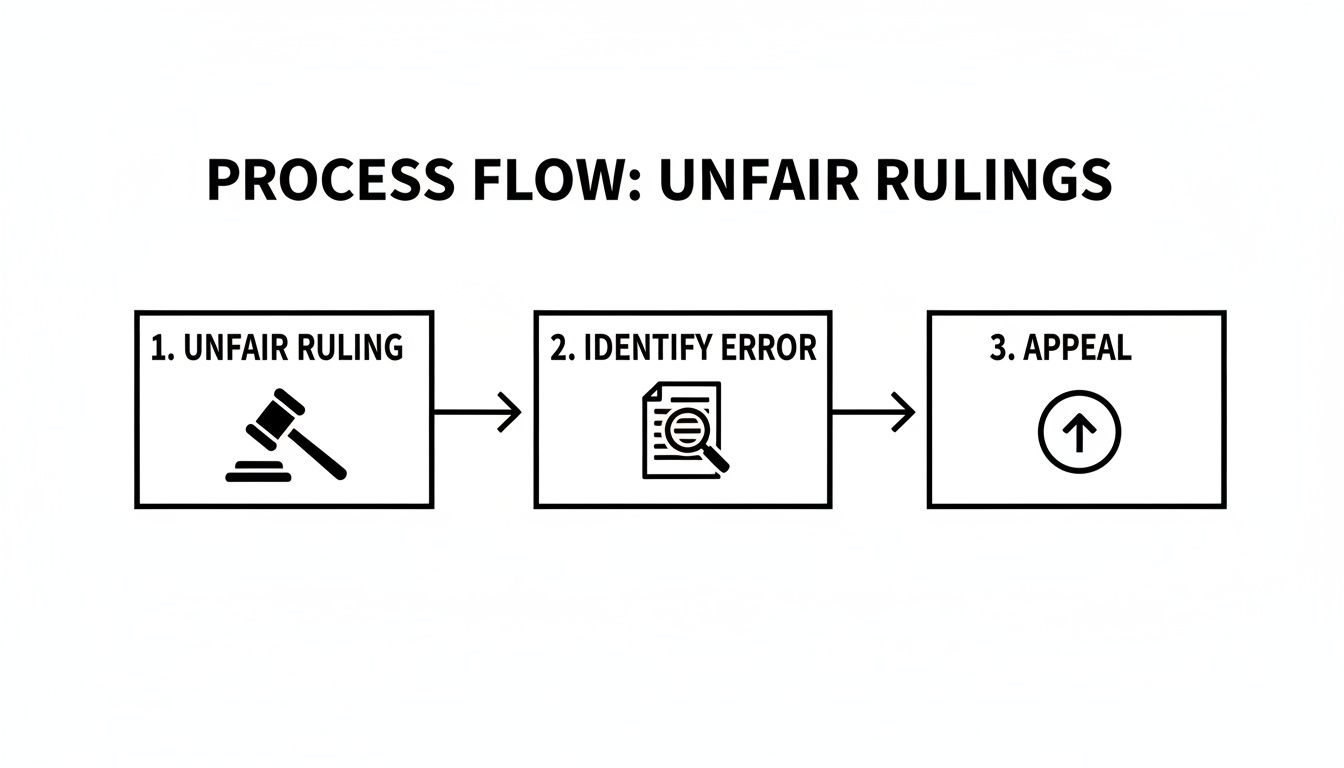
An appeal is not a new trial. You cannot present new evidence or re-argue your case. Instead, an appeal is a formal review by a higher court focused on one question: did the trial judge make a significant legal mistake? The entire process is about identifying and correcting errors that led to an unjust outcome.
Understanding Abuse of Discretion
One of the most common grounds for appealing a family law case is “abuse of discretion.” This legal term describes a ruling that is arbitrary, unreasonable, or completely disconnected from the evidence presented at trial.
It doesn’t just mean the appellate court would have ruled differently. It means the trial judge’s decision was so far outside the bounds of reasonable judgment that it cannot be allowed to stand. For fathers, this often arises when a ruling appears to ignore the law's mandate for gender neutrality or deviates from legal standards without proper justification.
Common Reversible Errors in Fathers' Rights Cases
A legal mistake serious enough that it likely caused the wrong outcome is called a “reversible error.” In cases involving father's rights in the State of Texas, certain errors occur more frequently. Identifying whether one happened in your case is the first step toward a successful appeal.
Common examples include:
- Ignoring Gender-Neutral Laws: The judge makes a decision based on the outdated assumption that mothers are inherently better caregivers, without evidence to support it.
- Restricting Possession Unjustly: The court reduces a father’s time with his child to less than the Standard Possession Order without proof that he poses a physical or emotional danger.
- Miscalculating Child Support: The judge incorrectly calculates net resources, ignores the statutory guidelines, or refuses to consider a valid modification request.
- Improperly Admitting or Excluding Evidence: The court allows unreliable testimony to influence its decision or refuses to consider crucial evidence that supports your case.
When a trial court ruling sidesteps the core legal principles of fairness and the child's best interest, it may be a textbook case of abuse of discretion and grounds for an appeal.
Navigating the Texas Family Law Appeals Process
You have received a final order from the court, and you are convinced the judge made a mistake. The next step is a highly structured process known as an appeal. Appealing a family law case is a matter of legal strategy, requiring specialized knowledge of appellate procedure.
The first thing to know is that time is critical. According to the Texas Rules of Appellate Procedure, you typically have only 30 days from the date the judge signs the final order to file a Notice of Appeal. Missing this strict deadline will likely mean losing your right to challenge the decision forever.
Step 1: Compiling the Appellate Record
Once the notice is filed, the work of assembling the appellate record begins. This is the official case file sent to the court of appeals, and it is the only information the appellate judges will review. New evidence is not permitted.
The record consists of two parts:
- The Clerk's Record: All official documents filed in your case, including petitions, motions, and final orders.
- The Reporter's Record: The official, word-for-word transcript of everything said during your court hearings and trial.
Our appellate attorneys meticulously review every page of the record to identify the specific legal errors the trial judge made. This chart shows how an unfair ruling is challenged through the appellate process.
Step 2: The Briefing Stage
The core of the appeal is the briefing stage. An appellate brief is a persuasive legal document that presents our argument to the court of appeals. In the brief, we outline the facts from the record, cite relevant laws and previous court decisions, and pinpoint exactly where the trial judge committed a reversible error.
The argument is purely legal. A successful brief isolates a clear mistake—such as misapplying a law or "abusing discretion"—and demonstrates how that error led directly to an unjust outcome. The other party files a response brief, and we may file a final reply. A panel of appellate judges then reviews all briefs and the record before issuing a written decision. They can affirm the trial court's decision, reverse it, or send the case back with instructions to correct the error.
Common Questions About Fathers' Rights and Appeals
It is normal to have questions about what an appeal looks like in practice. Here are answers to some of the most common concerns we hear from fathers considering an appeal.
Can I introduce new evidence on appeal?
No. An appeal is a review of the trial, not a new trial. Appellate judges are strictly limited to reviewing the official "record"—the documents and transcripts from your original case. Their job is to determine if the trial judge made a legal error based on the information they had at the time. This is why a meticulous review of that existing record is the most important part of finding a reversible error.
Can a Custody Order Be Appealed?
Yes. A final order on conservatorship, possession, and access is one of the most common types of family law orders challenged on appeal. If you believe the judge abused their discretion by unfairly limiting your time with your child, basing a decision on gender stereotypes, or otherwise failing to follow the law, an appeal is your primary recourse. The goal is to show the higher court that the trial judge's decision was not truly in the "best interest of the child" as required by the Texas Family Code.
While custody statistics in Texas show a trend toward joint custody, outcomes can still vary widely. When a ruling seems to contradict the evidence or the law, an appeal is the designated process to seek a correction.
What Does the Appeals Process Cost?
The cost of an appeal depends on the complexity of your case. The primary expenses are attorney's fees for legal research and writing the appellate brief, as well as the court costs for preparing the official appellate record. Understanding legal billing and retainer agreements is an important step in preparing for this process. We believe in transparency and will provide a clear fee structure during your initial consultation so you can make an informed decision about pursuing justice for your family.
If you believe the court made a mistake in your family law case, our appellate attorneys can help you seek a fair outcome. Contact The Law Office of Bryan Fagan today for a free consultation. Contact The Law Office of Bryan Fagan today.