
You may feel your case was handled unfairly. After a long court battle, you received a final order that seems to ignore your role as a father, limiting your time with your child or imposing an unjust financial burden. It’s a frustrating and demoralizing experience, but a trial court’s decision is not always the final word.
The Texas Family Code is built on the premise that it is in a child's best interest to have both parents actively involved. However, for many fathers, the path to securing those rights is filled with legal hurdles. If you believe the court made a critical mistake in your family law case, the appeals process offers a structured way to seek a fair outcome.
Securing Your Legal Role as a Father in Texas
If you’ve been through a court battle and feel like your rights were ignored or the outcome was unjust, you're not alone. Before any court can rule on your rights to custody or visitation, Texas law requires that you are legally recognized as the child’s father. For unmarried fathers, this is the non-negotiable first step, known as establishing paternity.

Paternity: The First and Most Important Step
Before a judge can even consider giving you custody (what Texas calls "conservatorship") or a visitation schedule ("possession and access"), the law must recognize you as the father. Your DNA isn't enough to get you in the courtroom door.
This is the non-negotiable first step. It’s the bedrock on which all other fathers rights in the state of Texas are built. For unmarried parents, there are two main paths to get this done:
- Voluntary Acknowledgment of Paternity (AOP): This is the simplest route. It’s a legal document both parents sign, usually at the hospital right after birth, swearing that you are the biological father.
- Court Order: If an AOP wasn't signed or if there's any disagreement, you'll need to file a lawsuit called a "Suit to Adjudicate Parentage." This gets the court involved to legally establish your fatherhood, which often requires genetic testing.
Once paternity is legally settled, you're on equal footing with a father who was married when his child was born. You now have the legal standing to ask the court for orders that spell out your specific rights and duties. To dig deeper into how this works, check out our guide on Texas custody laws for unmarried parents.
Establishing paternity is the move that gets you off the sidelines and into the game, giving you the power to fight for a meaningful role in your child's life. The table below breaks down exactly what rights become available once you're legally recognized as the father.
Key Legal Rights Unlocked by Establishing Paternity
| Legal Right Gained | What It Means for a Father |
|---|---|
| Right to Seek Custody | You can ask the court to be named a conservator, giving you the authority to make decisions for your child. |
| Right to Visitation | You can request a legally enforceable possession schedule to ensure you have time with your child. |
| Right to Inherit | Your child gains the legal right to inherit from you, and you from them. |
| Duty to Pay Child Support | You have the responsibility to financially support your child, but also the right to ensure the amount is fair. |
| Right to Make Decisions | You can petition for the right to be involved in major choices about education, healthcare, and religion. |
Securing these rights is essential not just for you, but for your child’s well-being and sense of identity. It formalizes your commitment and provides the stability that courts want to see.
Why Paternity Matters for a Potential Appeal
Getting this initial step right is absolutely critical, especially if you're considering an appeal. A trial judge cannot make binding decisions about your rights as a father until paternity is officially established. If the trial court rushed through a custody or support ruling without properly handling the paternity issue, that could be a significant legal mistake—what attorneys call a reversible error.
A reversible error is a mistake made by the trial court that is serious enough to have affected the outcome of the case. When an appellate court reviews your case, it scrutinizes the record to ensure the law was followed correctly. If the very foundation of the case—your legal parentage—was flawed, it could bring the entire original judgment into question and be a powerful argument for a new, fair hearing.
Understanding Custody and Visitation Appeals in Texas
If you’re a dad feeling you’ve been dealt an unfair hand by a court order, understanding the specific legal terms is the first step toward seeking justice. In Texas, "custody" is legally called conservatorship, and "visitation" is known as possession and access. Mastering this vocabulary is critical to protecting your relationship with your child and identifying potential legal errors in a judge's ruling that could be challenged on appeal.
Joint vs. Sole Conservatorship
The Texas Family Code presumes that it is in a child's best interest for both parents to be named Joint Managing Conservators (JMC). This is the standard arrangement because it means both parents share the rights and duties of raising their child. Even when parents are JMCs, one is usually named the "primary" parent, who establishes the child's residence.
However, a court may appoint one parent as the Sole Managing Conservator (SMC) if there is clear evidence that joint conservatorship would harm the child. This is a significant step, typically reserved for cases involving:
- A documented history of family violence
- Evidence of child abuse or neglect
- Serious substance abuse problems
- Such intense conflict that parents simply cannot make decisions together
If a judge names one parent as SMC without solid, credible proof of these kinds of serious issues, that decision might be an abuse of discretion. An abuse of discretion occurs when a judge makes a ruling that is arbitrary, unreasonable, or without reference to any guiding rules and principles. It is a common basis for a successful family law appeal.
Challenging an Unfair Possession Order
For visitation, Texas provides a default schedule called the Standard Possession Order (SPO). It is the baseline for the non-primary parent’s time with the child. For parents living within 100 miles of each other, the SPO typically includes:
- Weekends: Possession on the first, third, and fifth weekends of a month.
- Holidays: Alternating major holidays like Thanksgiving and Christmas.
- Summer: An extended 30-day period of possession.
The SPO is a starting point, not a mandate. Judges can deviate from it if evidence shows a different schedule is in the child's best interest. For a closer look at various arrangements, articles about fathers' visitation rights can offer some helpful perspective.
Fighting for More Than the Standard Schedule
For many fathers, the SPO does not provide enough time. While a 50/50 schedule is not the default in Texas, courts are increasingly willing to approve expanded schedules that give fathers more meaningful involvement.
What if you presented compelling evidence that a 50/50 schedule was best for your child—you live near their school, have a flexible job, and are the go-to parent for homework—but the judge ignored it without a valid reason? This could be a significant legal error. An appellate court can review the trial record to determine if the judge’s decision was supported by the facts presented. If not, the order could be reversed.
Understanding Your Child Support Obligations and Rights
For many fathers, child support can feel like a one-way street where financial obligations are clear but their rights are not. To ensure a court order is fair, it's essential to understand how Texas courts calculate support. The Texas Family Code provides a specific mathematical formula to keep calculations consistent, but mistakes in applying that formula can and do happen.

How Child Support Is Calculated in Texas
The process begins by calculating the non-primary parent's net monthly resources. This includes all sources of income—salary, commissions, overtime, rental income—minus specific deductions like federal income taxes and the cost of the child's health insurance.
Once the net resource amount is determined, the court applies a percentage based on the number of children requiring support:
- One Child: 20% of net resources
- Two Children: 25% of net resources
- Three Children: 30% of net resources
- Four Children: 35% of net resources
- Five or More Children: 40% of net resources
It is critical that all income is reported accurately. If the trial court miscalculates—by omitting an income source, making a mathematical error, or misapplying the guidelines—the final child support order could be legally incorrect. This is the type of mistake that can be considered a reversible error, which an appellate court has the authority to correct.
Navigating Income Caps and Recent Changes
To prevent excessive support orders for high-income earners, Texas law caps the amount of income subject to the guidelines. As of September 1, 2023, this cap was raised to $9,200 per month in net resources to reflect the modern costs of raising a child. While this may mean higher support obligations for some fathers, these legislative updates also encouraged courts to promote more shared parenting time, balancing financial duties with meaningful involvement.
Your Rights Beyond the Payment
Your role in child support extends beyond making payments. As a father, you have specific rights to ensure financial transparency and fairness.
You have the right to request a modification of the support order if there has been a material and substantial change in your circumstances. A job loss, a significant pay cut, or a change in the child's living arrangements are all valid reasons to ask the court for a review.
You also have the right to know how your payments are being used for your child’s benefit. While you cannot micromanage every purchase, you can request a formal accounting if you have a legitimate reason to believe the funds are not being used for the child's care.
If you feel the trial court misapplied the law, used incorrect income figures, or ignored key evidence when setting your support amount, the outcome may be legally unjust. These are precisely the kinds of errors that can be challenged through an appeal. For more information, explore our resources on Texas child support appeals.
Challenging an Unfair Ruling Through an Appeal
You have been through a grueling trial, only to receive a final order that feels like a gut punch—one that disregards your rights as a father. While deeply frustrating, a bad ruling is not necessarily the end of the story. An appeal provides a path to seek a fair outcome.
An appeal is not a retrial. You do not present new evidence. Instead, an appellate court conducts a formal review of what happened during your trial. Its job is to examine the official record—transcripts, evidence, and orders—to find a reversible error. This is a legal mistake so significant that it likely caused an improper outcome.
Understanding the Standard of Review: Abuse of Discretion
In most Texas family law appeals, the key question is whether the trial judge committed an abuse of discretion. This is the legal standard appellate courts use to evaluate a judge’s decisions. A judge abuses their discretion when they make a decision that is arbitrary, unreasonable, or without any regard for the guiding rules and principles of the law.
For example, if you presented extensive evidence showing you are an actively involved, caring father, but the judge ignored it and based a custody decision on an outdated belief that "children belong with their mothers," that is a clear abuse of discretion. Another example is a judge miscalculating child support by using incorrect income figures when the correct financial documents were provided in court.
Proving an abuse of discretion is often the key to a successful appeal involving fathers' rights in the state of texas.
How Appeals Differ From Trials: A Step-by-Step Insight
An appeal is a fundamentally different legal process from a trial, governed by its own rules and procedures under the Texas Rules of Appellate Procedure. Understanding these differences is the first step in evaluating your options.
Here’s a breakdown of the key differences:
Trial vs Appeal Key Differences for Fathers
| Aspect | Trial Court | Appellate Court |
|---|---|---|
| Purpose | To hear evidence, determine facts, and issue an initial ruling. | To review the trial record for legal errors that affected the outcome. |
| Evidence | New evidence is presented, and witnesses testify. | No new evidence is allowed. The court only looks at the existing record. |
| Key Player | The judge or jury acts as the fact-finder. | A panel of appellate justices reviews written arguments and record. |
| Timeline | A trial may last days or weeks. | The appellate process, involving briefing and review, typically takes many months. |
The appeal is not about retelling your story; it's about proving the trial judge misinterpreted or misapplied the law. Success depends on building a strong trial record and drafting a persuasive written argument, known as a brief. The first step is determining if you have solid grounds for appeal in a Texas family court.
Common Reversible Errors Affecting Fathers in Texas
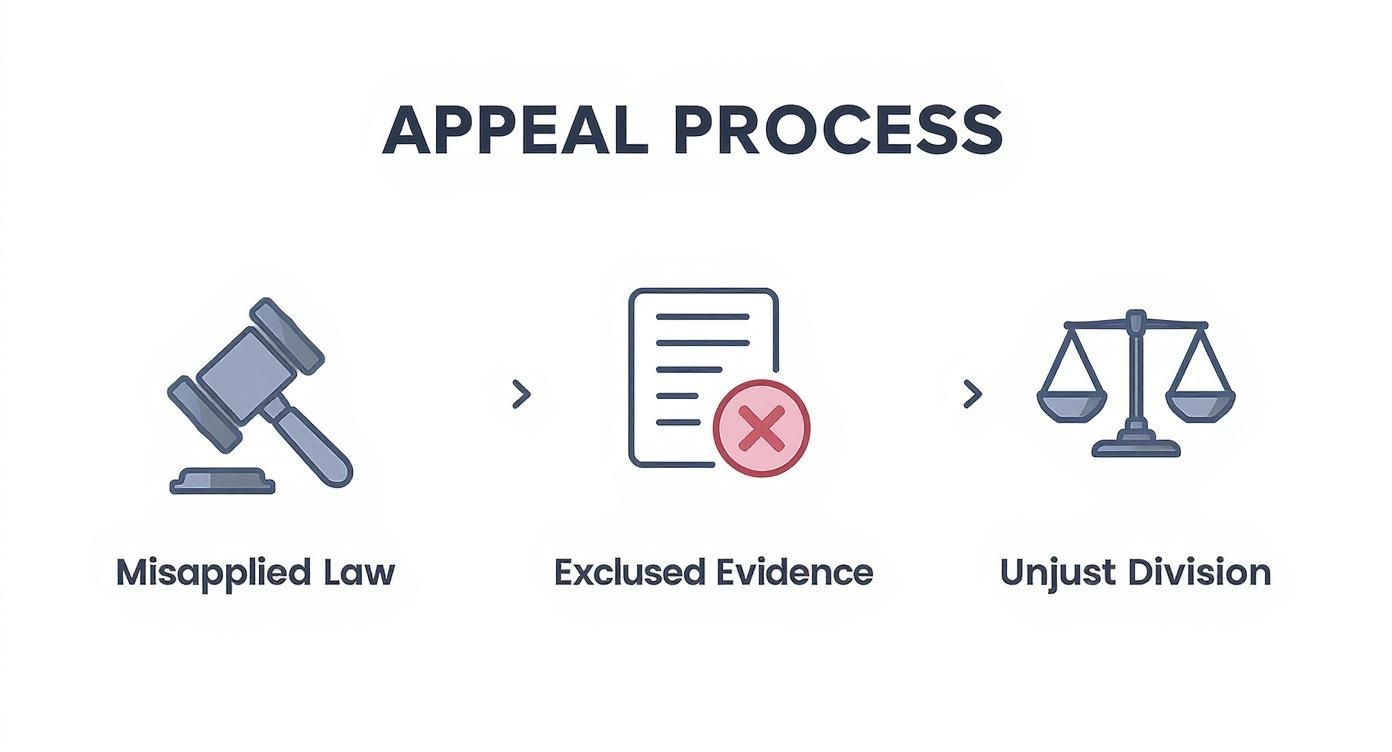
When a court order feels fundamentally unfair, it's easy to feel a sense of injustice. However, a successful appeal is not won on feelings; it is built on identifying specific, critical legal mistakes the trial judge made. We call these reversible errors—legal blunders so significant they likely led to the wrong outcome.
Misapplication of the Best Interest Standard
In every Texas family law case involving a child, all decisions must be based on the "best interest of the child." This standard is not a blank check for a judge to rule based on personal opinions or outdated stereotypes. The decision must be grounded in the evidence presented in court. A common error occurs when a judge’s ruling ignores substantial evidence showing a father is fit, capable, and deeply involved.
For example, you presented proof of a stable home, records of your involvement in your child's school and medical care, and demonstrated a strong, loving bond. If the final order still severely restricts your time with your child for reasons unsupported by those facts, it could be a clear abuse of discretion. An appellate court will examine the record to see if the judge connected the evidence to the final order. If the ruling appears based on subjective bias rather than facts, it creates strong grounds for an appeal.
Improper Exclusion or Admission of Evidence
The outcome of your trial depends on the evidence you are allowed to present. The appellate court can only review what is in the official trial record. Therefore, a judge's decision to wrongly block you from presenting crucial evidence—or to allow the other party to introduce improper evidence—can be a devastating reversible error.
Common examples include:
- Excluding Key Evidence: The judge refuses to allow your child's teacher to testify about your consistent involvement at school. This testimony is direct proof of your parental fitness, and excluding it could have skewed the outcome.
- Admitting Improper Evidence: The court allows the other parent to introduce baseless rumors or irrelevant information from your past that has no bearing on your ability to be a good father. This prejudicial information can lead to an unjust decision.
These evidentiary mistakes can compromise the fairness of the entire trial, which is why they are a primary focus for an appellate attorney reviewing a case.
A landmark development supporting fathers rights in the state of Texas was the 2023 passage of a constitutional amendment explicitly protecting parental rights. This amendment affirms a parent's fundamental right to the care, custody, and control of their children, giving fathers a stronger legal foundation to challenge court decisions that unjustly limit their role. You can learn more about how Texas lawmakers are enshrining parental rights in the state constitution.
If you believe the court made a mistake in your family law case, our appellate attorneys can help you seek a fair outcome. Contact The Law Office of Bryan Fagan today for a free consultation.
How to Protect Your Rights for a Potential Appeal
The best way to protect your rights is to prepare your case from the beginning as if you expect it might one day be reviewed by an appellate court. This means meticulous documentation and strategic action in the trial court.
Keep a detailed journal of your involvement in your child's life—every school pickup, doctor's visit, and parent-teacher conference. Save all communications with the other parent. Track every dollar of financial support you provide. This detailed preparation can be invaluable.
Creating a Strong Trial Record: A Step-by-Step Insight
An appellate court cannot consider new evidence; it can only review what the trial judge saw and heard. This is why building a solid trial record is one of the most powerful things you can do to protect your fathers rights in the state of texas. The trial record is the official transcript of the case, including all testimony and admitted evidence. If it is not in the record, it did not happen for purposes of an appeal.
To build a strong record, your trial attorney must:
- Make Timely Objections: If the opposing attorney introduces improper evidence or makes an inappropriate statement, your lawyer must object immediately. Failing to object at that moment often waives your right to complain about it on appeal.
- Ensure Evidence is Admitted: Your attorney must follow proper procedures to have your documents, photos, and testimony formally "admitted" into the record so the appellate court can review them.
- Request Findings of Fact and Conclusions of Law: After a trial, your attorney can ask the judge to issue a written document explaining the specific facts and legal reasoning behind their decision. This can be invaluable for exposing an abuse of discretion or other legal errors to the appellate court.
The Appeal Timeline: What to Do Immediately After an Unfair Order
The moment a judge signs a final order, a strict clock starts ticking. The Texas Rules of Appellate Procedure are unforgiving, and you have a very narrow window to act.
In most Texas family law cases, you have only 30 days from the date the final order is signed to file a Notice of Appeal. If you miss this deadline, your right to challenge the ruling is almost always lost.
Because this timeline is so short, you cannot afford to wait. Your first step should be to contact an attorney with experience in family law appeals. An appellate lawyer will obtain the trial record and conduct a thorough analysis to determine if a reversible error occurred. This expert evaluation is your best chance to understand your options and pursue a just result.
If you believe the court made a critical mistake in your family law case, our appellate attorneys can help you seek a fair outcome. Contact The Law Office of Bryan Fagan today for a free consultation.
Answering Your Questions About Fathers' Rights and Appeals
When you're facing an unfair court decision, it's natural to have questions. Here are plain-English answers to some of the most common concerns we hear from fathers in Texas.
Does Texas Law Favor Mothers Over Fathers in Custody Cases?
No. On paper, the Texas Family Code is completely gender-neutral. The law explicitly states that all decisions must be based solely on the "best interest of the child," without preference for either parent. However, individual biases can sometimes lead to an unfair ruling. If you believe a judge ignored the facts and ruled against you simply because you are the father, that could be a powerful argument for an abuse of discretion on appeal.
Can I Get a 50/50 Custody Schedule in Texas?
Yes, but it is not the automatic or default schedule. While Texas law encourages significant involvement from both parents, the Standard Possession Order (SPO) is the presumptive schedule, and it is not a 50/50 split. To obtain an equal possession schedule, you must present a strong case demonstrating why that arrangement is truly in your child's best interest. Factors like the parents' proximity to each other and their ability to co-parent effectively are crucial.
What Is the First Step to Starting an Appeal?
Act quickly. The timeline for an appeal is extremely strict. In most family law cases, you have only 30 days from the date the judge signs the final order to file a Notice of Appeal with the trial court. Missing this deadline will almost certainly cost you your right to appeal. It is critical to consult an appellate attorney immediately to evaluate your case and ensure this crucial first step is taken on time.
Plain-English Legal Terms:
Abuse of Discretion: A legal term for when a trial judge makes a decision that is unreasonable, arbitrary, or without reference to guiding legal principles. It's not just a disagreement with the outcome; it's a clear error in judgment.
Reversible Error: A mistake made by the trial court that is serious enough to have likely caused the wrong outcome. Finding one is the goal of an appeal.
Briefing: The process of writing the formal legal arguments for the appellate court. The "brief" is the written document that explains the trial court's errors and why the decision should be reversed.
If you believe the court made a mistake in your family law case, our appellate attorneys can help you seek a fair outcome. Contact The Law Office of Bryan Fagan today for a free consultation.