You may feel your case was handled unfairly. After presenting clear evidence that the other parent was systematically turning your child against you, the judge issued an order that ignored this painful reality. It can feel powerless and unjust, leaving you with a ruling that fails to protect your relationship with your child. If you believe the court made a mistake, the Texas appeals process offers a path to seek a fair outcome.
This destructive dynamic, where one parent deliberately undermines a child's bond with the other, is known as parental alienation. While the trial court may have failed to see it, an appellate court can review the case for legal errors.
Understanding Parent Alienation in Texas Family Law
Parental alienation is more than occasional badmouthing between co-parents. It is a persistent and damaging pattern of behavior designed to interfere with, poison, or completely sever the parent-child bond. While "parental alienation" is not a formal diagnosis or a specific claim in the Texas Family Code, family courts recognize these manipulative behaviors. Judges are required to consider such conduct when making decisions under the guiding principle of the "best interest of the child" standard.
Common Examples of Alienating Conduct
A trial court has a duty to weigh evidence of destructive actions when deciding what is best for a child. When a judge fails to properly consider clear evidence of these behaviors, the final order may not truly serve the child's best interests. This failure can be a legal mistake. Some common examples presented in Texas courts include:
- Blocking Communication: Consistently intercepting or preventing phone calls, texts, and video chats between the child and the other parent.
- Making False Allegations: Fabricating or exaggerating claims of neglect or abuse to Child Protective Services or the court to restrict the other parent’s access.
- Disparaging Remarks: Relentlessly criticizing the targeted parent in front of the child, blaming them for the divorce, financial problems, or other hardships.
- Violating Court Orders: Routinely ignoring or finding excuses to circumvent court-ordered possession, effectively keeping the child from the other parent.
This type of legal mistake is known as a reversible error—an error so significant it likely led to an improper judgment. An appeal is not a second trial, but it provides a critical opportunity to argue that the trial court misapplied the law to the facts of your case.
How Texas Courts Look at Alienating Behavior
In a Texas family courtroom, every decision is viewed through one critical lens: the best interest of the child. This standard, established in the Texas Family Code, is the guiding principle for every ruling a judge makes. The court's primary goal is to foster an environment that promotes a child's emotional and physical well-being. Evidence of one parent deliberately damaging a child's relationship with the other is taken very seriously because it directly conflicts with this core objective.

Impact on Conservatorship and Possession
In Texas, "custody" is referred to as conservatorship, which outlines a parent's legal rights and responsibilities. A judge may appoint parents as "joint managing conservators" or name one "sole managing conservator." Proven parental alienation can dramatically influence these decisions. A court might strip an alienating parent of the right to make decisions about the child's education or healthcare, concluding that they cannot be trusted to act in the child's best interest. It can also impact the possession schedule, potentially leading to supervised visitation for the parent engaging in harmful behaviors.
A judge’s ultimate goal is to create a stable, non-combative environment for the child. When one parent’s actions create conflict and emotional distress, the court has the authority to intervene to protect the child’s best interest.
Proving Your Case: The Power of Evidence
You cannot simply tell a judge that parental alienation is happening; you must present clear, specific proof of a pattern of destructive behavior. Knowing the different types of primary sources of information is key to gathering the right kind of evidence.
Judges look for concrete proof, such as:
- Written Communications: Text messages, emails, and social media posts from the other parent that show interference, disparagement, or manipulation are powerful evidence.
- Testimony from Others: Teachers, therapists, coaches, or neutral family friends can testify about changes in the child's behavior or actions they have witnessed firsthand.
- Professional Evaluations: A court may appoint a custody evaluator or psychologist to assess family dynamics and provide an expert opinion on the impact of the alienating behavior on the child.
While "parental alienation" is not explicitly defined in the Texas Family Code, courts evaluate this conduct within the "best interest" framework. When a parent actively undermines the child's relationship with the other parent, it can be a deciding factor in a custody determination.
Common Alienating Behaviors Recognized by Texas Courts
This table highlights specific actions that courts may view as parental alienation and the remedies a judge might order to protect the child.
| Alienating Behavior Example | How It Harms the Parent-Child Relationship | Potential Court-Ordered Remedy |
|---|---|---|
| Consistently badmouthing the other parent to the child. | It forces the child to choose sides and creates loyalty conflicts, causing emotional distress. | Ordering the alienating parent to attend co-parenting classes or counseling. |
| Interfering with communication (blocking calls/texts). | It severs the child's daily connection with the targeted parent, making them feel abandoned or unloved. | Specifying exact times and methods for communication in the court order. |
| Making false allegations of abuse or neglect. | It not only damages the targeted parent's reputation but can also cause severe trauma for the child. | Modifying the custody arrangement and potentially ordering supervised visitation. |
| Telling the child personal details about the divorce. | It burdens the child with adult problems, creating anxiety and making them a confidant instead of a kid. | Issuing an injunction that prohibits discussing the litigation with the child. |
| Rewarding the child for rejecting the other parent. | It teaches the child that love is conditional and that manipulating relationships is acceptable. | Ordering family therapy or reunification counseling to repair the bond. |
What to Do When the Court Gets It Wrong
What happens if you presented a mountain of credible evidence, yet the judge ignored it or issued a ruling that contradicts the facts? This is where an appeal becomes necessary.
If a judge's decision is clearly contradicted by the evidence, it may constitute an abuse of discretion. This legal term means the judge made a ruling that was arbitrary, unreasonable, or without reference to any guiding legal principles. In a parental alienation Texas case, this could occur if a judge dismisses a clear pattern of manipulation or downplays documented interference with possession. You can see more examples of parental alienation in our companion guide.
An appeal allows a higher court to review the record from your trial for legal errors. If the appellate court finds the trial judge made a significant mistake, it can reverse the decision and send the case back for a new hearing, ensuring the evidence is properly considered.
Understanding the Difference Between a Trial and an Appeal
If the judge’s ruling in your parental alienation case felt wrong, it’s natural to want a second chance to tell your story. However, an appeal is not a new trial. Understanding this distinction is the first step in evaluating your legal options. An appeal is a fundamentally different process, governed by its own strict rules and procedures under the Texas Rules of Appellate Procedure.
An appeal is not a do-over. It is a review of the trial court proceedings for legal error.
The Trial Court: Deciding the Facts
The trial court is where the facts of your case are presented and decided. The judge listens to witness testimony, examines evidence like text messages and emails, and determines the credibility of each party. The trial's focus is on establishing the facts and applying the law to those facts to reach a final decision. The final order in your case was the result of this fact-finding process.
The Appellate Court: Reviewing for Legal Error
An appeal moves the case to a higher court, where a panel of justices reviews the trial for legal mistakes. The appellate court does not hear new testimony or consider new evidence. Its sole function is to examine the appellate record—the official transcript and documents from the trial—to determine if the trial judge committed a significant error that unfairly affected the outcome.
The appellate record consists of two main parts:
- The Clerk’s Record: A compilation of all documents filed in your case, such as petitions, motions, and the final order.
- The Reporter’s Record: The word-for-word transcript of everything said in the courtroom during your trial.
The purpose of an appeal is to persuade the higher court that the trial judge made a reversible error—a legal mistake so significant that it likely caused an improper judgment.
Understanding the Standard of Review
A crucial concept in any appeal is the standard of review. This determines how much deference the appellate court must give to the trial judge's decisions. In most family law matters, including parental alienation Texas cases, the standard is abuse of discretion.
An abuse of discretion occurs when a trial judge makes a decision that is arbitrary, unreasonable, or made without reference to any guiding legal principles. It does not mean the appellate court simply disagrees with the outcome; it means the trial court’s ruling was fundamentally flawed and legally indefensible.
Proving an abuse of discretion is challenging. You must demonstrate that the judge's decision was either completely unsupported by the evidence in the record or based on an incorrect application of the law. For example, if you presented overwhelming documented evidence of alienation and the judge ignored it without a valid legal reason, that could be grounds to argue an abuse of discretion on appeal.
Your appeal will not be a retelling of your story. It will be a formal legal argument, presented in a document called a brief, designed to show the appellate court precisely how the trial judge erred and why that error must be corrected to ensure justice.
Pinpointing Appealable Errors in Your Case
A successful appeal is not about re-arguing the facts of your case; it is about proving the trial court made a significant legal mistake. This is known as a reversible error—an error so substantial that it almost certainly led to an unjust outcome. An appellate attorney's job is to meticulously search the trial record for these specific legal flaws and build a case around them.
The entire appeal is built on showing the higher court that the trial itself was legally flawed, and that this flaw led directly to an unjust result for you and your child.
Common Reversible Errors in Texas Family Courts
In the emotionally charged context of parental alienation Texas litigation, certain types of reversible errors are more common. If you presented strong evidence of alienation but the court failed to protect your parental rights, it is possible one of these mistakes occurred.
Examples of common reversible errors we look for include:
- Improperly Excluding Key Evidence: Imagine your attorney tried to introduce text messages and emails showing a clear pattern of the other parent interfering with your court-ordered possession time. If the judge refused to admit that evidence based on an incorrect legal ruling, it could be a reversible error because it prevented the court from seeing the complete picture.
- Admitting Unreliable or Prejudicial Evidence: Conversely, if the court allowed testimony from an unqualified "expert" or based its decision on evidence that should have been excluded, that could constitute an abuse of discretion. A custody decision must be based on reliable and relevant evidence.
- Misapplying the "Best Interest of the Child" Standard: The "best interest of the child" is the guiding standard for all custody decisions in Texas. If a judge's ruling is directly contrary to overwhelming evidence of alienation and lacks a sound legal basis, it can be argued that the judge misapplied the very standard they were required to follow.
A reversible error is a mistake in applying the rules of law or procedure that undermines the fairness of the entire trial. Identifying valid grounds for an appeal is the critical first step toward seeking justice.
When False Allegations Create an Appealable Issue
False accusations of parental alienation can also be a basis for appeal. These claims can be weaponized to punish a protective parent, and courts sometimes fail to see through the manipulation. A 2020 study of U.S. custody cases revealed a significant disparity: when fathers claimed alienation, mothers lost custody 44% of the time, but when mothers made the same claim, fathers lost custody in only 28% of cases. This suggests that such accusations can be used to unfairly penalize parents raising legitimate concerns. You can read more about these findings in this report from The Texas Tribune.
If the trial court based its ruling on false or exaggerated claims and punished a truly protective parent, that failure to properly weigh credibility can be a clear abuse of discretion. An appeal provides an opportunity to correct this injustice by demonstrating that the court's decision was based on a flawed and unsupported factual premise.
Navigating the Texas Appellate Process Step by Step
After an exhausting trial, the thought of another legal battle can be daunting. However, the appellate process is not another trial. It is a structured, predictable journey governed by the Texas Rules of Appellate Procedure. Understanding the steps involved can help demystify the process and provide a clear path forward.
Think of an appeal as a series of distinct stages, each with a specific purpose and strict deadlines.
Step 1: Filing the Notice of Appeal
This is the first and most time-sensitive step. To begin an appeal, you must file a Notice of Appeal with the trial court clerk. This document formally notifies the court system of your intent to challenge the final order.
Crucially, you generally have only 30 days from the date the final judgment is signed to file this notice. If you miss this deadline, you will almost certainly lose your right to appeal, regardless of how unfair the ruling was. It is essential to consult an appellate attorney immediately after receiving a final order you believe is wrong.
This infographic illustrates the four key steps of a Texas family law appeal.
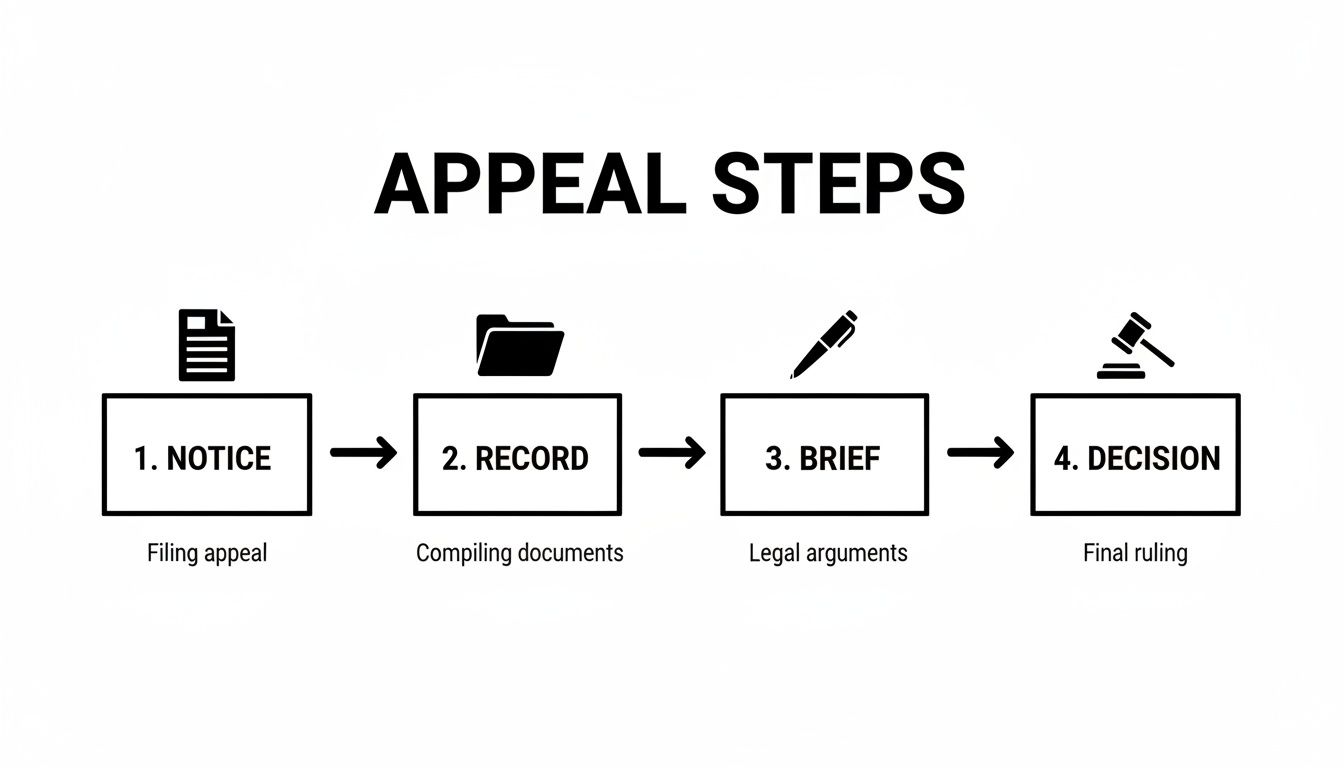
The process is methodical, moving from one phase to the next until a final decision is reached.
Step 2: Preparing the Appellate Record
Once the Notice of Appeal is filed, the next step is to assemble the official appellate record. As discussed, this is the only evidence the higher court will review. The record is composed of two key parts:
- The Clerk’s Record: This includes all official documents filed in your case, such as the original petition, motions, and the final judgment.
- The Reporter’s Record: This is the word-for-word transcript of the trial proceedings, prepared by the court reporter.
Your appellate attorney will handle the formal requests for these records and ensure they are complete and accurate, as they form the foundation of your appeal.
Step 3: Briefing
This is the core of the appellate process. Briefing is the formal term for drafting and filing the written legal arguments. Your attorney will meticulously review the appellate record to identify the reversible errors committed by the trial judge.
From this analysis, your lawyer will write a persuasive legal document called an appellate brief.
A brief is a detailed legal argument that combines the facts from the record with relevant statutes and prior case law (precedent) to demonstrate precisely how the trial judge erred and why the law requires the decision to be overturned.
After your brief (the "appellant's brief") is filed, the opposing party files their response brief. Your attorney may then file a final "reply brief" to address their arguments.
Step 4: Oral Argument and Decision
In some cases, the appellate court will schedule an oral argument. This is a formal session where attorneys for both sides appear before a panel of justices to answer questions and clarify the arguments made in their briefs.
After reviewing the record, briefs, and hearing oral argument (if any), the appellate court will issue a written decision, known as an opinion. The court may:
- Affirm the trial court’s decision, meaning the original ruling stands.
- Reverse the decision, meaning you have won the appeal. The case is often remanded (sent back) to the trial court for new proceedings consistent with the appellate court's instructions.
- Modify the judgment by changing part of the order while leaving the rest intact.
This structured process ensures every appeal receives a thorough and impartial review based strictly on the law and the trial record.
How an Appellate Attorney Can Fight for You
When a trial ends with an unjust result, you have the right to seek a fair outcome through the appeals process. Challenging a court's decision, however, requires a different set of skills and a deep understanding of appellate procedure. An experienced appellate attorney serves as your advocate, focusing exclusively on identifying and correcting the legal errors that led to the unfair ruling.
Our first step is to conduct a comprehensive review of the entire trial record—every document, exhibit, and word of testimony. We are searching for a specific type of mistake: a reversible error. This meticulous investigation is crucial because an appeal is not a second trial; the appellate court's review is limited to the existing record. This is why a perfect written record is essential, and why many legal teams use dedicated legal transcription services to ensure accuracy.
Building a Winning Legal Argument
Once we identify a reversible error, we construct the formal legal argument that will form the basis of your appeal. This is presented in a meticulously researched and written document called an appellate brief. The brief connects the facts of your case to established Texas law and legal precedent to prove that the trial judge's mistake in your parental alienation Texas case amounted to an abuse of discretion—a decision so legally flawed that it cannot be allowed to stand.
Our mission is to translate your sense of injustice into a powerful, persuasive legal argument designed to convince a panel of appellate justices that the trial court's ruling was not just unfair, but legally wrong. A skilled family law appeal attorney has the strategic experience to navigate this complex process and fight for the correct result.
If you believe the court made a mistake in your family law case, our appellate attorneys can help you seek a fair outcome. Contact The Law Office of Bryan Fagan today for a free consultation.
Your Questions About Texas Parent Alienation Appeals, Answered
After a difficult trial results in an unfair order, it is normal to have questions about your options. The appellate process can seem complex, but understanding the basics can provide clarity and a sense of control. Here are plain-English answers to some of the most common questions we receive from clients considering an appeal in a parental alienation Texas case.
What Is the Deadline to Appeal a Family Court Order in Texas?
This is the most critical question because the deadline is strict and unforgiving. In most Texas family law cases, you have only 30 days from the date the judge signs the final order to file a Notice of Appeal.
If you miss this 30-day deadline, you almost certainly forfeit your right to challenge the court's decision. Because this timeline is so short, it is vital to contact an appellate attorney as soon as you receive a final order that you believe is legally incorrect.
Can I Introduce New Evidence of Alienation on Appeal?
No. This is a common misconception. An appeal is not a new trial or a second opportunity to present your case.
The appellate court is limited to reviewing the official appellate record from the trial court. This record includes the documents filed in your case and the word-for-word transcript of the trial proceedings. You cannot introduce new evidence, such as recent text messages or testimony from a new witness. The purpose of an appeal is to argue that the trial judge made a legal error based on the evidence that was presented at the time.
A core concept here is "reversible error." This isn't just about disagreeing with the outcome. It's a specific, significant legal mistake that likely led the judge to make the wrong decision. A successful appeal hinges on proving that kind of error happened.
What Does "Abuse of Discretion" Mean?
In Texas family law, trial judges are given significant discretion in making decisions about children. On appeal, their rulings are reviewed under a standard called abuse of discretion. This legal term does not mean the judge was personally abusive. It means the judge made a ruling that was arbitrary, unreasonable, or made without reference to guiding legal rules or principles.
To win an appeal based on this standard, it is not enough to show that the appellate court might have ruled differently. You must prove that the trial judge's decision was so contrary to the facts or the law that it was legally indefensible. For example, if a judge ignored overwhelming and undisputed evidence of parental alienation without providing a valid reason, that ruling could be considered an abuse of discretion.
How Long Does a Family Law Appeal Take in Texas?
An appeal is a marathon, not a sprint. The process is thorough and methodical, driven by legal research and writing rather than live testimony. The timeline can vary depending on the complexity of the case and the caseload of the specific court of appeals.
Typically, you can expect the appellate process—from filing the Notice of Appeal to receiving a final written decision—to take anywhere from nine months to over a year. It is a patient and deliberate process designed to ensure a careful and fair review of the trial court's actions.
If you believe the court made a mistake in your family law case, our appellate attorneys can help you seek a fair outcome. Contact The Law Office of Bryan Fagan today for a free consultation at https://familylawcourtappeals.com.