If you are looking at your final divorce decree and feel the court made a profound mistake in dividing your property, you are not alone. You may feel your case was handled unfairly, especially when a home you owned before marriage or land you inherited was treated as a community asset. This feeling often stems from a complex legal issue called commingling.
Commingling occurs when separate property—what you owned before marriage or received as a gift or inheritance—gets mixed with community property acquired during the marriage. This can lead a trial court to mischaracterize your assets, resulting in a property division that is fundamentally unjust. The good news is that the Texas legal system provides a remedy for these kinds of judicial mistakes: the appellate process. An appeal is your opportunity to seek fairness and restore balance.
Why Your Property Division May Have Been Unfair
Does your divorce settlement feel wrong? If you're looking at the final decree and thinking, "this isn't right," especially about your home or other real estate, that feeling often comes from a very real legal issue: the mischaracterization of your property. And more often than not, commingling is the culprit.

It’s a gut-wrenching experience to bring significant assets into a marriage, only to watch a court divide them as if you never owned them in the first place. Many people find themselves in this exact spot, convinced the court simply didn't see or acknowledge their separate property rights. The Texas legal system has a built-in fix for these kinds of judicial mistakes. An appeal exists for this very reason—to correct a trial court's errors and fight for a just outcome.
Understanding Separate vs. Community Property
The entire foundation of a fair property division in Texas rests on a crucial distinction laid out in the Texas Family Code:
-
Separate Property: This is what’s yours and yours alone. It includes assets you owned before you got married. It also covers any property you received during the marriage specifically as a gift or through an inheritance.
-
Community Property: This is the default category. The law presumes that anything and everything you or your spouse acquired while married is community property, belonging equally to both of you.
The real trouble starts when these two distinct types of property get tangled up. Let's say you owned a house free and clear before you said, "I do." That's your separate property. But then, for the next 10 years, you used money from your joint marital bank account (community property) to pay for a major kitchen remodel, property taxes, and insurance. Just like that, you've commingled the asset.
Reversible Error: A common reversible error occurs when a trial court ignores clear evidence of an asset's separate character and mischaracterizes it as community property. This fundamental mistake can lead to a manifestly unjust division of assets that an appellate court can and should correct.
This mixing of funds makes it incredibly hard for a trial court to sort out what's what. If the evidence wasn't presented with perfect clarity, or if the judge simply got the law wrong, your separate real estate could be mistakenly split down the middle. This is where a skilled appellate attorney becomes essential. They can comb through the trial record, pinpoint these specific legal errors, and build a powerful argument showing why the judge’s decision was legally flawed. An appeal isn’t just a second chance—it's a critical opportunity to seek the just and right outcome you deserved from the start.
The Legal Test for Commingled Property in Texas
When a Texas court decides whether a piece of real estate is separate or community property, the decision must be rooted in specific legal rules laid out in the Texas Family Code. If you suspect the trial court got it wrong and misclassified your property, understanding this legal framework is the first step in building a solid appeal.

Two core principles guide every property characterization decision in Texas. A trial court's failure to apply either of these correctly can be a major legal error—and powerful grounds for an appeal.
Understanding the Standard of Review: The Inception of Title Rule
The first, and most foundational, rule is the inception of title doctrine. This legal standard is simple but absolute: an asset's character as separate or community property is locked in the very moment you first acquire rights to it. What happens later doesn't change its fundamental nature.
Let's say you signed a contract to buy a condo the week before your wedding. That condo is your separate property. It doesn't matter if you closed on it after you were married or if every single mortgage payment for the next 20 years came from community funds. The condo itself always remains your separate property. The community estate might have a claim for reimbursement for all those payments, but the asset's core identity never changes.
One of the most common reversible errors we see is a trial judge mistakenly deciding that years of community contributions somehow transformed the property's ownership. An appellate court can, and should, correct this misapplication of the law.
The Community Property Presumption
The second critical rule is the community property presumption. Texas law automatically presumes that all property in your possession when you get divorced is community property. This is the starting line for every judge in every case.
This presumption shifts a heavy burden squarely onto your shoulders. It's up to you to prove that an asset—like a house or a piece of land—is actually your separate property. If you can't produce enough evidence to do so, the presumption holds, and the court will divide the asset as part of the community estate.
Plain English Definition: Think of it like trying to un-mix paint. Once you pour blue paint (your separate funds) into a bucket of red community paint (marital funds) to buy a house, you can't just scoop the blue back out. You have to provide a clear, almost scientific formula—a process called tracing—to prove exactly which molecules are still blue. Without that proof, the court will treat the entire bucket as purple community property.
To overcome this powerful presumption, you must present clear and convincing evidence. This is a much higher legal hurdle than the "preponderance of the evidence" standard used in most other civil cases. It means your proof has to be strong enough to create a firm belief or conviction in the judge’s mind that what you're claiming is true.
If you presented solid tracing evidence at trial and the judge either ignored it or ruled against you anyway, that could be an abuse of discretion. This is a key basis for a property division appeal. Our appellate attorneys are experts at combing through trial records to pinpoint where a court may have disregarded compelling evidence, leading to a profoundly unjust result.
To put these concepts into perspective, here's a quick reference for how Texas property claims work.
Texas Property Claims at a Glance
| Legal Concept | Default Presumption | Who Must Prove It | Required Standard of Proof |
|---|---|---|---|
| Separate Property | All property is presumed to be community property. | The spouse claiming the property as separate. | Clear and Convincing Evidence |
| Reimbursement | No presumption. The claim must be specifically pleaded. | The spouse seeking reimbursement. | Preponderance of the Evidence |
| Economic Contribution | No presumption. The claim must be specifically pleaded. | The spouse seeking contribution. | Preponderance of the Evidence |
| Fraud on the Community | No presumption. The claim must be specifically pleaded. | The spouse alleging fraud. | Preponderance of the Evidence |
This table shows just how high the stakes are for proving separate property compared to other financial claims in a Texas divorce.
If you believe the court made a mistake in your family law case, our appellate attorneys can help you seek a fair outcome. Contact The Law Office of Bryan Fagan today for a free consultation.
How Separate Real Estate Gets Mixed Up in a Marriage
It’s surprisingly easy for separate property to get tangled up with community funds during a marriage. Most of the time, it’s not intentional. It happens through the normal, everyday financial decisions a couple makes, like paying the mortgage on a pre-marital home out of a joint checking account.
These simple acts don't automatically flip a separate asset into community property, but they do weave a complex financial knot. A trial judge has to carefully untangle it. If they don't, that failure can become a powerful basis for an appeal.
Using Community Funds for a Separate Property Mortgage
This is probably the most common way commingling happens. Let's say you bought a house years before you met your spouse. That house is your separate property, period. Texas law is clear on that—it’s called the inception of title rule.
But after you get married, the mortgage payments start coming out of a joint bank account where you both deposit your paychecks. Every single one of those payments gives the community estate a tiny foothold in your separate property. The house itself doesn't become community property, but the community now has a right to reimbursement for the money it paid down on the loan principal.
A judge can't just ignore this. They have to calculate the community’s contribution and make sure the community estate gets its money back. Simply splitting the home’s total equity as if it all belonged to the marriage is a misapplication of the law and grounds for an appeal.
Funding Improvements with Marital Money
Here’s another classic scenario. You inherit your family’s lake cabin—your separate property—but it’s a bit of a fixer-upper. Over the years, you and your spouse use $75,000 from your joint savings to put on a new roof, remodel the kitchen, and build a deck.
Those community-funded improvements boosted the value of your separate property. Because of that, the community estate has a solid claim to get that $75,000 back. A trial court has to acknowledge that contribution. If the judge awards you the entire enhanced value of the cabin without reimbursing the community, or worse, decides the whole cabin is now community property, that’s a legal error ripe for appeal.
A core principle in Texas family law is that the community estate deserves to be paid back for contributions that enhance a separate asset. The claim is for the actual funds spent, not necessarily the resulting increase in market value, unless a specific economic contribution claim is proven.
Refinancing a Separate Property in Both Names
Refinancing can really muddy the waters. Imagine you decide to refinance the mortgage on your pre-marital home to get a better interest rate. To qualify, you add your spouse’s name to the new loan.
While this doesn’t magically change the house into community property (thanks again, inception of title rule), it creates confusion. A trial court might mistakenly see this as a "gift to the community." And with both spouses on the hook for the new debt, the argument for community claims gets a lot stronger. It's vital to understand the details of a divorce loan assumption, because a judge's misunderstanding of a refinance can lead to a deeply unfair property division.
Recognizing these patterns in your own divorce is the first step. When you can pinpoint exactly where the trial court went wrong in untangling your assets, you’ve found the foundation for a strong appeal.
How to Trace and Prove Your Separate Property Claim
When you walk into a Texas divorce court and claim a piece of real estate is your separate property, the judge essentially says, "Prove it." The burden of proof is entirely on you. You can't just state that the house was yours before the marriage; you have to show them, with an unbroken financial trail, exactly how that asset has remained separate.
This process is called tracing, and it’s the cornerstone of overcoming the powerful community property presumption in Texas.
Think of it as forensic accounting for your marriage. Your job is to follow the money, step-by-step, from its origin as a separate asset all the way to its current form. It takes organization, precision, and an unshakeable paper trail. So many separate property claims fall apart at trial precisely because the tracing was sloppy or incomplete. For an appellate attorney, a poorly executed tracing analysis is often a bright, flashing sign of a reversible error.
The journey from separate to commingled property can be simple on the surface but complex underneath.
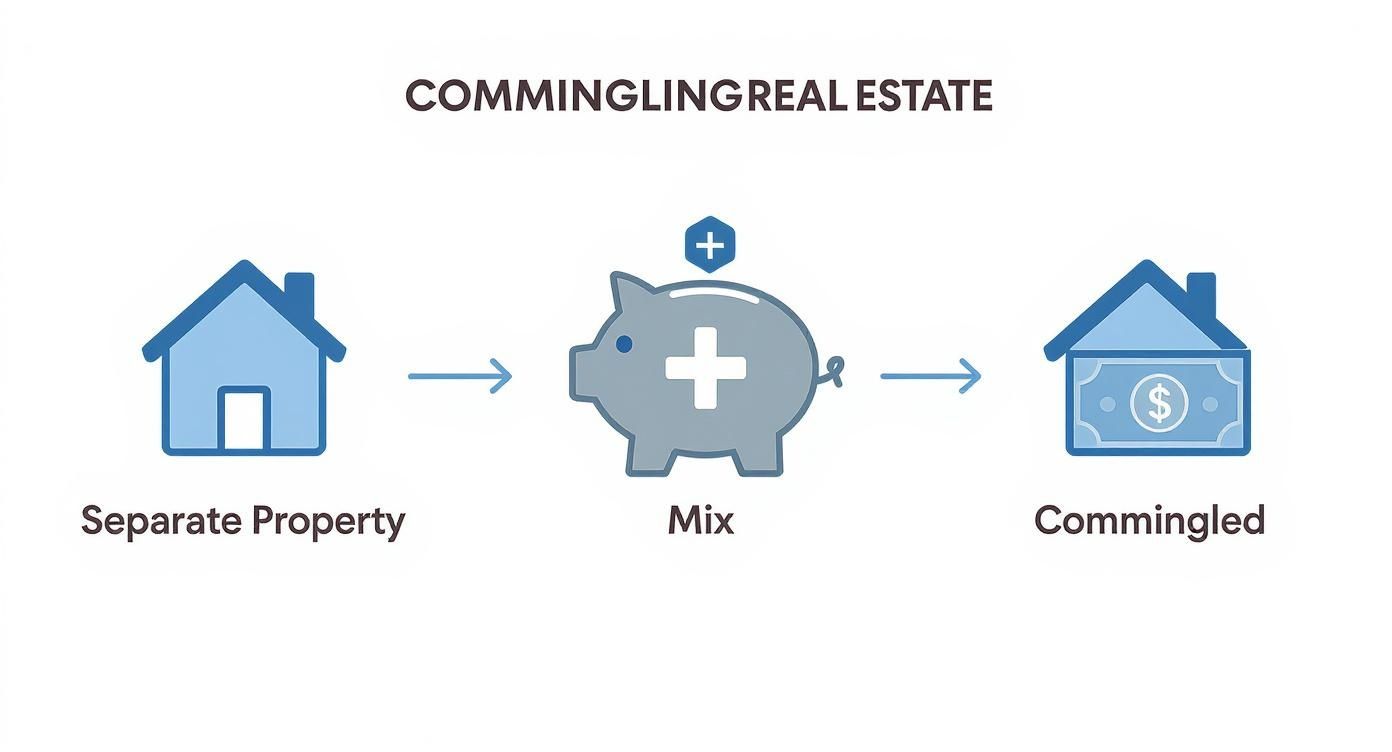
As this visual shows, the moment community funds touch a separate asset, you've created a commingled property that requires a careful legal and financial untangling.
Gathering the Essential Evidence
A tracing claim is built on a mountain of paper. Without comprehensive records, your claim is just a story, not a legal argument backed by facts. The first, and arguably most important, step is gathering every relevant document using thorough and secure data acquisition methods.
Your legal team will need to collect and organize records going back years, sometimes decades:
- Deeds and Closing Statements: These establish the "inception of title," proving exactly when and how the property was first acquired.
- Bank and Investment Account Statements: You'll need statements from before, during, and after the purchase to create a clear timeline of how funds moved.
- Inheritance or Gift Documents: A will, trust instrument, or even a clear letter from the person who gave you the money can be critical to proving its separate origin.
- Mortgage Statements: These are vital for tracking payments and calculating any potential reimbursement claims the community might have.
- Tax Returns: These can sometimes offer supporting clues about how an asset was treated financially during the marriage.
This meticulous data gathering is the raw material you need to build a compelling financial narrative for the judge. And this isn't just a personal issue; it reflects broader market trends. With global real estate deal values recently growing by 11% to around $707 billion, the sheer volume of investment activity means commingling scenarios are becoming more complex than ever.
Understanding Common Tracing Methods
Once all the documents are in hand, the real work begins. Texas courts have approved several methods for untangling commingled funds, and the right approach depends on the specific facts of your case. One of the most common is the "community-out-first" rule.
Plain English Definition: The community-out-first rule is a legal presumption that says when money is spent from a commingled account, community funds are spent first. This leaves the separate property funds untouched for as long as possible.
This is a helpful starting point, but it still requires a painstaking, transaction-by-transaction analysis of the entire account history.
For instance, say you deposit $50,000 of inherited money into a joint account that already holds $10,000 of community funds. The total is now $60,000. If your spouse then pays a $5,000 credit card bill from that account, the court presumes that money came from the community portion. Your separate funds are presumed to remain safe. The catch? If that account balance ever drops below your initial $50,000 separate property deposit, those separate funds are gone for good—you can't replenish them with later community deposits.
The Role of a Forensic Accountant
Let's be blunt: tracing commingled real estate is rarely a DIY project. It’s often far too complex for lawyers and judges to tackle on their own. This is exactly why a forensic accountant can be the most valuable player on your legal team.
These financial detectives specialize in digging through complex financial data and presenting their findings in a way that is clear, credible, and persuasive to a court.
A forensic accountant will:
- Analyze years—or even decades—of financial records with an expert eye.
- Create clear charts and summaries that make complicated transactions easy for a judge to follow.
- Provide powerful expert testimony at trial to explain the tracing analysis and defend their conclusions.
- Accurately value the property, which is essential for a just and right division. To understand this better, you can get more details on the professional appraisal for divorce and its impact.
When a case comes up on appeal, that forensic accountant’s report and testimony are a permanent part of the trial record we review. If we find that the trial court ignored or dismissed this expert evidence without a valid reason, it can be a clear abuse of discretion—and that’s often a winning argument on appeal.
Appealing an Unfair Property Division in Texas
So, you’ve been through a divorce, and you feel the court got it wrong. The judge looked at your separate property, saw the commingled funds, and wrongly classified it as community property. It’s a gut-wrenching feeling, especially when you feel like your evidence was overlooked or the judge just didn't grasp the financial complexities.
This is exactly why the appeals process was created. An appeal isn't a do-over of the trial; it’s a focused review designed to correct legal errors that led to a deeply unfair result.
As appellate attorneys, our job is to comb through the trial record, pinpoint where the court went off track, and build a powerful argument showing how that mistake resulted in a property division that is, in legal terms, manifestly unjust.
Understanding the Grounds for an Appeal
In a commingling case, you don't get to re-argue the facts on appeal. The battle has to be fought on legal grounds. The appellate court is looking for specific mistakes the trial judge made, and the entire analysis hinges on a couple of key concepts.
- Abuse of Discretion: This is the legal standard. It sounds harsh, but it simply means the judge made a decision that was unreasonable, arbitrary, or completely disconnected from guiding legal principles. For example, if your forensic accountant presented a perfect tracing report and the judge tossed it aside without a valid reason, that’s a potential abuse of discretion.
- Reversible Error: This isn’t just any mistake. It’s an error so significant that it almost certainly led to the wrong outcome. Mischaracterizing your separate property home as community property just because of commingled mortgage payments is a classic reversible error.
Our work is to craft a compelling legal argument—called a brief—that walks the appellate court through the trial record, shows them exactly where the judge erred, and explains precisely why that error must be fixed.
Common Reversible Errors in Commingling Cases
When trial courts get commingling cases wrong, the mistakes often fall into a few familiar patterns. If any of these sound like what happened in your case, you may have strong grounds for an appeal.
Here are some of the most frequent errors we see:
- Ignoring Clear Tracing Evidence: The judge simply disregards a well-documented report that traces the separate funds used for a down payment or improvements.
- Misapplying the Inception of Title Rule: The court mistakenly concludes that refinancing a home and adding a spouse's name to the mortgage somehow converted the property from separate to community.
- Confusing Reimbursement with Ownership: Instead of just ordering the community to be reimbursed for its contributions, the judge divides the entire equity of the separate property home.
- Failing to Apply the "Clear and Convincing" Standard Correctly: The court holds the spouse claiming separate property to an impossibly high burden of proof, demanding a level of certainty the law just doesn't require.
These aren't minor technicalities. They are fundamental mistakes that can cost you hundreds of thousands of dollars in assets. The process for appealing a divorce decree is structured to correct these very kinds of injustices.
The Appellate Process Step by Step
Challenging a judge's decision follows a very structured path laid out in the Texas Rules of Appellate Procedure. It can seem intimidating, but at its core, it's a logical process designed to ensure a fair review.
- Filing the Notice of Appeal: This is the first critical step. It officially starts the process and must be filed within a very strict deadline—usually 30 days from when the final judgment is signed. Miss it, and you lose your right to appeal.
- Preparing the Appellate Record: We work with the court to assemble the official record from your trial. This includes the clerk’s record (every document filed) and the reporter’s record (the word-for-word transcript of testimony). This record is the entire universe for the appellate court; they can't consider anything outside of it.
- Briefing: This is the heart and soul of the appeal. We write a detailed, persuasive legal brief that lays out the facts, cites relevant case law and statutes, and methodically argues how the trial judge committed reversible error.
- Oral Argument: In some cases, the court of appeals will schedule a hearing for attorneys to argue their case in person. It’s a chance to clarify points from the brief and directly answer the justices' questions.
- The Court's Decision: After reviewing everything, the appellate court issues a written opinion. It can either affirm the trial court’s decision, reverse it and send the case back for a new trial, or, in rare instances, render a new judgment itself.
The complexities of commingling in real estate aren't just a headache for divorcing couples; they also challenge large-scale investment strategies. From a risk management standpoint, commingling in real estate funds creates significant issues with liquidity and transparency. For context, global commercial real estate transactions recently hit $193 billion in a single quarter, showing the massive sums of money flowing through similarly tangled financial structures. Discover more insights about these global real estate trends on marketsgroup.org.
If you’re convinced the trial court failed to properly untangle your commingled assets, a strategic, well-argued appeal is your most powerful tool for achieving a just and right outcome.
Common Questions About Commingled Property and Appeals
When you’re dealing with property division, divorce, and your personal finances all at once, things get complicated fast. It’s only natural to have a lot of questions. And when you suspect a court has made a mistake with your most important assets, you need answers you can actually understand.
Here are some of the most common questions our appellate attorneys get about commingling in real estate. Our goal is to help you see the road ahead and understand your options for getting a fair result.
What Happens if I Used Inherited Money for a Down Payment?
This is a textbook example of a commingling issue. In Texas, any money you inherit is your separate property, period. The challenge is proving it. If you can show a clear paper trail—tracing the funds directly from the inheritance into the down payment on the marital home—that chunk of the home's equity should be legally recognized as yours alone.
So, what about all the mortgage payments made over the years with community funds? That doesn't change the separate nature of your initial investment. Instead, the community estate typically gets what's called a reimbursement claim for the money it put toward the principal on the loan. If a trial judge fails to separate your down payment from the community's claim for reimbursement, that’s a major legal mistake and a powerful reason to appeal.
Does My Pre-Marital House Become Community Property If We Lived in It?
No. Just living in a house you owned before the wedding doesn't magically turn it into community property. Texas law is crystal clear on this, thanks to the inception of title rule. The character of an asset is determined when you first acquire it. What was yours before you got married stays yours.
But, as with most things in law, there’s a catch. If you used community funds during the marriage to pay the mortgage or make significant improvements—like a new roof or a full kitchen remodel—things get more complex. Your spouse doesn’t get ownership, but the community estate may have a right to be paid back for enhancing the value of your separate property. A judge has to calculate this correctly. Simply calling the whole house "community property" is a huge, reversible error.
Is It Too Late to Fix This If My Divorce Is Final?
Maybe not, but you have to move incredibly fast. The deadlines to appeal a Texas divorce decree are non-negotiable. You typically have only 30 days from the moment the judge signs the final order to file a Notice of Appeal. If you miss that window, your right to challenge the court’s decision is usually gone for good.
The first thing an appellate lawyer will do is dig into the official trial record. This includes every document filed in your case and a word-for-word transcript of everything said in court. A successful appeal depends on finding a legal error in that record that led directly to an unfair and unjust division of your property.
Ownership vs. Reimbursement: This is a crucial distinction that can make or break a case. An ownership claim says, "That asset, or a piece of it, is mine." A reimbursement claim says, "The community paid for something and should get its money back." Confusing these two separate legal concepts is a common mistake and a frequent reason for a successful appeal.
What Is the Difference Between Reimbursement and an Ownership Claim?
Getting this right is absolutely essential. It’s a concept that even trial courts sometimes bungle, leading to wildly unfair outcomes.
Here’s the breakdown:
- An ownership claim is an argument that a specific asset (or a defined percentage of it) is your separate property. You have to prove this with "clear and convincing" evidence, which is a high bar.
- A reimbursement claim, on the other hand, is a request for payback. It’s an argument that the community estate spent its own money to pay down debt or make improvements on one spouse's separate asset, and it deserves to be repaid.
Think of it this way: if the community pays $100,000 toward the mortgage on a home that is your separate property, the community doesn't suddenly own $100,000 of your house. It simply has a right to be reimbursed for that $100,000 contribution. An appellate court can, and should, step in to correct a trial judge who incorrectly awards an ownership stake instead of calculating the proper reimbursement.
If you believe the court made a mistake in your family law case, our appellate attorneys can help you seek a fair outcome. Contact The Law Office of Bryan Fagan today for a free consultation at our family law appeals website.