
You may feel your case was handled unfairly. When a family court judge issues a ruling that seems fundamentally wrong—whether in your Texas divorce, a child custody determination, or a complex property division dispute—the sense of injustice can be overwhelming. A final order that ignores the facts or misapplies the law can leave you feeling powerless. However, it is critical to understand that the trial court’s decision does not have to be the final word.
Appealing a family court decision is a strategic legal process designed to correct significant errors made by a trial judge. It is not a second trial or a “do-over,” but a focused review by a higher court to ensure the law was applied correctly and fairly.
What to Do When a Court Ruling Feels Wrong

The moment you receive a final order that defies logic, especially when your children’s well-being or your financial security is at stake, is deeply discouraging. The good news is that the Texas legal system provides a path to challenge an unjust result.
Appealing a family court order means you are formally asking a higher court—the court of appeals—to scrutinize the trial court’s actions for legal mistakes. This process does not involve presenting new evidence or re-arguing the facts of your case. Instead, it is a meticulous review of the existing trial record to determine if a “reversible error” occurred.
Understanding the Purpose of an Appeal
A reversible error is not merely a decision you disagree with. It is a legal mistake so significant that it likely caused the trial court to reach the wrong conclusion. If the appellate court does not find such an error, it will not overturn the decision, even if the appellate judges might have ruled differently. Proving that a specific legal misstep occurred is the central objective of an appeal.
Common questions that drive a family law appeal include:
- Did the judge misinterpret or misapply a key provision of the Texas Family Code?
- Was a critical piece of evidence improperly excluded, or was unreliable evidence wrongly admitted?
- Did the final order regarding child custody or property division disregard established legal precedent?
An appeal serves as a vital check on the trial court’s authority. Its purpose is to ensure that life-altering decisions are grounded in a correct interpretation of the law and a fair evaluation of the evidence presented.
This guide will clarify the Texas appellate process, explaining what constitutes a “reversible error,” how to navigate strict deadlines, and how a strategic appellate plan can restore balance. Our goal is to provide the clarity you need to decide if an appeal is the right path for your family. A devastating ruling does not have to be the end of your story.
Identifying Grounds for a Family Law Appeal
An appeal is not a second chance to present your case to a new judge. Think of it as a review of the original proceeding, where a higher court examines the trial judge’s decisions for specific legal mistakes. Your entire appeal must be built on a reversible error—a legal mistake so significant that it likely led to an improper judgment.
The appellate court will not hear new testimony or consider new evidence. A panel of justices will carefully review the existing trial record—transcripts, exhibits, and all official documents—to determine if the trial judge made a legal error. Without a clear error documented in that record, an appeal cannot succeed.
Misapplication of Texas Law
One of the most common grounds for appeal is when a judge misinterprets or misapplies the Texas Family Code or established case law. Family law is governed by a complex set of statutes that dictate everything from how community property is divided to what is in a child’s best interest.
For example, if a judge divides a family business equally but fails to account for one spouse’s separate property (like an inheritance) that was used to fund the business, this is a clear misapplication of Texas property law. Similarly, a judge who bases a custody decision primarily on a parent’s gender, without properly weighing all the legally required “best interest” factors, has committed a reversible error.
Errors in Evidence
The rules of evidence exist to ensure court decisions are based on reliable and relevant information. When a judge makes a mistake by either admitting improper evidence or excluding valid evidence, it can fundamentally alter the outcome of a case and create strong grounds for an appeal.
Consider these examples:
- Improperly Admitting Evidence: A judge allows a witness to testify about second-hand information (hearsay), such as what a friend told them your spouse said. This is generally inadmissible.
- Wrongfully Excluding Evidence: A judge refuses to admit financial records that clearly demonstrate a spouse was hiding assets, preventing a just and right division of property.
If your trial attorney made a timely objection to these errors, “preserving” the issue for appeal, you can argue that the mistake led to an unjust ruling.
Understanding “Abuse of Discretion”
Many decisions in family court, particularly those involving children, are left to the trial judge’s discretion. However, this power is not unlimited. An “abuse of discretion” occurs when a judge makes a decision that is arbitrary, unreasonable, or without any regard for guiding legal principles.
It is not enough that the appellate court simply would have decided the case differently. An “abuse of discretion” means the trial judge’s decision was so far outside the bounds of reason that it constitutes a legal error.
For example, a judge who severely restricts a parent’s visitation based on a single, uncorroborated allegation, despite substantial evidence of that parent’s positive involvement, may have abused their discretion. A ruling with no factual basis in the record is a prime candidate for being overturned. To learn more about this and other potential appellate issues, you can review the specific grounds for an appeal in family court.
Family courts operate under immense pressure, which can sometimes lead to errors. Identifying these specific, legally recognized mistakes is the first and most critical step in the appellate process.
Navigating Critical Deadlines and Procedures
The Texas appellate process operates on a strict and unforgiving schedule. Unlike in trial court, where extensions may be possible, appellate deadlines are firm. Missing a deadline can result in the permanent loss of your right to appeal, regardless of the merits of your case.
The clock starts ticking the moment the judge signs the final order. This initial period is critical, requiring swift and precise action to preserve your rights.
First Things First: The Notice of Appeal
The first essential step is filing a Notice of Appeal. This document formally notifies the trial court, the opposing party, and the appellate court that you are challenging the decision.
Under the Texas Rules of Appellate Procedure, you generally have only 30 days from the date the final judgment is signed to file this notice. While certain post-judgment motions, like a Motion for New Trial, can extend this deadline to 90 days, this extension is not automatic and requires a timely and strategic legal filing.
Key Takeaway: A Notice of Appeal is the key that unlocks the door to the court of appeals. Filing it on time is the single most important first step in the entire process.
This is precisely why you should contact an appellate attorney as soon as you receive an unfavorable final order. They understand these deadlines and can ensure this foundational step is handled correctly, preventing a procedural misstep from ending your appeal before it begins.
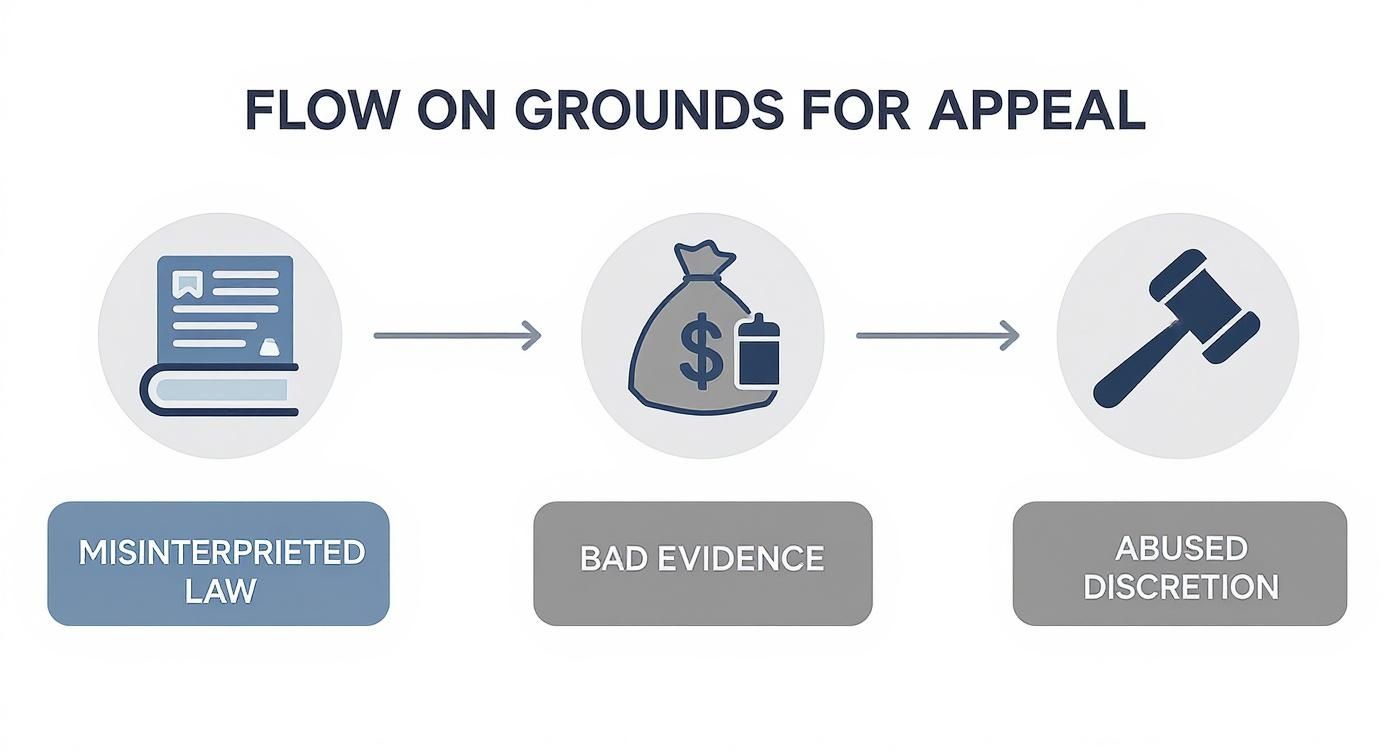
As shown, a successful appeal is about proving the judge misapplied the law, relied on improper evidence, or made a decision so unreasonable that it amounts to an abuse of discretion.
Key Deadlines for Filing a Texas Family Law Appeal
A summary of the critical initial deadlines you must meet to begin the appellate process in Texas. Missing these can result in the loss of your right to appeal.
| Action Item | Typical Deadline (Post-Judgment) | Purpose |
|---|---|---|
| Motion for New Trial | 30 Days | Extends the Notice of Appeal deadline to 90 days and gives the trial judge a chance to reconsider. |
| Notice of Appeal | 30 Days (or 90 Days if a timely post-judgment motion is filed) | Officially initiates the appeal and gives the appellate court jurisdiction over your case. |
| Request for Findings of Fact and Conclusions of Law | 20 Days | Asks the trial judge to explain the legal and factual basis for their decision, which is crucial for the appeal. |
These are just the initial hurdles. Each represents a potential pitfall, highlighting the importance of having an expert guide you through the process.
Building the Case File: The Appellate Record
After the Notice of Appeal is filed, the next task is to assemble the appellate record. This is the official case file that the appellate justices will review. Because the justices were not present in the courtroom, the record is their only window into your case.
The appellate record consists of two main parts:
- The Clerk’s Record: This contains all documents filed in your case, including the original petition, motions, discovery responses, and court orders.
- The Reporter’s Record: This is the official transcript of everything said in court, prepared by the court reporter.
You must formally request and pay for the preparation of these records. It is essential that the record is complete. If a crucial objection was made during trial but is not reflected in the transcript, from the appellate court’s perspective, it never happened.
An experienced appellate attorney will meticulously review the record to ensure every document, exhibit, and line of testimony needed to prove the trial court’s errors is included. A sloppy or incomplete record can undermine even the most compelling legal argument. While every case is unique, understanding these procedural steps can help set realistic expectations, which is also important when considering how long it takes to process a divorce in Texas.
How an Appeal Is Different from a Trial
After a difficult trial, it is natural to wish for another chance to tell your story to a different judge. However, it is crucial to understand that an appeal is not a new trial.
There are no witnesses, no new evidence, and no jury. An appeal is a scholarly review of what already happened. A panel of appellate justices examines the written record from your case with one goal: to identify significant legal errors made by the trial judge.
The Power of the Written Word
The central battleground of an appeal is the “briefing” process. An appellate brief is a persuasive written argument that methodically outlines the trial court’s mistakes, supported by legal authority.
This document is a sophisticated legal narrative that weaves the facts from your case record with Texas statutes and relevant appellate decisions. The objective is to demonstrate not only that the judge erred, but that the error was harmful and likely led to an improper outcome. The opposing party files its own brief in response, and the case is decided almost entirely on these written submissions. This focus on correcting judicial errors through written review is a cornerstone of our legal system and others worldwide. For example, you can review recent family court reporting from the UK to see similar appellate standards in action.
Understanding the Standard of Review
One of the most important concepts in an appeal is the “standard of review.” This is the lens through which the appellate court examines the trial judge’s actions. It dictates how much deference the appellate justices must give to the original rulings and shapes the arguments your attorney can make.
In Texas family law, two primary standards apply:
- Abuse of Discretion: This standard applies to most custody and property division rulings. To succeed, you must prove the judge acted unreasonably, arbitrarily, or without regard for guiding legal rules. It is a high bar to meet.
- De Novo Review: This applies to pure questions of law, such as when a judge misinterprets a statute. “De novo” means “from the new,” indicating the appellate court looks at the issue with fresh eyes, giving no deference to the trial judge’s conclusion.
A “reversible error” is a legal mistake so serious that it probably caused an unjust outcome. The entire point of your appeal is to convince the higher court that this kind of error happened, all while working within the correct standard of review.
Applying the correct standard of review is non-negotiable. This technical precision is what makes appellate work a specialized skill, focused on disciplined legal analysis rather than courtroom drama.
Forging a Partnership with Your Appellate Attorney

Pursuing a family law appeal is a collaborative effort. A strong partnership with your appellate lawyer is essential for success. While your attorney provides the legal strategy, you are the expert on the history of your case.
From the outset, it is vital to provide your attorney with a complete and honest account of all relevant facts. Every document and detail matters. Often, a small fact from the trial can become the key to a winning appellate argument.
Building the Strongest Argument, Together
Your appellate counsel will meticulously review the official trial record, but your firsthand insights provide crucial context that brings the transcript to life. By understanding the full narrative, your lawyer can more effectively identify subtle errors the trial judge may have made.
Here’s how you can be an invaluable part of the team:
- Organize Your Documents: Gather every pleading, order, email, and financial statement and arrange them chronologically. This saves your attorney time and reduces your legal fees.
- Create a Timeline: A simple timeline of key events can help your attorney quickly grasp the case’s progression and identify where things went wrong.
- Be Completely Transparent: Be honest about all facts, even those you feel are unfavorable. Your attorney needs the full picture to anticipate the opposing party’s arguments and build a strong case.
Your attorney will craft the legal arguments, but you provide the essential raw materials. A full and transparent flow of information is the absolute foundation of a successful partnership on appeal.
This focus on strategic, efficient work is a growing trend in family law. For instance, recent judicial reforms in the UK have aimed to streamline legal processes to benefit all parties. You can read about these judicial improvements to see how this principle is applied elsewhere.
Understanding the Three Potential Outcomes
After the briefs are filed and any oral arguments are heard, the appellate court will issue a written opinion. Your case will have one of three primary outcomes.
1. Affirmance
The court can affirm the trial court’s judgment, meaning it found no reversible error. The original decision stands.
2. Reversal
The court can reverse the judgment, meaning it found a significant legal error that impacted the outcome. The reversal can be complete or partial, affecting only certain parts of the order.
3. Remand
The court might remand the case, sending it back to the trial court with specific instructions for further proceedings. For example, the appellate court might order the trial judge to recalculate a property division using the correct legal standard.
The appellate process is complex, and the stakes for your family are high. Having the right legal partner is crucial. Find out more about how a skilled family law appeal attorney can help build your case and craft the compelling legal narrative needed to pursue a just result.
Common Questions About Texas Family Law Appeals
Facing an unfair court ruling can be confusing, and the thought of an appeal can be overwhelming. Here are answers to some of the most common questions clients ask about the process.
How Long Does a Family Law Appeal Take in Texas?
An appeal is a marathon, not a sprint. The process is deliberate and methodical, so it is important to have realistic expectations. From filing the Notice of Appeal to receiving a final decision, the process often takes a year or more.
Factors that affect the timeline include:
- The Court’s Caseload: The court of appeals in your district handles hundreds of cases simultaneously.
- Case Complexity: An appeal involving a single legal issue will generally move faster than one with a lengthy trial record and multiple complex issues.
- Oral Argument: If the court schedules oral arguments, this can add several months to the timeline.
Does the Original Court Order Stop During My Appeal?
No. This is a critical point. The trial court’s order remains in full force and effect while the appeal is pending.
If you were ordered to pay child support or follow a specific possession schedule, you must continue to do so. Failure to comply can lead to enforcement actions, including contempt of court, even while your appeal is active. In some cases, it is possible to pause the enforcement of certain parts of a judgment (typically financial obligations) by filing a motion to “supersede” the judgment and posting a substantial bond. This is a complex strategic decision, especially when child custody is involved, and should be discussed with your attorney immediately.
What Are My Real Chances of Winning an Appeal?
Winning an appeal is challenging. Appellate courts begin with the presumption that the trial judge’s decisions were correct and give considerable deference to the trial court.
Success requires proving that a reversible error occurred—a mistake so significant that it likely led to an unjust outcome. It is not about convincing the appellate justices that they would have ruled differently. An experienced appellate attorney can provide a realistic assessment of your case’s strengths and weaknesses after a thorough review of the trial record.
Your appeal’s success depends on the cold, hard evidence of legal error in the trial record. An honest, thorough case review is the first step toward understanding your true odds.
For a broader perspective on the importance of precision in legal matters, you might explore various legal use cases that highlight different applications of legal documentation.
What Is the Cost of Appealing a Family Court Decision?
An appeal is a significant financial investment. The primary expenses include:
- Court Filing Fees: Standard fees required to initiate the appeal.
- Preparing the Record: You must pay the court reporter for the trial transcript and the court clerk for compiling the case documents. This can cost several thousand dollars.
- Attorney’s Fees: This is the largest expense, covering the attorney’s time for record review, legal research, and writing the appellate brief.
During a consultation, we can provide a transparent projection of the costs for your specific case, allowing you to make an informed financial decision.
If you believe the court made a mistake in your family law case, our appellate attorneys can help you seek a fair outcome. Contact The Law Office of Bryan Fagan today for a free consultation. You can reach us at https://familylawcourtappeals.com.