You may feel the judge got it wrong. You sat through the hearing, heard the testimony, watched important facts get minimized, and left with the sinking sense that the ruling doesn't fit the evidence.
That feeling matters. But in Texas appellate practice, it isn't enough by itself.
When parents talk about appealing a custody ruling based on insufficient evidence in Texas, the hardest adjustment is mental. Trial court is about persuading the judge who hears the witnesses live. Appeal is about proving, from a closed record, that the ruling cannot stand under the legal standards that govern family-law review. That shift is where many appeals are either built correctly or lost before they begin.
Why a Custody Appeal Is Not a Second Trial
You leave a final custody hearing believing the judge ignored what mattered. You remember the weak answers, the missing documents, the testimony that did not add up. A trial reaction like that is common. An appeal asks a narrower question. It asks whether the result can be defended under the record and the law.
At trial, the court weighs live testimony, reads the room, and decides credibility. On appeal, the judges do not hear the witnesses again or accept new proof. They work from the existing record. In a Texas custody case, that usually means the Clerk's Record and Reporter's Record, then applying a deferential standard of review to what the trial court did.

What abuse of discretion means
In custody appeals, abuse of discretion gives the trial judge a fair amount of room. The appellate court does not ask which parent it would have favored if it had heard the case first. It asks whether the ruling had a reasonable legal and evidentiary basis.
That distinction changes everything.
Clients often tell me, "The judge should have believed me," or, "Their case was paper-thin." Those concerns may point to a real appellate issue, but only after they are translated into legal terms. The court of appeals wants a preserved error, a supporting record, and a standard of review that fits the complaint. A feeling that the evidence was weak is still a trial-level reaction. An insufficiency point on appeal requires a tighter showing, especially in a family-law case involving factual sufficiency review in Texas family-law appeals.
What the appellate court actually reviews
The record controls the case. The Clerk's Record usually contains pleadings, motions, written exhibits that were filed, and the signed orders. The Reporter's Record contains the testimony, objections, rulings, and oral statements made in court. If something important is missing from those materials, the court of appeals usually cannot supply it later.
That is why preservation matters so much in an evidence-based appeal. If counsel did not make the right objection, request findings when they were needed, offer the exhibit, or file the post-judgment motion required for a factual-insufficiency complaint in a bench trial, the argument may be limited or lost. Parents are often surprised by that. They assume the unfairness is obvious. Appellate courts still require the issue to be preserved in a form the rules recognize.
The practical trade-off is hard but real. Trial lawyers often focus on persuading the judge in the moment. Appellate lawyers focus on whether the record will support review months later. The strongest cases do both.
Why this distinction matters strategically
A custody appeal is an error-correction process, not a chance to retell the family story with better emphasis. That can feel unsatisfying, especially when the judge's view of credibility drove the result. Appellate courts rarely disturb credibility calls unless the record creates a legal problem they can act on.
So the question is not whether the other side's evidence felt weak in the courtroom. The question is whether the signed order rests on evidence that fails the governing appellate standard, or on a procedural mistake that probably affected the outcome.
That is also why smart appeals often begin before the notice of appeal is filed. Preservation starts in the trial court. Clear objections, offers of proof, requests for findings of fact and conclusions of law when appropriate, and carefully framed post-judgment motions can make the difference between an argument that sounds compelling and one the court can decide.
Proving Insufficient Evidence The Appellate Standard
Saying “there wasn't enough evidence” is a start. It is not yet an appellate issue. Texas custody appeals are described by family-law sources as rarely granted and reviewed under a deferential abuse-of-discretion standard, which makes pure sufficiency arguments difficult unless they are tied to legal error. Those same sources note that a common mistake is assuming weak evidence alone is enough, when the appellate brief must instead show either legal insufficiency so severe that no reasonable factfinder could reach the ruling, or factual insufficiency so contrary to the great weight of the evidence that the result is clearly unjust. They also note that temporary custody orders are generally not appealable, which creates another common trap if the wrong order is challenged, as explained in McClure Law Group's overview of child custody appeals.
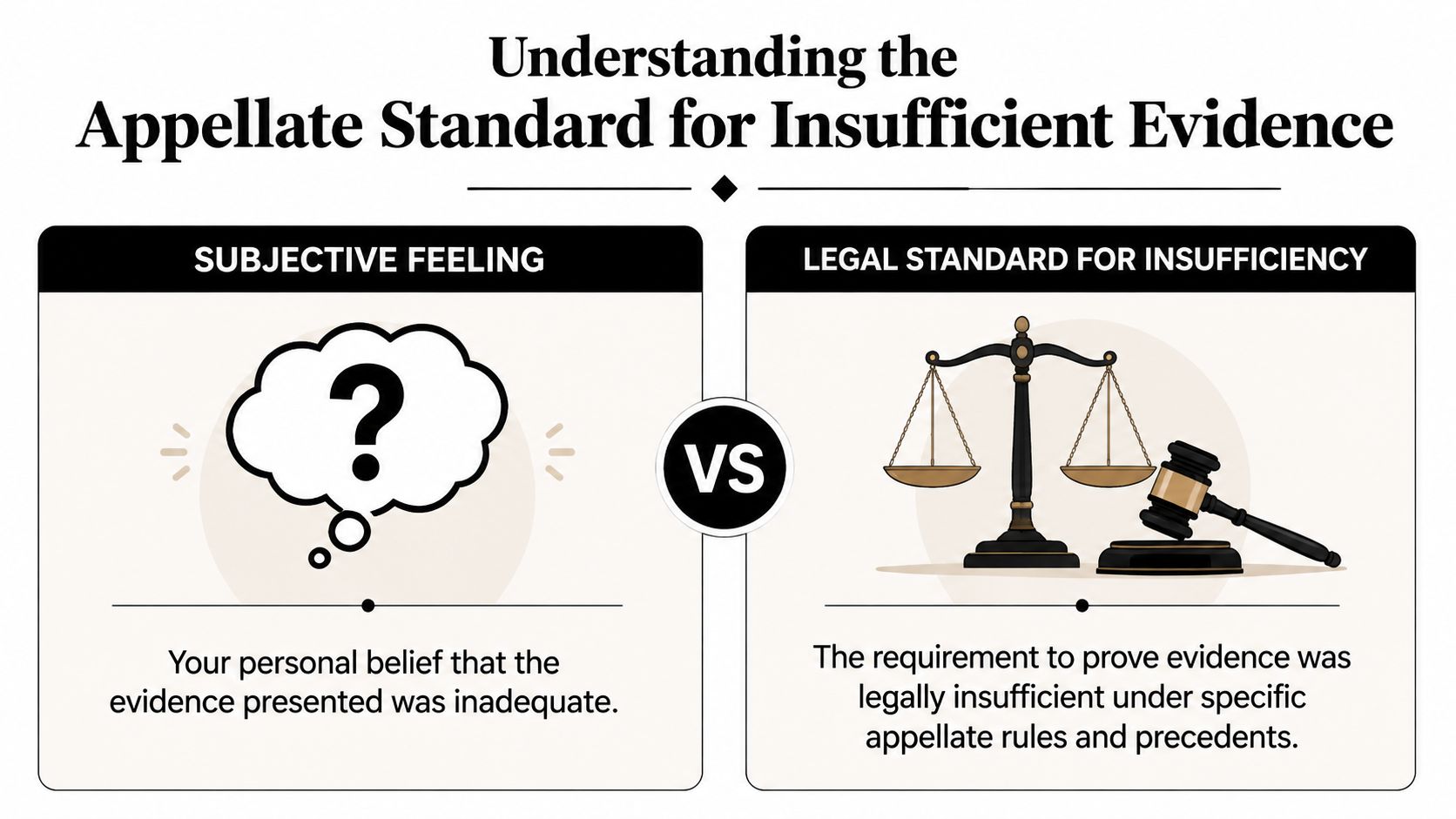
Legal insufficiency and factual insufficiency
These are related ideas, but they are not the same.
A legal insufficiency challenge is often called a “no evidence” challenge. You are arguing that a vital finding has no meaningful support in the record. In plain English, even giving the ruling every reasonable benefit, there still is not enough record support for that finding to exist.
A factual insufficiency challenge is different. It concedes there may be some supporting evidence, but argues that the supporting proof is so weak, or the contrary evidence is so strong, that the result is clearly unjust.
Here is the comparison clients usually need:
| Challenge Type | Legal Standard | What You Argue |
|---|---|---|
| Legal insufficiency | No reasonable factfinder could make the finding on this record | “There is no legally sufficient evidence for this key finding.” |
| Factual insufficiency | The finding is against the great weight of the evidence and clearly unjust | “Some evidence exists, but it is overwhelmed by the contrary record.” |
For a more focused discussion of how these arguments work in family cases, see this guide on a factual sufficiency appeal in Texas family law.
What works and what usually doesn't
The most effective sufficiency arguments are narrow. They target a specific finding that mattered to the outcome. They identify the exact testimony and exhibits that were missing, weak, contradictory, or unsupported.
What usually doesn't work is a broad complaint that the judge “ignored the truth.” Appellate judges expect legal framing, not trial-level frustration.
Strong appellate framing often looks like this:
- Target one necessary finding: If the order depended on a finding about endangerment, parental fitness, decision-making ability, or the child's best interest, the brief should isolate that finding instead of attacking the whole case at once.
- Tie the challenge to the record: Every factual statement needs a citation to where it appears in the transcript or record.
- Connect sufficiency to legal error: In custody appeals, that often matters because abuse-of-discretion review is deferential.
Weak appellate arguments sound like re-argued closing statements. Strong ones sound like careful demonstrations that the record cannot support a necessary finding.
A trial mindset versus an appellate mindset
At trial, lawyers build impressions. They emphasize witness credibility, human detail, and momentum. On appeal, that style alone won't carry the day.
The appellate mindset asks different questions:
- What exact finding supported the custody ruling?
- Where in the record is the proof for that finding?
- Is that proof legally enough?
- If some proof exists, is it so weak that the result is clearly unjust?
- Was the issue preserved in a way the appellate court can review?
That last question is where many promising arguments fail. A parent may be right that the evidence was weak, but if the complaint was not preserved correctly, the appellate court may never reach the merits.
The Critical First Steps After the Ruling
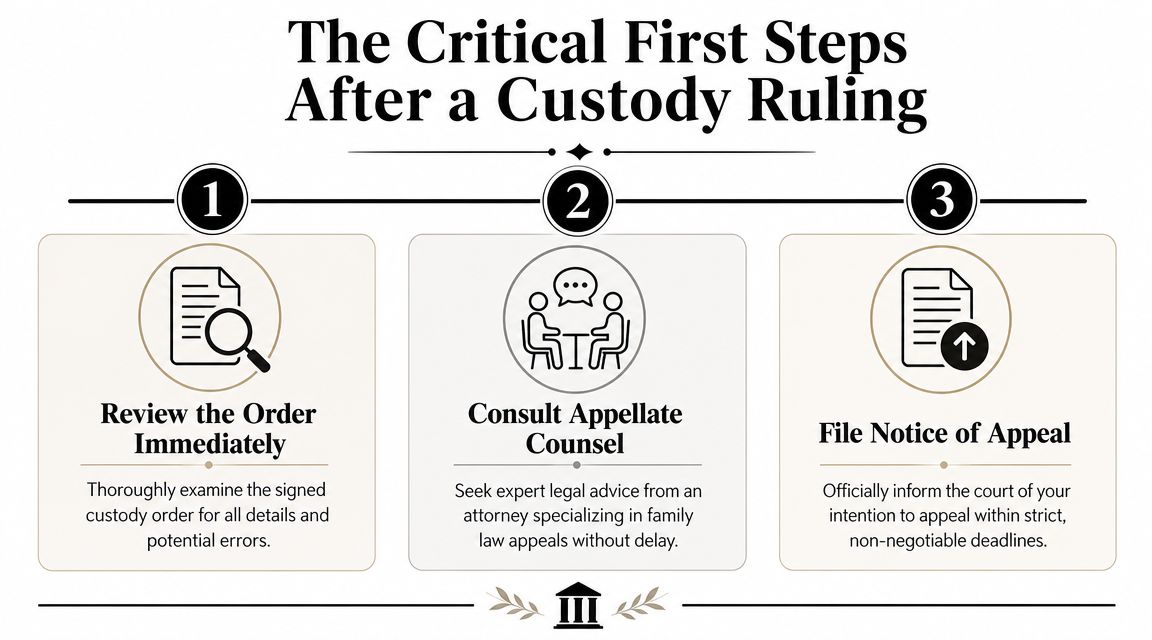
The judge signs the custody order on Friday. By Monday, many parents are still replaying the testimony and asking whether the court really believed that witness. From an appellate standpoint, the better question is narrower and far more useful. What order was signed, what deadlines started running, and did the trial record preserve a legal complaint the court of appeals can effectively decide?
That shift matters. A parent can be completely sincere in saying, “The evidence was thin,” and still lose on appeal if the record does not show the right preserved issue. Appeals are won and lost in that gap between frustration and proof.
Start with the order and the deadline
Once a final custody order is signed, the timetable for appellate action begins. In many Texas cases, the notice of appeal is due quickly, and post-judgment filings can change some deadlines. Waiting to “see what happens” is one of the more common ways parties damage an otherwise arguable appeal.
The first job is simple but technical. Get the signed order, confirm the date it was signed, and determine whether it is final and appealable. In custody litigation, that is not always obvious. Temporary orders, enforcement rulings, and interlocutory decisions often require a different procedural response.
The wording of the order matters too. If the ruling is broad, vague, or internally inconsistent, appellate counsel needs to see that early.
Preservation comes before persuasion
Clients often assume the appellate court will review any point that felt unfair at trial. Texas appellate courts do not work that way. They review complaints that were properly preserved in the trial court and supported by the appellate record.
For an insufficient-evidence challenge, preservation can be more technical than people expect. In a bench trial, that may involve requests for findings of fact and conclusions of law, objections to the lack of a required finding, or a post-trial motion that clearly raises factual insufficiency. In a jury case, preservation may require different steps, such as directed verdict, objections to the charge, or a motion for judgment notwithstanding the verdict, depending on the issue.
A parent who wants to challenge a custody ruling based on weak proof should review the Texas rules on objections required to preserve an appeal as early as possible. That review often answers the hard question quickly. Do you have an appellate issue, or do you mainly have a disagreement with how the judge weighed the witnesses?
The first file review usually focuses on four things
Appellate counsel usually starts with a targeted file review, not a broad retelling of the case. The goal is to find the points that matter under appellate standards.
- The signed order: It tells you what the court decided, not what everyone assumed the court meant.
- The deadline chart: Notice of appeal, findings deadlines, and post-judgment motion deadlines should be calculated immediately.
- The record status: Hearings, exhibits, and transcripts have to be identified and requested. If part of the reporter's record is missing, the insufficiency argument may be much harder to present.
- The preservation trail: Objections, offers of proof, requested findings, and post-trial motions often determine whether the appellate court can reach the merits.
I often tell clients that this stage feels unsatisfying because it is procedural. It is also where strong appeals are built. A careful deadline and preservation review can save a viable issue. A rushed one can lose it.
The record decides what can be argued
The appellate record is usually made up of the Clerk's Record and the Reporter's Record. One contains the filed papers and signed orders. The other contains the testimony, objections, rulings, and admitted evidence.
For an insufficient-evidence appeal, the record is the whole case. The court of appeals will not hear new testimony, consider new documents, or revisit the case because one side now has a better presentation. The question is whether the existing record contains legally sufficient support for the findings that drove the custody ruling, and whether any factual insufficiency complaint was preserved in a way Texas law requires.
That is the practical trade-off after trial. Money spent gathering transcripts, exhibits, and findings quickly is often far more valuable than money spent drafting a long memo about why the judge was wrong in a general sense.
What you should do immediately
A disciplined first response helps more than an emotional one.
- Get the signed order: Make sure it is the filed, signed version.
- Collect every hearing date and court reporter name: Custody cases often involve multiple settings over months.
- Preserve the paper trail: Keep filed motions, requests, exhibits, and any notice from the clerk.
- Ask trial counsel what was requested after trial: Findings, objections, and post-judgment motions can matter as much as the hearing itself.
- Write down the findings that seem unsupported: Focus on specific points such as endangerment, best interest, conservatorship limits, or possession restrictions.
That last step helps clients make the mental shift appellate courts require. “The judge got it wrong” is not yet an appellate issue. “The record does not support this necessary finding, and the complaint was preserved” is the beginning of one.
Building Your Case in the Appellate Brief
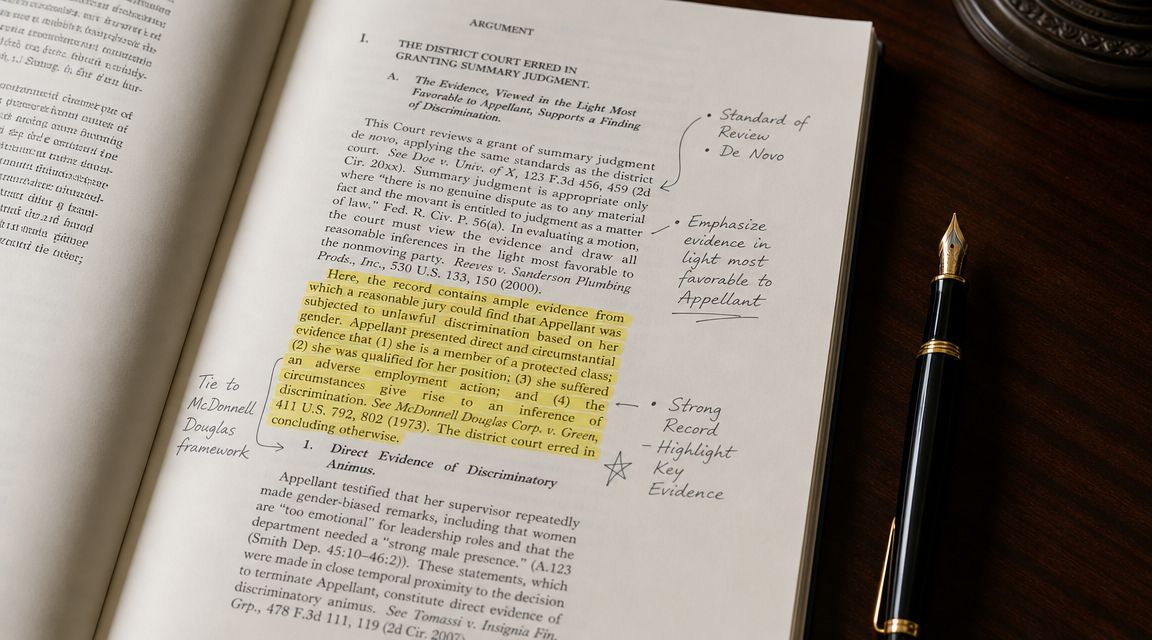
By the time the brief is due, many parents are still writing the case in their heads as if they are speaking to the trial judge. That instinct is understandable, but it hurts appeals. An appellate brief has a different job. It must isolate a specific finding, apply the correct standard of review, and show from the existing record why that finding cannot stand.
The issue presented shapes the whole appeal
Issue framing is where many custody appeals gain strength or lose it.
A client may say, “the evidence was weak.” That is a trial reaction. On appeal, the question becomes much narrower. Which finding was necessary to support the ruling? Was there no more than a scintilla of evidence supporting it, or was the finding so against the great weight and preponderance of the evidence that it cannot stand, assuming that complaint was preserved?
Those are different arguments, and they require different briefing choices. If the issue is too broad, the court may read it as a general complaint that the judge believed the wrong witness. If it is too vague, it may fail to identify the legal point the court needs to decide. Good briefing starts by naming the exact finding under attack and matching it to the standard that governs review.
What a persuasive insufficiency brief has to do
A persuasive brief usually needs to do four things at once:
- Identify the controlling finding: The brief should pinpoint the finding that drove the conservatorship, possession restriction, geographic limitation, or other challenged ruling.
- Tie every factual statement to the record: If a witness said something important, the brief should cite the reporter's record page. If a motion, exhibit, or finding matters, the clerk's record cite should be there.
- Apply the right sufficiency standard: Legal insufficiency and factual insufficiency are not interchangeable. The argument has to reflect the standard the court will use.
- Show preservation where required: If Texas procedure required a request for findings, a post-judgment motion, or another step to preserve the complaint, the brief should say where that happened in the record.
That last point often decides whether a promising complaint can even be heard. Many parents focus on what felt unfair at trial. Appellate courts focus on what was preserved, what was necessary to the judgment, and what the record proves or fails to prove.
Strong briefs translate frustration into a disciplined appellate argument. They do not ask the court to reweigh the case from scratch.
A short explainer can also help clarify how appellate courts think about this process:
Where many custody briefs go wrong
Weak briefs often make one of three mistakes.
Some retell the hearing in detail without connecting the facts to a specific legal issue. Others argue fairness in broad terms but never identify the preserved complaint or the standard of review. Others still challenge every adverse ruling, which can dilute the one issue that had a realistic chance of producing relief.
Custody appeals also present a recurring problem. Trial judges are given latitude on many family-law decisions, so a sufficiency argument must be written with that reality in mind. It is rarely enough to show conflicting testimony. The brief must explain why, even giving proper deference to the trial court, the record does not contain the support Texas law requires for the finding that matters.
Why precision beats volume
Longer does not mean stronger.
In many appeals, the better strategy is to narrow the case. After reviewing the full record, the strongest argument may center on one unsupported endangerment finding, one best-interest finding with weak record support, or one restriction that lacks evidence tying it to the child's welfare. That kind of focus usually serves the client better than a sweeping brief that treats every disappointment as reversible error.
This is also where trial preservation pays off. If trial counsel requested findings, objected with enough specificity, or filed the right post-judgment motion, appellate counsel has more room to present a clean insufficiency issue. If those steps were missed, the brief may need to work around preservation limits or abandon arguments that would otherwise have been worth pursuing.
That is the hard truth about appellate briefing in Texas custody cases. The brief is not a second closing argument. It is a technical, record-based explanation of why a specific ruling fails under a demanding standard of review.
Oral Argument and Potential Remedies
Some appeals are decided on the briefs alone. In others, the court schedules oral argument. Clients sometimes expect this to be the moment when they finally get to tell their story directly to the appellate judges. That isn't what oral argument is.
What oral argument really is
Oral argument is a structured conversation between the judges and the lawyers. The judges usually focus on pressure points. They may ask about preservation, the standard of review, the wording of the issue presented, or the exact record support for a challenged finding.
It is not a new evidentiary hearing. No new witnesses testify. No new exhibits come in. The court is testing the legal arguments already made in the briefs.
Oral argument is often about the court's hardest questions, not your case's most emotional facts.
What relief can the court give
A successful appeal does not usually mean the appellate court takes over and writes a new custody order from scratch. More often, the remedy is more limited and procedural.
Common outcomes can include:
- Affirmance: The trial court's order stays in place.
- Reversal and remand: The appellate court sends the case back for further proceedings consistent with its ruling.
- Partial relief: The court may address one issue while leaving other parts of the order intact.
In custody cases, reverse and remand is often the realistic goal. That means the appellate court found a meaningful legal problem and returned the matter to the trial court to correct it through a new hearing or further proceedings.
Why realistic expectations matter
A good appellate strategy balances hope with accuracy. Winning an appeal usually means obtaining another legally proper opportunity, not instant final vindication.
That can still be enormously important. If the first ruling rested on an unsupported finding, a preserved procedural error, or a legal standard applied the wrong way, appellate relief can restore fairness to the process. In family law, that often matters as much as any single hearing result.
When You Need a Texas Appellate Attorney
Appeals require a different skill set from trial work. The focus shifts from witness presentation and live courtroom dynamics to record analysis, preservation, legal research, and written advocacy under the Texas Rules of Appellate Procedure and the Texas Family Code.
What appellate counsel adds
An appellate lawyer's first task is usually not filing papers. It is evaluating whether a real appellate issue exists.
That review is often more objective than clients expect. Sometimes the record supports the ruling enough that an appeal is unlikely to succeed. In other cases, the better path may involve a different procedural tool. And sometimes there is a viable insufficiency argument, but only if it is tied carefully to preservation and the correct standard of review.
An experienced appellate attorney should be able to answer practical questions such as:
- Is the order final and appealable?
- Was the insufficiency complaint preserved?
- Does the record contain the materials needed to raise the issue?
- Is this better framed as legal insufficiency, factual insufficiency, abuse of discretion, or a related legal error?
- What remedy is realistically available?
Why specialization matters in family appeals
Family-law appeals are especially technical because custody decisions are fact-intensive but reviewed deferentially. That combination creates a narrow lane for reversal. The lawyer has to understand how to challenge a family court ruling without drifting into arguments that ask the appellate court to reweigh credibility.
That is why many clients and trial attorneys look for counsel who handles family appeals specifically. If you are comparing lawyers, this guide on how to choose a family law attorney is a useful place to start.
A sound consultation should give you clarity, even if the answer is that an appeal is not the best tool for your situation.
The value of an early case review
Early appellate review can protect options. It can identify deadline problems, preservation gaps, and missing parts of the record before those issues become fatal.
Just as important, it can help separate a painful result from a reversible one. That distinction is difficult to make when you are living through the consequences of the order. It is exactly the kind of disciplined judgment appellate counsel is supposed to provide.
If you believe the court made a mistake in your family law case, our appellate attorneys can help you seek a fair outcome. Contact The Law Office of Bryan Fagan today for a free consultation.
If you believe the court made a mistake in your family law case, our appellate attorneys can help you seek a fair outcome. Contact The Law Office of Bryan Fagan, PLLC today for a free consultation.