You may feel your case was handled unfairly, and you want to know how long it will take to challenge that result. In Texas family law, an appeal typically takes 12 to 24 months from the filing of the notice of appeal to the court's decision.
That answer can feel discouraging when you're already living with a custody order, property ruling, or support decision that doesn't seem right. But an appeal is built for careful review, not speed alone. It gives a higher court a structured way to decide whether the trial court followed the law, respected the evidence, and reached a result the law can support.
If you're searching for how long does an appeal take in Texas, the most useful answer isn't just a broad range. You need to know what happens during that time, where delays usually come from, and what your lawyer is doing while the case appears quiet.
Starting the Appellate Journey After an Unfair Ruling
A lot of clients reach out after a hearing or trial that left them stunned. They expected the judge to weigh the evidence one way, but the written order says something else. Sometimes the result affects parenting time. Sometimes it changes the division of a home, retirement account, or business interest. Sometimes it imposes a support obligation that feels disconnected from what happened in court.
That reaction matters. It often points people toward the right next question, which is not just whether the ruling was disappointing, but whether it was legally wrong.
Texas family law appeals move slowly because they are based on a formal record and written legal argument. One source discussing Texas family law appeals states that the average timeline from filing the notice of appeal to receiving the court's decision is 12 to 24 months, with family law cases often taking 6 months to over a year depending on complexity and court schedule in some settings of the process, not as a universal rule for every case (Onda Family Law on Texas appeal timing).
An appeal is often the first time a client feels that someone is finally looking closely at whether the rules were followed.
What that means for you right now
The road ahead is structured. You won't be starting over, and you won't be reliving every factual dispute from trial. Instead, the appellate court reviews what was filed, what was said, what evidence was admitted, and what rulings the judge made.
That structure can be reassuring. It also means patience matters. Appeals aren't won by urgency alone. They're won by identifying the right issues, preserving deadlines, and presenting a focused legal argument.
The first question to ask
Before talking about timing in detail, ask this: Was there a legal mistake that likely affected the outcome?
If the answer may be yes, the appeal process becomes a practical path forward. If the answer is no, a long appeal may not serve your goals. A seasoned appellate review should help you tell the difference early.
Understanding How an Appeal Differs from a Trial
A trial asks, "What happened?" An appeal asks, "Did the court apply the law correctly to what happened in that courtroom?"
That difference shapes everything about timing, strategy, and expectations. Clients often come into an appeal wanting one fair chance to fully explain the story again. Appellate courts do not reopen the evidence. They study the trial record, the judge's rulings, and the written arguments about legal error. If you want a practical picture of what follows the filing stage, this overview of what happens after you file an appeal in Texas family court gives the sequence.
The appellate court works from a closed record
Trials are built through witnesses, exhibits, objections, and real-time decisions from the bench. Appeals are built from that paper trail and transcript.
That is why two concepts matter early. First, the record has to contain what the appellate court needs to review. Second, the issue usually has to be preserved in the trial court. If a party never raised the complaint, or the record does not clearly show what happened, the appeal gets harder before the briefing even begins.
This is one reason appeals can feel slow to clients. Much of the work happens before a single argument is filed. Lawyers have to identify what the record supports, not just what feels unfair in hindsight.
Plain English terms that matter
A few appellate terms come up in nearly every Texas family law appeal.
- Standard of review is the rule the appellate court uses to evaluate the trial court's decision. Some rulings get a lot of deference. Others get closer scrutiny.
- Abuse of discretion means the trial court acted outside the range the law allows. It does not mean the appellate judges merely disagree.
- Reversible error means a legal mistake likely affected the outcome. Courts do not reverse for harmless error.
- Briefing is the written argument that explains the mistake, cites the record, and shows why the error matters under Texas law.
Practical rule: "The judge was unfair" is rarely enough by itself. "The judge made a ruling the law does not permit, and the record shows it affected the result" is the kind of argument an appellate court can act on.
Appeals reward focus, not repetition
Trial advocacy and appellate advocacy are different skills. At trial, persuasion often turns on testimony, credibility, and fast decisions. On appeal, persuasion turns on issue selection, framing, and disciplined writing.
That creates a real strategic choice. A client may want to challenge everything that went wrong. In many appeals, that weakens the case. The stronger approach is usually to isolate the few rulings with the best legal footing and the clearest connection to the outcome.
A good appeal does not reargue the entire case. It shows the court where the legal error occurred, why the record preserves it, and why that error justifies relief. That is the difference between frustration on paper and an argument a panel of judges can seriously consider.
The Texas Appellate Timeline A Stage by Stage Breakdown
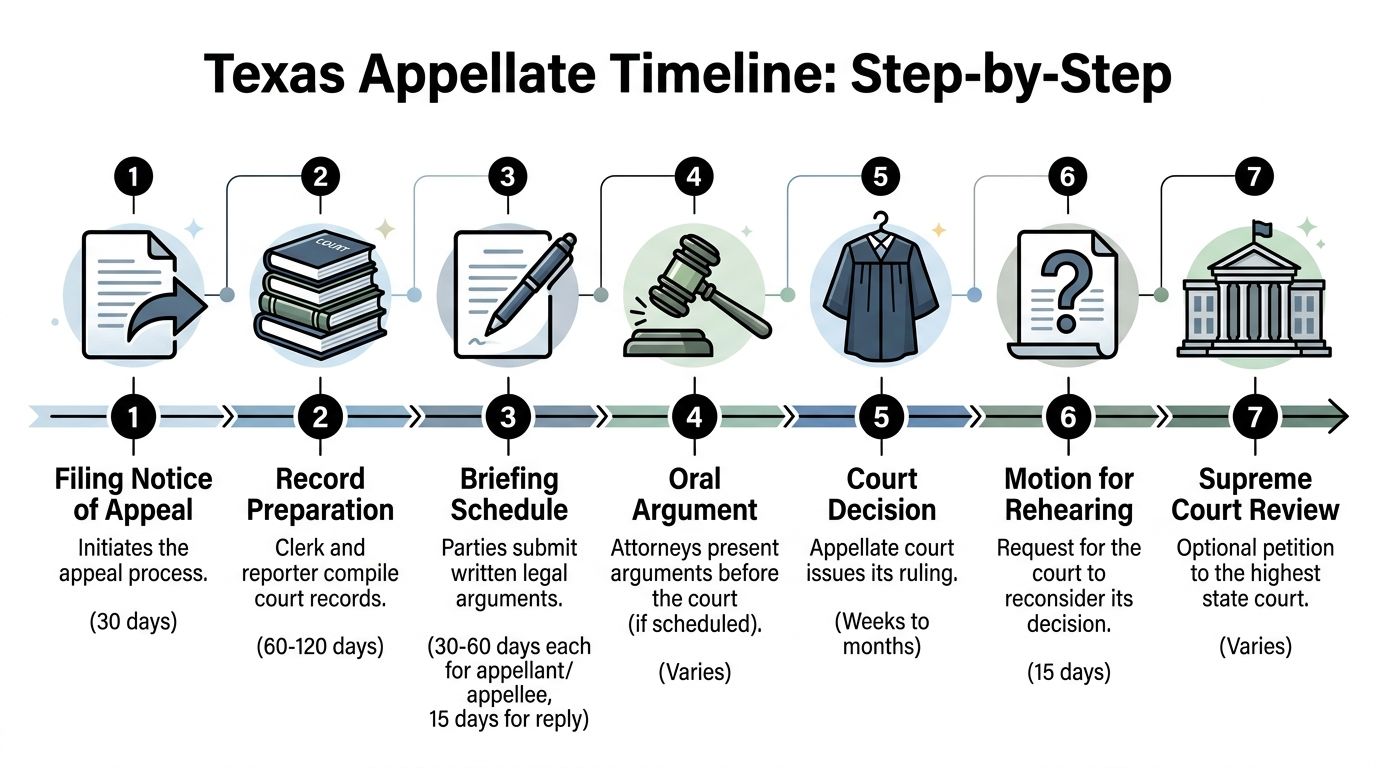
A realistic timeline is more helpful than a vague promise. In Texas family law appellate practice, the total duration from the filing of the notice of appeal to the final written decision typically spans twelve to twenty-four months, depending heavily on complexity and court docket efficiency (Texas appellate timeline in practice).
This visual gives a simple overview before we break the stages down.
The early filing stage
The process starts when the notice of appeal is filed. Under the timing described in that same source, the notice is filed within 30 days of the judgment, or 90 days if certain post-trial motions were filed.
That deadline is the first hard gate. If it's missed, the appeal may end before it begins.
Building the appellate record
After the notice is filed, the clerk's record and reporter's record must be prepared. The same timeline source describes a 30 to 60 day record preparation phase in typical practice.
This stage often feels quiet to clients. It isn't. The court file, hearing transcripts, admitted exhibits, orders, and judgment all have to be collected and transmitted so the appellate court can review a complete record.
For a closer look at what follows the filing step, see what happens after you file an appeal in Texas family court.
The briefing phase
Once the record is filed, briefing begins. The same source explains that although Rule 38 sets statutory briefing windows, the actual briefing period routinely extends to four to six months because extensions are common.
That makes sense in family law appeals. Good briefing takes time. The lawyer has to:
- Review the record carefully and match each issue to the correct pages
- Research the governing law under the Texas Family Code and appellate precedent
- Write under the proper standard of review rather than just argue fairness
- Answer the other side's arguments without drifting into issues the court can't consider
Here is the video overview many clients find helpful before reading a brief-heavy docket:
Oral argument and the court's decision
Not every case gets oral argument. When it does happen, the schedule depends on the court. In Houston's First and Fourteenth Courts of Appeals, the same source notes that clients typically experience a two to four month delay between final brief submission and receipt of a hearing date.
After submission, whether by briefs alone or after oral argument, the court works toward a written opinion. That final stretch can feel the longest because there may be little visible activity. Internally, though, the judges and staff attorneys are reviewing the briefs, the record, and the controlling law.
| Stage | What happens |
|---|---|
| Notice of appeal | Starts the case and preserves review rights |
| Record preparation | Assembles the papers, transcripts, and exhibits |
| Briefing | Each side files written legal arguments |
| Oral argument | Sometimes granted for focused judicial questioning |
| Opinion | The court issues its written decision |
The appellate calendar is not a straight line. It moves in bursts of filing and long periods of review.
Common Grounds for a Family Law Appeal in Texas
A family law appeal usually starts with a specific problem in the record. The judge applied the wrong legal standard. Key evidence was excluded. The written decree says something the court never ordered. Those are the kinds of issues that can justify the time and expense of an appeal.

An appeal is not a second trial. The court of appeals reviews what happened below and asks whether the trial court made an error that mattered to the outcome. That is why good appellate issues are usually narrow, record-based, and tied to a clear ruling.
Property division errors
Property issues are a common reason spouses consider an appeal after divorce. A court may have labeled an asset as community property when the evidence supported a separate property claim. A division may also rest on a mistaken legal premise, such as treating a reimbursement issue incorrectly or dividing property the court had no authority to divide.
The trade-off is practical. Even where the result feels unfair, an appeal has to focus on an identifiable legal error, not the simple fact that one side received less. The record has to show what evidence was offered, what objection was made if one was needed, and how the ruling affected the final division.
Custody and conservatorship mistakes
Appeals involving children are often the most urgent for families and the most demanding on review. Trial judges receive broad discretion in conservatorship, possession, and access decisions, so the issue must be framed carefully.
The stronger appellate points usually involve one of these problems:
- Excluded evidence: The court kept out testimony or documents that directly affected the child's best interest analysis.
- Wrong legal standard: The ruling reflects the wrong rule, or leaves out findings Texas law requires.
- Insufficient support in the record: A restriction on possession, decision-making, or parent-child contact lacks the factual basis the court needed.
- Protective order spillover: Safety findings in one part of the case shaped custody terms in another without proper support or procedure.
In these cases, the transcript often matters as much as the final order. If you want to see why, this explanation of how transcripts affect your Texas family law appeal shows how appellate courts evaluate what was said, offered, and ruled on in the trial court.
Support and decree problems
Support orders are appealed less often than clients expect, but they can present strong issues when the court misapplies the governing rules. Income may have been calculated incorrectly. Required findings may be missing. The court may have entered an order that does not match the evidence or the ruling announced from the bench.
Decree language creates its own set of problems. I often see final orders that go further than the judge's oral ruling, conflict with prior findings, or use wording that changes the effect of the judgment in a meaningful way. Those issues matter because appellate courts review the signed order, not the parties' assumptions about what the judge intended.
A strong appeal issue sounds precise. "The court excluded school records after they were properly offered" is far stronger than "the judge was unfair."
Factors That Can Change Your Appeal's Timeline
Two clients can file appeals the same week and still finish months apart. The difference usually is not luck. It comes from the size of the record, the number of issues raised, the court's docket, and whether the case presents one clean legal question or several intertwined disputes.
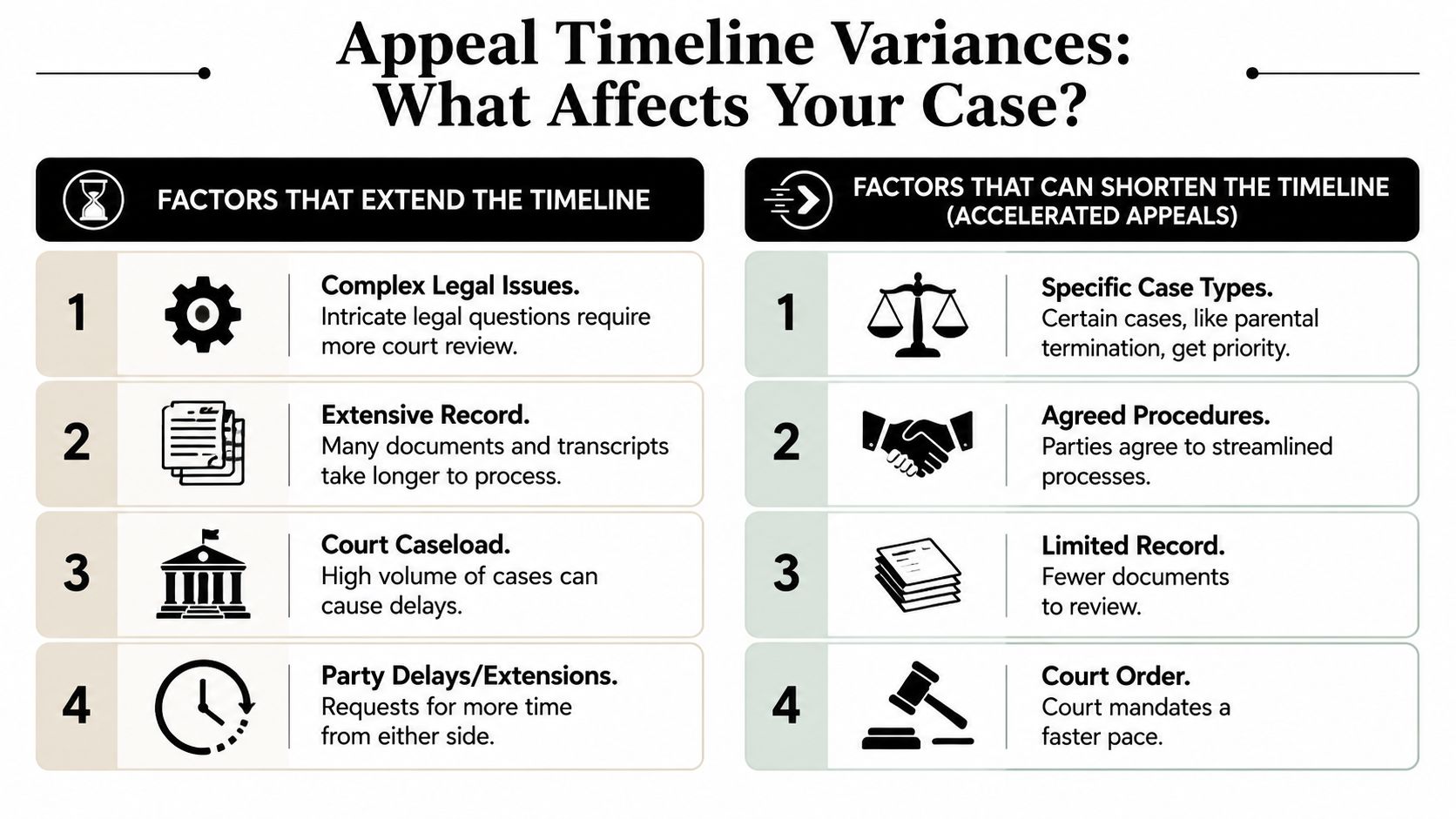
A realistic timeline has to account for those variables. I tell clients to expect movement in stages, not a perfectly straight line. One phase may stay on track while another slows because the clerk's record needs correction, the reporter's record takes longer to prepare, or briefing requires more time than the initial estimate suggested.
What usually extends the process
The record is often the first pressure point. Family law cases rarely happen in a single hearing. Temporary orders, pretrial disputes, trial dates, and post-judgment hearings can all matter on appeal. Pulling that material together takes time, and one missing transcript or exhibit can hold up the next step. For a closer look at that issue, see how transcripts affect your Texas family law appeal.
Briefing can add time too. A short appeal built around one preserved error is different from an appeal that challenges several rulings across custody, support, and property. More issues mean more record citations, more legal analysis, and more room for the other side to respond in detail.
Other common causes of delay include:
- Extension requests: Courts often grant reasonable extensions for filing briefs, especially in record-heavy cases.
- Busy appellate dockets: Some courts have more pending cases and longer times for submission and decision.
- Record problems: Sealed materials, corrected orders, missing exhibits, or incomplete transcripts can delay the briefing schedule.
- Procedural disputes: Motions about the record, deadlines, or jurisdiction can interrupt the ordinary pace of the appeal.
What can shorten the process
Some appeals move faster because the case is narrower from the start. A limited record, a focused legal issue, and clean preservation give the court a simpler file to review. That does not guarantee a quick opinion, but it usually removes avoidable delay.
Certain family law matters may also receive faster treatment under the rules or by court practice because the subject matter is time-sensitive. Cooperation on procedural matters helps as well. If the parties can address record preparation and briefing issues without side disputes, the appeal tends to stay closer to the expected schedule.
The real trade-off
Clients often ask whether faster is better. Sometimes it is. More often, the better question is whether the appeal is being built carefully enough to give the court a clear path to the right result.
A rushed brief can bury the strongest issue under weaker ones. A measured approach may take longer, but it often gives the appellate court a cleaner record, sharper arguments, and a fairer basis to decide the case. That is the trade-off. The goal is not speed by itself. The goal is a timeline that serves the argument instead of hurting it.
Why You Must Act Quickly to Preserve Your Right to Appeal
The overall process may be long, but the decision to protect your rights must happen quickly.
The notice of appeal deadline is one of the most important dates in the entire case. In many situations, the notice must be filed within 30 days after the final judgment. In some situations involving timely post-trial motions, the deadline can extend to 90 days. If that deadline passes, the right to appeal may be lost.
That's why waiting to “see how things feel in a few weeks” can be risky. Appellate work starts with urgency even though the court's final review takes time.
What to do after the ruling
If you think the trial court made a serious mistake, take these steps right away:
- Get the final order reviewed promptly. Small wording issues can matter.
- Gather hearing dates and filings. Your lawyer needs the timeline and the trial court paperwork.
- Identify possible preserved errors. Appeals turn on what happened in the record, not just what feels unfair.
- Confirm the notice deadline. This is not a date to estimate.
For a focused explanation of that filing window, read what is the deadline for filing a notice of appeal in Texas.
When clients act early, their lawyer has room to evaluate the order, the record, and the right appellate issues. When they wait, the conversation often becomes about damage control.
An appeal can restore balance, but only if the path stays open.
If you believe the court made a mistake in your family law case, our appellate attorneys can help you seek a fair outcome. Contact The Law Office of Bryan Fagan, PLLC today for a free consultation.