You may feel your case was handled unfairly. In family court, that feeling often comes from more than disagreement with the result. It comes from sitting through testimony, objections, and rulings, then reading an order that seems to leave out what really happened in the courtroom.
An appeal can be the right next step, but it isn't a new trial. The appellate court won't hear new witnesses, revisit side conversations, or consider facts that never made it into the official record. In many Texas family law appeals, the transcript becomes the difference between a reviewable error and an argument the court can't even reach.
That is why understanding how transcripts affect your texas family law appeal matters so much. If the transcript is complete, accurate, and timely requested, it can show what the judge heard, what objections were made, and whether the law was properly applied. If it's missing, incomplete, or flawed, even a strong sense that something went wrong may not be enough.
Your Case Was Decided Unfairly What Happens Next
You may feel your case was handled unfairly, especially if the ruling affects your children, your property, or your financial stability. That reaction is common after a difficult custody hearing, divorce trial, or post-judgment enforcement proceeding. The question is what the appellate court can do with that concern.
An appeal asks a higher court to review the trial court for legal error. It does not give you a second chance to present the same case with better testimony or stronger exhibits. The court looks backward, not forward.
What an appeal is really about
A successful appeal usually turns on showing reversible error. In plain English, that means a mistake that likely affected the outcome of the case. Not every bad ruling qualifies. Some errors are harmless. Others matter enough to require a new hearing, a different ruling, or further proceedings.
Another phrase clients often hear is abuse of discretion. That means the trial judge had some room to decide, but made a ruling outside the range of what the law allows based on the record. In family law, that standard comes up often in custody, visitation, property division, support, and evidentiary rulings.
Briefing is the written part of the appeal. Your lawyer prepares a formal written argument explaining the errors, citing the record and the law, and showing why the judgment should be changed or sent back.
Practical rule: If your argument depends on something said in court, the appellate court usually needs to see it in the transcript.
Common examples of appealable issues
Family law appeals often focus on issues like these:
- Wrong legal standard: The court applied the wrong rule in a custody or property decision.
- Improper evidence ruling: The judge admitted evidence that should have been excluded, or kept out evidence that should have been considered.
- Lack of preserved findings: The order doesn't explain the basis for a decision, and key post-judgment steps were missed.
- Procedure that affected fairness: A party didn't get a meaningful chance to present or challenge evidence.
Clients are often surprised by how technical this process is. That's not because the court ignores fairness. It's because appellate courts must decide fairness through a specific record, under specific rules, within specific deadlines.
Understanding the Appellate Record in Texas
The appellate court reviews a closed file called the appellate record. In Texas family cases, that record has two main parts. One is the Clerk's Record. The other is the Reporter's Record, which is commonly known as the transcript.
The Clerk's Record contains the filed documents. That usually includes pleadings, motions, orders, judgments, and other papers placed in the case file. The Reporter's Record contains the verbatim record of what was said in court.

What the transcript does
The transcript is the written version of testimony, objections, rulings, and argument made on the record. If a witness testified about parenting history, substance use, finances, or property tracing, the appellate court sees that testimony through the transcript. If a lawyer objected to hearsay or challenged an exhibit, the court looks for that language in the same place.
That is why careful review matters. Lawyers often use methods similar to the close reading used in interpreting witness testimony transcripts, because word choice, speaker attribution, and context can affect how an appellate issue is framed.
What the appellate court cannot consider
Texas appellate courts cannot consider anything outside the clerk's record and transcripts, as explained in this discussion of the silent record problem in Texas family law appeals. In custody cases, judges may make credibility observations, comment on a parent's conduct, or rely on in-court impressions that never appear in a written order. If those statements weren't transcribed or reduced to findings, the appellate court usually can't review them.
That creates a major practical problem in family law. A parent may leave court convinced the judge focused on something improper, but if the remark happened off the record, it may not exist for appellate purposes.
If it isn't in the clerk's record or the reporter's record, the court of appeals usually treats it as though it never happened.
The silent record problem in real life
This problem shows up in several ways:
- Off-the-record discussion: A bench conference or hallway agreement never makes it into the official record.
- No written explanation: The trial court denies a modification or enforcement request without findings that explain why.
- Unrecorded observations: The judge comments on demeanor or parent-child interaction, but the comments aren't transcribed.
- Missing context: An exhibit is referenced during testimony, but the document itself isn't properly identified or included.
For clients, the lesson is simple. The appeal is built from the official record, not memory, not frustration, and not what everyone in the courtroom thought was obvious.
Why the Transcript Is the Foundation of Your Appeal
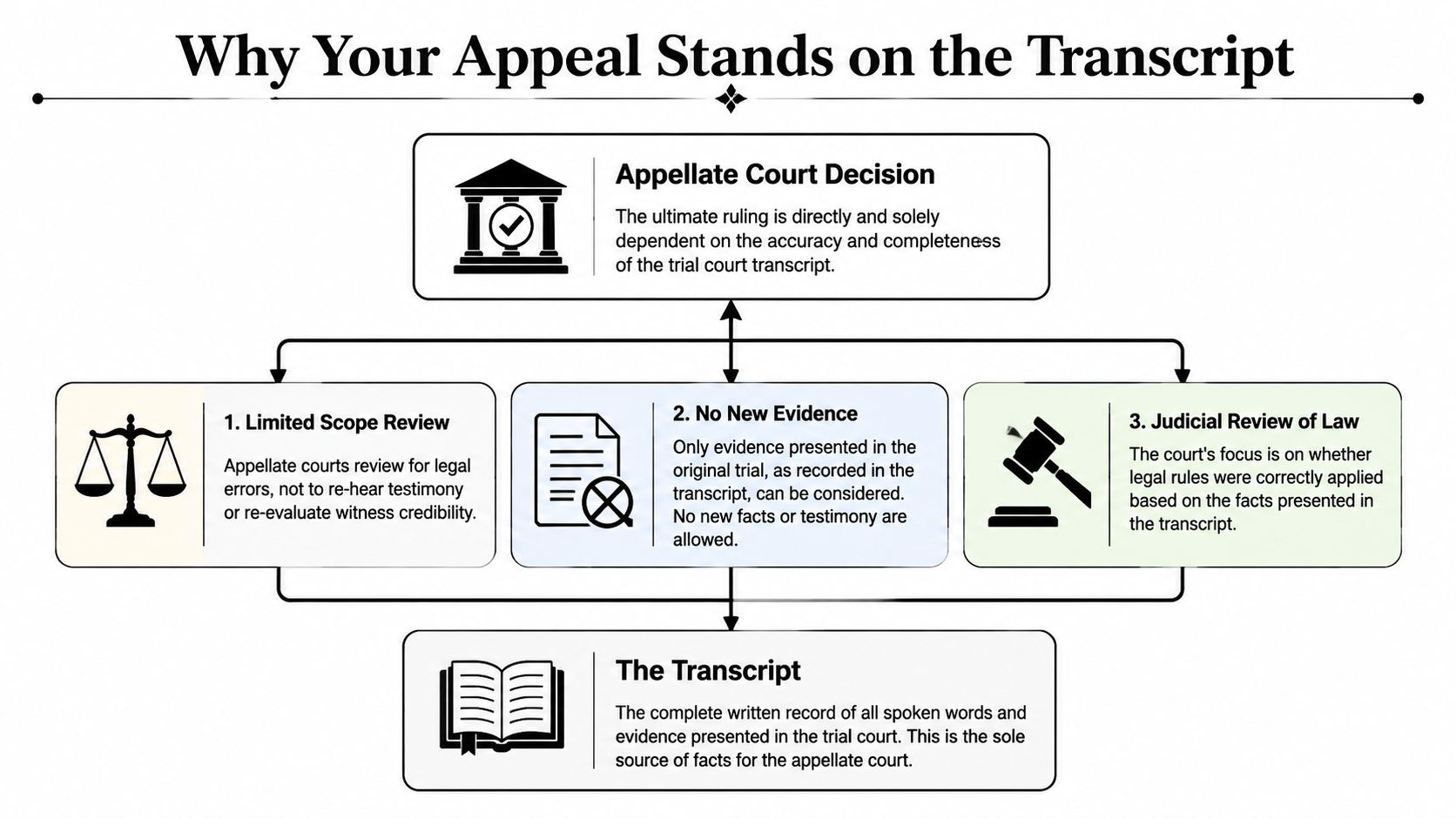
The transcript is not just helpful. It is often the foundation of the entire appeal. Appellate judges do not re-try family law cases. They don't decide which witness they personally believe, and they don't hear new evidence. They review what happened in the trial court through the written record.
Preserving error in the record
Under Texas Rule of Appellate Procedure 33.1(a)(1), a complaint must be made to the trial court with enough specificity to preserve it for appeal, and without a record showing that, the appellate court presumes the trial court acted correctly, as summarized in the Texas Children's Commission material on preserving your record for appeal. That rule matters in nearly every family appeal.
Suppose a judge admits testimony your trial lawyer believed was improper. If the transcript doesn't show a timely and specific objection, the appellate court may treat the complaint as waived. The same problem arises after judgment. If required post-judgment requests, such as findings of fact and conclusions of law, weren't timely made, the court can presume unstated facts support the judgment.
Why a missing transcript changes the whole case
Without the transcript, many arguments collapse. The appellate court may have no reliable way to evaluate:
- What evidence the judge heard
- Whether a party objected
- How the judge ruled during testimony
- Whether counsel preserved the complaint for review
That is why clients sometimes hear a hard truth. A case can feel unfair and still be difficult to reverse if the record doesn't show the mistake in a reviewable way.
A practical risk many families don't see coming
Texas also has a record-preservation problem outside the courtroom itself. The court reporter shortage has left many litigants without official verbatim transcripts, effectively cutting off meaningful appellate review in many cases, and official court reporters are only required to preserve notes for three years under Texas Government Code Section 52.046(a)(4), as discussed in this article on no transcript, no appeal in Texas.
That matters in long-running family cases. Some custody and property disputes stretch over years. If no one takes affirmative steps to secure the record, notes may be destroyed before the appeal issues are fully developed.
The transcript doesn't just support your appeal. In many cases, it determines whether the appellate court can evaluate your complaint at all.
Common Transcript Problems That Derail Family Law Appeals
Transcript issues don't always look dramatic. Often they show up as small defects that create big consequences. A missing speaker label, a word transcribed incorrectly, or a stretch of testimony marked as inaudible can weaken an issue that otherwise had real appellate value.

Errors that change meaning
Family law cases often turn on precise facts. Consider a custody hearing where a witness testifies that a parent did not violate a temporary order, but the transcript drops the word "not." On paper, that single omission reverses the meaning.
The same problem can appear in property cases. If the transcript blurs whether an account was described as separate or community property, the appellate argument becomes harder to present cleanly. Appellate judges rely on text. They don't get to ask the witness what was really meant.
Common examples include:
- Misquotes: Testimony is recorded inaccurately.
- Unattributed statements: In fast hearings, the transcript doesn't clearly show whether the judge, a lawyer, or a witness spoke.
- Inaudible passages: Critical testimony appears as unintelligible or incomplete.
- Broken exhibit references: Witnesses discuss documents or recordings that aren't properly tied to the record.
When the record is incomplete
Some transcript problems are larger than errors on a page. Sometimes a key hearing was never transcribed at all. Sometimes electronic recordings exist, but no proper written transcription was prepared. Sometimes one hearing is requested and another is overlooked, leaving a gap in the appellate timeline.
That gap can be fatal when the missing hearing contains the ruling you're challenging, the objection that preserved error, or the testimony that explains the judge's reasoning.
A short overview can help if you're trying to understand how these issues affect appellate review:
The hardest problem is no transcript at all
The most serious problem is the complete absence of an official verbatim record. As noted earlier in the article, that can happen because of unavailable court reporters, delayed requests, or note preservation problems. In practical terms, no transcript often means no way to prove what error occurred in a fact-intensive family law dispute.
That is especially damaging in cases involving:
- Custody and visitation rulings
- Support determinations tied to disputed testimony
- Property division based on competing evidence
- Protective order hearings with credibility disputes
The lesson is not that every transcript flaw destroys an appeal. It is that transcript problems must be identified early, while there is still a meaningful chance to correct them.
Corrective Actions for an Inaccurate or Missing Transcript
A flawed transcript does not always end the appeal. Texas procedure provides tools to fix or supplement the record, but those tools work best when appellate counsel identifies the problem quickly and acts with precision.
Start with a record audit
The first step is to compare the transcript against the issues you plan to raise. That means matching hearing dates, witness names, exhibits, objections, and rulings. In many appeals, the problem isn't that the transcript is broadly unusable. The problem is narrower. A key page is missing, a ruling isn't attributed, or an exhibit reference doesn't line up with the clerk's record.
A careful audit usually asks:
- Which hearings matter most: Final trial, temporary orders, enforcement, modification, or post-judgment proceedings.
- Which objections matter: Hearsay, relevance, authentication, privilege, or due process objections.
- Which rulings need clarity: Admission of evidence, denial of a continuance, limitation on testimony, or refusal to make findings.
Review the record like a judge will read it. Line by line, not by memory.
Formal ways to correct the record
If the transcript is inaccurate or incomplete, counsel may need to use one of several procedural tools.
| Corrective Action | Purpose | When to Use |
|---|---|---|
| Motion to correct the record | Asks the court to address errors or omissions in the appellate record | When testimony, rulings, or pages are incorrect, missing, or mismatched |
| Request for clarification from the court reporter | Seeks confirmation or correction of transcription issues | When a passage is unclear, a speaker is misidentified, or formatting creates confusion |
| Bill of exception | Preserves evidence or argument that the court excluded or prevented from being fully presented | When the trial judge refused evidence, limited questioning, or blocked a proffer |
| Agreed statement | Creates a substitute description of part of the proceedings based on party agreement | When no transcript exists for a limited issue and both sides can agree on what occurred |
| Settled statement or court-approved reconstruction | Provides a court-resolved substitute when the parties cannot fully agree on the missing record | When a transcript is unavailable and a record must be reconstructed for review |
What each option looks like in practice
A motion to correct the record is useful when the official record exists but contains errors. If a witness's testimony was mistranscribed or a portion of the hearing was omitted, counsel can ask the court to resolve the discrepancy.
A bill of exception matters when the issue is not what the court admitted, but what the court kept out. If the judge refused to allow testimony or excluded an exhibit, counsel may need a formal method to show the appellate court what the evidence would have been.
An agreed statement can help when both sides can fairly describe a missing part of the proceeding. That is less common in contested family appeals, but it can be useful in narrow circumstances.
When a trial court refuses to act, delays action, or blocks a record-related duty that must be performed, extraordinary relief may be necessary. In that setting, counsel may evaluate whether a petition for writ of mandamus in Texas family court is the right procedural response.
What doesn't work
Some approaches sound reasonable but usually fail in appellate practice:
- Client recollection alone: Your memory matters for strategy, but it is not a substitute for an official record.
- Unsworn summaries: Informal explanations from counsel or parties usually won't replace a missing transcript.
- Waiting to see if it becomes a problem: Delay narrows your options fast.
The best corrective action depends on the kind of defect, the stage of the appeal, and whether the error affects an issue that was properly preserved.
Navigating Transcript Timelines and Costs
Time matters as much as substance in an appeal. In Texas family law cases, appellants generally face a 30-day deadline after judgment to perfect the appeal, and they must request transcripts under Texas Rule of Appellate Procedure 34.6(b)(1), as explained in this article about trial lawyers and Texas appellate transcript traps.

The deadline problem
Many families lose ground without realizing it. A client may focus on whether the ruling feels wrong, while the appellate clock is already running. The transcript request is not paperwork to handle later. It is part of protecting the appeal from the start.
That same source explains another trap. Rule 34.6(f) allows relief for a lost or destroyed transcript only if the appellant made a timely request and was without fault. Courts have also declined appeals when parties failed to file written transcriptions of electronically recorded proceedings.
What to budget for
Transcript cost is a practical concern in almost every appeal. Court reporters generally charge by page, and the total cost depends on how long the hearing or trial lasted, how many proceedings must be transcribed, and whether expedited preparation is needed.
The right way to think about cost is not whether a transcript is optional. In most family law appeals, it isn't. The more useful question is which portions of the proceedings are essential to the issues being raised.
For example, a narrow legal issue may not require every hearing. A fact-heavy custody appeal often requires much more. Strategic selection matters, but under-ordering the record can create a bigger problem than over-ordering it.
A practical timeline to follow
After judgment, the safest course is usually:
- Consult appellate counsel immediately
- Identify every hearing date tied to the issues you may raise
- Submit the transcript request in writing within the required window
- Confirm whether any proceedings were electronically recorded
- Track preparation and filing status carefully
If you want a broader procedural overview, this step-by-step Texas family law appeal process timeline is a helpful companion to understanding transcript deadlines.
Your Transcript Checklist and How We Can Help
If you're considering an appeal, the most useful next step is not guessing whether the judge was wrong. It is protecting the record before deadlines pass and options narrow.
A practical checklist after judgment
Use this checklist as soon as a final order is signed:
- Call appellate counsel quickly: Early review helps identify deadline issues, record gaps, and preservation problems.
- List every important hearing: Trial, temporary orders, modification hearings, enforcement hearings, and post-judgment proceedings may all matter.
- Request the transcript in writing: Oral requests are not enough protection when deadlines become disputed.
- Identify missing findings or post-judgment steps: Some appellate issues depend on timely requests after judgment.
- Review the transcript carefully once received: Check speaker labels, objections, exhibit references, and rulings.
- Compare the transcript to the clerk's record: Testimony about an exhibit won't help if the exhibit isn't properly in the record.
- Flag anything inaccurate or missing immediately: Correction options are strongest when raised early.
What clients often miss
Clients understandably focus on what felt unfair in the courtroom. Appellate work starts from a different place. It asks whether the record shows a legal error, whether that error was preserved, and whether the court of appeals can review it under the proper standard.
That difference is why trial dissatisfaction and appellate viability are not the same thing. A disciplined record review can reveal strong appeal points that a client didn't initially notice. It can also expose procedural barriers that need to be addressed before briefing begins.
Good appellate strategy starts with an honest record assessment, not wishful thinking.
Choosing the right kind of help
Appeals require a different skill set from trial work. The lawyer reviewing your case should be comfortable with record analysis, issue preservation, standards of review, and written advocacy. If you're comparing options, this guide on how to choose a family law attorney can help you ask better questions.
If you believe the court made a mistake in your family law case, a transcript review is often the first serious test of whether that mistake can be corrected on appeal.
If you believe the court made a mistake in your family law case, our appellate attorneys can help you seek a fair outcome. The Law Office of Bryan Fagan, PLLC handles Texas family law appeals involving custody, visitation, property division, support, protective orders, and related post-judgment disputes. Contact the firm today for a free consultation and a focused review of your case, your deadlines, and your appellate record.