
When a Texas court issues an order to terminate your parental rights, you may feel your case was handled unfairly. It's a gut-wrenching experience, and you might believe the judge didn't see the whole picture. It is critical to know that the trial court's ruling does not have to be the last word. The Texas legal system provides a path—the appeal—to challenge these life-altering decisions and seek a fair outcome.
If you believe the court made a mistake, our appellate attorneys can help you seek justice.
Understanding the Appeal of a TPR Order
If you are convinced the court misapplied the law, got the facts wrong, or made a critical procedural mistake, the fight for your family is not over. An appeal is a structured legal process designed specifically to correct errors made by the trial court.
It's important to understand that an appeal is fundamentally different from a trial. This is not a "do-over" where you can introduce new evidence or make new arguments. Instead, the appellate court performs a careful, meticulous review of everything that already happened at trial to determine if a significant legal error occurred that led to an unjust result.
What is a "Reversible Error" in a Family Law Appeal?
The goal of an appeal in a termination of parental rights in Texas case is to identify what appellate attorneys call "reversible error." In plain English, a reversible error is a legal mistake so significant that it likely caused the trial judge to make the wrong decision.
An appellate court examines the trial record—the collection of all documents and testimony from your case—to find specific problems, such as:
- The judge incorrectly interpreted a section of the Texas Family Code.
- Key evidence was improperly admitted or wrongly excluded from the trial.
- The judge committed an "abuse of discretion," meaning they made a ruling that was arbitrary, unreasonable, or without reference to any guiding rules or principles.
- There was legally insufficient evidence to meet the high standard required to terminate parental rights.
An appellate attorney’s role is to build a persuasive legal argument demonstrating that one of these errors occurred and that it unfairly tipped the scales against you. While the process is complex, it is rooted in the core principles of fairness and due process. If you are questioning the judgment in your case, one of the first steps to consider is whether a motion for a new trial in Texas is the right strategic move.
An appeal provides a critical check on the power of the trial court. It ensures that decisions of such immense gravity, like severing the parent-child bond, are made only when the law has been followed with the utmost precision and care.
Our mission is to provide you with a clear, strategic path to restore balance and fight for your rights when you believe an injustice has occurred.
How Texas Courts Decide to Terminate Parental Rights
To build a successful appeal, it is essential to understand the strict rules the trial court was required to follow. In Texas, terminating a parent's rights is often called the "civil death penalty" because it permanently and irrevocably severs the legal ties between a parent and their child.
Because this is the most drastic measure a family court can take, Texas law establishes a demanding two-part test that must be satisfied. This legal framework is designed to protect the fundamental right to parent your child.
The Two-Prong Test for Termination
A court cannot terminate your rights based on a single finding. The party seeking termination—usually the Texas Department of Family and Protective Services (DFPS) or sometimes the other parent—must prove two separate and distinct things.
- Statutory Grounds: They must prove you committed at least one specific act listed in the Texas Family Code. These are the legally recognized reasons for termination, such as endangerment, neglect, abandonment, or failure to comply with a court-ordered service plan.
- Child's Best Interest: They must also prove that permanently ending your parental rights is in the child's best interest. This is a separate analysis where the court weighs factors like the child's emotional and physical well-being, the stability of their home, and any parental conduct that suggests an unhealthy relationship.
Proving one without the other is not enough. The court must find that both a statutory ground exists and that termination is in the child's best interest. This two-part requirement is a frequent battleground on appeal, because if the evidence failed to support either prong, that could constitute a reversible error.
Grounds for Termination vs. Best Interest Finding
| Legal Requirement | What It Means for Parents | Example |
|---|---|---|
| Statutory Grounds | This is about your past conduct. The court looks for specific actions or inactions that violate a specific section of the Texas Family Code. | Failing to complete court-ordered drug testing, which falls under Texas Family Code § 161.001(1)(O). |
| Best Interest Finding | This is about the child's future. The court looks forward, considering the child’s physical and emotional needs and what environment will best serve them going forward. | A judge determines that even if the parent has completed services, the child is thriving in a stable foster home and would be traumatized by being moved again. |
Ultimately, a court must find against you on both of these fronts before it can issue a termination order.
Understanding the Standard of Review and Burden of Proof
In most civil lawsuits, the standard of proof is a "preponderance of the evidence," meaning one side's story is just slightly more believable (51%) than the other.
That is not the standard in a termination case.
The law requires "clear and convincing evidence" for both the statutory grounds and the best interest finding. This is a much higher burden of proof. It means the evidence must produce a firm belief or conviction in the judge's mind that the allegations are true.
This heightened standard is a constitutional safeguard. On appeal, we meticulously review the trial record to determine if this demanding standard was met. If the evidence was thin, speculative, or contradictory, it likely does not rise to the "clear and convincing" level, creating a powerful argument for reversing the decision. When an appellate court reviews this, it applies a specific standard of review to determine if the trial court erred.
The Adversarial Nature of a TPR Case
The trial process is adversarial. The party seeking termination presents evidence and witnesses to satisfy the two-pronged test. As the parent, you have the right to present your own evidence and cross-examine their witnesses.
However, the system can be overwhelming, and mistakes happen. In 2018, Texas terminated parental rights in over 5,500 cases, a rate of 7.53 per 10,000 children. You can read a detailed analysis of termination of parental rights in Texas to see the data. These numbers highlight the critical need for a thorough appellate review to ensure justice was served.
Navigating the Texas Appeals Process for TPR Cases
If you have received an order terminating your parental rights and believe the court made a legal error, the next phase is the appeals process. As a reminder, an appeal is not a second trial to re-argue your case. It is a highly technical legal challenge focused on whether the trial court made a mistake based on the evidence and arguments already presented.
These cases move on an accelerated timeline with strict, specialized rules under the Texas Rules of Appellate Procedure. This process demands an attorney who is an expert in appellate law. Understanding what to expect can provide a clearer perspective on how our legal system offers a path to correct judicial errors.
Step-by-Step Insights on the Appellate Timeline
The moment a judge signs the final TPR order, a strict clock begins ticking. Your first move must be to file a Notice of Appeal. This is the official document that informs the court system of your intent to challenge the ruling.
In a termination of parental rights in Texas case, the deadline is extremely short—you have only 20 days from the date the order is signed. Missing this deadline almost always results in losing your right to appeal. This is why you must contact an appellate attorney immediately after a final order is issued. You can learn more about this critical document by reading about a Notice of Appeal in Texas to understand its importance.
Preparing the Record for Appeal
Once the Notice of Appeal is filed, your appellate lawyer begins assembling the official appellate record. This record is the entire universe for your appeal; nothing new can be added. It consists of two key components:
- The Clerk’s Record: A collection of all official documents filed in your case, including petitions, motions, and court orders.
- The Reporter’s Record: The complete, word-for-word transcript of everything said during the trial, including witness testimony and the judge’s rulings.
Your attorney will meticulously review every page of this record to identify legal errors. It is a detailed investigation to find clues that the legal process went wrong, such as evidence that was improperly admitted or a legal standard that was misapplied.
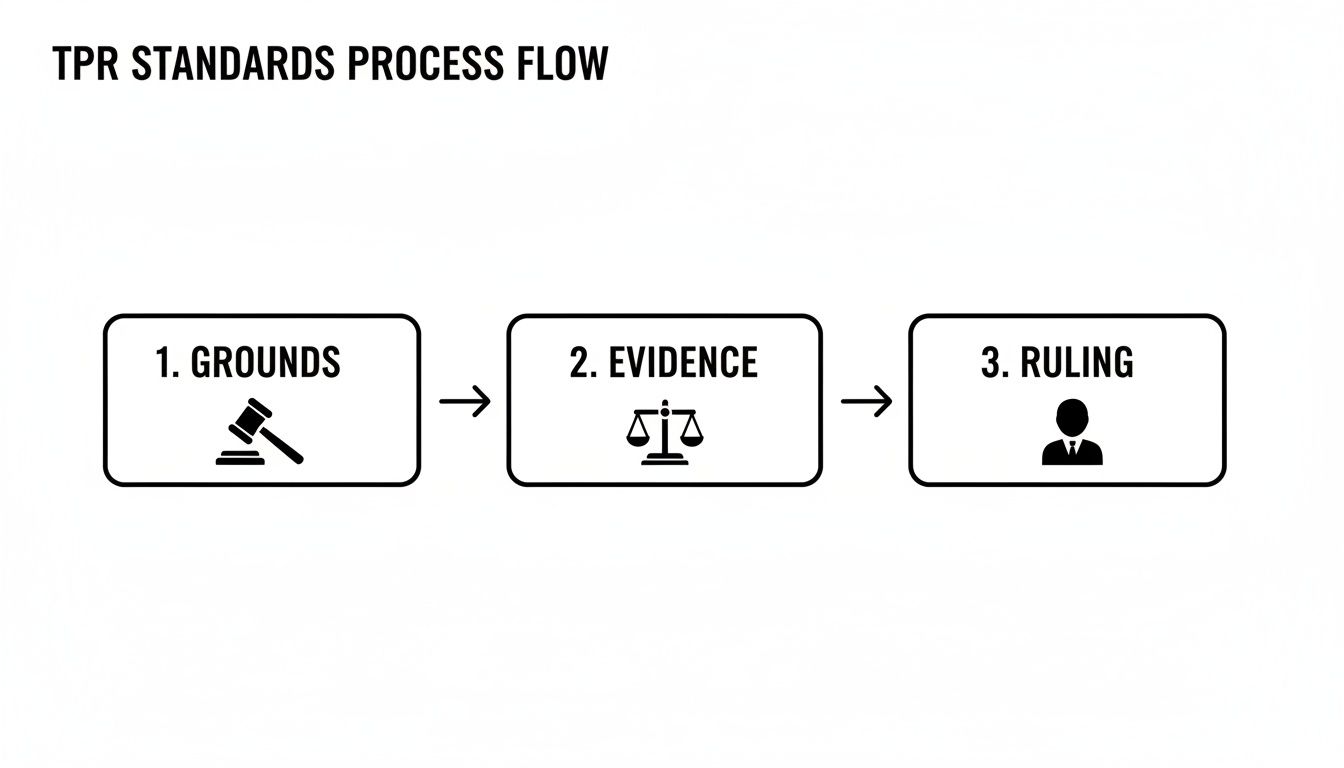
This chart illustrates the legal framework—establishing grounds, presenting evidence, and making a ruling—that courts must follow. An appeal often centers on proving that the court stumbled somewhere in this precise, step-by-step process.
Crafting the Legal Argument: The Appellate Brief
After analyzing the record, your attorney drafts the single most important document in your appeal: the appellate brief. This is not a story of what happened; it is a formal, persuasive legal argument detailing exactly where the trial court made a reversible error. Briefing is the process of writing and filing these crucial documents.
A powerful brief must:
- Identify the specific legal mistakes made during the trial.
- Support the argument with relevant laws from the Texas Family Code and decisions from past appellate cases (precedent).
- Explain why the mistake was harmful and likely led to the wrong outcome.
An appeal is won or lost based on the quality of the brief. It must be clear, compelling, and grounded in a sophisticated understanding of both family law and appellate procedure. It is your opportunity to convince a panel of appellate judges that the trial court’s decision cannot stand.
After your brief is filed, the other side files a response. The appellate judges then review both briefs, the record, and the law to render their decision, ensuring the termination order complied with Texas law.
Common Reversible Errors in Texas Family Courts

When you feel a court's decision was profoundly unfair, it is often because a legal error occurred during the trial. A successful appeal is not about disagreeing with the outcome. It is about proving the judge made a reversible error—a legal mistake so significant that it led directly to an unjust result.
Our appellate attorneys are trained to comb through the trial record to find these specific flaws. We are not looking for minor technicalities but for errors that fundamentally compromised the fairness of the proceeding.
Example 1: Insufficient Evidence to Support the Judgment
One of the most powerful arguments on appeal is that the evidence presented at trial was legally insufficient. To terminate parental rights, the state must prove its case with "clear and convincing evidence," a high standard that should leave no substantial doubt.
An appellate court will meticulously review the entire trial record to see if the evidence met this standard. Common examples of insufficient evidence include:
- An Unsupported "Best Interest" Finding: The judge concluded termination was in the child’s best interest based on vague assumptions rather than concrete facts about your child’s needs or your conduct.
- Failure to Prove a Statutory Ground: The state did not present enough hard evidence to prove one of the specific legal reasons for termination laid out in the Texas Family Code, like endangerment.
- Relying on Outdated Information: The court based its decision on old events while ignoring recent progress you have made.
If the evidence against you was weak or circumstantial, an appellate court can reverse the trial court's decision.
Example 2: Procedural and Due Process Violations
The legal process is governed by strict rules to ensure every parent receives a fair hearing. When these rules are broken, it is a violation of your fundamental right to due process and can be a powerful basis for an appeal.
Serious procedural mistakes can taint the final judgment. For example, parents have a right to receive proper notice of hearings and the opportunity to present their case. Data from Tarrant County shows that nearly 50% of termination cases take between six months and a year to resolve. The longer a case proceeds, the more opportunities there are for critical procedural errors to occur.
A core principle of our justice system is that a fair process matters just as much as the final outcome. If a parent wasn't given proper notice of a hearing or was denied the chance to present their side of the story, the resulting judgment is fundamentally flawed, regardless of the underlying facts.
Example 3: Wrongful Admission or Exclusion of Evidence
The Texas Rules of Evidence govern what information a judge can consider. When a judge misapplies these rules, it can unfairly sway the case and create strong grounds for an appeal.
A common example is the wrongful admission of hearsay. If a CPS caseworker testifies about something a third party supposedly said, that is often inadmissible hearsay. If the judge allowed that testimony and relied on it for the final decision, that could be a reversible error.
Conversely, a judge might have wrongfully excluded critical evidence that would have supported your case, such as testimony from a supportive family member or documents proving you completed required services. If you were blocked from presenting evidence that could have changed the outcome, that is an error worth appealing.
For a deeper look into what qualifies as a valid reason to challenge a court's ruling, you can explore our article on the general grounds for an appeal in Texas family law.
Why Your Trial Lawyer Probably Shouldn't Be Your Appellate Lawyer
The bond you form with your trial lawyer can be strong, as they fought alongside you in court. When it comes time for an appeal, it is natural to want to continue with the attorney you know. However, the skills required to win a trial are very different from the skills needed to win an appeal. Choosing an appellate specialist is a strategic decision for the next stage of your legal battle.
An appeal is not a second chance to tell your story; it is a deep dive into the legal record to find mistakes.
Different Skills for a Different Battlefield
Appeals operate under a completely different set of rules and require a unique mindset. An appellate attorney's job is to meticulously analyze every page of the trial transcript and every exhibit to identify legal errors made by the court.
Their expertise lies in areas that differ from a trial lawyer's focus:
- An Objective Perspective: An appellate lawyer brings fresh eyes. They were not in the courtroom and can objectively analyze the record to spot errors that someone closer to the case might overlook.
- Deep Legal Research and Writing: Their focus is on legal precedent, statutory interpretation, and procedural rules. An appeal is won or lost on the strength of the written appellate brief—a highly structured, persuasive document written for an audience of experienced judges.
- Understanding the Standard of Review: Appellate attorneys are experts in how higher courts review lower court decisions. They know how to frame arguments based on whether the standard is "abuse of discretion," "legal sufficiency," or another technical standard.
The trial lawyer is the storyteller, captivating the judge with a live narrative. The appellate lawyer is the legal scholar, building a precise, logical argument for a panel of judges who will decide the case based on the law and the written record alone.
Navigating a Changing Legal Landscape
The legal landscape of Texas's child welfare system is evolving. In 2018, the state removed 20,685 children from their homes. By 2024, that number dropped to 9,220—a 55% decrease. Read more about the revolution in Texas child welfare statistics.
An appellate specialist stays on top of these systemic shifts because they directly impact how appellate courts review trial court decisions, especially when interpreting the "best interest of the child" standard. Hiring an attorney who specializes in appeals means you get an advocate who is an expert in the Texas Rules of Appellate Procedure and deeply aware of the evolving legal climate.
Critical Next Steps to Protect Your Right to Appeal

Hearing a judge order the termination of your parental rights can be devastating and paralyzing. However, the moments immediately following that decision are critical. Any delay can permanently close the door on your right to seek justice.
Texas appellate deadlines are notoriously strict and move quickly. You must act immediately and decisively to have your case reviewed by a higher court.
The Absolute First Step: Contact an Appellate Attorney
Your first and most important step is to speak with an attorney who specializes in Texas family law appeals. While your trial lawyer is skilled in the courtroom, appeals are a distinct legal field with unique rules and strategies.
An appellate specialist knows how to identify reversible error—legal mistakes made during the trial that are serious enough to overturn the judgment. They can guide you through the complex next steps with the urgency your case demands.
Understanding "Preserving Error" for Appeal
For an appellate court to review a mistake from your trial, that mistake must have been "preserved."
In plain English, preserving error means your trial attorney had to make a timely objection, on the record, the moment the mistake happened. For example, if the judge allowed improper hearsay evidence, your lawyer needed to object at that moment.
If no objection was made, the appellate court will generally not consider the issue. A key part of your appellate lawyer's job is to comb through the trial transcript to identify which errors were properly preserved. These preserved errors form the foundation of your appeal.
Filing the Notice of Appeal and Ordering the Record
Once you hire an appellate attorney, their first official act will be to file a Notice of Appeal. This document initiates the entire process. The deadline is non-negotiable and brutally short—often just 20 days from the date the judge signed the termination order.
Simultaneously, your attorney will order the official records from the trial court:
- The Clerk’s Record: All documents filed in your case, such as motions, petitions, and orders.
- The Reporter’s Record: The word-for-word transcript of everything said during the trial.
These two records constitute the only evidence the court of appeals will consider. Your attorney will scrutinize every page, looking for the preserved errors they can use to build a powerful argument that the trial court's decision was legally flawed and must be reversed.
Questions About Termination of Parental Rights Appeals
Receiving an order that terminates your parental rights can feel like an unjust end to a long fight. The first step toward seeking fairness is understanding what comes next. Here are some of the most common questions parents have when considering an appeal of a termination of parental rights in Texas.
How Long Do I Have to Appeal a TPR Order in Texas?
You must act quickly. The timelines for these cases are much shorter than for most other civil appeals. In Texas, you have just 20 days from the date the judge signs the final order to file your Notice of Appeal.
This is a strict deadline. If you miss this 20-day window, you will almost certainly lose your right to challenge the termination. It is absolutely critical to speak with an appellate attorney as soon as you receive the final order.
Can I Introduce New Evidence During My TPR Appeal?
No. This is a common point of confusion. An appeal is not a second trial or a chance to bring in new facts or witnesses. The court of appeals only reviews the official “record” from your original trial. This record includes the Clerk's Record (all filed documents) and the Reporter's Record (a word-for-word transcript of the trial).
An appellate lawyer's job isn't to find new evidence but to scrutinize the existing record for legal mistakes made by the judge or attorneys. This is precisely why your trial lawyer's performance was so crucial. If they didn't object at the right moments to "preserve" errors for appeal, those mistakes can't be fixed later.
What Are the Possible Outcomes of a Successful Appeal?
A successful appeal does not automatically restore your parental rights, but it provides another chance to fight for a fair outcome. If the appellate court agrees that a significant legal error occurred, it can “reverse” the trial court’s judgment and “remand” the case.
In plain English, this means the termination order is vacated, and your case is sent back to the trial court for a new trial. The goal is to secure a fair proceeding where the law is applied correctly, giving you a new opportunity to present your case.
How Much Does It Cost to Appeal a TPR Case?
The cost of an appeal depends on the specifics of your case, particularly the length and complexity of the original trial, which determines the size of the appellate record that must be reviewed.
Typical expenses include:
- Attorney’s fees for legal research and writing the appellate brief.
- The cost of preparing the official court record.
- Court filing fees.
We understand this is an overwhelming time. We offer a consultation to evaluate your case, determine if an appeal is a viable option, and provide a clear understanding of the potential costs.
If you believe the court made a mistake in your family law case, our appellate attorneys can help you seek a fair outcome. Contact The Law Office of Bryan Fagan today for a free consultation.