You may feel your case was handled unfairly. A judge signed an order that ended one of the most important legal relationships in your life, and now everything seems to be moving too fast.
That reaction is normal. Panic usually makes these cases harder, though. A termination of parental rights appeal in Texas is a narrow, deadline-driven review of what happened in the trial court, and the parents who protect their options are usually the ones who act quickly, gather the right record, and focus on legal error instead of trying to relive the whole trial.
Understanding Your Right to Appeal a Termination Order
A termination order doesn't just change possession or visitation. It ends the legal parent-child relationship. For many parents, the first instinct is to think, “The judge didn't hear me,” or “The court got key facts wrong.” Those concerns may support an appeal, but only if they fit into the appellate process the way Texas law requires.
An appeal is not a second trial. You usually don't bring in new witnesses, new documents, or a new story. The court of appeals reviews what was already said, filed, admitted, and ruled on in the trial court. The question becomes whether the judge committed a legal mistake serious enough to justify reversal or remand.
What an appeal actually reviews
The appellate court studies the trial record for legal error. In plain English, that means your lawyer looks for problems such as:
- Wrong legal standard used: The trial court applied the law incorrectly.
- Evidence problems: The proof presented didn't legally support termination.
- Procedure failures: Notice, hearing rights, or other due process protections were denied.
- Preserved trial mistakes: Objections or post-trial filings properly raised errors for review.
An appeal asks whether the result was reached lawfully, not whether another judge might have felt more sympathy for your position.
That distinction matters. Many parents know something went wrong, but not every unfair feeling becomes a reversible issue. Strong appellate work means translating that feeling into a specific legal argument tied to the record.
Terms worth knowing early
A few phrases come up in almost every termination appeal:
| Term | Plain-English meaning |
|---|---|
| Reversible error | A mistake serious enough that the judgment can't stand |
| Abuse of discretion | A ruling outside the range of reasonable judicial decisions |
| Briefing | The written legal argument filed with the appellate court |
Parents often ask whether they still have any rights once the order is signed. The answer is that you may still have the right to challenge the ruling on appeal, but that right depends on taking the correct steps immediately and framing the case the right way.
The Accelerated Timeline Critical First Steps After Judgment
The judge signs the termination order on Friday. By Monday, a parent is still trying to understand what happened, whether visitation stops, and whether there is any realistic chance to challenge the ruling. In a Texas termination case, that confusion is dangerous because the appellate clock is already running.
These appeals are accelerated. The first mistake I see is treating the case like an ordinary family law appeal and assuming there is time to sort things out later. There usually is not. A missed early deadline can end the case before the court ever looks at the merits.
The deadline that controls everything
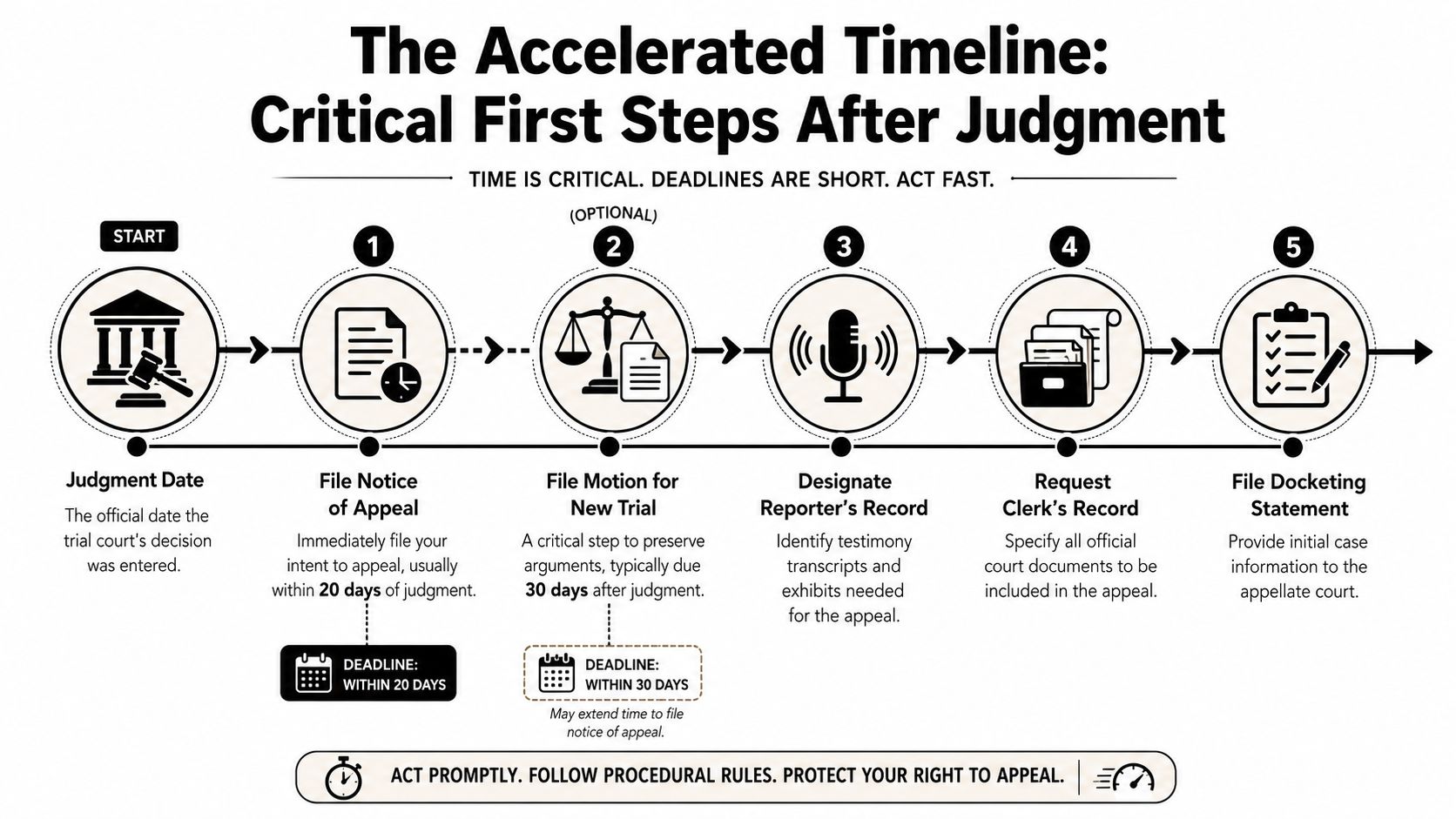
In Texas, the Notice of Appeal in a parental-rights termination case is due 20 days after the judgment is signed. Texas treats these as accelerated appeals under the appellate rules, and the filing deadline is shorter than the deadline that applies in many other family cases. The Texas Rules of Appellate Procedure set that framework.
The Notice of Appeal is a short filing, but it carries enormous weight. It tells the appellate court you are invoking review. It does not spell out every legal argument, and it does not need to. Its job is to preserve the appeal itself.
If you are comparing deadlines, what is the deadline for filing a notice of appeal in Texas gives broader context. Termination cases follow a tighter schedule, and that difference matters from day one.
Parents also benefit from understanding how the accelerated deadline fits into the wider family-law framework. The Notice of Appeal Deadline in Texas Family Cases explains the general rule and why termination orders are treated differently.
What to do first
The practical sequence is straightforward, even if the situation is not:
- Confirm the signing date of the judgment. Use the date the court signed the termination order, not the date you received a copy.
- File the Notice of Appeal right away. Waiting to see how you feel in a few days is a common and costly error.
- Address counsel immediately. If appellate counsel needs to be appointed or retained, that decision affects everything that follows.
- Protect the record early. Identify the hearings, exhibits, and rulings that need to be included in the clerk's and reporter's records.
- Evaluate post-judgment filings at once. A Motion for New Trial can preserve issues, but it does not extend the accelerated notice deadline.
Treat the signed judgment date like a stopwatch.
That practical approach matters because termination appeals are already difficult cases. Reversal is rare, and many losses on appeal trace back to procedure, not just the underlying facts. A parent may have a serious complaint about the trial, but if the notice is late or an issue is waived, the appellate court may never reach it.
Where parents lose ground early
The biggest trap is confusing two different jobs. The Notice of Appeal protects the right to pursue appellate review. A Motion for New Trial may preserve complaints that would otherwise be waived. One does not substitute for the other.
That distinction sounds technical until it costs someone a case. Parents often hear that a post-trial motion can be filed after judgment and assume the appeal deadline must also be extended. In a termination appeal, that assumption can be fatal.
A second trap is waiting to gather new evidence before taking the first appellate step. Appeals are built from the trial record. The immediate task is to secure jurisdiction, identify preservation problems, and make sure the record will support the arguments that remain available.
A third trap is using trial-court instincts in an appellate case. The question is not whether the parent can tell a more persuasive story now. The question is whether the record shows reversible legal error and whether that error was preserved in time.
Later in the process, the court will need the clerk's record, the reporter's record, and early appellate paperwork such as the docketing statement. Strong appellate work starts before those materials arrive, because counsel should already be identifying deadlines, omissions in the record, and issues that may require immediate action in the trial court.
A short overview can help if you need to orient yourself before speaking with counsel.
What does not work
Several approaches fail repeatedly in these cases:
- Waiting for emotions to settle: Understandable, but the court does not pause the deadline.
- Assuming a Motion for New Trial buys more time: It does not extend the 20-day notice period in a termination appeal.
- Trying to rebuild the case before filing notice: The first job is preserving appellate jurisdiction.
- Treating the appeal like a second trial: Appeals turn on the record, preservation, and legal framing.
When a parent calls after the deadline has passed, the available options narrow fast. The safest first move is usually the simplest one. File the notice on time, then build the strategy carefully.
Preserving Your Arguments with a Motion for New Trial
A Motion for New Trial is one of the most misunderstood tools in a termination appeal. It does not serve the same function as the Notice of Appeal, and it does not rescue a missed notice deadline. Its value is different. It helps preserve issues for review.
That word, preservation, matters. If a complaint wasn't properly raised in the trial court or in a required post-trial filing, the appellate court may refuse to consider it at all. In other words, a parent can have a strong fairness argument and still lose because the issue wasn't preserved the right way.

Why this motion matters so much
Texas termination appeals have a low success rate. Approximately 10 to 15% result in reversal or remand, primarily when appellants show insufficient evidence that was properly preserved in a Motion for New Trial, according to this Texas termination appeal discussion.
That doesn't mean a Motion for New Trial is always required for every argument. It does mean that in many termination cases, this motion is where appellate counsel protects the client from waiver.
What preserving error means in real life
Preserving error means making sure the appellate court can reach the issue. In practice, that often includes claims such as:
- Insufficient evidence: The State did not meet the required burden.
- Ineffective assistance of counsel: Trial representation was so deficient that it affected the outcome.
- Due process concerns: The parent did not receive fair notice or a fair opportunity to be heard.
Some of those arguments depend heavily on what was raised after judgment and what was attached or developed then. If evidence needed to support the motion isn't properly included, that omission can follow the case into the appeal.
What should go into the motion
The motion should be strategic, not emotional. It should identify specific legal grounds, point to parts of the record, and where necessary include admissible supporting materials.
A useful way to think about it is this:
| Weak approach | Better appellate approach |
|---|---|
| “The judge was unfair.” | Identify the exact ruling and why it violated law or procedure |
| “I have new facts now.” | Explain whether the issue was preserved and whether the appellate record supports it |
| “My lawyer failed me.” | Tie the complaint to omissions, prejudice, and the existing record |
Filing a Motion for New Trial without a preservation strategy can create motion paper without creating appellate value.
For a fuller explanation of how post-judgment strategy works in family appeals, motions for new trial in Texas family law appeals is a useful reference.
The trade-off here is real. A rushed motion can be weak, but no motion at all can waive an issue that might have been the center of the appeal. The right answer depends on the record, the trial errors, and the issues that can still be preserved cleanly.
Building Your Case The Appellate Record and Persuasive Briefing
A parent often reaches this stage expecting a second chance to tell the story better. That is not how an appeal works. The court of appeals decides the case from the record already made, and in termination cases that record has to carry extraordinary weight because the judgment rests on clear and convincing proof.
The appellate record
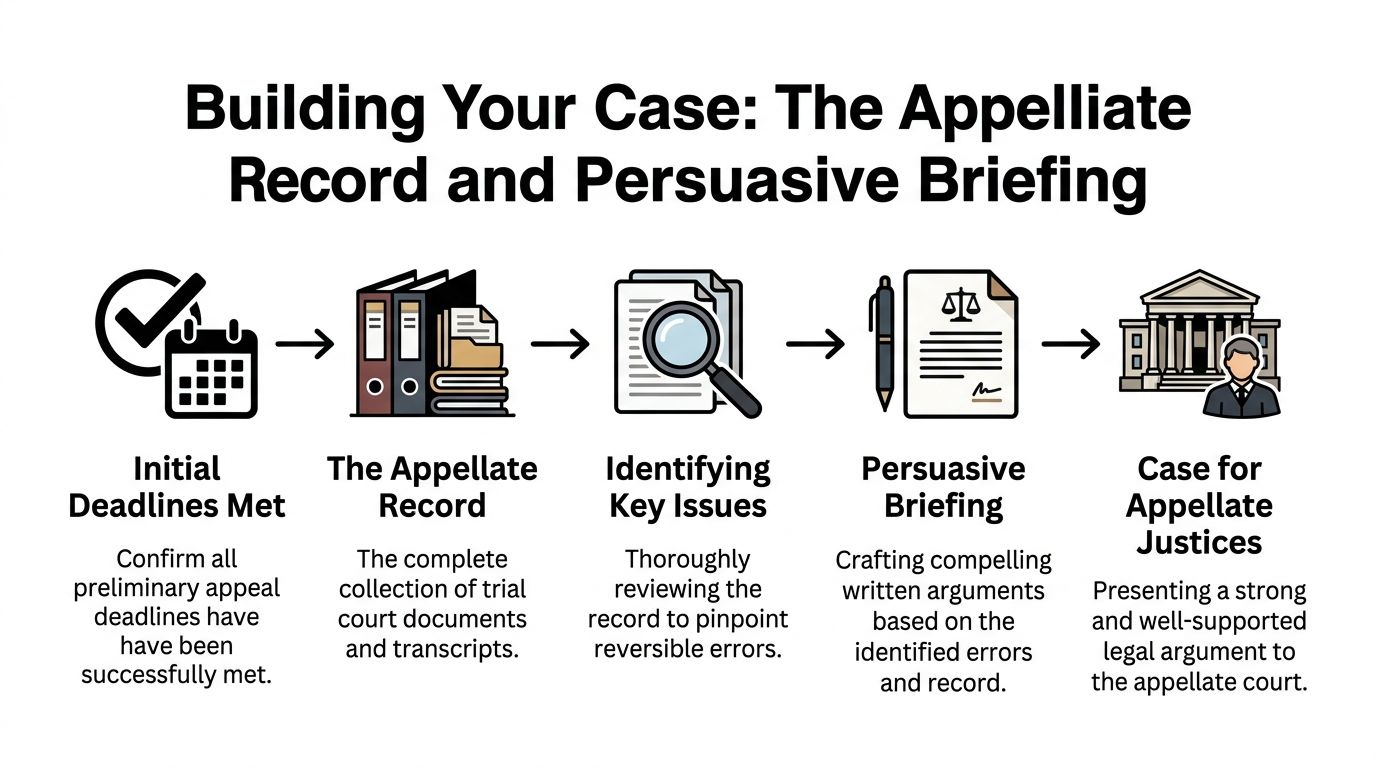
The record is the case. If a fact, objection, exhibit, or ruling is missing from it, the court of appeals usually cannot use it to reverse the judgment.
That record usually has two parts:
- Clerk's Record: pleadings, orders, motions, filed exhibits, and other court papers
- Reporter's Record: the transcript of testimony, objections, rulings, and hearings
In termination appeals, the process moves on an accelerated track. That compressed schedule creates one of the most common traps in these cases. Families assume there will be time later to sort out missing papers, request omitted hearings, or clarify what happened at trial. Often there is not. Appellate counsel should check early whether the record includes every hearing that matters, every exhibit needed for a sufficiency challenge, and every written order tied to the issues on appeal.
I tell clients the same thing in nearly every termination appeal. Panic is not useful, but speed is.
The standard of review
A strong appeal does not start with the question, "Was the result unfair?" It starts with a narrower question. "What rule will the court of appeals apply to this issue?"
That rule is the standard of review. It determines how much deference the trial court receives and what the appellant has to prove.
The standards clients most often need to understand are these:
- Abuse of discretion: the trial court chose an option the law did not permit
- Legal sufficiency: even viewed under the required appellate lens, the evidence does not support the finding
- Factual sufficiency: the full record does not support the finding under the governing burden of proof
Many weak briefs diminish in effectiveness at this juncture. They argue every complaint the same way. A good brief matches each issue to the right standard and then builds the argument around that standard. In parental termination appeals, that discipline matters because appellate courts describe successful reversals as rare, and broad fairness arguments do not usually overcome the deference built into review.
The burden in termination cases
Termination requires clear and convincing evidence. In practice, that means the proof must be strong enough to produce a firm belief or conviction on the required findings.
That burden changes how a persuasive brief is written. Counsel cannot stop at showing factual conflict or pointing out that a different result was possible. The brief has to show why, under the controlling standard, the evidence falls short of what Texas law requires for both a statutory ground and best interest. A record may contain painful facts and still fail to meet that burden. The challenge is identifying where the proof breaks down in a way the appellate court can act on.
A focused issue is usually more valuable than five diluted ones.
What persuasive briefing does
A brief is the written legal argument filed in the court of appeals. In a termination case, it should do more than summarize the trial. It should identify the reversible error, tie each factual statement to the record, apply the right authority, and ask for the correct remedy.
Strong briefing usually has four traits:
- A precise issue statement. The court should be able to see the legal question in one sentence.
- Record citations that matter. Every important factual point should send the justices to the exact page supporting it.
- Arguments shaped by the standard of review. Sufficiency points, procedural complaints, and constitutional issues should not be argued as if they were interchangeable.
- A remedy that fits the error. Some mistakes support rendition. Others support remand for a new trial.
Parents are often surprised by how technical this part becomes. The formatting rules matter, but strategy matters more. A brief can comply with every rule and still miss the case. For a practical explanation of both the formal rules and the strategic choices involved, see these appellate brief requirements in Texas family law.
If you are evaluating counsel for this phase, a Texas Family Law Appeals Lawyer should be looking for more than a timeline. The primary work involves identifying what the record preserves, spotting procedural traps that limit review, and presenting the few issues that give the court a legally sound reason to reverse.
Common Reversible Errors in Termination Cases
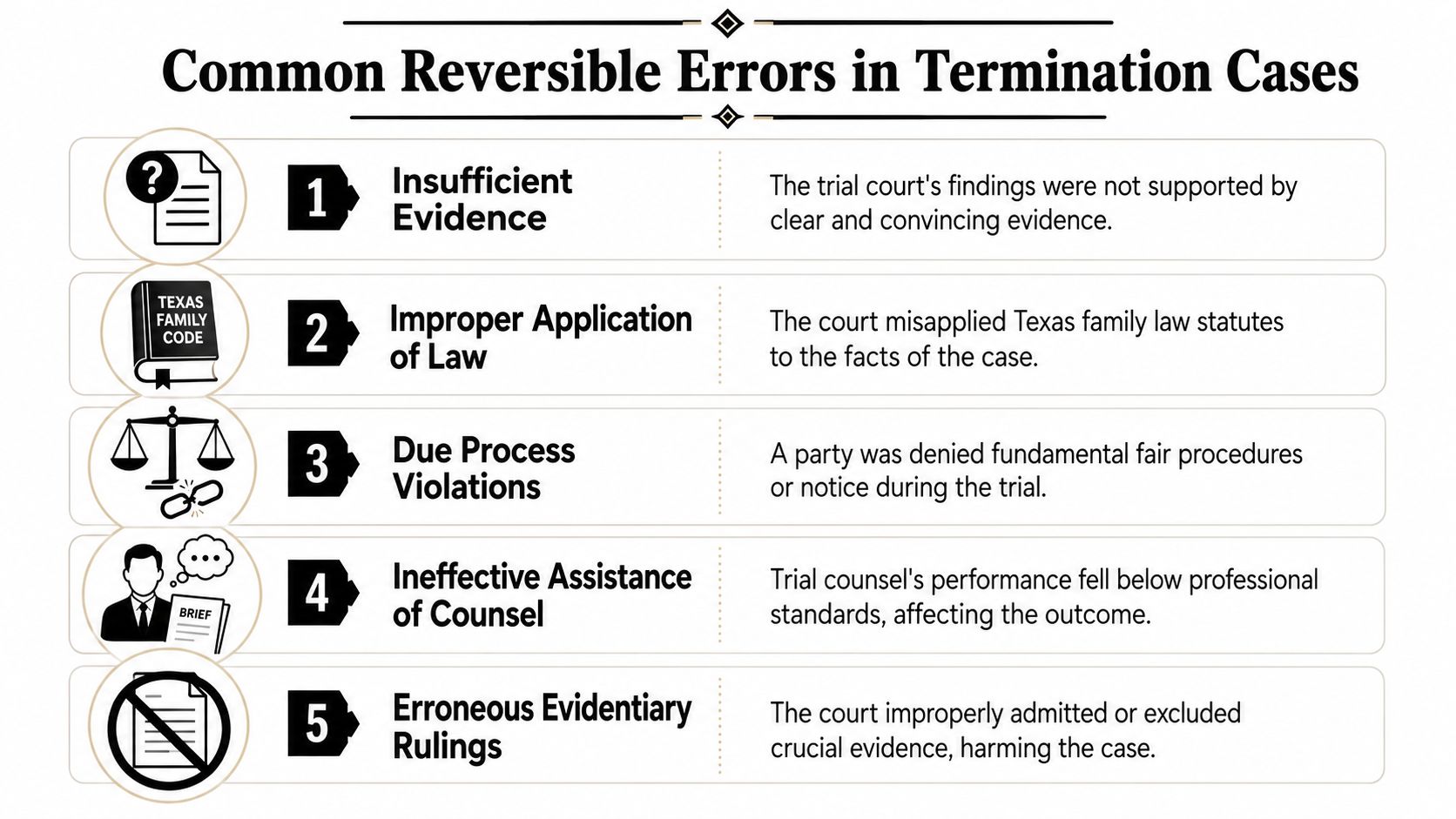
A termination appeal succeeds when counsel can identify reversible error, not just hardship. The question is whether the trial court committed a legal mistake that affected the judgment.
The recurring categories are easier to understand when separated by type.
Insufficient evidence
This is often the first issue parents ask about, and for good reason. In a termination case, the State must prove both a statutory ground and best interest under a very high burden. If the evidence does not legally support those findings, the judgment may be vulnerable.
Still, not every “thin” record becomes a winning appeal. Appellate courts do not retry witness credibility. They review whether the proof in the record was enough under the governing legal standard and whether the complaint was preserved correctly.
Due process violations
Termination cases must be handled with careful attention to fair procedure. A parent may have an appellate issue if the court process denied basic fairness, such as meaningful notice or a fair hearing.
Due process arguments can be powerful, but they must be tied to specifics. General frustration with how the case felt won't be enough. The brief has to show what process was denied, where that appears in the record, and why it mattered.
Some of the strongest appellate issues come from procedure, because appellate judges can identify them directly from the record.
Ineffective assistance of counsel
Texas recognizes that counsel's failures in a termination case can affect the integrity of the judgment. But this is not an easy argument to win.
The appellate court usually wants to see more than disagreement with trial tactics. A workable ineffective-assistance claim often involves serious omissions, missed preservation, failure to present critical matters, or other conduct that undermined the reliability of the result.
Misapplication of law
Sometimes the trial court had facts in the record but applied the law the wrong way. That can be a clean appellate issue because appellate courts are well positioned to correct legal analysis.
The most important recent example involves criminal history. A 2025 Texas Supreme Court ruling clarified that extensive criminal history alone can constitute grounds for termination without a direct causal link to child endangerment, which means appellate briefs now need to confront that issue directly when arguing for reversal, as reported in this KERA coverage of the ruling.
That changes defense strategy in a practical way. Older assumptions about requiring a direct harm link may not carry the day if the trial court relied on criminal history as evidence of endangerment. The better appellate question may be whether the court applied that standard correctly to the specific record before it.
Evidentiary rulings and other trial errors
Not every evidentiary mistake leads to reversal, but some do. If the court admitted harmful evidence it should have excluded, or excluded material evidence it should have considered, that may matter. The challenge is showing both error and harm.
A useful screening approach is this:
| Potential issue | When it may matter on appeal |
|---|---|
| Bad facts | Usually not enough by themselves |
| Legal mistake | Stronger if clearly shown in rulings or findings |
| Unpreserved complaint | Often difficult or impossible to raise |
| Record-backed preserved error | Most useful starting point for briefing |
The hard truth is that a lot of termination appeals fail because the appellate issue is emotionally compelling but legally underdeveloped. The cases with a realistic path forward usually involve one or more of these: a preserved insufficiency argument, a procedural violation, a serious counsel problem, or a clear legal misapplication.
Your Path Forward Seeking a Fair Outcome on Appeal
A termination appeal demands speed, discipline, and realistic judgment. You need more than a belief that the trial went badly. You need a review built around the record, the Texas Rules of Appellate Procedure, and the Texas Family Code.
These appeals also move to the front of the line. Texas Family Code Chapter 109(a-1) gives termination appeals precedence over other civil cases, which means appellate courts review them faster to protect the child's best interests and finalize legal status, as reflected in Texas Family Code Chapter 109(a-1). That speed is one more reason not to wait for clarity to arrive on its own.
If you're evaluating whether you have an appeal, focus on three questions:
- Was the notice deadline protected?
- Was any key issue preserved for review?
- Does the record show a real legal error, not just an unfavorable outcome?
A careful appellate lawyer can answer those questions by reviewing the judgment, deadlines, motions, transcripts, and rulings. That review often brings calm to a chaotic moment because it replaces guessing with strategy.
If you believe the court made a mistake in terminating your parental rights, our appellate attorneys can help you seek a fair outcome. Contact The Law Office of Bryan Fagan today for a free consultation to evaluate your case.
If you believe the court made a mistake in your family law case, our appellate attorneys can help you seek a fair outcome. Contact The Law Office of Bryan Fagan, PLLC today for a free consultation.