You may feel like the judge got it wrong, ignored what mattered, or locked in a child support number that doesn’t reflect reality. That reaction is common. It’s also not enough, by itself, to win an appeal.
An appeal is not a second hearing where you get to tell your story one more time and hope for a better result. It’s a structured legal challenge focused on one question: did the trial court make a reversible error under Texas law? If the answer is yes, there may be a path to relief. If the answer is no, even a harsh result may still stand.
If you’re searching for how to appeal child support order decisions in Texas, start with that distinction. The process is technical, deadline-driven, and unforgiving. But when a court misapplied the law, ignored required procedures, or based its ruling on a defective record, appellate review can restore balance.
Your Child Support Order Feels Wrong What Happens Now
A parent leaves court, reads the order again in the parking lot, and feels sick. The support amount seems inflated. Income was discussed, but not carefully. Documents were offered, but the judge appeared to move past them. The order is now signed, and the other side says there’s nothing left to do.
That’s usually the moment people start asking whether they can appeal.

Sometimes the answer is yes. Sometimes the right answer is not an appeal at all, but a modification, clarification, or targeted post-judgment motion. The key is to stop guessing and get the order, the hearing record, and the procedural history reviewed quickly.
What clients usually get wrong first
A common misconception is that an appeal means, “The judge was unfair.” Appellate courts don’t work that way. They don’t reweigh every fact because one side feels mistreated. They review whether the trial court made a legal mistake that matters.
That difference changes everything.
A support appeal usually turns on details such as how income was calculated, what evidence the court admitted or excluded, whether the court followed the Texas Family Code, and whether your trial lawyer preserved the issue for review. The feeling that the case went sideways may be real. But the appeal lives or dies on the record.
A strong appeal begins with discipline, not outrage.
The practical next move
If the order was just signed, act fast. Gather the final order, any findings, your exhibits, hearing notes, emails with trial counsel, and the docket information. Don’t wait until enforcement starts to ask whether the ruling can be challenged.
That early review matters because child support appeals are governed by the Texas Rules of Appellate Procedure, and appellate strategy is different from trial strategy in every meaningful way. Fairness still matters. But in an appeal, fairness has to be translated into legal error.
Understanding the Grounds for a Child Support Appeal
The most important concept in any appeal is simple. You are not appealing because you disagree. You are appealing because the trial court made a reversible error.
That’s the test.
A reversible error is a mistake that affected the outcome or undermined the fairness of the proceeding enough that the appellate court can justify changing the result. A harmless mistake usually won’t carry an appeal. An irritating ruling won’t either. The error has to matter.
What abuse of discretion means
Many Texas family law appeals use the abuse of discretion standard. That phrase sounds dramatic, but it has a specific meaning.
Abuse of discretion means the trial court acted without following guiding legal rules or principles, or made a decision that the law and record can’t reasonably support.
That does not mean the appellate court would have ruled differently. It means the trial court crossed a legal line.
Common grounds that may support an appeal
In child support cases, certain problems come up again and again. These are not automatic wins, but they are the kinds of issues appellate lawyers look for.
Income was calculated incorrectly. The court may have used the wrong income figure, overlooked required deductions, or treated irregular money as if it were dependable monthly income without proper support in the record.
The court failed to account for relevant sources of income or evidence. That can cut either way. Sometimes a parent’s actual earnings were understated. Other times the court attributed income without adequate proof.
The statutory guideline approach was applied incorrectly. Texas child support law is not free-form. Judges have discretion, but they still must work within the Family Code and applicable rules.
The court refused to consider admissible evidence. If the judge excluded financial records, testimony, or other proof that should have been considered, that may create a serious appellate issue.
The court relied on insufficient findings or a flawed legal framework. A support order must rest on more than intuition. If the reasoning in the record doesn’t support the result, that can matter.
Disagreement versus legal error
Here’s the blunt version. If you tell an appellate court, “The judge believed the other parent instead of me,” you usually won’t get far. Trial judges decide credibility. Appellate courts generally do not retry witness disputes from a cold record.
If you tell the court, “The judge applied the wrong legal standard to the support calculation and the transcript shows I objected,” that’s different. Now you’re identifying a specific legal problem tied to the record.
Examples that often deserve a closer look
Consider these common scenarios:
Net resources were mishandled
Texas child support often depends on the correct calculation of net resources. If the court used a number that doesn’t match the admitted records, or ignored evidence affecting that calculation, the issue may be appealable.
Evidence was ignored for the wrong reason
A judge can decide what weight to give evidence. A judge cannot disregard governing law. If the court excluded or sidelined important financial proof based on a mistaken legal view, that may support appellate review.
The order doesn’t match the hearing
Sometimes the written order overreaches what the judge announced. Sometimes it contains terms the evidence didn’t support. That disconnect matters.
The strongest appellate issues are specific, preserved, and tied to the written record.
Why legal framing matters more than frustration
You need to frame the case the way appellate judges analyze cases. That means identifying the issue, naming the standard of review, pointing to where the error happened, and explaining why the mistake changed the result.
That’s why generic internet advice is often useless. “File an appeal if the outcome was unfair” is not legal strategy. The better question is whether the record shows an issue that can survive appellate scrutiny. If you want a broader overview of what courts treat as appealable error, this guide to grounds for appeal in civil cases is a useful starting point.
Plain-English terms you should know
- Reversible error means a legal mistake serious enough to justify changing the result.
- Abuse of discretion means the trial court acted outside the rules or reached a ruling the law and record won’t support.
- Briefing means the written legal argument filed in the appellate court. It is the centerpiece of the appeal, not a formality.
If your child support order feels wrong, the primary question isn’t whether you’re upset. It’s whether the order is legally vulnerable.
The Critical First Steps and Deadlines for Your Appeal
The judge signs the child support order on Friday. By Monday, you know something went wrong. The court may have relied on the wrong income figure, ignored an exhibit, or signed an order that does not match the ruling from the bench. At that point, frustration is irrelevant. The real question is whether you can identify a reversible error and protect the deadlines before they expire.
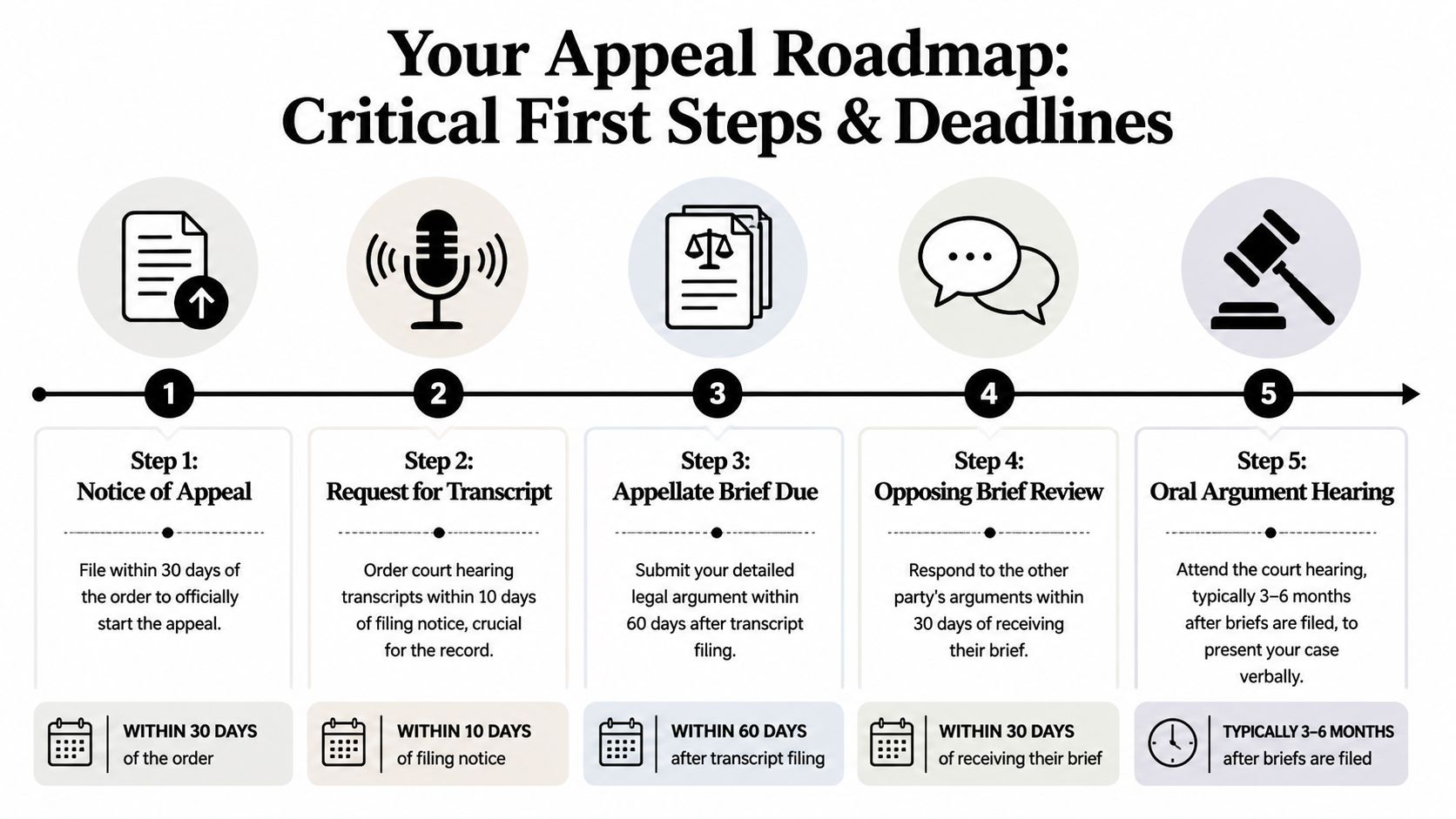
Texas appellate practice is unforgiving on timing. If you sit on the order while deciding whether to fight, you can lose the appeal before the legal analysis is finished. That happens more often than people expect.
Start with the Notice of Appeal
In Texas, the first major filing is usually the Notice of Appeal. The deadline is often tied to the date the final order was signed, and certain post-judgment filings can change that calculation under the Texas Rules of Appellate Procedure. Do not guess. Confirm the date, confirm whether the order is final, and confirm whether anything extended the deadline.
For a focused explanation of that filing, read this Texas guide on how to file a notice of appeal.
Error preservation decides whether the court will even listen
A weak appeal often fails before the appellate court reaches the merits. The problem is preservation.
Under appellate procedure, a complaint usually must have been raised in the trial court through a timely, specific objection, request, or motion. If the record does not show that step, the court may treat the issue as waived, as explained in this family court appeals guide on preserved objections.
That rule drives strategy. You are not trying to prove the judge was unfair in some general sense. You are trying to show that the judge made a legal mistake, that the mistake was properly brought to the trial court’s attention, and that the mistake likely affected the result.
A lot of potential clients hate hearing that. It is still true.
If no one objected when the court excluded financial records, applied the wrong standard, or signed language that exceeded the ruling, the appeal may be dead on arrival.
Review these four points before you spend serious money
A disciplined appellate review should answer four questions early:
Is the order final and appealable?
Some family court rulings feel final but are not yet in a posture for appeal.What is the actual deadline?
The signing date matters. So do post-judgment motions and notice issues.What issues were preserved?
The transcript, filings, and written objections need to show where the complaint was raised.What is in the record?
Appeals rise or fall on the clerk’s record and reporter’s record. If the key exhibit was never admitted, or the hearing was not transcribed, your options narrow fast.
Here’s a short overview before you dive deeper into the process:
The order usually remains enforceable during the appeal
Filing an appeal does not automatically stop child support enforcement. If support is due under the signed order, the obligation may continue unless a court grants relief.
That creates a hard practical problem. Parents often assume the appeal freezes collection. It usually does not. Arrearages can keep building, enforcement can continue, and later relief may not erase the disruption caused in the meantime.
What to do right after the order is signed
- Get the signed order immediately. You need the exact document on file with the clerk.
- Order the records early. Ask for the reporter’s record, exhibits, and clerk’s record before delay creates a new problem.
- Write out the errors while they are fresh. Identify the ruling, the page or hearing where it happened, and whether counsel objected.
- Separate appellate issues from future changes. A legal error in the signed order is one issue. A later job loss or income change is a different issue with a different remedy.
If you want a real chance on appeal, act fast and think like an appellate court. The standard is not whether the order feels wrong. The standard is whether the record shows a preserved, harmful legal error that justifies reversal under Texas law.
How an Appeal Differs from Your Original Trial
Most clients come into an appeal expecting another courtroom fight. That’s not what happens. An appeal is not a new trial. You do not call fresh witnesses, introduce new documents, or retell the case from scratch.
The appellate court reviews what already happened. Its job is to decide whether the trial court made a legal error based on the existing record.
Trial Court versus Appellate Court
| Aspect | Trial Court | Appellate Court |
|---|---|---|
| Decision-maker | One judge, sometimes with live hearings and credibility calls | A panel of justices reviewing the written record |
| Main focus | Facts, testimony, exhibits, and immediate rulings | Legal error, preserved objections, and application of law |
| Evidence | Live witnesses and admitted exhibits | No new evidence |
| Witness testimony | Central to many hearings | None |
| Credibility decisions | The trial judge evaluates who to believe | The appellate court usually defers to trial-level credibility calls |
| Primary work product | Motions, testimony, exhibits, and trial presentation | Written briefs grounded in the record and law |
| Possible result | Original child support ruling | Affirm, reverse and render, or reverse and remand |
What standard of review means in plain English
The standard of review is the rule the appellate court uses to evaluate the trial judge’s decision. This framework determines the specific level of difficulty you face during the appeal process.
For child support rulings, many issues are reviewed through abuse of discretion. Legal questions may be handled differently. Mixed questions can get more complicated. The point is simple: appellate courts do not start from scratch. They review within defined limits.
That’s why a trial loss doesn’t automatically become an appellate win, even when the outcome feels harsh.
An appeal asks, “Did the court follow the law with this record?” It does not ask, “Who deserves to win if we do the whole case over?”
The record controls the case
The appellate court usually works from two core parts of the record:
Clerk’s Record
This includes pleadings, motions, orders, requests, and other filed papers. If something important was filed with the court, it may appear here.
Reporter’s Record
This is the transcript of what was said in court, along with admitted exhibits from the hearing. It often decides whether an objection was made, whether evidence was admitted, and what the judge ruled.
Why this shift surprises people
At trial, speed and reaction matter. A witness says something unexpected, an exhibit gets challenged, or the judge asks questions from the bench. Appeals feel very different. They reward precision, writing, and record analysis.
That difference is also why trial success and appellate skill are not identical. A lawyer can be excellent in a live courtroom and still struggle with appellate briefing. The work is more analytical, more rule-bound, and more dependent on framing.
What a careful appellate review looks for
- Where the trial court ruled
- Where counsel objected
- What legal authority controlled the issue
- Whether the alleged error probably affected the outcome
If a potential client says, “I have texts and bank records that prove the judge was wrong,” the next question is immediate: were those materials admitted or otherwise made part of the record? If not, the appeal gets harder.
For related family law disputes that often overlap with support issues, many clients also need guidance on child custody appeals, divorce decree challenges, property division disputes, and protective order appeals. The same basic truth applies across all of them. The record is king.
Crafting the Winning Argument The Appellate Brief and Oral Argument
You read the order, read the transcript, and still feel the trial court got it wrong. At this stage, that feeling is not enough. The appeal turns on whether your lawyer can identify a reversible error, tie it to the record, and show the court why that mistake probably mattered.
That work happens in the appellate brief.
A strong brief does four things well. It picks the issues worth fighting about. It states the facts from the appellate record, not from memory or frustration. It applies the right standard of review under Texas appellate law. It asks for a remedy the court can lawfully grant.
Issue selection matters more than many clients expect. Raising every complaint rarely helps. It usually weakens the brief. Good appellate lawyers cut weak points and spend their credibility on the few errors that can support reversal.
Form matters too, because appellate courts expect strict compliance with the rules. If you want to see what Texas courts require in structure, citations, and argument sections, review these Texas appellate brief requirements in family law cases.
The best briefs are built methodically. They do not recycle a trial motion with a new caption. They require close record review, careful framing, and disciplined writing. Lawyers who want to improve that process sometimes borrow drafting methods from outside appellate practice. This practical guide for legal operations is useful for tightening workflow and document control.
Oral argument, if the court grants it, is a different skill. The justices usually want direct answers to hard questions. They want to know where the issue was preserved, what rule controls, and what remedy fits the error. A lawyer who gives a speech instead of answering the panel will lose ground fast.
Oral argument tests the brief. It does not rescue a weak one.
One more point clients need to hear clearly. Filing the appeal does not rewrite the facts, add new exhibits, or give you a second trial. The argument must stay anchored to the existing record and to errors the appellate court can correct under the rules.
If you are hiring counsel for this stage, ask blunt questions. Who is reading the full record personally? Who is drafting the brief? Who is preparing for oral argument if the court sets it? The Law Office of Bryan Fagan, PLLC handles record review, briefing, and oral advocacy in Texas family law appeals. That kind of continuity is worth insisting on from any appellate lawyer you hire.
What Are the Potential Outcomes of a Child Support Appeal
A successful appeal doesn’t always mean the appellate court enters the exact result you wanted. Appellate outcomes are narrower than that, and you need to understand them before you invest in the process.
Affirm
If the court affirms, the trial court’s order stays in place. That means the appellate court found no reversible error that justifies disturbing the judgment.
This is why honest case evaluation matters. Some rulings feel unfair and still survive appeal because the record doesn’t show a legal basis to reverse.
Reverse and render
If the court reverses and renders, it changes the result and issues the judgment that should have been entered under the law. In plain English, the appellate court concludes the mistake is clear enough that it can fix the outcome without sending the case back for more work.
That can be powerful, but it is not available in every case.
Reverse and remand
If the court reverses and remands, it sends the case back to the trial court for further proceedings. That often means another hearing, additional findings, or a corrected ruling using the legal instructions from the appellate court.
For many families, this is the most realistic kind of appellate win. The appellate court identifies the problem, but the trial court still has work to do.
What these outcomes mean for you
- Affirmed means the support order remains enforceable as entered.
- Reversed and rendered means the appellate court itself corrects the legal result.
- Reversed and remanded means the case returns to the trial court, often with new limits or instructions.
A good appeal does not promise a perfect ending. It seeks a legally justified correction.
The right goal is not revenge against the trial court. It is a fair outcome under the law, based on a record the appellate court can use.
Let Us Help You Seek a Fair Outcome
If you believe your child support order was decided unfairly, you’re not powerless. But you do need to be realistic. Appeals are technical. Deadlines are short. The difference between a bad result and a reversible error matters, and it matters immediately.
That’s why disciplined review is the first step. Someone needs to examine the signed order, the hearing record, the objections that were made, and the legal standards that controlled the ruling. If the issue is appealable, you need a plan. If it isn’t, you need to know that early and clearly.
Some families also need help outside the appellate lane, especially when the core issue is ongoing support enforcement or modification strategy. In those situations, a focused resource such as expert child support legal counsel may help you understand the broader child support environment while you assess appellate options.
A well-handled appeal can correct legal error, protect your financial rights, and restore confidence that the process still has rules. That’s the point. Not false hope. Not noise. A clear path to a potential remedy.
If you believe the court made a mistake in your family law case, our appellate attorneys can help you seek a fair outcome. Contact The Law Office of Bryan Fagan, PLLC today for a free consultation.