You may feel like the judge didn’t hear your case. You may have walked out of court thinking the result made no sense, especially after months of showing up for your child, following orders, and trying to stay composed while the other parent escalated conflict.
That feeling matters. But in Texas family law, the next step isn’t just emotional. It’s strategic.
Most articles about how to win a custody battle stop at trial advice. They talk about dressing well, being polite, and bringing evidence. That advice has value, but it leaves out the part many parents only learn after an unfair ruling. A custody case can be won over time, not only on the day the trial court signs an order.
Your Custody Battle Begins Before You Enter the Courtroom
A parent who wants to protect parental rights in Texas has to think further ahead than the hearing date. Trial preparation matters. So does the way you communicate with the other parent, the records you keep, and the legal objections your lawyer makes when something goes wrong. Those details may decide whether you can challenge an unjust result later.

Most mainstream custody guides never reach that point. As noted in this discussion of common custody battle advice, the appellate side of custody litigation is largely missing from typical “how to win” content. That gap matters because a bad ruling at trial isn’t always the end of the road.
Win the case in two ways
You want to build a case that does one of two things:
- Persuades the trial judge to reach a fair result
- Creates a clean record if the trial judge gets it wrong
That second point is where many parents lose options without realizing it. Appeals don't happen in a vacuum. Appellate judges review the record that was created below. If key evidence never made it into that record, or if legal errors were never preserved, a serious problem can become very hard to fix.
Practical rule: Don’t prepare for trial as if trial is the final chapter. Prepare as if every filing, exhibit, objection, and ruling may later be reviewed by an appellate court.
Texas parents also have to manage the human side of this process. If your children are struggling during separation or divorce, outside support can help you parent more steadily while the legal case moves forward. Resources like expert guidance for families facing divorce can help you focus on your child’s emotional needs without turning the case into a fight over blame.
Early case decisions shape later appeals
A strong appeal often starts long before the notice of appeal is filed. It starts with discovery, document requests, calendars, school records, and communication logs. If you don’t know how to force disclosure or pin down facts early, the trial record may stay thin. For a practical look at that groundwork, review this guide to discovery in Texas divorce cases.
The parents who put themselves in the best position usually do something simple but hard. They stop asking, “How do I beat the other side next week?” and start asking, “How do I build a record that still holds up months from now?”
That mindset changes everything. It changes how you speak in mediation. It changes what you save. It changes what you ask your attorney to preserve. And if the trial court makes a mistake, it gives you something concrete to challenge.
Understanding the Standard for Custody Decisions in Texas
Texas courts decide custody issues under the best interest of the child standard. In many cases, judges also look to the familiar Holley considerations, which include the child’s needs, the parents’ abilities, the stability of each home, any danger to the child, and the plans each parent has for the child’s future. These aren’t boxes to check. They are the framework courts use to justify a conservatorship and possession order.
An appeal doesn’t ask whether an appellate judge would have made a different parenting schedule. It asks whether the trial court had a legally sufficient basis for the decision and whether it used its discretion in a lawful way.
What the best interest standard looks like in real life
At trial, broad claims rarely carry a custody case. Specific facts do. Judges want to know who gets the child to school, who talks to teachers, who attends medical appointments, who handles routines, and who creates consistency.
The Holley factors often play out through evidence like this:
Daily care history
Who handled homework, meals, transportation, hygiene, and bedtime?Emotional and physical needs
Which parent has shown reliable follow-through with counseling, health care, and school support?Stability of the proposed home
Is the living arrangement steady, predictable, and appropriate for the child?Co-parenting judgment
Does a parent support the child’s relationship with the other parent when safe to do so?Risk factors
Is there evidence of family violence, substance abuse, untreated mental health concerns, or unsafe decision-making?
A judge doesn’t have to mention every factor out loud for the ruling to stand. But if the record shows the court ignored controlling evidence, relied on improper considerations, or made findings unsupported by the admitted evidence, that may matter on appeal.
The custody arrangement you request matters
Parents often assume asking for sole custody shows seriousness. In many cases, it can do the opposite if the evidence doesn’t support that level of restriction. A study found that plaintiffs who requested joint custody were 1.74 times more likely to win than those requesting sole custody, according to this published custody outcomes study.
That doesn’t mean every parent should ask for joint custody. Some cases involve family violence, severe instability, or other facts that justify a more restrictive order. But it does show an important legal and strategic point. The relief you request should match the facts you can prove.
Ask for the order your evidence supports. An exaggerated request can make a reasonable parent look unreasonable.
How appellate courts look at trial court judgment calls
In Texas, custody rulings are often reviewed under an abuse of discretion standard. In plain English, that means the appellate court gives the trial judge room to make judgment calls, but not unlimited room. A court abuses its discretion when it acts without guiding legal rules or reaches a decision that the record can’t reasonably support.
That standard is demanding, but it isn’t meaningless. It rewards careful lawyering.
A parent considering appeal should ask questions like these:
| Trial question | Appellate significance |
|---|---|
| Did the judge exclude important evidence? | The record may show harmful evidentiary error |
| Did the judge apply the wrong legal standard? | That may support reversal |
| Did the order conflict with the findings or evidence? | The appellate court may review for legal or factual support |
| Did counsel fail to object? | The issue may not be preserved for appeal |
What works and what hurts
What works in Texas custody litigation is usually disciplined and child-centered. Parents help themselves when they present a realistic parenting plan, tie requests to actual evidence, and stay focused on the child’s daily life rather than moral attacks on the other parent.
What hurts is overreaching. So does treating the courtroom like a place to settle personal scores.
If you want to know how to win a custody battle, start here. Learn how the court is supposed to decide your case. Then compare that legal standard to what happened in your courtroom. That’s often where the first signs of an appealable problem appear.
Building an Evidence Locker for Trial and Appeal
Evidence wins custody cases. More precisely, admissible, organized, and preserved evidence wins custody cases and supports appeals.
Parents often say, “I have proof.” What they usually mean is that they have screenshots on a phone, strong memories, and a lot of frustration. That isn’t enough by itself. You need a system.

Courts increasingly focus on documented parental involvement. As described in this guidance on custody documentation and trial presentation, detailed records of daily caregiving, school communication, and medical involvement can become the trial record an appellate court later reviews. That matters because appeals depend on what was presented below.
What to collect
Think of your file as an evidence locker, not a scrapbook. Every item should help prove a point.
Useful categories include:
School records
Attendance notices, teacher emails, report cards, special education communications, and records showing which parent responded.Medical records
Appointment confirmations, prescriptions, discharge instructions, and portal messages showing who scheduled care and attended visits.Parent communication
Text messages, email threads, and co-parenting app logs. Save complete conversations, not selected fragments.Calendar history
Exchanges, overnights, missed visits, extracurricular events, and transportation records.Photos and videos
Use these carefully. Date them, identify the event, and connect them to a relevant issue such as attendance, caregiving, or conditions in the home.Third-party support
Teachers, counselors, daycare workers, coaches, and relatives may have relevant observations. Your attorney can help determine what is useful and admissible.
How to organize it
Good evidence loses value when it’s chaotic. Use folders by month and by category. Keep a master timeline. Label documents in plain English. If a text exchange matters, note the date, the issue, and why it matters.
A simple structure often works well:
| Folder | What goes inside |
|---|---|
| Parenting time | Calendars, exchange notes, missed visitation records |
| Education | Emails with teachers, report cards, school event records |
| Health care | Appointments, messages, medication records |
| Co-parent communication | Texts, emails, app messages |
| Court use | Draft exhibit list, witness notes, attorney requests |
If you’re preparing for possible appellate review, the goal isn’t just personal organization. The goal is to help your lawyer present evidence cleanly and preserve disputes when the other side objects or the judge excludes something.
Keep a log that sounds like a record, not a rant
A parenting log should read like a business record. Date each entry. State what happened. Note who was present. Avoid loaded language unless you’re quoting someone directly.
Good entry: “April 14. Picked up child from school at 3:20 p.m. Teacher advised homework packet was missing from other household for second time this week. Sent message to co-parent at 4:05 p.m. asking to coordinate.”
Bad entry: “Other parent is lazy and never cares about school.”
Records persuade. Editorial comments usually don’t.
This is also where many appeals are, in effect, won or lost. If the court later claims there was no evidence of a pattern, your exhibits, testimony, and logs may prove otherwise. If the evidence never made it into the record, the appellate court may have nothing to review.
Making the record in court
Evidence on your laptop or phone doesn’t count unless it becomes part of the case in the right way. That’s why trial preparation and appellate thinking have to work together.
Your lawyer must think about:
Authenticating the document
Showing what it is and how you know it’s genuine.Offering it into evidence
Asking the court to admit it formally.Responding to objections
Hearsay, relevance, and foundation issues can keep evidence out.Preserving excluded evidence
If the judge refuses to admit something important, counsel may need an offer of proof or bill of exception so the appellate court can understand what was excluded.
Parents should also understand the importance of the reporter’s record and the factual narrative built at trial. This article on the statement of facts in a Texas family appeal explains why the appellate record has to reflect what the trial court heard and considered.
A short video can help you think about how judges evaluate parenting conduct and proof in contested custody cases:
What not to do
Some evidence choices backfire fast.
Don’t secretly alter screenshots
Cropping, highlighting, or annotating may create authenticity problems.Don’t flood the court with duplicates
Volume is not the same as proof.Don’t record everything without legal advice
Recording issues can raise legal and practical concerns.Don’t rely on memory for dates
Use calendars, portal entries, receipts, and contemporaneous notes.Don’t hold evidence back for appeal
New evidence usually isn’t considered on appeal. If it matters, it needs to be developed at trial.
The strongest parents in custody litigation usually aren’t the loudest. They are the ones who can show, with documents and testimony, what they did for their child and how the trial court handled that proof.
When the Verdict Is Unjust Understanding a Texas Appeal
An appeal is not a second custody trial. You don’t get to start over, call new witnesses, or hand the appellate court a better version of the case that should have been presented the first time.
An appeal asks a narrower question. Did the trial court make a harmful legal mistake?
Plain-English terms every parent should know
These terms matter because they define what an appellate court can do.
Reversible error
A mistake by the trial court that probably affected the outcome or prevented a fair presentation of the case.Abuse of discretion
A ruling that falls outside the zone of reasonable decisions under the law and the evidence.Briefing
The written legal argument filed in the appellate court, which presents the law, record citations, and error analysis.Appellate record
The clerk’s record and reporter’s record. These contain the filings, exhibits, orders, and testimony from the trial court.Preservation of error
The requirement that a party usually raise the issue in the trial court, through an objection, request, or motion, before complaining about it on appeal.
Common examples of reversible error in custody cases
Not every bad result is appealable. But some mistakes are.
A Texas custody appeal may involve issues such as:
| Problem at trial | Why it may matter on appeal |
|---|---|
| The judge applied the wrong legal standard | Appellate courts review whether the law was correctly applied |
| The court excluded material evidence without a valid basis | The ruling may have prevented a fair presentation of the case |
| The court admitted improper evidence over objection | Harmful evidentiary rulings can affect the judgment |
| The final order doesn’t match the ruling or findings | Internal inconsistency can create legal error |
| The court restricted a party’s chance to present evidence or cross-examine | Due process concerns may arise |
| The judge ignored required procedures under applicable rules or statutes | Procedural error can justify reversal if harm is shown |
A hard truth for parents is that some unfair outcomes still get affirmed because the legal error wasn’t preserved or the appellate court finds the error harmless. That’s why preparation before and during trial matters so much.
If the record doesn’t show the error, the appellate court usually can’t correct it.
Appeals focus on law, not fresh storytelling
Parents often want the appellate court to “see what really happened.” That instinct is understandable. But appellate judges don’t weigh credibility the same way a trial judge does. They read transcripts, review exhibits, and evaluate whether the law was followed.
That means the strongest appeal is usually not the most emotional. It is the most precise.
A persuasive custody appeal often answers four questions:
- What ruling is being challenged?
- What legal rule controlled that ruling?
- Where in the record did the issue arise and get preserved?
- Why did the error probably affect the outcome?
This legal framing can feel cold when you’re dealing with your child and your daily life. But it can also be advantageous. It turns a vague sense of injustice into a focused analysis.
A trial loss is not always the end
Some parents assume an appeal means accusing the judge of bias or asking a higher court to be more sympathetic. That’s not how the process works, and it’s not how strong appeals are won.
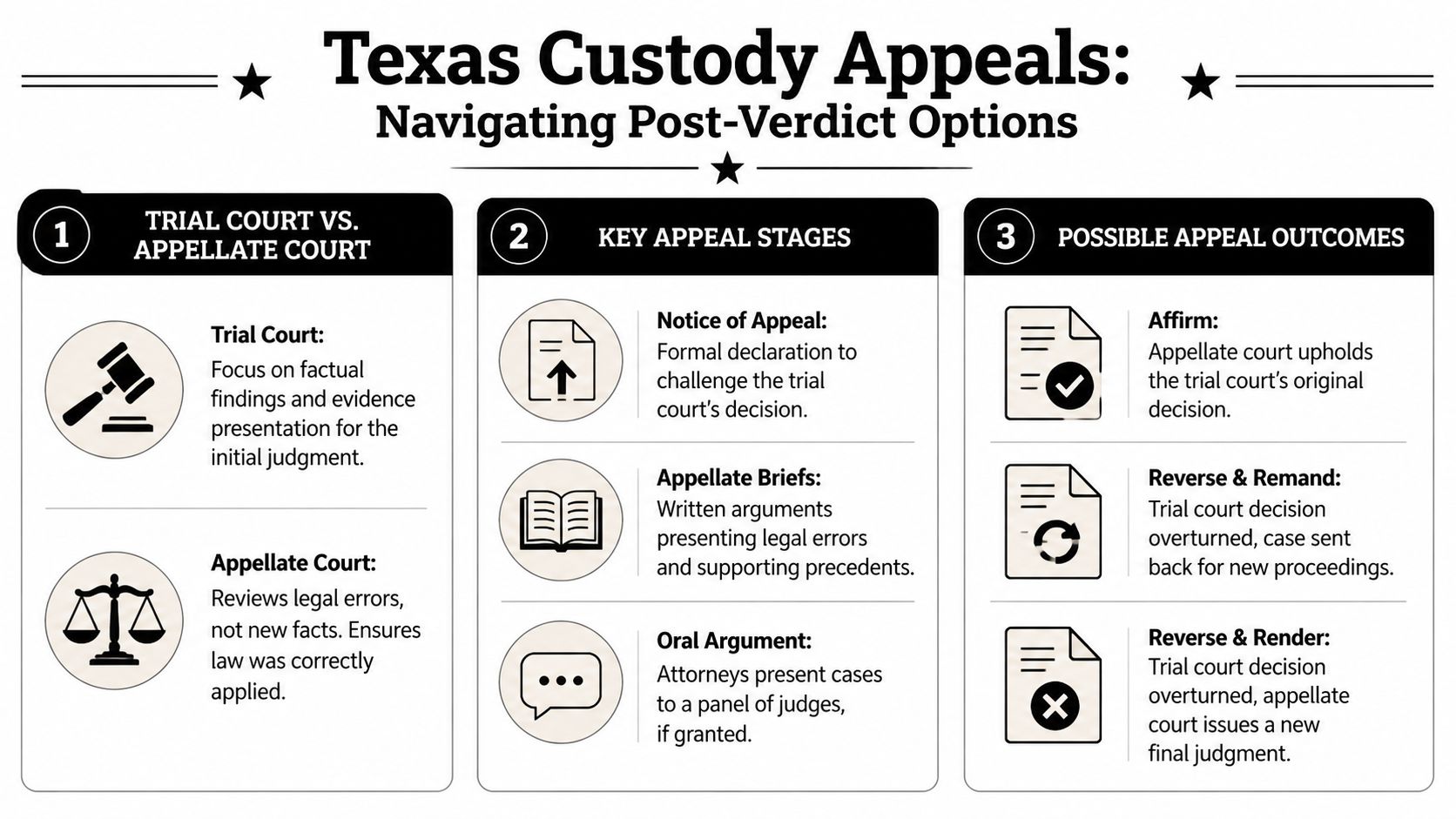
Strong appeals identify a specific problem, tie it to the record, and explain why Texas law requires correction. Sometimes the result is affirmance. Sometimes it is reversal and remand, meaning the case goes back for further proceedings. In some situations, the appellate court may reverse and render, issuing the judgment that should have been entered.
If you believe the verdict was unjust, the key question isn’t only whether you lost. It’s whether the court lost sight of the law in a way the record can prove.
Navigating the Texas Appellate Process
Texas appeals move by rules and deadlines. Parents are often shocked by how quickly the clock starts after a final order is signed.
Under the Texas Rules of Appellate Procedure, the deadline to file a notice of appeal is short, and post-judgment filings can affect that timeline. In plain terms, waiting to “see what happens” can cost you the right to challenge the order.
The basic path of a Texas family law appeal
Most custody appeals follow a sequence like this:
Final order is signed
The appellate timetable usually begins here.Notice of appeal is filed
This tells the court and the other party that you are seeking review.Clerk’s record and reporter’s record are prepared
These gather the papers, exhibits, and transcripts from the trial court.Appellate briefs are filed
The appellant explains the legal errors. The appellee responds.Oral argument may be granted
In some cases, the appellate court allows attorneys to answer the judges’ questions in person or remotely.The appellate court issues an opinion
The court may affirm, reverse, remand, or render judgment depending on the issues presented.
For a more detailed overview of those steps, this guide to Texas family law appellate procedure is a useful starting point.
Why each stage matters
The notice of appeal protects your place in the process. Miss that deadline, and many otherwise viable appeals end before they begin.
The appellate record matters because appeals are record-driven. If a hearing wasn’t transcribed, if exhibits weren’t admitted, or if motions and rulings are missing, the court’s review becomes harder.
The briefing stage often decides the case. A brief is not a complaint letter. It is a structured legal argument that cites the record and controlling authority. Good briefing identifies the standard of review, explains preservation, and shows harm.
Oral argument can help in close cases, but many appeals are decided on the briefs. That’s one reason appellate writing is such a specialized skill.
A practical timeline mindset
Parents often ask how long a Texas custody appeal takes. The answer depends on the court, the complexity of the record, and whether there are procedural disputes along the way. What matters most at the beginning is speed and discipline.
Use this checklist early:
Get the signed order immediately
You need the exact date.Request transcripts quickly
Delays here can create problems later.Secure trial exhibits and filings
Confirm what was admitted and what was excluded.Review post-judgment options
In some situations, motions in the trial court may affect deadlines or issues.Have appellate counsel examine preservation
The first review should focus on what the record can support.
Appeals are built on deadlines, transcripts, and precise written arguments. They are not built on general unfairness alone.
How appeals differ from trials
A trial lawyer often works through live testimony, witness control, and courtroom momentum. An appellate lawyer works through records, standards of review, and legal framing.
That difference matters because a parent can have a serious complaint and still need a very different kind of advocacy after judgment. The focus shifts from persuading one judge on disputed facts to persuading a panel of judges that the law was applied incorrectly.
When parents understand that shift, the process becomes less mysterious. You stop expecting a re-do and start evaluating whether there is a legally supportable path to relief.
Why Your Appellate Attorney Is Your Most Important Ally
The hardest moment in a custody case often comes after the judge rules, when a parent realizes the hearing is over but the consequences are just beginning. That is when the right appellate lawyer changes the case from a reaction to a strategy.
Trial counsel and appellate counsel do different jobs. At trial, the work centers on testimony, objections, witness order, and the pressure of a live courtroom. On appeal, the work is slower and sharper. An appellate attorney reads the record for preserved error, matches that error to the right standard of review, and writes the kind of argument a panel of judges can act on.
That difference affects outcomes.
A parent may leave trial convinced the judge missed the truth. On appeal, the question is narrower and more disciplined. What ruling was legally wrong. Where was the issue preserved. How did that error probably affect the result. Those are the questions that turn frustration into a viable appeal.
What specialized appellate counsel adds
An appellate attorney strengthens a custody case in specific ways:
Issue selection
Focusing on the strongest preserved errors instead of raising every complaint.Record analysis
Reviewing transcripts, exhibits, offers of proof, objections, and rulings with precision.Brief writing
Presenting the case in a form appellate judges expect, with the law tied tightly to the record.Procedural protection
Managing deadlines, clerk and reporter records, and filing requirements that can decide whether the court reaches the merits at all.
Good appellate counsel also helps a parent make hard choices. Some complaints feel important but do not give the court a realistic basis to reverse. Some smaller rulings matter more because they were preserved cleanly and affected the final order. The value is not just legal writing. It is judgment.
In some cases, a parent needs that judgment before the trial court case is fully over. An appellate-minded lawyer can spot preservation problems early, identify gaps in the record, and advise trial counsel on steps that may matter later if review becomes necessary. The Law Office of Bryan Fagan, PLLC handles family law appeals involving custody, visitation, divorce decrees, protective orders, and related orders under Texas procedure.
Parents often ask whether hiring appellate counsel means giving up on the trial fight. It means the opposite. It means treating custody litigation as a long-term effort to protect the parent-child relationship, not a single hearing that decides everything forever. That mindset is how you stop chasing the feeling of winning the day and start building a case that can survive a bad ruling.
Frequently Asked Questions About Texas Custody Appeals
Can I appeal any custody order I disagree with
No. You generally need an appealable order and a legal basis for review. Disagreeing with the judge’s view of the facts isn’t enough by itself. The stronger question is whether the trial court made a preserved legal or procedural mistake that probably affected the outcome.
How fast do I need to act after the judge signs the order
Fast. Texas appellate deadlines are strict. The date the final order is signed matters immediately, and certain post-judgment filings can affect the timetable. You should have an appellate attorney review the order and the docket as soon as possible.
Can I introduce new evidence on appeal
Usually no. Appeals are usually limited to the record made in the trial court. If you found new documents after trial, or if a witness is now willing to say more, that does not usually become part of the appellate review in the ordinary course.
What does abuse of discretion mean in plain English
It means the trial judge had decision-making authority, but used it outside the bounds allowed by law and evidence. Appellate courts give trial courts room to make judgment calls. They do not give them unlimited freedom to ignore the law or make unsupported rulings.
Is mediation still worth it if I think the other parent is unreasonable
Often, yes, if it can be done safely and in good faith. Mediation can narrow disputes, reduce cost, and produce workable parenting plans. But it only helps when both sides engage in good faith.
Appellate courts rarely overturn custody orders based on mediated settlements unless fraud or gross inequity can be shown, as explained in this discussion of good faith negotiation and custody settlements. That’s one reason parents should approach mediation seriously and avoid making unrealistic demands out of anger.
What if my trial lawyer didn’t preserve the issue
That can make an appeal harder, but not always impossible. Some issues are preserved in different ways, and some errors may still be reviewable depending on the record. An appellate attorney needs to examine the transcripts, filings, rulings, and final order before giving a meaningful answer.
Will the appellate court give me custody
Sometimes the appellate court sends the case back to the trial court for further proceedings. In other situations, it may leave the order in place. The outcome depends on the kind of error involved and what relief the law allows.
Is it worth talking to an appellate lawyer even before trial ends
Yes. That can be one of the smartest decisions in a contested custody case. Appellate-focused advice during trial can help preserve objections, shape offers of proof, and make sure the record reflects the issues that matter most if the case goes badly.
If you believe the court made a mistake in your family law case, our appellate attorneys can help you seek a fair outcome. Contact The Law Office of Bryan Fagan, PLLC today for a free consultation.