A judge signed the divorce decree. You walked out of court feeling stunned, unheard, or trapped by an outcome that doesn’t seem to match the facts you lived. That reaction is common, especially in family cases where the stakes are personal, immediate, and intense.
What many people don’t realize is that feeling wronged and having a valid appeal are not the same thing. The good news is that Texas law does provide a path for review when a trial court made a meaningful legal mistake. An appeal is the process of asking a higher court to decide whether the law was followed, whether procedure was fair, and whether the judgment can stand.
If you’re searching for answers about an appellate court reversal texas divorce case, you probably want two things at once. You want someone to understand why this feels so unfair, and you want a clear explanation of whether anything can still be done. Both matter.
When Your Texas Divorce Decree Feels Unjust
A divorce judgment can feel unjust in ways that are hard to explain to other people. Sometimes it’s not one dramatic moment. It’s a stack of smaller problems that lead to one painful result. A custody order that doesn’t reflect the evidence. A property division that seems detached from reality. A default judgment entered when you believe notice was defective. A post-divorce enforcement order that changes the original deal instead of enforcing it.
Many clients come in saying some version of the same thing: “I know something went wrong. I just don’t know if it was legally wrong.”
That’s an important distinction. Appellate courts don’t correct every hard outcome. They correct reversible error, which means a mistake significant enough to justify changing the result. The first step is translating your sense of injustice into legal categories the appellate court recognizes.
What emotional unfairness can mean in legal terms
A few examples help:
- You feel the judge ignored key proof. That may point to an evidence problem, a legal sufficiency problem, or an abuse of discretion issue.
- You feel the court changed property rights after the divorce was final. That may raise a jurisdiction issue under the Texas Family Code.
- You never had a real chance to appear. That may point to a service or notice defect.
- The result seems one-sided for no clear legal reason. That may require a close review of the record, the rulings, and the written decree.
The law won’t usually reverse a decree just because it feels harsh. It may reverse a decree when the record shows the court applied the wrong rule, lacked authority, or entered a judgment unsupported by the required proof.
Modern divorce disputes can also involve digital evidence, online conduct, and hidden financial behavior. If your case involved subscription platforms, secret communications, or online income concerns, PartnerScanX discusses OnlyFans divorce in a way some readers may find useful for understanding how new fact patterns can affect divorce litigation.
Why calm analysis matters right now
After judgment, people often want immediate action. That instinct makes sense, but appeals reward precision, not speed alone. The strongest appellate strategy starts with a disciplined review of three things:
- The final order itself
- The clerk’s and reporter’s records
- The legal standards that apply to each complaint
That’s how you move from “this was unfair” to “this ruling may be reversible.”
Appeals Are Not Retrials Understanding the Key Differences
You read the decree, your stomach drops, and your first reaction is simple: "They got this wrong." That reaction is human. The next step is legal. An appeal asks a narrower question than many people expect. It asks whether the trial court made a reviewable legal mistake based on the record already created.
You are not starting the case over. You are asking a higher court to examine what happened below through appellate rules, standards of review, and the written record.
What the appellate court actually reviews
An appeal works more like a careful audit than a second courtroom fight. The judges usually review:
- The clerk’s record, including pleadings, orders, motions, and filed papers
- The reporter’s record, including testimony, objections, and the court’s rulings
- Exhibits admitted at trial
- The briefs, where each side explains the law and points to parts of the record that matter
That distinction matters because many clients describe an appeal in emotional terms first. "The judge did not listen." "My ex lied." "The outcome made no sense." Those reactions may point to a legal issue, but the appellate court can only work with what was preserved and recorded. If the problem does not appear in the record, the court usually cannot act on it.
What appeals do not do
Appeals do not allow new witnesses, new documents that were never admitted, or a fresh credibility contest. Appellate judges were not in the room. They did not watch facial expressions, hear tone of voice, or observe the pace of the testimony. For that reason, they usually defer to the trial judge on credibility and disputed facts.
A short comparison helps:
| Trial court | Appellate court |
|---|---|
| Hears live testimony | Reviews the written record |
| Receives evidence | Reviews evidence that was admitted |
| Resolves factual disputes | Reviews claimed legal error |
| Observes credibility firsthand | Usually defers on credibility |
| Makes discretionary calls | Examines whether discretion stayed within legal limits |
This is often the point where frustration starts to make more sense. If your complaint is "the judge believed the wrong person," the appeal may be difficult. If your complaint is "the judge excluded evidence under the wrong rule," "signed an order the law did not permit," or "made a discretionary ruling without sufficient support in the record," you may be getting closer to an appellate issue. For a fuller explanation of how Texas courts analyze that kind of mistake, see this guide to reversible error in Texas family court.
Key terms in plain English
A few terms cause confusion because lawyers use them constantly and clients almost never do:
- Record means the official file showing what happened in the trial court
- Briefing means the written argument submitted to the appellate court
- Notice of appeal means the filing that begins the appeal
- Standard of review means the rule the appellate court uses to judge the trial court’s decision
- Oral argument means a live presentation to the appellate court, if the court sets one
The phrase standard of review deserves extra attention. It is the lens through which the appellate court looks at your complaint. Some issues are reviewed with a great deal of deference to the trial judge. Others receive closer scrutiny. That is why two clients can feel equally wronged, yet only one has a strong basis for reversal.
Why this difference changes strategy
Trial strategy asks, "How do we persuade the judge in the room?" Appellate strategy asks, "What legal error can we prove from a cold record, and what standard will the court apply to it?"
That shift is hard, especially in divorce cases. The decree affects your children, your home, your finances, and your future. But appellate courts do not reverse because a result feels harsh. They reverse when a party shows a legal reason to disturb the judgment, such as an error of law, a ruling outside the trial court’s allowed discretion, or a problem preserved in the record that likely affected the outcome.
So the goal is not to retell the divorce. The goal is to translate the feeling of injustice into specific appellate questions the court can answer.
Grounds for Reversal What is a Reversible Error?
A reversible error is not just any mistake. It’s a mistake that gives the appellate court a legal reason to disturb the judgment. In plain English, the higher court has to see more than frustration, and more than a close call. It has to see an error with legal significance.

Texas family appeals are challenging for a reason. In Texas courts of appeals, family law cases had a statewide reversal rate of 21%, and divorce cases stood at 24%, according to the Houston Law Review analysis of reversal rates in the Texas courts of appeals. Those figures don’t mean appeals are hopeless. They mean the legal target is narrow and must be identified carefully.
Abuse of discretion in plain English
The phrase abuse of discretion sounds harsher than it is. It doesn’t mean the trial judge acted unfairly on purpose. It usually means the judge made a decision outside the range the law allows.
A useful way to think about it is this: the law may give a trial judge room to choose among several reasonable outcomes. But it doesn’t give unlimited freedom. If the judge ignores controlling legal principles, relies on legally insufficient proof, or acts beyond the authority granted by statute, that can become an abuse of discretion.
Examples in family law often involve:
- property characterization
- reimbursement claims
- conservatorship rulings
- support and enforcement orders
Legal sufficiency and factual complaints
Another common ground is legally insufficient evidence. That means the record doesn’t contain the proof required to support the ruling.
This often surprises people because a ruling can still be reversed even when there was a full hearing. A judge may hear many hours of testimony, but if the record lacks the kind of proof Texas law requires for a particular finding, the order may still be vulnerable on appeal.
For readers wanting a more focused explanation of how courts analyze these issues, this guide on reversible error in Texas family court is a helpful companion.
Standards of review shape the odds
A standard of review is the rule the appellate court uses when examining a complaint. Its importance stems from some standards being more deferential than others.
Here’s a simple overview:
| Standard of review | What it means |
|---|---|
| Abuse of discretion | The appellate court gives the trial judge significant leeway |
| De novo | The appellate court decides the legal issue fresh, without deference |
| No evidence or legal sufficiency review | The court asks whether the record contains legally sufficient proof |
A service-of-process defect in a default case may receive a more exacting form of review because the court is examining whether procedural rules were strictly followed. A property or custody issue may face a more deferential review because trial judges usually have room to make judgment calls.
That’s why the same feeling of unfairness can lead to very different appellate prospects depending on the type of error involved.
A short video can also help if you prefer hearing appellate concepts explained aloud before diving deeper into the record and briefing standards.
The question appellate judges ask
Appellate judges don’t ask, “Was this outcome upsetting?” They ask something closer to this:
Did the trial court apply the correct law, follow the required procedure, and have enough proper evidence to support what it ordered?
That shift in perspective is often the turning point for a client. Once you understand that framework, your case starts to look less like a personal story alone and more like a set of reviewable legal decisions.
Common Reversible Errors in Texas Divorce Cases
The clearest way to understand an appellate court reversal texas divorce case is to look at the kinds of mistakes that lead to reversal. Not every appeal involves dramatic misconduct. Many involve technical but important failures in proof, procedure, or jurisdiction.
When a reimbursement claim lacks proof
Property division appeals often turn on evidence. One example is a reimbursement claim, where one spouse argues that separate property was used in a way that should be compensated in the division.
The Dallas Court of Appeals fully reversed a $641,458.40 reimbursement award because the wife failed to provide clear and convincing evidence tracing the separate property funds used, as discussed in this analysis of the Dallas Court of Appeals reversal of a $641,458.40 reimbursement award. The point is larger than that one case. If a party must trace funds with documents and the record doesn’t supply that proof, the award may not survive appeal.
Clients often become confused. They say, “But the judge believed her.” Belief isn’t always enough. Some issues require a certain kind of evidence, and appellate courts can reverse when that proof is missing.
When service problems infect a default divorce
Default divorce cases create a different kind of danger. If one party didn’t answer and the trial court entered judgment, the appeal may focus not on the merits of the divorce but on whether the case was started correctly.
In Pike-Grant v. Grant, the judgment was reversed because the return of service failed to show strict compliance with service rules. The return referenced the citation but did not show that the petition was served with it. In a restricted appeal, that kind of error can be powerful because the appellate court looks at the face of the record.
A default judgment can fall apart even without a fight over custody or property if the papers were not served in the exact way Texas procedure requires.
When the trial court goes too far after divorce
Post-decree litigation is another common source of confusion. Many people assume the trial court can “fix” a property result later if something seems unfair or incomplete. Texas law is much narrower than that.
A recent Texas Supreme Court decision, Morrison v. Morrison as described in prior reporting, involved reversal after a trial court improperly attempted to reallocate property years after the divorce in violation of Tex. Fam. Code § 9.007(a). The lesson is straightforward. An enforcement order must enforce the decree as written. It can’t become a second property division.
Other examples clients often recognize
These issues appear in many forms:
Property characterization mistakes
A court treats separate property as community property without the required support in the record.Child support rulings based on the wrong legal foundation
The problem may not be the amount alone. It may be the legal basis used to reach it.Conservatorship orders tied to flawed procedure or insufficient support
The emotional part is obvious, but the appeal still turns on legal error and the record.Orders beyond the court’s authority
Even a well-meaning trial court can issue relief it has no power to grant.
The pattern across all of these is the same. Appeals work when a difficult outcome can be connected to a specific legal defect the record demonstrates.
The Texas Appellate Process A Timeline
A common moment in an appeal looks like this. You leave court with a signed divorce decree, a knot in your stomach, and the strong sense that something went wrong. Then the process shifts from emotion to calendar. In appellate work, timing matters because a valid complaint can be lost if the required steps are not taken on time.
The clock starts before you feel ready
Many clients expect a long pause after trial. Texas appellate procedure usually gives you much less breathing room than that. The first job is to identify the order being challenged and calculate the deadline tied to that order.
You do not need a finished appellate strategy on day one.
You do need a prompt review of the decree, any post-judgment motions, and the key hearing dates so the appeal stays alive while the legal analysis takes shape.
The timeline in plain English
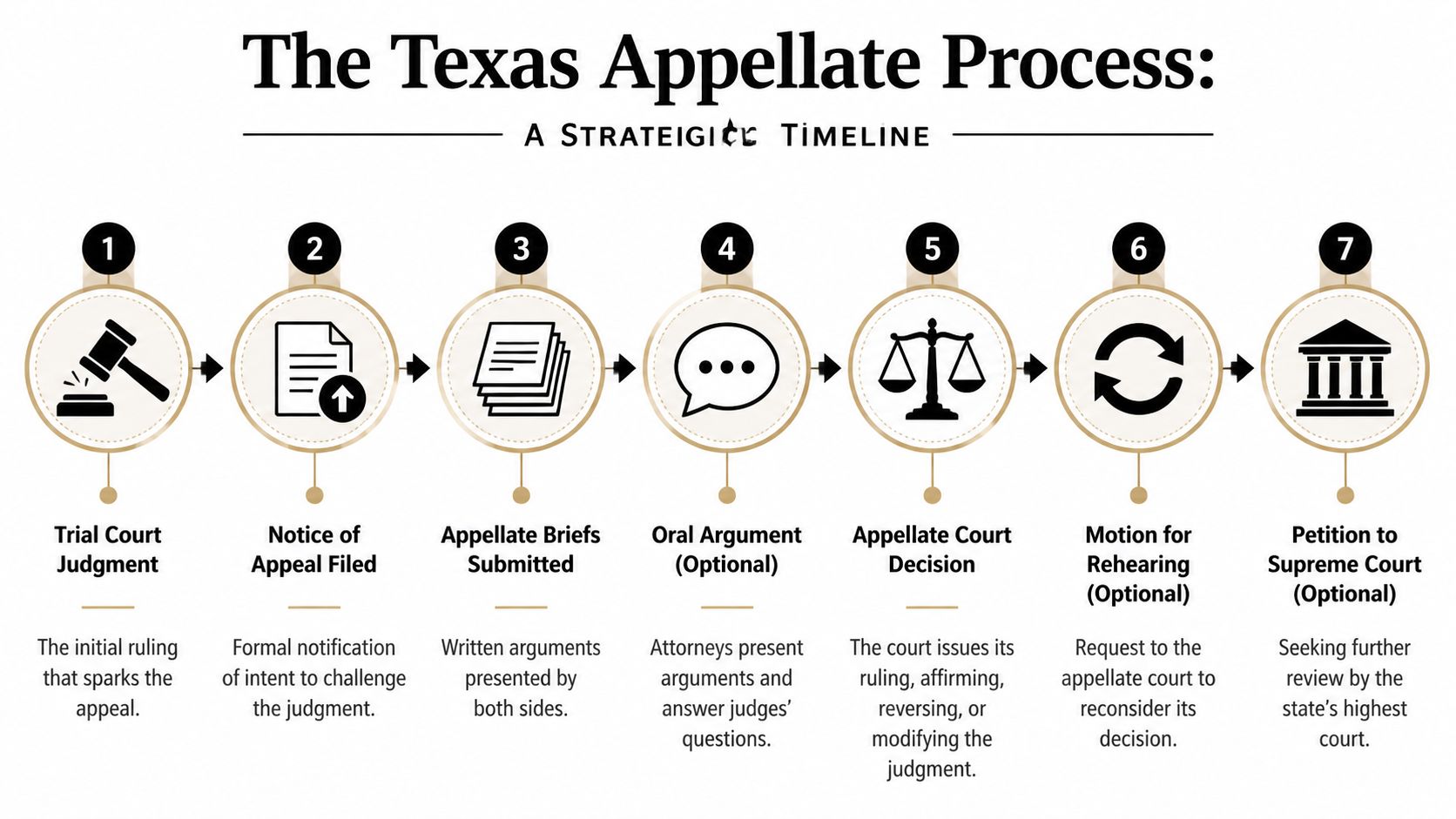
A Texas family law appeal usually moves through these stages:
Final judgment or appealable order
This is the ruling the appellate court will review. The first question is often simple but important. Is the order final and appealable?Notice of appeal
This filing tells the trial court and the other side that appellate review is being requested. It protects your place in line, but it does not explain the full case for reversal.Appellate record
The appellate judges do not hear witnesses again. They read the clerk’s record, which contains filed documents and orders, and the reporter’s record, which contains testimony and objections. If a complaint is not reflected in that record, it is much harder to pursue.Briefing
The appellant’s brief connects the feeling of unfairness to legal standards the court can act on, such as abuse of discretion, legal error, or lack of authority. The appellee then responds, and a reply brief may follow.Oral argument in selected cases
Some cases are decided on the briefs alone. In others, the court wants to test the lawyers’ positions through questions. Oral argument matters, but it usually sharpens arguments already made in writing.Opinion and judgment
The court may affirm the ruling, reverse it, modify it, or send the case back to the trial court for further proceedings.Further review
A party may ask for rehearing or seek review in a higher court when the issues justify it.
If you want a fuller procedural map, this guide to the Texas family law appeal process can help you compare the general sequence to your own case.
Why briefing carries so much weight
Clients often picture the appeal as a courtroom argument. In practice, the brief is usually the center of the case. It works like the blueprint for the judges. It identifies the exact ruling being challenged, cites the precise place in the record, states the standard of review, and explains why the mistake was serious enough to justify reversal.
That last point is where many appeals succeed or fail.
A judge may have made a ruling that felt unfair. An appellate court still needs the complaint translated into legal terms it recognizes. For example, if the issue is discretion, the question becomes whether the trial court acted outside the range of reasonable choices. If the issue is authority, the question becomes whether the court entered an order Texas law did not permit. That is how frustration becomes a legal argument.
Post-decree appeals follow the same timeline, but the legal question can be different
Some appeals come from the original divorce trial. Others arise months or years later in enforcement or modification proceedings. The sequence of notice, record, briefing, and decision is similar, but the legal problem may shift from "the judge got the facts wrong" to "the judge did something the law does not allow."
As noted earlier, Morrison v. Morrison is a useful example of that distinction. The lesson from that case is practical. A post-divorce order can be vulnerable because the trial court exceeded its authority, even if the order was framed as an attempt to fix an old problem.
What to gather early
The first case review is faster and more accurate when you collect the basic documents right away:
- The signed decree or order
- Any post-judgment motions and rulings
- The dates of hearings or trial
- Any transcripts you already have
- A short written timeline of what happened and why you believe the ruling was wrong
That preparation does not prove reversible error by itself. It gives your appellate lawyer the raw materials needed to identify deadlines, isolate the issues, and decide whether the record supports a real path to relief.
Preserving Your Right to Appeal During the Trial
A common moment in a divorce trial goes like this. The judge allows testimony you believe is unfair, cuts off a line of questioning, or signs wording in the final order that does not match what happened in court. You leave feeling that something went seriously wrong. On appeal, that feeling has to connect to something the record shows the trial court was asked to fix and did not fix.
That is what preservation means.
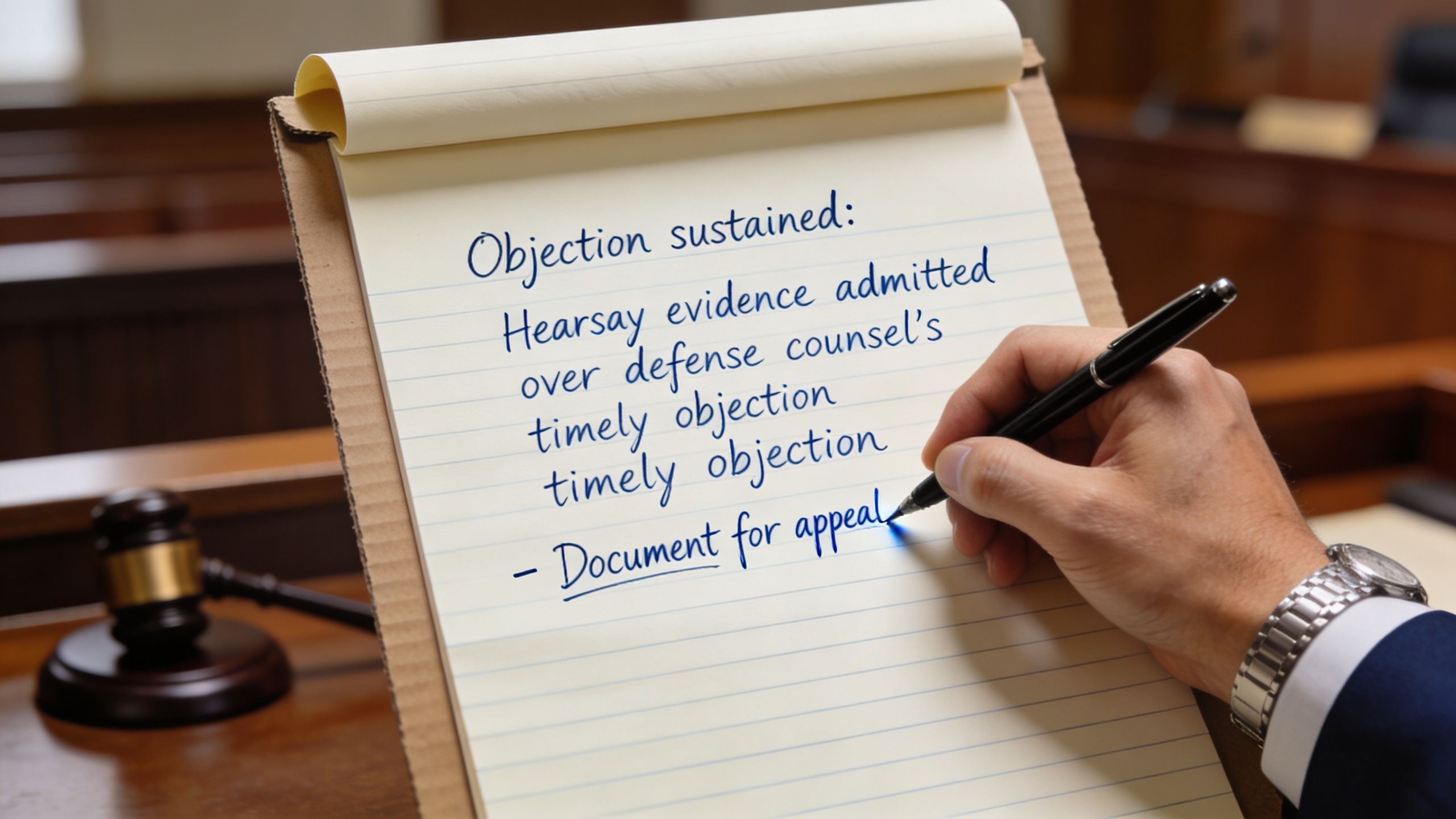
Preservation is the rule that turns courtroom frustration into an issue an appellate court can review. In many situations, the trial lawyer must make a timely, specific objection, request, or motion so the judge has a fair chance to correct the problem then and there. If that step never appears in the record, the court of appeals will often treat the complaint as waived, even if the client still feels aggrieved by what happened.
Why preservation matters so much
Courtroom objections work a lot like calling a foul during a game. The complaint usually has to be raised when the problem happens, not after the final score is posted. Appellate judges review a written record. They do not reconstruct private assumptions, side conversations, or unspoken objections.
In practice, preservation often involves steps such as:
- objecting when evidence is offered
- raising procedural defects promptly
- asking for a ruling on a request or objection
- filing a post-judgment motion when the rules require one to preserve a complaint
The wording matters too. A vague objection may preserve very little. A specific objection gives the trial court a real opportunity to correct the error and gives the appellate court a clear issue to review. If you want a practical explanation of how that works, see objections required to preserve appeal in Texas.
Some issues are preserved by the record itself
Preservation does not always require a spoken objection in open court. Certain errors can be reviewed because the defect appears on the face of the record.
Default divorce cases are the clearest example. If the record shows a failure to comply strictly with service rules, that defect may support a restricted appeal even though the respondent did not appear at trial to object. As noted earlier in the discussion of Pike-Grant v. Grant, service problems can create an appellate issue because the error is visible in the clerk's record itself.
That distinction matters. Some complaints depend on what counsel said and when they said it. Others depend on whether the paperwork and procedural steps satisfy Texas law.
The appeal does not ask, "Was this unfair?" in the abstract. It asks, "Was the legal error preserved, or is it otherwise clear from the record?"
What to do if you are unsure whether error was preserved
Do not rely on memory alone. Preservation questions often hide in the transcript, a written motion, a bench ruling, or the exact language of the decree.
A careful review usually starts with four questions:
| Question | Why it matters |
|---|---|
| Was there a timely objection, request, or motion? | Delay can waive the complaint |
| Was it specific enough to identify the legal problem? | General objections often preserve less than clients expect |
| Did the judge rule, or refuse to rule after being asked? | The appellate record usually needs that ruling |
| Does the error appear on the face of the record anyway? | Some procedural defects can still be raised without a trial objection |
This is often the point where a client begins to feel less lost. The question stops being whether the result felt unjust, and becomes whether the record captures a reversible legal problem. That shift does not guarantee an appeal. It does give you a clearer, more strategic way to assess whether one is possible.
After the Appeal Potential Remedies and Realistic Outcomes
A successful appeal doesn’t always mean the entire divorce gets erased. The remedy depends on the kind of error and what the appellate court decides to do about it.
Reverse and render
If the record allows the appellate court to enter the correct judgment itself, the court may reverse and render. In plain English, that means the appellate court changes the result rather than sending it back for more work.
This can happen when the law points to a clear outcome and no further fact-finding is needed.
Reverse and remand
In many family cases, the appellate court will reverse and remand. That means the higher court sends the case back to the trial court for further proceedings consistent with the appellate opinion.
Clients sometimes think this means they lost. It doesn’t. It means the trial court must revisit the issue under the correct legal framework. Depending on the issue, that may involve a new hearing, additional findings, or a new property division analysis.
What realistic expectations look like
An appeal is not a quick emotional reset. It’s a structured legal challenge. Even strong cases require patience, careful briefing, and realistic expectations about remedies.
At the same time, persistence can matter. While intermediate courts are cautious, the Texas Supreme Court reversed the courts of appeals in 72.3% of argued state cases in the 2024-2025 term, according to Reverse & Render’s report on Texas Supreme Court reversal rates. That doesn’t promise a result in any individual divorce appeal. It does show that meaningful correction remains possible when a case presents the right legal issue and is argued well.
A “win” on appeal may mean a corrected judgment. It may also mean another chance, under the proper legal rules, to obtain a fair result.
If you believe the court made a mistake in your family law case, the right next step is a focused review of the decree, the record, the deadlines, and the likely standard of review. That review should be calm and candid. Not every case is appealable. Some are. The difference lies in the record and the law.
If you believe the court made a mistake in your family law case, our appellate attorneys can help you seek a fair outcome. The Law Office of Bryan Fagan, PLLC evaluates Texas divorce, custody, support, property division, protective order, and enforcement appeals by reviewing the record for reversible error, procedural defects, and jurisdictional problems. Contact the firm today for a free consultation.