You may feel that the judge heard your case but missed the point. In family court, that feeling often comes after a custody ruling that didn't match the evidence, a property division that seems one-sided, or a protective order that moved too fast for anyone to fully explain what happened.
An appeal can be a path toward fairness. But it's not a second trial, and it's not a chance to start over with better witnesses or new documents. An appellate court reviews what already happened in the trial court and asks a narrower question. Did the court make a legal mistake that matters?
That's why one part of the case matters more than almost anything else. The appellate record.
Think of the record as a locked box. Once the trial ends and the appeal begins, the judges reviewing your case can only look inside that box. If a fact, objection, exhibit, ruling, or transcript page isn't inside, the appellate court usually can't use it. That rule surprises many clients. It also explains why strong appeals are often built before anyone files the notice of appeal.
Your Path to a Fairer Outcome Starts with the Record
A client often comes in with a story that sounds compelling and unfair. The judge cut off testimony. An important document was ignored. The final order says something broader than what was argued in court. The instinct is to tell the appellate court everything that went wrong.
That instinct makes sense. It also runs into the central limit of appellate practice. The court of appeals won't decide your case from memory, emotion, or informal explanation. It decides from the official record.
Practical rule: The appeal only moves as far as the record allows it to move.
In Texas family law, that matters in cases involving child custody, visitation, property division, child support, spousal maintenance, and protective orders. If you believe the court misapplied the Texas Family Code, excluded important evidence, or made a ruling no reasonable judge should have made on the evidence presented, your appeal lives or dies on what the record shows.
A record-based appeal can still be powerful. Texas has 14 intermediate Courts of Appeals, and they serve as the primary gatekeepers between trial courts and the Texas Supreme Court in civil matters, including family law appeals. Across 2011-2023, Texas appellate courts and the Supreme Court issued 124,921 opinions, which underscores both the scale of appellate review and the importance of careful record work in a system handling a high volume of cases, as reflected in Texas appellate statistics and annual reports.
If you're searching for what is the appellate record in texas and why it matters, the short answer is this. It is the final, sealed account of your case. If the right material is inside, an appellate court can correct serious error. If it isn't, even a strong underlying complaint may never get full review.
What Is the Appellate Record in Texas
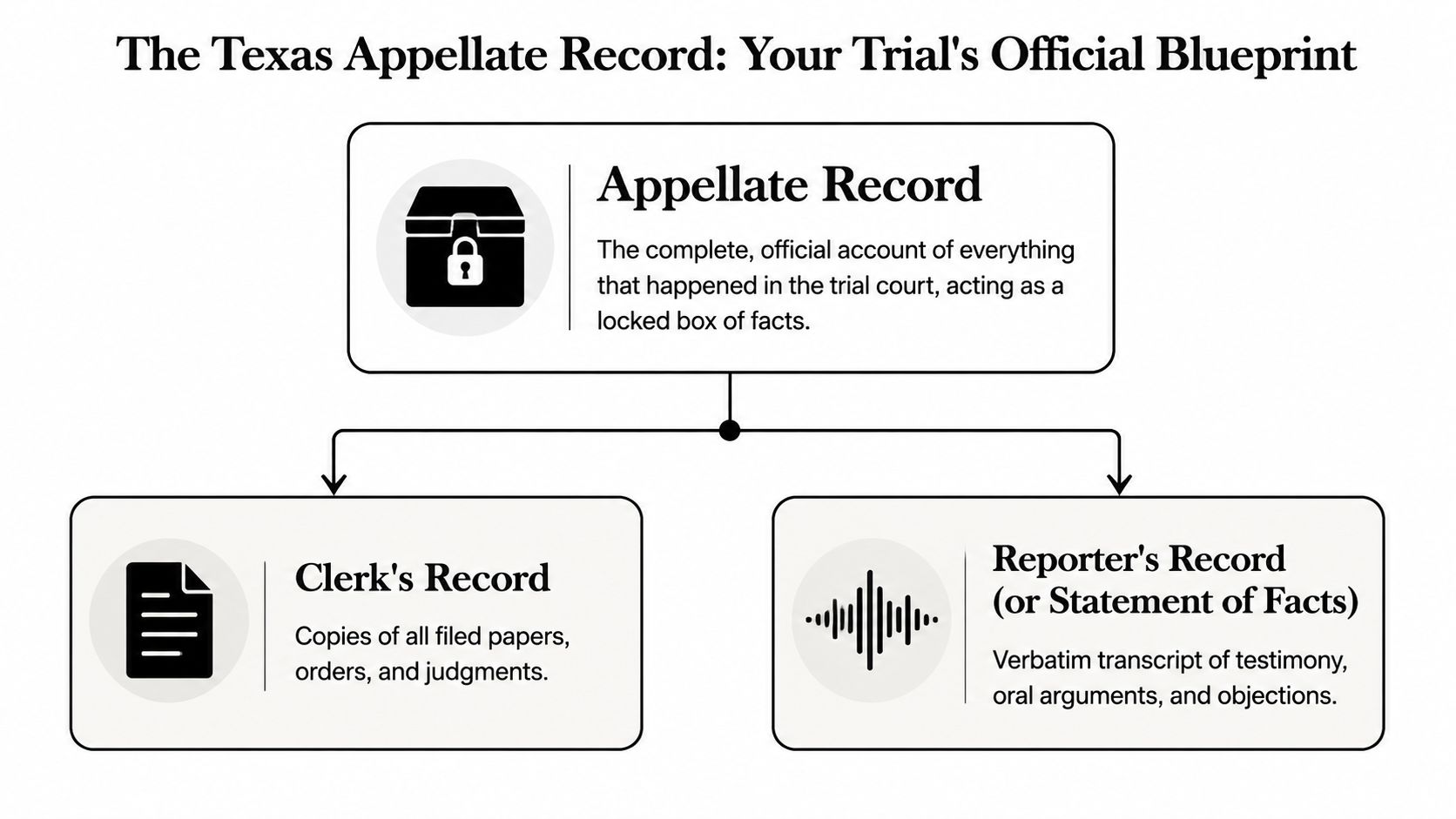
The appellate record is the official set of materials the appellate court is allowed to review. In Texas, it has two mandatory parts. The clerk's record, prepared by the trial court clerk, and the reporter's record, prepared by the court reporter. Those materials must be filed electronically through the Records Submission Portal under the Texas Rules of Appellate Procedure, as described in this explanation of the Texas appellate record.
Think of it as a locked box of facts and procedure. Once that box is sealed, the appellate judges don't get to look outside it. They don't call witnesses. They don't take new exhibits. They don't hear side conversations from the hallway or private explanations about what “really happened.”
The clerk's record
The clerk's record is the paper trail of the case. It should contain the documents that frame the dispute and show what the court formally did.
That includes items such as:
- Pleadings filed by the parties
- The trial court's docket sheet
- Findings of fact and conclusions of law
- The judgment or order being appealed
- Post-judgment motions and rulings
In a family case, this can include divorce petitions, counterpetitions, temporary orders, inventory documents, written stipulations, proposed parenting plans, final decrees, and requests for findings.
The reporter's record
The reporter's record is the verbatim transcript of what was said in court. It captures testimony, objections, arguments, rulings, and other spoken parts of the proceeding.
This is often where appellate issues become visible. If a lawyer objected to hearsay, challenged an exhibit, or asked the judge to clarify a ruling, the reporter's record may be the only place that event appears.
Where exhibits fit
Exhibits matter because they are often the documents, photos, financial records, evaluations, and communications that support or weaken the trial court's ruling. If an exhibit was admitted, identified, or discussed, it needs to be reflected in the official record in a way the appellate court can review.
Clients who want a plain-English way to think about documentary proof may find Documind's take on digital records useful. The key appellate point is simpler. A document only helps on appeal if it made its way into the trial court record properly.
The appellate judges are not deciding whose story feels more persuasive now. They are deciding whether the trial court made reviewable legal error based on the official materials already preserved.
Why the Record Controls Every Aspect of Your Appeal
A family law appeal usually turns on restraint, not drama. The appellate court asks what the trial judge did, what legal standard applies, and whether the record shows a reversible problem. That's why the record controls nearly every serious appellate question.

Preservation of error
One of the hardest rules for clients to accept is this one. If your lawyer didn't raise the issue properly in the trial court, the appellate court often won't consider it later.
That is called preservation of error. In plain English, it means the trial judge usually has to be given a fair chance to hear the complaint and rule on it. If the objection, request, motion, or ruling doesn't appear in the record, the appellate court may treat the issue as waived.
Examples in family cases include:
- Evidence objections that were never made on the record
- Requests for findings that were never filed after a bench trial
- Complaints about vague orders that were never brought to the trial court's attention
- Excluded evidence that was never described through an offer of proof
Standard of review
Appeals are also shaped by the standard of review. That phrase means the legal lens the appellate court uses when reviewing the trial court's decision.
A common standard in family law is abuse of discretion. In plain English, that asks whether the trial court acted outside the range of reasonable choices allowed by law. It is not enough to show that another judge might have ruled differently. The record must show that the ruling crossed a legal line.
For testimony-related disputes, the statement of facts in a Texas family appeal often becomes the core battlefield. It shows what the witnesses said, what objections were made, and how the judge responded.
No new evidence means no second chance to fill gaps
Clients often ask whether they can add a missed text message, an updated school report, or a newly organized spreadsheet once the appeal starts. In a direct appeal, the answer is generally no. The appellate court reviews the existing record, not fresh proof.
That's one reason record quality matters so much. In the 2024-2025 term, affirmance rates in matters reaching the Texas Supreme Court from lower courts varied sharply, ranging from 75% for the Thirteenth Court of Appeals to 8.3% for the Third Court and 0% for the Fourth Court, according to Texas Supreme Court review data for the 2024-2025 term. Small sample sizes matter, but the broader lesson is still useful. Outcomes vary, and when appellate courts do reverse, they do it based on what the record proves.
A strong appeal doesn't begin with outrage. It begins with a record that shows the exact mistake, where it happened, and why it mattered.
Building Your Appeal Before It Begins Key Actions at Trial
Many people assume appeals start after judgment. In practice, a viable appeal often begins during trial. The record is being built in real time, line by line, exhibit by exhibit, ruling by ruling.

Say the objection clearly and get a ruling
A vague objection rarely helps on appeal. Trial counsel needs to state the legal basis clearly enough for the judge to understand the complaint and rule on it.
If the judge never rules, there may be no appellate issue to review. That's why the lawyer's job is not only to object, but to press gently and respectfully until the court either sustains or overrules the objection on the record.
For a closer look at that process, this guide on objections required to preserve appeal in Texas is a useful companion.
Put the evidence in the box before it closes
If a financial spreadsheet, custody evaluation, school record, or text thread matters, counsel has to do the work of offering it into evidence properly. Marking a document for identification is not the same as getting it admitted. Talking about a document is not the same as making it part of the appellate record.
What works:
- Offering key exhibits formally so the court can admit or exclude them
- Making an offer of proof if the judge excludes evidence
- Asking follow-up questions that tie testimony to the legal issue in dispute
What doesn't work:
- Assuming the judge “knows” what a document says
- Referring to materials never admitted
- Saving critical evidence for a motion that never gets heard
Request findings after a bench trial
In many family cases, the judge, not a jury, makes the key decisions. After a bench trial, findings of fact and conclusions of law can be one of the most important tools for appeal.
They force the trial court to identify the factual basis and legal reasoning behind the judgment. That gives appellate counsel a clearer target. If the judge's written findings don't support the result, conflict with the record, or apply the wrong law, the appeal becomes much more focused.
A short practical overview can help:
Coordinate early with appellate counsel
In higher-stakes family cases, trial counsel sometimes consults appellate counsel before judgment. That can help identify preservation problems, clarify how to frame objections, and decide whether findings, offers of proof, or record supplementation steps are needed.
The Law Office of Bryan Fagan, PLLC handles this kind of family law appellate review, including analysis of custody, divorce, property division, and protective-order records, so trial and appellate strategy align before the box is sealed.
The Post-Trial Process Assembling and Filing the Record
A lot of clients assume that once the notice of appeal is filed, the record is already on its way to the court of appeals. That is not how it works. The record is more like a locked box. Trial counsel had to make sure the right materials were placed inside before judgment. After judgment, someone still has to make sure the box is assembled correctly, requested in full, and delivered on time.
Who prepares what
In Texas, the trial court clerk prepares the clerk's record, and the court reporter prepares the reporter's record. The appellant does not physically compile those volumes, but the appellant still bears the practical burden of getting the right record filed. That means identifying what hearings were reported, what exhibits were admitted, what filings belong in the clerk's record, and whether any deposit or payment issue could delay preparation.
The filing sequence matters. This overview of how to file a notice of appeal helps place the record deadlines in context, especially in cases where post-judgment motions affect the timetable.
Deadlines that matter
The deadlines are strict, and they start running quickly after the judgment is signed. In a standard appeal, the record is generally due later than in an accelerated appeal. If a timely post-judgment motion extends appellate deadlines, that can change the due date, but only if the motion was filed on time and is the kind of motion that extends deadlines.
Accelerated appeals are less forgiving. Family lawyers see this in protective-order matters and other proceedings that move on a compressed schedule. In those cases, waiting a week to request the clerk's record or reporter's record can create problems that are hard to fix.
I tell clients and trial lawyers the same thing. If the case may be appealed, contact the clerk and court reporter immediately after judgment, and sooner if possible.
What practical coordination looks like
Post-trial record work is administrative, but it is not routine. Small mistakes at this stage can leave the court of appeals with an incomplete box.
A careful appellate lawyer usually checks several things right away:
- Record scope, including every hearing, trial session, exhibit list, and filed document needed to present the issues
- Deadline calculation, especially if findings, a motion for new trial, or other post-judgment filings may affect the schedule
- Reporter status, including whether a hearing was recorded and whether the reporter has what is needed to prepare the transcript
- Clerk's record contents, so omissions can be identified early and corrected through supplementation if necessary
- Payment and request details, because a missed request or unresolved fee issue can delay filing
Pre-judgment strategy reveals its importance here. If trial counsel failed to get an exhibit admitted, failed to secure a court reporter, or failed to obtain a ruling, no amount of careful post-trial coordination can add that missing item to the box after it has been sealed. But when the record was built correctly during trial, disciplined follow-up after judgment gives the appeal a fair chance to be decided on what happened.
Common Mistakes and Misconceptions About the Record
Some record problems begin with a legal mistake. Others begin with a practical one. A hearing goes forward without a court reporter. An important exhibit gets discussed but never admitted. A party agrees to a limited record without seeing the risk.
Those errors can subtly strip an appeal of its strongest arguments.

Mistake one, no transcript of a key hearing
A client may say, “The judge said something very important at the temporary-orders hearing.” That may be true. But if no reporter's record exists, proving that point becomes much harder.
Without a transcript, the appellate court often has no reliable way to examine the statement, context, objection, or ruling. In family cases, that can affect issues involving conservatorship, possession schedules, enforcement, or interim property restraints.
Mistake two, agreeing to too little
Texas Rule of Appellate Procedure 34.2 allows parties to submit an agreed record, and that record is presumed to contain all relevant evidence. But this shortcut carries real danger. If the agreed record leaves out a document or transcript passage that supports your argument, you may be barred from relying on it later. That risk is described in Texas Rule of Appellate Procedure 34.2 guidance from the Texas Children's Commission bench book.
A common family-law example is a custody appeal involving a psychological evaluation, school records, or communications about a child's needs. If those materials are omitted from the agreed record, the appellate court generally can't treat them as part of the case.
Mistake three, assuming you can add it later
Clients often discover a missing piece only after judgment. A text message wasn't offered. A bank statement stayed in trial counsel's folder. A proposed exhibit never became an exhibit at all.
That usually can't be cured by attaching the item to an appellate brief. Briefing is the written argument filed in the court of appeals. It explains why the law and the record support reversal. It is not a place to add new evidence.
If a document never made it into the locked box, the brief can't unlock it later.
A quick reality check
| Problem | Why it hurts |
|---|---|
| No court reporter present | No transcript to show what was said or ruled |
| Exhibit discussed but not admitted | Appellate court may treat it as outside the record |
| Incomplete agreed record | Important support may be waived |
| Missing findings after bench trial | Harder to identify the judge's reasoning |
Prevention is better than repair. Some record defects can be supplemented or corrected. Many cannot.
Frequently Asked Questions About the Texas Appellate Record
What happens if the court reporter's audio is lost or inaudible
That issue can be serious because the appeal depends on a usable reporter's record. The remedy depends on the specific circumstances and whether the missing material is necessary to the appeal. If an essential portion of the proceedings can't be recovered, counsel may need to evaluate whether the loss affects the ability to obtain meaningful appellate review.
The first step is not panic. It's analysis. An appellate lawyer needs to determine what is missing, whether it can be reconstructed, and how central it is to the issues on appeal.
Can my lawyer add a key text message after the trial is over
Usually, no. A direct appeal reviews the trial court record that already exists. If the text message was never admitted or otherwise made part of the official record in a way the appellate court can review, it generally can't be added just because it seems important now.
That's why trial preparation and preservation matter so much in family cases. The locked box analogy applies here exactly.
How much does it cost to prepare the appellate record
The cost usually depends on the size of the clerk's file, the length of hearings or trial, and the amount of transcription work required. Fees are typically paid to the trial court clerk and the court reporter, not to the appellate court itself for creating the record.
A short hearing usually costs less to transcribe than a multi-day custody trial. The practical lesson is to ask early, budget for it, and avoid last-minute delay.
What does reversible error mean
Reversible error is a legal mistake serious enough to justify changing the result. Not every trial mistake leads to reversal. The appellate court looks at whether the error likely affected the judgment or prevented a fair process.
What is briefing in an appeal
Briefing is the written legal argument submitted to the appellate court. It explains what happened in the trial court, identifies the legal errors, cites the relevant authorities, and points the judges to the exact places in the record that support the argument.
A strong brief is precise. It doesn't retell the case loosely. It anchors every important point to the record and the governing law.
Take the First Step to Correct an Unfair Judgment
The appellate record is not a technical side issue. It is the foundation of the entire appeal. In Texas family law, the court of appeals reviews a sealed, official account of what was filed, what was said, what was admitted, and what the judge ruled. If that account is complete and carefully preserved, an appeal has a real structure to stand on. If it is thin or incomplete, even a valid complaint can lose force.
That is why what is the appellate record in texas and why it matters is such an important question. It matters because fairness on appeal depends on proof, and proof on appeal depends on the record.
If you believe the court made a mistake in your family law case, our appellate attorneys can help you seek a fair outcome. Contact The Law Office of Bryan Fagan today for a free consultation.
If you believe the court made a mistake in your family law case, the appellate team at The Law Office of Bryan Fagan, PLLC can review your record, evaluate whether reversible error exists, and help you pursue a fairer result in your appeal. Contact the firm today to schedule a free consultation.