You may feel your case was handled unfairly. Maybe the judge limited your time with your child, divided property in a way that doesn't make sense, or signed an order that seems to ignore important evidence you presented.
That reaction is common, and it matters. But in Texas family law, the next step isn't just asking another court to hear your story all over again. A family law appeal lawyer in Texas looks at something narrower and more powerful: whether the trial court made a legal mistake that affected the outcome.
If you're thinking about appealing a divorce decree, child custody order, support ruling, property division, or protective order, clarity matters more than emotion. Appeals are technical. They move on strict deadlines under the Texas Rules of Appellate Procedure and depend heavily on the existing trial record, the Texas Family Code, and written legal arguments.
This guide walks through the process in plain English so you can understand what an appeal can do, what it can't do, and how to evaluate whether your case has a real path forward.
Your Case Was Decided Unfairly What Happens Next
When a family court ruling lands badly, the immediate question often asked is: “Can I fix this?”
Sometimes the answer is yes. But an appeal isn't a second trial. It's a formal review by a higher court to decide whether the trial judge made a legal error, used the wrong rule, or handled the case in a way that denied a fair result.
What an appeal is really for
A Texas appeal exists to correct legal mistakes, not to re-weigh every hard fact in your case. That distinction surprises many people.
If you believe the judge misunderstood the law on child support, ignored a required procedure in a custody hearing, or made a ruling that wasn't supported by the record, an appeal may be the right tool. If you feel the judge believed the other side too much, the path is harder because appellate courts usually defer to the trial court on credibility and fact questions.
Practical rule: An appeal asks, “Did the court follow the law?” It doesn't ask, “Would another judge have felt differently?”
Why quick evaluation matters
The most dangerous mistake after an unfair order is waiting too long to get advice. Texas appellate deadlines are strict, and some families lose their right to appeal before they've even gathered their thoughts.
A careful review should happen early. That review usually focuses on a few core questions:
- Was there a final order: Most standard appeals begin only after the trial court signs a final judgment or order.
- Was error preserved: If no one objected at the right time in the trial court, the appellate court may refuse to consider the issue.
- Was the error harmful: Not every mistake leads to reversal. The error must matter to the outcome.
That's why the first job of an appellate lawyer isn't to promise a result. It's to test whether the case presents a real appellate issue.
How a Texas Family Law Appeal Differs From a Trial
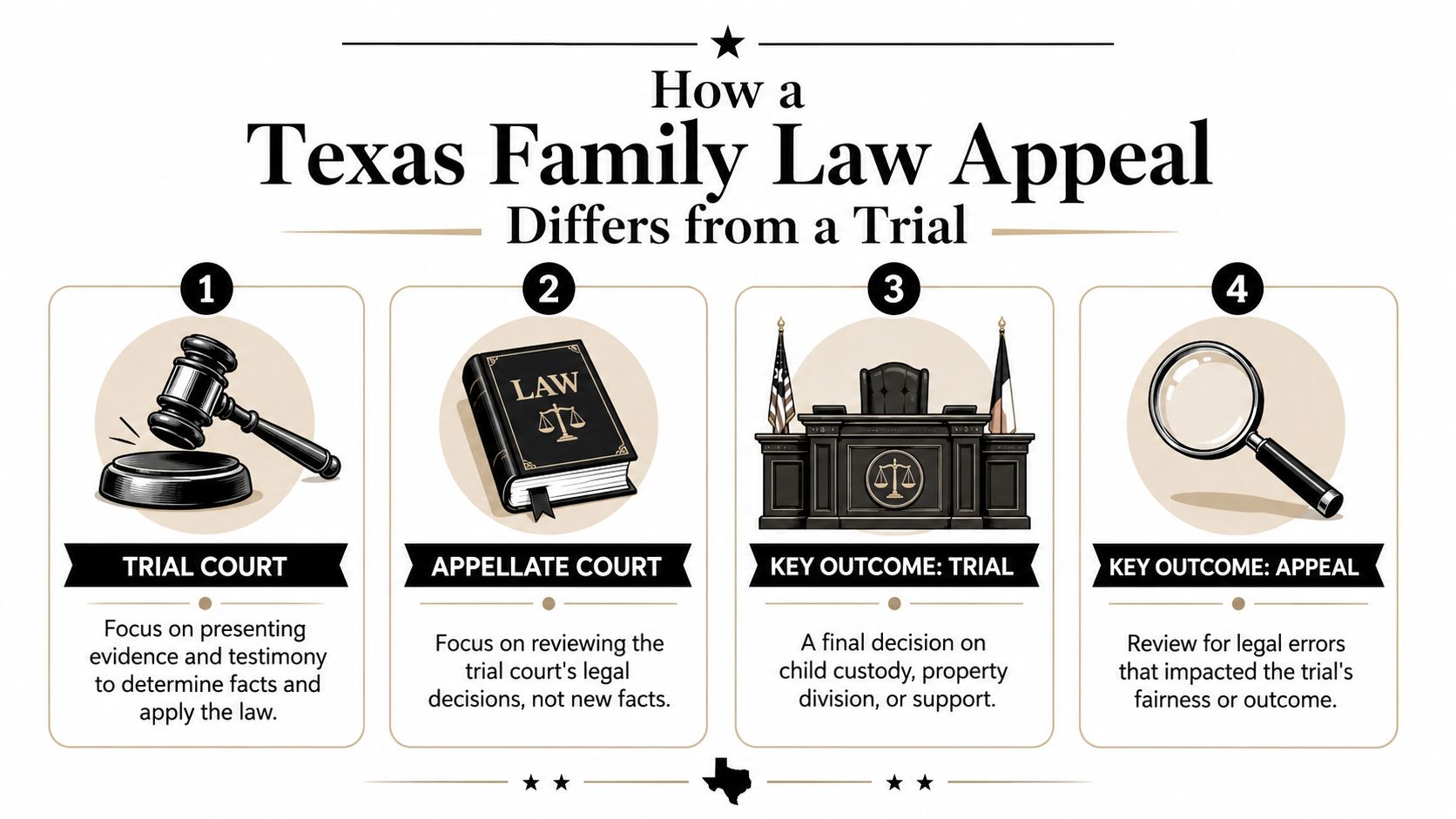
You leave the courtroom with a signed order in your hand and a sinking feeling that something went wrong. The next step can feel confusing because an appeal is not a second trial with a new chance to tell your story from the beginning. It is a focused review of whether the trial court followed the law and used the proper process.
An appeal reviews the work already done
At trial, the court builds the factual record. Witnesses testify. Documents are offered. The judge decides what happened and enters orders about custody, support, property, or protection.
On appeal, the court works from that finished record. Appellate judges read the papers, the transcript, the admitted exhibits, and the signed orders. They do not hear new witnesses or consider new documents that were never presented below.
That point causes a lot of frustration for parents and spouses who later find better evidence or better wording for what they wanted to say. An appeal usually cannot fix gaps in proof after the fact. It can only address whether the trial court made a legal error based on what was presented.
The appellate court is asking a narrower question
Trial courts decide disputed facts. Appellate courts review rulings.
That difference shapes everything. A trial judge may have to decide which parent was more credible, how to divide property, or what facts support a protective order. An appellate court usually asks a more disciplined set of questions: Did the judge use the right rule? Was the required procedure followed? Does the ruling stay within the range the law allows?
A helpful way to understand it is to picture the trial as the stage where the record is built, and the appeal as the stage where that record is examined line by line for legal error. The appellate court is not starting over. It is checking the legal soundness of what already happened.
Here's the comparison in plain English:
| Aspect | Trial Court | Appellate Court |
|---|---|---|
| Main job | Resolve factual disputes and enter orders | Review the trial court's rulings for legal error |
| Evidence | Live testimony, exhibits, objections | Existing record only |
| New testimony | Yes | No |
| Main focus | What happened and what order should be signed | Whether the law was applied correctly |
| Decision-maker | One trial judge, sometimes with a jury in some matters | A panel of appellate judges |
| Possible result | Final order or judgment | Affirm, reverse, modify in limited situations, or remand |
Family law appeals are especially record-driven
Family cases often involve emotional facts, urgent concerns about children, and a strong sense that the result was unfair. Those feelings are real. But appellate courts do not reverse because a case feels harsh. They reverse when the record shows a legal problem that matters.
That is why specialized appellate counsel matters so much in family law. The lawyer has to do more than say the judge got it wrong. The lawyer must identify where the issue appears in the record, match it to the right standard of review, and explain why that specific error justifies relief under Texas law.
Writing carries much more weight at this stage.
A persuasive appeal is usually built through careful briefing, precise citations, and a realistic strategy about which issues are strong enough to pursue. Good appellate counsel also knows when the path is narrow. Some complaints sound powerful in conversation but are weak on appeal because they depend on witness credibility, missing objections, or evidence that never made it into the record.
Why this difference matters to your strategy
People often come to an appellate lawyer hoping to retry the entire case. A sound appellate review starts somewhere else. It starts with the transcript, the clerk's record, the rulings, and the objections, then asks whether there is a legally supportable path to change the outcome.
That realistic assessment is part of good advice. In some cases, the record reveals a serious and reviewable error. In others, the better course may be a different post-judgment remedy rather than a standard appeal. Either way, understanding how an appeal differs from a trial helps you focus on the question that matters most. Is there a viable legal path to relief based on the record that already exists?
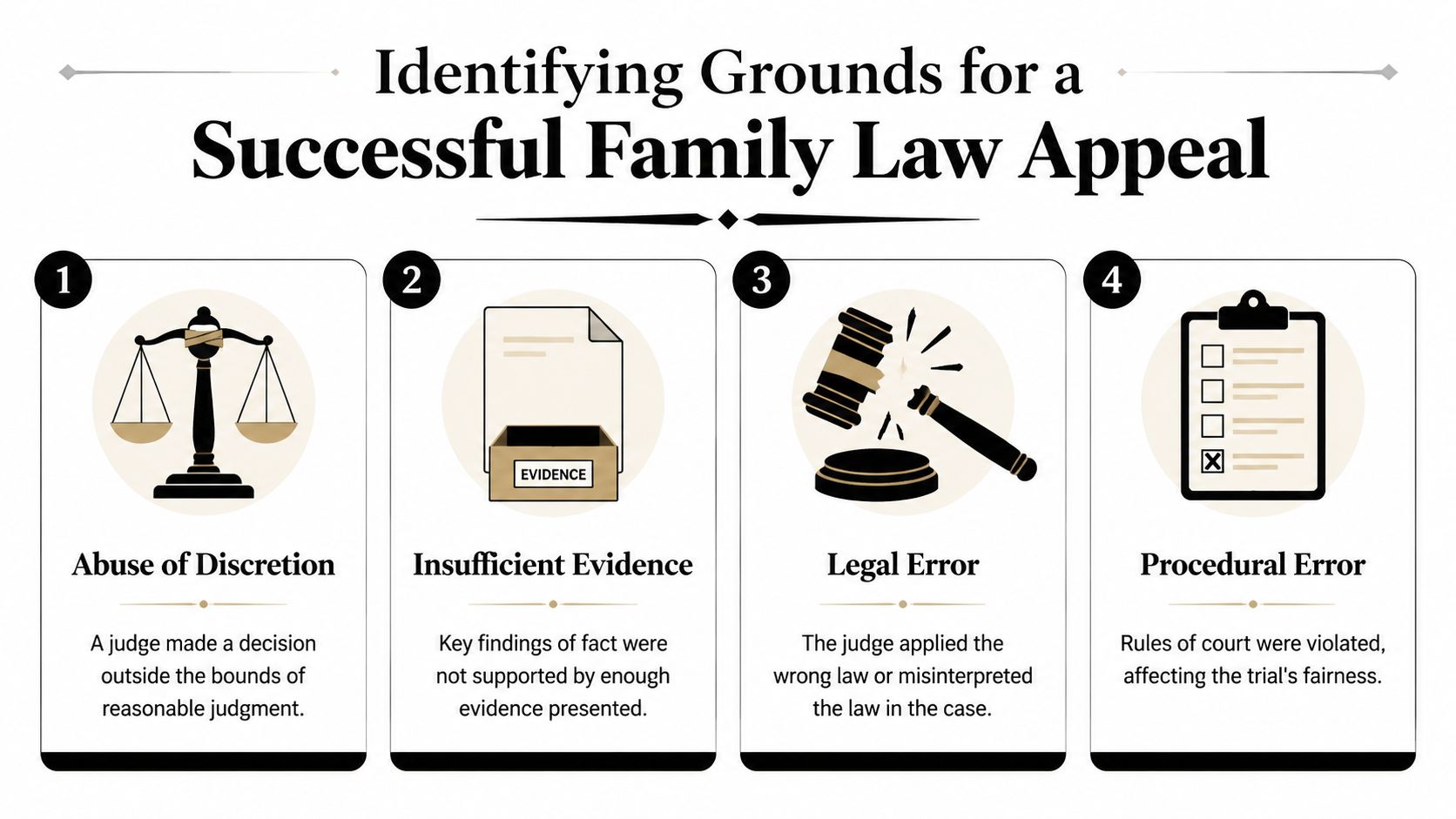
Identifying Grounds for a Successful Family Law Appeal
You leave the courthouse convinced the result was wrong. That feeling is real, but an appeal turns on a narrower question. Did the trial court make a legal error that the appellate court can identify in the record and treat as harmful enough to justify a different result?
That question is the center of any serious appeal review.
A Texas appeal is not built around general unfairness. It is built around reversible error. In plain English, that means a mistake that likely affected the outcome. If the error did not change anything important, the appellate court may agree a mistake happened and still leave the order in place.
What abuse of discretion means
Many family law rulings are reviewed under abuse of discretion. That standard gives trial judges room to make judgment calls, especially in custody, possession, support, and property issues. An appellate court does not ask whether it would have ruled differently. It asks whether the ruling fell outside the range a reasonable judge could reach under the law and the evidence.
That is why standards of review matter so much. They are the measuring tools of an appeal. A legal question may get one kind of review, while a discretionary ruling gets another. If you want a clearer explanation of how those measuring tools work, see Standards of Review in Texas Family Appeals.
For many clients, this is the first hard shift in perspective. The appeal is not a second chance to argue every point. It is a focused effort to find issues that fit the correct standard and have a realistic chance of changing the result.
Common examples of appealable issues
A family law appeal lawyer in Texas often examines issues such as:
- Misapplying the Texas Family Code: using the wrong legal framework to decide conservatorship, support, enforcement, or property questions.
- Child support errors: calculating support from the wrong income figures or applying the wrong rule.
- Property division mistakes: classifying property incorrectly or dividing the estate using a legally flawed approach.
- Evidentiary errors: excluding evidence that should have been admitted, or admitting evidence that should have been kept out, if the ruling likely affected the judgment.
- Procedural errors: failing to provide required notice, refusing a hearing that the rules require, or making a ruling after a preservation issue was properly raised.
Each of these examples has an extra layer many people do not see at first. The issue must be preserved, supported by the record, and connected to harm. A weak issue often sounds persuasive in conversation but falls apart when you test it against those three requirements.
The issue must appear in the record
The appellate record works like the official camera angle for the case. If the camera did not capture it, the appellate court usually cannot rely on it. That is why The Appellate Record: Clerk's and Reporter's Records matters.
Clients are often surprised by this. They remember a judge cutting off testimony or a lawyer making an argument that felt important. But memory is not evidence on appeal. The court looks to the clerk's record, the reporter's record, the exhibits, the written motions, and the rulings that were made.
A strong issue is usually specific and visible on the page. “The judge ignored my side” is too broad to carry an appeal. “The court excluded key evidence after counsel made a proper offer of proof, and that exclusion likely affected the conservatorship ruling” gives the appellate court something concrete to analyze.
Strategy matters more than the number of complaints
More issues do not always make a stronger appeal. Often the opposite is true. A careful appellate lawyer looks for the few issues that are preserved, legally sound, and tied to a meaningful chance of relief.
That review usually starts with the signed order, the docket information, the key motions, and the available record. Then counsel tests each possible issue against the governing standard of review, asks whether harm can be shown, and decides whether the case points toward a standard appeal or another post-judgment option. If you want a practical picture of how that review fits into the broader process, this step by step Texas family law appeal timeline helps show where issue selection fits.
Disagreement alone is not enough. A workable appeal needs a legal path. The value of specialized counsel is not just spotting something that feels wrong. It is identifying the narrower issue the appellate court can correct.
Navigating the Texas Appellate Process Step By Step
You receive the signed order, read it twice, and still feel the same thing. The result does not seem right. The next question comes fast. What happens now, and how do you avoid making the situation worse?
An appeal becomes easier to handle when you see it as a sequence of controlled steps rather than one giant fight. The appellate court is not reopening the whole case. It is reviewing a closed file under strict rules, much like a panel of editors checking whether the rules were followed in the first draft.

The first step is usually the filing deadline
The first practical question is timing. In many Texas family law cases, the notice of appeal is due shortly after the final order is signed. Some post-judgment filings can change that deadline, but only in specific circumstances and only if they were filed correctly.
That is why appellate counsel often starts with a calendar, the signed order, and the trial court docket. Before anyone writes a detailed argument, counsel needs to confirm the last day to file, whether the order is final, and whether any post-judgment motion affects the timetable. One deadline mistake can end the appeal before the court ever reaches the legal issue.
The process in plain English
The path from trial court to appellate decision usually looks like this:
Notice of Appeal
This filing tells the trial court and the appellate court that you are seeking review of the order.Record request and preparation
The clerk gathers the papers filed in the case, and the court reporter prepares the hearing or trial transcripts. If something important is missing from the record, the appellate court usually cannot consider it.Opening brief
This is the appellant's written argument. It explains what the trial court did, identifies the legal error preserved in the record, and shows why that error matters under the governing standard of review.Response brief
The other side answers your arguments and tries to show that the trial court acted within the law or that any mistake did not justify reversal.Reply brief, sometimes
A shorter reply may be filed to address points raised in the response. It is not a chance to start over. It is a chance to sharpen the issues already presented.Oral argument in selected cases
Some appeals are set for oral argument. Many are decided on the briefs and record alone.Opinion and judgment
The court issues a written decision explaining whether the order will be affirmed, reversed, or sent back to the trial court for further proceedings.
If you want a visual map of how those stages fit together, this step by step Texas family law appeal process timeline shows the sequence clearly.
A short visual explanation can also help make the process less abstract:
What clients often misunderstand about the middle of the case
The record stage and the briefing stage do most of the heavy lifting.
Clients sometimes hear the word "brief" and picture a short summary. In an appeal, a brief works more like a detailed blueprint. It must point the judges to the exact pages in the record, explain the legal rule that applies, and connect the trial court's ruling to a specific reversible error. General frustration does not help the court. Precision does.
That is also where specialized appellate counsel matters. A trial lawyer may know the story of the case inside and out. An appellate lawyer focuses on a different task. The job is to frame a narrow, winnable issue, present it under the right standard of review, and avoid arguments that sound strong emotionally but do not give the court a legal basis to act.
Why small procedural errors matter so much
Appeals are rule-driven. That can feel cold when the family issues are personal, but there is a reason for it. Appellate judges need a fixed record and clearly presented questions so they can decide whether the law was applied correctly.
A missed record request, a weak issue statement, or a brief that does not tie the facts to the governing rule can limit the court's ability to help, even when the client has a serious concern. The practical question is not just whether the trial result felt unfair. The practical question is whether the record and the rules give the appellate court a clear path to correct it.
That is the value of the step by step process. It turns a painful result into a series of strategic decisions.
Understanding Timelines Costs and Potential Outcomes
You lose at trial, go home, and then the practical questions hit. How long will an appeal take. What will it cost. What can the appellate court do if it agrees something went wrong.
Those questions matter because an appeal is not a quick reset button. It works more like asking a second set of judges to inspect the blueprint of what happened in the courtroom. They are not rebuilding the house from scratch. They are checking whether the legal framework was sound.
How long an appeal usually takes
Appeals usually move more slowly than clients expect. The court reporter must prepare transcripts. The clerk must assemble the record. Both sides file written briefs. Then the court studies the record, the law, and the arguments before issuing an opinion.
In many family law appeals, that process takes many months, and sometimes more than a year. A request for further review can add more time, but that does not mean the higher court will take the case. In practical terms, the first appeal often carries the most weight, so the strategy at that stage needs to be focused and realistic.
Patience matters here. So does planning.
What costs usually depend on
Appeal costs are driven by labor and record size. A short case built around one clear legal issue usually costs less than a custody dispute with a long transcript, multiple hearings, exhibits, and several possible appellate arguments.
Common cost categories include filing fees, clerk and reporter charges for the record, and attorney time for reviewing the file, researching the law, drafting the brief, and preparing for oral argument if the court sets one. If you want a plain-English breakdown of those expense categories, this guide to the cost of a Texas appeal is a useful starting point.
A careful lawyer should be able to explain not just the likely bill, but why the work is needed.
What outcomes are realistic
Appellate courts do not usually offer dramatic do-overs. Their job is narrower.
A court may:
Affirm the order
The trial court's ruling stays in place.Reverse the order
The appellate court decides the ruling was legally wrong.Remand the case
The case goes back to the trial court for more proceedings under the correct legal rule.
Sometimes clients hope a successful appeal will end the dispute immediately. Sometimes that happens. Often, a remand means the case returns to the trial court for another round, this time with clearer instructions. That is why a good appellate assessment looks beyond "Can we win?" and asks a second question. "If we win, what do we gain?"
Family law appeals are hard to win. Many orders are affirmed. That is not a reason to give up. It is a reason to examine the record with discipline and ask whether the alleged error is preserved, legally significant, and likely to change the result.
The goal is not to chase every possible complaint. The goal is to identify the issue that gives the appellate court a workable path to correct a real legal error.
Exploring Alternatives to a Standard Appeal
Not every bad ruling should go straight into a standard appeal. In some situations, another procedural tool may fit better.
That's especially true when timing is short, the order isn't final, or the trial court may still have a chance to correct its own error.
Motion for new trial
A motion for new trial asks the trial judge to reconsider what happened and grant a new trial or correct the judgment. In some cases, this can help preserve issues, clarify complaints, or create a better record.
It isn't always the right move. But when the complaint involves something the trial court can address directly, it may be part of a sound strategy.
Interlocutory relief and mandamus
Some orders create urgent problems before the case reaches a final judgment. In those situations, a standard appeal may not be available yet.
A writ of mandamus is a special appellate request that asks a higher court to order a trial judge to correct a serious legal error when ordinary appeal isn't an adequate remedy. Lawyers often consider mandamus in high-pressure family cases involving non-final rulings.
Accelerated appeals in parental rights cases
Termination of parental rights and certain child protection matters can move on accelerated timelines. Verified guidance notes that these cases may have deadlines as short as 15 days to file a notice of appeal, and they carry a higher risk of dismissal when parties miss procedural requirements, as noted earlier in the discussion of accelerated Texas family appeals.
That shorter deadline changes strategy immediately. Waiting for the usual pace of a divorce appeal can be a serious mistake.
Here are the practical takeaways:
- Check the type of order: A termination order may follow different deadlines than a standard divorce decree.
- Ask whether the order is final: If it isn't, mandamus may be the proper path instead of appeal.
- Move fast on record review: In accelerated matters, the briefing schedule can tighten quickly.
When alternatives make more sense
An appeal is one tool. It isn't the only tool.
If the order is non-final, if the trial court can still correct the problem, or if an emergency issue threatens parental rights before normal review is available, your lawyer should evaluate alternatives before defaulting to a standard appeal.
How to Choose the Right Appellate Lawyer and Seek Justice
You leave the courthouse feeling that something went wrong, but you are not sure whether the problem was the judge's ruling, the way the issue was presented, or a deadline that is already running. That is the moment when the right appellate lawyer matters. An appeal is a focused review of what already happened, and your lawyer's first job is to tell you, clearly and accurately, whether the record shows a real path forward.
A trial lawyer builds the case in real time. An appellate lawyer studies the paper trail after the fact. The work is closer to reconstructing a flight from the black box than rearguing the whole trip. The lawyer reviews the clerk's record, the reporter's record, the orders, and the objections to see whether the trial court made a legal error that an appellate court can correct.

What to look for in appellate counsel
Start with communication.
If a lawyer cannot explain your position in plain English during a consultation, that is a warning sign. Appellate judges read careful written arguments for a living. Clarity is not a nice extra. It is part of the skill set.
A strong consultation usually answers a few practical questions:
- What standard of review is likely to apply
- Which issue appears strongest and whether it was preserved
- What parts of the record matter most
- What deadlines control the case
- Whether an appeal is the right tool, or whether another remedy should be considered
You are not looking for false confidence. You are looking for disciplined judgment. A good appellate lawyer should be willing to say, "This issue feels unfair, but it may not be reversible," or "This point has real potential because the record appears to preserve it." That kind of candor helps you make a sound decision before you invest more time and money.
Why the fit matters
Fit matters because appellate work is specialized. Family law adds another layer. A lawyer handling a custody or property division appeal needs to understand both appellate rules and how family court rulings are reviewed in Texas. The question is not only whether the result felt wrong. The question is whether the law and the record give the court of appeals a reason to step in.
For readers comparing options, this overview of family law appeal attorney services gives a useful picture of the work involved in reviewing records, identifying reversible error, and preparing briefs. The Law Office of Bryan Fagan, PLLC handles Texas family law appeals involving custody, support, divorce decrees, property division, protective orders, and enforcement-related judgments.
Seek a lawyer who can do three things at once. Explain the process without fog. Assess the weaknesses as carefully as the strengths. Build a strategy that matches the existing record, not the case you wish had been tried.
If you believe the court made a mistake in your family law case, our appellate attorneys can help you seek a fair outcome. Contact The Law Office of Bryan Fagan, PLLC today for a free consultation.