Skip to content
You may feel your case was handled unfairly or that the court's decision doesn't truly protect your child. If you're aiming for what most people call "full custody" in Texas, you need to prove to a judge that it's absolutely in your child's best interest. The court has a different name for it: Sole Managing Conservatorship. It's a high bar to clear, and this outcome is typically reserved for serious situations where the other parent's involvement would genuinely harm the child's well-being. If a trial court failed to see the danger, an appeal might be your path to justice.
The Hard Truth About Full Custody in Texas

Pursuing sole custody means you're likely convinced it's the only way to keep your child safe and stable. It's an incredibly stressful and emotionally draining fight to prepare for. The first step isn't just filing papers; it's getting a firm grasp on how Texas courts view these cases.
The legal system in Texas starts with a very strong belief: that it's best for a child to have both parents actively involved in their life. This isn't just a suggestion; it's the law. The default arrangement is called Joint Managing Conservatorship, where parents share the rights and responsibilities of raising their child, even if the child lives primarily with one parent.
What this means for you is that a judge won't grant sole custody easily. Your job is to build a solid, evidence-backed case that systematically proves why joint conservatorship would be damaging to your child. Think of it less as a battle to win and more as a careful, strategic presentation of facts.
Why Courts Start with Joint Custody
The court's preference for joint custody isn't random. It's built on decades of family law focused on what helps children thrive after a separation. The core idea is that kids do better when they have a meaningful relationship with both parents. A judge will always look for ways to keep both parents in the picture unless there's a truly compelling reason not to.
The reality I see every day is that Texas courts only award sole managing conservatorship when there's clear and convincing proof that one parent is a danger. We're not talking about minor disagreements. We're talking about situations like:
- A documented history of family violence or child abuse.
- Serious, ongoing drug or alcohol abuse.
- Extreme neglect of the child's basic needs.
- One parent has abandoned the child.
It's critical to understand that simply being the "better" parent or disagreeing on parenting styles won't get you there. The court must see evidence of behavior that actively endangers the child’s physical or emotional health.
Looking at the Numbers
Nationally, only about 10% of custody cases end with one parent getting sole custody, and Texas follows this trend closely. The overwhelming majority of cases—well over 90%—end in some form of joint managing conservatorship, even when one parent is named the "primary" parent.
Under Texas Family Code Section 153.002, every decision is guided by the child's best interests, not what the parents want or which parent is male or female. Unless you can prove a significant safety risk, both parents will almost certainly walk away with some legal rights and duties for their children. To dive deeper, you can explore the myths and facts of sole custody in Texas.
Understanding the Best Interest of the Child
When you walk into a Texas courtroom for a custody battle, everything boils down to one guiding principle: the best interest of the child. This isn't just a sentimental phrase; it's the legal yardstick a judge uses for every single decision. If you're fighting for full custody—what the courts officially call Sole Managing Conservatorship—you have to convince the judge that your plan is the only one that truly serves your child's well-being.
This standard intentionally shifts the spotlight from what the parents want to what the child needs. Every piece of evidence, every testimony, is viewed through this lens. A judge is constantly asking, "How does this fact impact the child?" Getting your head around this perspective is absolutely crucial for building a strong case.
The Holley Factors: What the Court Actually Looks At
So, how does a judge figure out what's in a child's best interest? They don't just guess. The Texas Supreme Court laid out a framework known as the Holley Factors. Think of it less as a rigid checklist and more as a guide for the judge's analysis.
A judge will weigh several key elements, including:
- The child's needs, both emotional and physical, now and down the road. This often involves looking at who has historically been the primary caregiver.
- Any potential danger to the child, emotional or physical. This is where evidence of neglect, abuse, or substance use becomes incredibly important.
- The parenting skills of each person fighting for custody. The court looks at who can provide a safe, nurturing, and stable home.
- The stability of the home each parent is offering. This isn't just about the physical house but the consistency and security that come with it.
- Helpful resources available to assist parents. Things like counseling, parenting classes, or rehab programs can show a commitment to the child's welfare.
- A parent's actions (or lack thereof) that might suggest the current parent-child relationship is unhealthy.
- Any valid explanations for those actions or omissions.
The goal isn't to find a "perfect" parent. It's about identifying the environment that will best support a child's health, safety, and overall development.
Stability Is More Than Just a Paycheck
When the court considers "stability," it’s looking at the whole picture, not just who makes more money. Of course, financial security matters, but emotional and environmental stability often carry far more weight.
For example, a parent with a modest but steady income who provides a consistent daily routine, a supportive home, and reliable emotional connections might be seen as the more stable choice. This could easily be more compelling to a judge than a wealthier parent with a chaotic lifestyle or a demanding travel schedule. The court wants to see who can offer the child a predictable and safe world to grow up in.
Overcoming the Joint Custody Presumption
Here's something many people don't realize: Texas law starts with the assumption that keeping both parents involved in major decisions is best for the child. This is a legal presumption in favor of joint custody.
However, "joint custody" doesn't automatically mean a 50/50 time split. Most arrangements still name a primary parent, especially for younger kids. The final division of time and rights is based on a deep dive into the child's needs, each parent's abilities, and the home environments. Even when one parent has primary physical custody, the other parent usually retains significant legal rights. The bar to strip those rights and grant sole custody is set deliberately high. You can read a detailed breakdown of 2025 Texas family law changes to see how these dynamics are evolving.
Key Takeaway: To win sole custody, you have to overcome the court's starting point that both parents should have a say. Your evidence must be powerful enough to prove that a joint arrangement would be actively harmful to your child.
Grounds for Sole Managing Conservatorship

While Texas courts start with a preference for keeping both parents involved, their primary mission is always to protect the child. This means that in certain serious situations, a judge will decide that limiting one parent's rights isn't just an option—it's a necessity. These specific circumstances, legally known as "grounds," are what can lead a court to award Sole Managing Conservatorship.
Figuring out these grounds is the first real step in building your case. It’s about shifting from emotional arguments to objective facts. The court needs to see clear, compelling proof that a standard joint custody arrangement would put your child's physical or emotional well-being at risk.
Documented History of Family Violence
Family violence is one of the most direct paths to a sole custody order. Under the Texas Family Code, if there's credible evidence of a history or pattern of family violence by one parent—whether against the other parent, a partner, or the child—the law creates a presumption. It presumes it's not in the child’s best interest for that parent to be a joint managing conservator.
This isn't about a few heated arguments. The court is looking for a pattern of behavior that makes the home a dangerous place.
- Hard evidence is king: Police reports, medical records detailing injuries, and existing protective orders are incredibly powerful.
- Witnesses matter: Testimony from neighbors, teachers, or family members who have seen the abuse firsthand can be just as compelling.
If you're in a situation involving abuse, seeking a protective order can be a crucial move. It helps safeguard your child immediately and creates an official record of the danger for the court.
Substance Abuse That Endangers the Child
A parent's battle with drug or alcohol abuse can directly threaten a child's safety and stability. For this to be grounds for sole custody, you have to show that the substance abuse actually impairs their ability to be a parent.
It’s not enough to simply accuse the other parent. You need to provide solid proof. This could be anything from failed drug tests and DUI convictions to credible testimony from people who saw them using substances while they were supposed to be watching the child. The entire focus must be on how that specific behavior puts the child in harm's way.
The key is to draw a straight line from the parent's substance abuse to the potential harm. For instance, proof that a parent drove under the influence with the child in the car is infinitely more impactful than showing they have a few beers on the weekend.
Child Neglect or Abandonment
Neglect isn't just about one mistake; it's a consistent failure to provide for a child's basic needs—food, shelter, medical care, or adequate supervision. Abandonment is a bit different; it’s when a parent voluntarily leaves the child with no intention of returning or providing any support.
Proving neglect often means you have to meticulously document a pattern of failures. You might gather:
- School records showing constant absences or tardiness.
- Medical records proving a failure to get necessary care.
- Photos of unsafe or dirty living conditions.
- Reports from Child Protective Services (CPS).
In abandonment cases, you’d need evidence showing the other parent has made zero contact and provided no financial support for a significant amount of time.
To grant sole custody, judges need to see concrete proof directly linked to these specific grounds. The table below breaks down the kind of evidence that Texas courts typically find compelling for each situation.
Evidence Required for Sole Managing Conservatorship Grounds
| Grounds for Sole Custody | Primary Evidence Required | Supporting Documentation Examples |
|---|---|---|
| Family Violence | Official reports and third-party validation of a pattern of abuse. | Police reports, protective orders, medical records, photos of injuries, witness statements. |
| Substance Abuse | Proof of substance abuse that directly impairs parenting ability. | Court-ordered drug test results, DUI/DWI convictions, testimony from credible witnesses. |
| Child Neglect | A documented pattern of failure to provide for basic needs. | CPS reports, school attendance records, medical records, photos of living conditions. |
| Abandonment | Evidence of voluntary absence and lack of contact or support. | Communication logs (or lack thereof), bank statements showing no financial support. |
| Parental Alienation | Expert testimony confirming a pattern of manipulative behavior. | Psychological evaluations, emails/texts showing alienation, testimony from teachers/counselors. |
Ultimately, a strong case for sole custody is built on a solid foundation of evidence, not just accusations.
Severe Parental Alienation
Parental alienation is a deeply damaging situation where one parent systematically tries to destroy the child's relationship with the other. This goes way beyond occasional bad-mouthing. It’s a deliberate pattern of manipulation designed to turn a child against a parent for no good reason.
Proving alienation is tricky and almost always requires the testimony of a mental health expert who has evaluated the family. A judge needs to see evidence that the alienating parent's actions are causing real emotional harm. To build a case, you'll need to document a long, consistent pattern of hostile and manipulative behaviors.
At the end of the day, winning Sole Managing Conservatorship isn't about proving the other parent has flaws. It’s about presenting a clear, well-documented argument that their specific behaviors create a harmful environment, leaving you as the only parent who can provide the safety and stability your child deserves. If the trial court didn't see the danger, an appeal of your child custody case might be the next step to get a just outcome.
Building Your Case with Strong Evidence

Winning sole managing conservatorship isn't about emotional pleas or heated accusations in a courtroom. It's won long before you ever see a judge. A strong case is built piece by piece, on a solid foundation of credible, organized evidence.
Frankly, the judge can't just take your word for it. It's on you to provide clear, compelling proof that shows why giving you sole custody is the only decision that truly protects your child’s best interests. This might feel like a monumental task, but it really comes down to being disciplined and consistent. Every piece of evidence helps paint a complete picture for the court.
Documenting a Pattern of Behavior
One of the most effective things you can do is show a consistent pattern of problematic behavior, not just a few isolated incidents. A single angry text? A judge might dismiss that as a bad day. But a log of harassing messages stretching over six months? That shows a pattern of instability that’s impossible to ignore.
This is where a detailed, factual journal becomes your most important tool.
- Log everything with dates and times: Every missed visit, late pickup, or concerning phone call needs to be noted. Precision is key.
- Describe events objectively: Don't just write, "He was furious." Instead, describe what happened: "He raised his voice, used profane language, and slammed the car door."
- Record the details that matter: Note who else was there, what was said, and—most importantly—how it affected your child.
This journal will become the roadmap for your entire case. It helps you and your attorney pinpoint the most powerful facts to present to the judge.
Gathering Different Types of Evidence
Your argument becomes exponentially stronger when you back it up with various forms of proof. A judge is far more likely to be convinced when multiple, independent sources all point to the same conclusion.
Digital Communications
Save absolutely everything. Text messages, emails, and even social media posts can offer a direct, unfiltered look into the other parent's behavior, priorities, and state of mind. Make sure you preserve these communications in a way that's admissible in court—that usually means screenshots showing the full context, including dates and times.
Witness Testimony
Nothing backs up your story like a neutral third party. Think about credible people who have seen the concerning behavior firsthand. These could be:
- Teachers or school counselors
- Neighbors
- Family members or trusted friends
- Therapists or doctors
Their unbiased observations can add tremendous weight to your claims, confirming that what you're saying isn't just your opinion.
Official Records
Documents from official sources carry a lot of authority in court because they are seen as impartial. Go after any records that can support your case, like police reports, your child's medical records, school attendance sheets and report cards, or any files from Child Protective Services (CPS).
If you have voicemails or other audio clips, it’s a smart move to convert audio evidence to text. Having a transcript makes the key information searchable, quotable, and much easier for the court to review.
The Role of Expert Evaluations
In really tough cases, especially where mental health or parental alienation is a concern, the court will often lean on expert evaluations. A custody evaluator, who is a neutral psychologist or social worker, can give the judge a professional, in-depth assessment of the entire family dynamic.
This expert will interview you, the other parent, the child, and other important people in your child's life. They review all the documents and may conduct psychological tests before making a formal recommendation on the custody arrangement that serves the child’s best interest.
If you believe the other parent is actively trying to turn your child against you, an expert is almost always necessary to identify this complex pattern of manipulation. It’s crucial to understand the specifics of parental alienation treatment and its legal implications if you find yourself in this situation.
Strategic Insight: Your goal in collecting evidence is to build a factual narrative. Every document, screenshot, and witness statement is a building block. You are methodically demonstrating to the court not just that you should have sole custody, but why your child's safety and well-being depend on it.
Navigating the Texas Court Process
Walking into a Texas family courtroom can be intimidating, but understanding the road ahead makes all the difference. The system is designed to help parents find a resolution, starting with negotiation and only moving to a trial as a last resort. Knowing the key stages helps you stay focused on what really matters: building the strongest possible case for your child.
The entire process kicks off when one parent files an Original Petition in a Suit Affecting the Parent-Child Relationship (SAPCR). This is the formal legal document that tells the court what you're asking for regarding custody (conservatorship), visitation, and child support. After it's filed, the other parent has to be officially notified, which is a formal step known as "service."
The Initial Stages: Temporary Orders and Discovery
Soon after the initial filing, you'll likely have a temporary orders hearing. This is one of the most critical early moments in your case. A judge will make temporary decisions about where your child will live and create a possession schedule while the lawsuit is pending. These early rulings can set the tone for the rest of the case, so being prepared is non-negotiable.
In situations where a child is in immediate danger, you can't wait for a standard hearing. You'll need to explore getting an emergency custody order in Texas for immediate protection.
Next comes the discovery phase. This isn't like the drama you see on TV; it's a structured, methodical process where both sides exchange information and evidence. Think of it as putting all the cards on the table.
Common discovery tools you'll encounter include:
- Requests for Production: Formally asking the other parent for documents like bank statements, text messages, emails, or school records.
- Interrogatories: A list of written questions the other party must answer in writing, under oath.
- Depositions: An out-of-court session where lawyers question the other parent or key witnesses under oath, with a court reporter transcribing everything.
The goal here is to make sure everyone has the same set of facts, which helps prevent surprises at trial and often encourages a fair settlement.
Mediation: The Path to Resolution
Before a judge will hear your case for a final trial, Texas courts will almost certainly require you to attend mediation. This is a confidential meeting with you, the other parent, both attorneys, and a neutral third-party mediator.
The mediator’s job isn't to pick a side or make a decision. Instead, they guide the conversation, helping you and the other parent find areas of agreement. Mediation is incredibly powerful because it keeps you in control of the outcome. You know your family best—far better than a judge ever could after a short trial. A huge number of custody cases are resolved successfully at this stage.
This infographic lays out the typical journey of a custody case through the Texas court system.
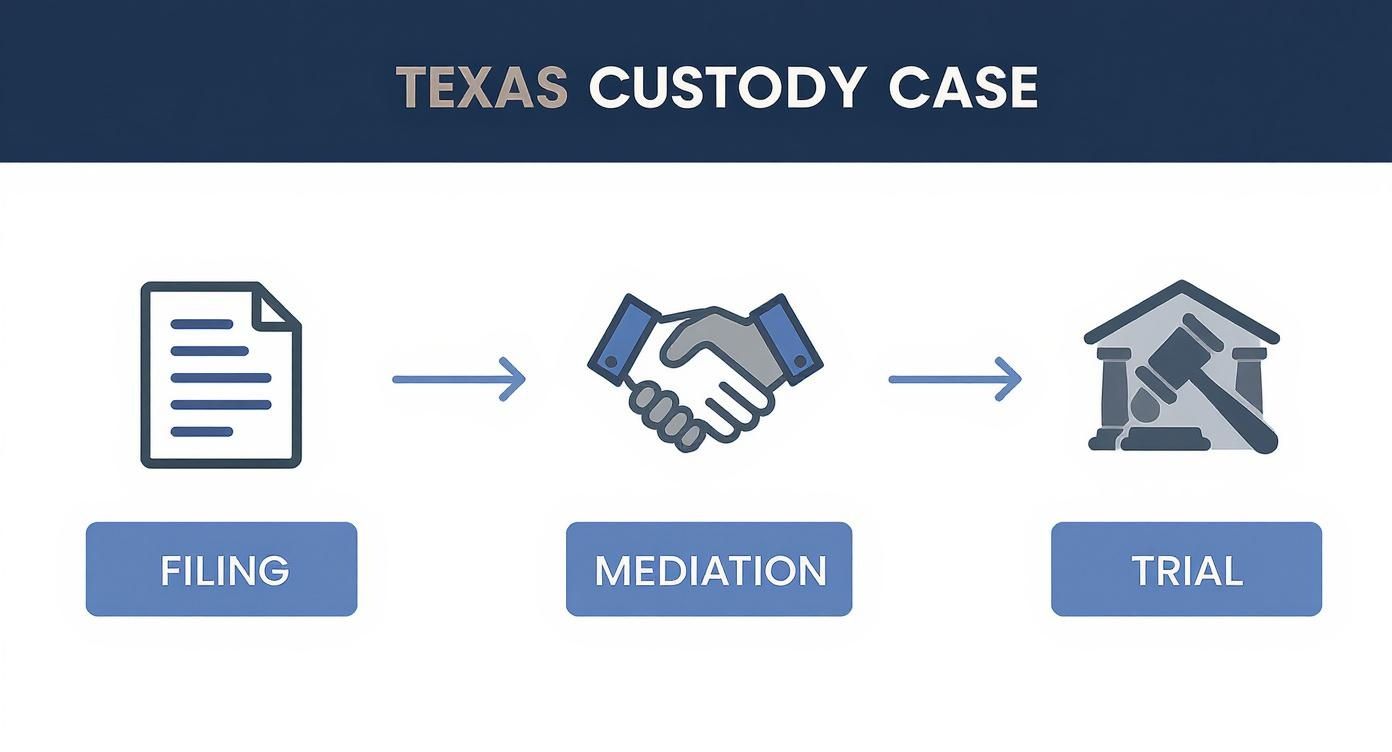
As you can see, the process is built to funnel cases toward a resolution before they ever reach a final, contested trial.
Preparing for a Final Trial
If you and the other parent simply can't reach an agreement in mediation, your case will be scheduled for a final trial. This is your chance to present every piece of your evidence—documents, witness testimony, expert opinions—to the judge, who will then issue a final, legally binding order. Understanding the various resources for legal professionals can also provide insight into how your attorney prepares for this critical stage.
A Strategic Approach: Remember, your behavior throughout this entire process is being observed. The parent who comes across as calm, reasonable, and consistently focused on the child's well-being is the one who builds credibility with the judge. Avoid letting personal conflicts overshadow the needs of your child.
A trial is where your careful preparation pays off. It's your opportunity to tell the full story, backed by the solid evidence you've gathered, and show the court exactly why giving you sole managing conservatorship is in your child's absolute best interest.
What to Do When a Custody Ruling Just Isn't Right
Sometimes, even with the best preparation and a mountain of evidence, a family court judge simply gets it wrong. You walk out of the courtroom with a final order that feels like it ignored the most important facts of your case, or worse, completely misapplied the law. When a decision fails to protect your child’s best interests because of a serious judicial mistake, you have the right to fight for a fair outcome through an appeal.
It's important to understand that an appeal isn't a second trial. You don't get to bring in new evidence or re-argue your case from scratch. Instead, an appellate court conducts a formal review of what already happened. They'll pour over the trial transcripts and the evidence that was presented to see if a reversible error was made—a mistake so substantial that it almost certainly led to the wrong judgment.
The "Abuse of Discretion" Standard of Review
In Texas family law, the standard for most appeals is called abuse of discretion. This is a high legal bar. It means you have to prove that the trial judge's decision was unreasonable, arbitrary, or made without any regard for the guiding legal rules and principles they were supposed to follow.
Simply disagreeing with the outcome isn’t enough. You must show that the ruling was either completely unsupported by the evidence or a clear misreading of the Texas Family Code. This is tough to prove, which is why having an experienced appellate attorney meticulously comb through every page of the court record is absolutely critical.
So, what does a reversible error actually look like? Here are a few real-world examples:
- Improperly excluding crucial evidence that was essential for you to make your point.
- Misapplying the "best interest of the child" standard by completely ignoring one or more of the key Holley Factors.
- Failing to make the required findings of fact that are legally necessary to support the final custody order.
- Allowing biased or legally inadmissible testimony that clearly swayed the outcome against you.
How the Appeals Process Actually Works
The appellate process is a whole different ballgame from a trial. There are no witnesses, no jury, and no dramatic courtroom testimony. The entire battle is fought on paper through highly technical legal documents called briefs. Your appellate lawyer’s job is to write a powerful, persuasive brief that lays out every legal error from your trial, backing up each claim with specific laws and past court decisions.
Be warned: the deadlines are incredibly strict. After the judge signs the final order, you typically have just 30 days to file a Notice of Appeal. If you miss that window, your right to appeal is usually gone for good. This is why you must contact an appellate lawyer the moment you think a serious error was made in your case. From there, successfully navigating the process requires a deep knowledge of Texas appellate procedure.
There's often a frustrating gap between what the law says and what happens in Texas courtrooms. While the law pushes for shared parenting, statewide data reveals that fathers are awarded, on average, only about 33% of parenting time. This puts Texas behind many other states on the path to gender-equal parenting. Given these trends, it's vital to ensure the law is applied correctly in every single case. To understand more about these statistics, you can discover key insights into Texas divorce and custody trends.
An appeal is your chance to ensure the justice system is held accountable and that the law was followed to the letter. It’s a path to correct the record when a trial court decision falls short of protecting what truly matters—your child's well-being.
Of course, sometimes the issue isn't an error, but a major life change that makes the old order unworkable. In those cases, the process is different; you can learn more about seeking child custody modifications when circumstances have significantly changed.
Common Questions About Full Custody in Texas
When you're fighting for your child, questions are going to come up. It's only natural. Let's walk through some of the most common concerns we hear from parents, giving you a clear picture of how Texas courts handle these situations.
Can a Child Choose Who They Live With?
This is a big one. In Texas, a judge can absolutely listen to a child's preference, particularly if that child is 12 years of age or older. However—and this is critical—the child's wish is never the only factor.
Think of it as one important piece of evidence among many. The judge will weigh the child's maturity and their reasons for the preference alongside all the other evidence to decide what's truly in their best interest. It’s never as simple as the child just picking a side.
Will My Higher Income Help Me Win Full Custody?
While financial stability is definitely a plus, having a bigger paycheck doesn't automatically make you the better parent in the court's view. The judge's primary concern is who can provide the most stable, safe, and nurturing home.
Child support is the legal tool used to balance out any financial differences between parents. Its entire purpose is to ensure the child's needs are met, no matter which parent they live with most of the time. Don't assume that wealth is a golden ticket to winning custody.
Understanding the Legal Lingo: Custody Titles in Texas
The specific terms used in a Texas custody order can be confusing, but knowing what they mean is crucial. Here’s a quick breakdown:
- Sole Managing Conservator: This is the parent who gets the exclusive right to make most of the big decisions for the child. We're talking about things like choosing their school, consenting to non-emergency medical procedures, and so on.
- Possessory Conservator: This is the legal term for the other parent. They are granted specific rights to possession of the child—what most people call visitation.
You might hear the term "Sole Possessory Conservator," but that isn't a standard legal title in Texas. A court order that gives one parent "sole possession" is an incredibly rare and extreme measure. It almost always means the other parent has been denied any contact whatsoever, usually due to a protective order or other severe circumstances.
If you believe the court made a mistake in your family law case, our appellate attorneys can help you seek a fair outcome. Contact The Law Office of Bryan Fagan today for a free consultation.